
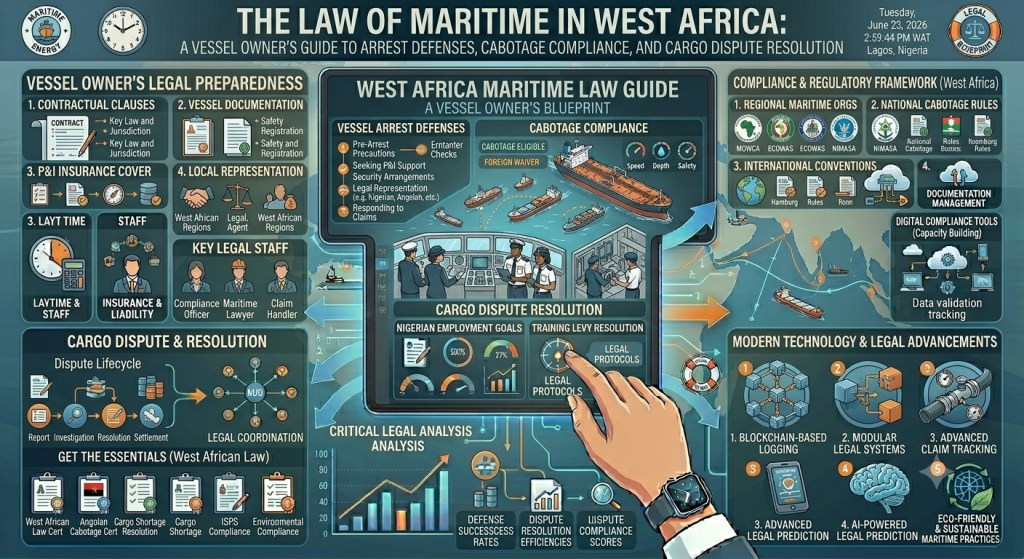
The maritime corridors of West Africa, stretching from the Cape Verde peninsula to the dynamic offshore oil fields of the Gulf of Guinea, represent some of the most lucrative yet operationally complex shipping lanes in the global energy and cargo markets. For shipowners, charterers, and upstream logistics coordinators, executing voyages in these waters requires navigating a dual reality. On one hand, there is the massive commercial opportunity presented by regional trade, bulk liquid exports, and offshore support campaigns. On the other hand, operators face a complex and overlapping web of regional maritime laws, localized cabotage restrictions, and the ever-present risk of regulatory detention or judicial vessel arrest.
To protect multi-million dollar assets and safeguard razor-thin voyage margins, operators must have a deep, technical understanding of maritime law as it is applied across West African jurisdictions. This comprehensive guide provides vessel owners with an operational blueprint for navigating the law of maritime in West Africa, with a specific focus on ship arrest defenses, local content compliance, and the resolution of commercial cargo disputes.
+———————————————————————————+
| REGIONAL ADMIRALTY JURISDICTION SYSTEM |
+———————————–+———————————————+
| Anglophone Jurisdictions | Francophone Jurisdictions |
| (Common Law System) | (Civil Law System – OHADA Framework) |
| | |
| • Applied in Nigeria, Ghana, Gambia| • Applied in Senegal, Togo, Benin, Cameroon |
| • Governed by Admiralty Court Acts| • Governed by OHADA Uniform Acts |
| • Actions “in rem” against hulls | • Focuses on conservatory seizure (saisie) |
+———————————–+———————————————+
Understanding West African Admiralty Jurisdictions
The first legal hurdle any international shipowner faces in West Africa is the division between two fundamentally different legal traditions: the Anglophone Common Law system and the Francophone Civil Law system.
Anglophone Jurisdictions (Common Law)
In countries like Nigeria, Ghana, Sierra Leone, and The Gambia, maritime law is heavily influenced by English admiralty jurisprudence. In these nations, specialized courts—such as the Federal High Court of Nigeria or the specialized Maritime Division of the High Court of Ghana—exercise exclusive jurisdiction over admiralty matters.
The defining characteristic of these jurisdictions is the ability of a claimant to institute an action in rem. This legal action is brought directly against the vessel itself (the res), allowing the court to arrest the ship to secure a maritime claim, even if the shipowner has no personal liability under the contract.
Francophone Jurisdictions (Civil Law and OHADA)
Conversely, in Francophone West African states (such as Senegal, Côte d’Ivoire, Togo, Benin, and Cameroon), maritime operations are governed by Civil Law principles, standardized under the OHADA (Organisation pour l’Harmonisation en Afrique du Droit des Affaires) treaty framework.
Under the OHADA Uniform Act on General Commercial Law and regional merchant shipping codes, the concept of an action in rem does not exist in the same format. Instead, claimants apply for a conservatory arrest (saisie conservatoire), which is a pre-judgment attachment of the ship designed to prevent it from sailing until security is provided. The legal processes, evidentiary standards, and mechanisms for releasing vessels in Francophone ports differ significantly from their Anglophone counterparts, requiring local expertise to resolve.
The Law of Maritime Ship Arrests: Operational Defenses & Prevention
For any vessel owner or bareboat charterer, a judicial ship arrest is a catastrophic event. Beyond the immediate halt in operations, the owner faces mounting port charges, crew maintenance costs, cargo deterioration claims, and catastrophic demurrage fees, which can quickly exceed $50,000 to $100,000 per day for Suezmax or VLCC tankers.
Common Triggers for Ship Arrests
Under West African maritime law, ship arrests are typically triggered by:
- Maritime Liens: Highly protected claims that attach directly to the hull, including crew wage claims, salvage rewards, port dues, and claims for loss of life or personal injury.
- Proprietary Claims: Disputes over ship ownership, mortgage defaults, or possession rights.
- General Maritime Claims: Claims arising from charterparty breaches, unpaid bunker bills, cargo shortages, or collision damages.
Strategic Defenses Against Wrongful Arrests
When a vessel is threatened with an arrest, or when an arrest warrant has been executed, the owner must deploy a rapid, structured legal and operational defense:
- Challenging the Court’s Jurisdiction: The shipowner’s legal counsel must immediately review the claimant’s affidavit. If the claim does not fall under the statutory definition of an “admiralty claim” as defined by local laws (such as the Nigerian Admiralty Jurisdiction Act), the court must set the arrest aside.
- Challenging the Propriety of the Arrest: If the claimant cannot establish a prima facie case, or if the claim is based on a sister-ship arrest where the beneficial ownership does not align with the statutory requirements, the arrest can be declared wrongful. In Anglophone courts, proving a wrongful arrest can make the arresting party liable for substantial damages to cover the shipowner’s operating losses.
- The Letter of Undertaking (LOU): To secure the immediate release of the ship without waiting for a lengthy trial, the vessel’s Protection and Indemnity (P&I) Club will typically issue a Letter of Undertaking. Courts and maritime authorities regularly accept an LOU or a bank guarantee as sufficient security to release the hull, shifting the legal battle to a standard commercial trial while allowing the vessel to resume its voyage.
Calculating the Security Bond
When a court demands a bank guarantee or cash bailment to lift an arrest, the security bond ($S$) is not calculated solely on the raw value of the claim. To prevent under-securing the claimant, courts use a standard mathematical calculation to estimate the ultimate liability:
$$S = C \times (1 + r \cdot T) + L_c$$
Where:
- $S$ represents the total security bond required by the court.
- $C$ is the principal claim value asserted by the arresting party.
- $r$ is the court-approved annual statutory interest rate (typically ranging from $10\%$ to $21\%$ depending on the jurisdiction).
- $T$ is the estimated duration of the maritime litigation in years (commonly estimated at $2$ years for fast-track maritime divisions).
- $L_c$ represents the estimated legal costs and administrative court expenses associated with the proceedings.
Using this formula, a seemingly modest cargo damage claim of $1,000,000$ USD can quickly result in a court demanding a security bond exceeding $1,300,000$ USD to release the vessel.
Navigating Cabotage Compliance & Local Content Frameworks
For offshore support vessels (OSVs), tugs, and product tankers operating in West African oil fields, complying with local content laws is a critical commercial requirement. The most notable framework in this region is the Nigerian Coastal and Inland Shipping (Cabotage) Act, alongside similar regulatory regimes implemented by the Ghana Maritime Authority and neighboring states.
+———————————————-+
| THE FOUR PILLARS OF CABOTAGE |
+———————————————-+
|
+——————————-+——————————-+
| |
v v
[VESSEL CREWING] [VESSEL BUILDING & REGISTRATION]
• Must be 100% crewed by citizens. • Must be built in the host nation.
• Requires continuous crew audits. • Must fly the national flag.
• Strict limits on foreign waivers. • Must be owned by local citizens.
The Four Pillars of Cabotage Compliance
Under the Cabotage Act, any vessel engaged in domestic trade, coastal shipping, or offshore logistics within national waters must comply with four strict rules:
- Built in Nigeria: The vessel must have been constructed within the host country.
- Owned by Nigerians: The vessel must be owned by a company where at least 60% of the shares are held by domestic citizens.
- Crewed by Nigerians: The entire crew, from Master to deck cadet, must be local citizens.
- Registered in Nigeria: The ship must fly the national flag and be registered under the national flag-state administration (such as NIMASA).
Navigating Ministerial Waivers
Recognizing that the regional maritime industry does not currently have the capacity to build complex deepwater assets like DSVs (Dive Support Vessels) or high-spec PSVs (Platform Supply Vessels) locally, the law provides for Ministerial Waivers.
Vessel owners can apply for temporary waivers for ownership, crewing, and shipbuilding requirements if they can prove that local capacity is unavailable. Navigating this waiver process requires meticulous administrative preparation. Failing to secure a valid waiver before beginning a charter can lead to vessel detention, heavy financial penalties, and blacklisting by major offshore oil operators.
Cargo Disputes and Freight Claims in Regional Corridors
The West African shipping trade is heavily dominated by liquid bulk movements (crude oil exports and refined petroleum imports) and containerized retail trade. This environment frequently gives rise to cargo disputes, short-delivery claims, and quality disputes.
Hague-Visby vs. Hamburg Rules
A key challenge for shipowners operating across West African borders is the inconsistent application of international cargo liability conventions.
- The Hague-Visby Rules: Adopted by some nations, these rules provide shipowners with a robust set of 17 legal exemptions, including the defense of “error in navigation” and strict package limitation values.
- The Hamburg Rules: Adopted by several West African states (such as Nigeria and Senegal), this regime is significantly more claimant-friendly. Under the Hamburg Rules, the carrier is presumed liable for any cargo loss or damage unless they can prove they took all reasonable measures to avoid the loss. It also eliminates the “error in navigation” defense, making shipowners far more vulnerable to cargo claims.
+————————————————————————-+
| THE SHIP-TO-SHIP COMPLIANCE FLOW |
+——————-+—————————+————————-+
| Phase 1: Planning | Phase 2: Double-Banking | Phase 3: Cargo Flow |
| Risk assessment & | Approach and mooring with | Secure manifold tie-in, |
| vessel vetting. | primary pneumatic fenders.| continuous flow metering|
+——————-+—————————+————————-+
Liquid Cargo Shortage and “Paper Losses”
In liquid bulk trades, disputes often arise from differences between shore tank measurements at the loading port and discharge port. These “paper losses” are often caused by changes in temperature, sediment settlement, or cargo line holdup rather than actual physical loss.
To defend against these claims, shipowners must ensure that their crew records accurate ship’s figure calculations, maintains a detailed vessel log, and coordinates with independent marine surveyors at both ends of the voyage.
The Strategic Role of a Local Protective Agency
When a shipping company encounters regulatory issues or cargo disputes in West Africa, having a trusted, on-the-ground marine partner is essential. A local protective agency acts as your primary liaison with regional port and maritime authorities, helping you resolve issues before they escalate.
High-Compliance Maritime Logistics with Oitha Marine
Navigating the operational and legal complexities of the West African maritime corridor requires a partner with deep local roots and a commitment to international standards.
Oitha Marine provides turnkey marine logistics, vessel agency support, and regulatory compliance consulting across West Africa. We combine local operational experience with strict adherence to international safety and legal frameworks, helping shipowners and charterers protect their assets and execute successful voyages.
Our Support Capabilities
- Vessel Husbandry and Agency Support: We manage port clearances, customs documentation, and coordinate directly with regional maritime and port authorities to ensure smooth, delay-free operations.
- Cabotage and Local Content Advisory: We help international shipowners navigate the complex waiver processes under the Cabotage Act, ensuring full compliance while optimizing local crew hiring.
- Offshore Support Fleet Deployment: We operate a modern, technically audited fleet of Platform Supply Vessels (PSVs) and Fast Crew Boats, maintained to high international safety standards.
- 24/7 Dispute and Incident Management: Our dedicated operations desk works closely with your legal representatives and P&I Clubs to provide real-time support during cargo disputes, port detentions, or technical emergencies.
Protect your investments and keep your voyages on schedule. Partner with Oitha Marine to secure your maritime operations in West Africa.
Frequently Asked Questions (FAQ)
Q: What is the primary difference between Anglophone and Francophone maritime jurisdictions in West Africa?
A: Anglophone countries (like Nigeria and Ghana) follow Common Law, allowing claimants to file an action in rem directly against the ship to secure a claim. Francophone countries follow Civil Law (governed by the OHADA framework), which uses conservatory seizures (saisie conservatoire) of the vessel to secure commercial debts.
Q: How can a vessel owner prevent an arrest over an outstanding commercial dispute?
A: Shipowners should work closely with their Protection and Indemnity (P&I) Club to issue a Letter of Undertaking (LOU). In most jurisdictions, courts accept a valid LOU or bank guarantee as security, allowing the vessel to continue its voyage while the legal dispute is resolved in court.
Q: What is the Cabotage Act, and does it apply to foreign-flagged ships?
A: Yes, the Cabotage Act applies to any vessel operating in domestic coastal waters. It requires domestic trade vessels to be built, owned, registered, and crewed by local citizens. Foreign-flagged vessels must secure a formal Ministerial Waiver before starting domestic operations.
Q: How does the Hamburg Rules cargo liability regime impact shipowners?
A: The Hamburg Rules are more claimant-friendly than the older Hague-Visby Rules. Under Hamburg, carriers are presumed liable for cargo damage or loss unless they can prove they took all reasonable measures to prevent it, and they lose the traditional “error in navigation” defense.
Q: How does Oitha Marine support international shipowners with regulatory compliance?
A: Oitha Marine acts as a local protective agent. We manage pre-arrival compliance audits, coordinate customs and port clearances, assist with cabotage waivers, and provide local crewing solutions to ensure your operations run smoothly and legally.
🚢 Partner with West Africa’s Trusted Maritime Operator Ensure legal compliance, protect your assets, and streamline your operations in West African waters. Contact Oitha Marine’s 24/7 commercial support desk at oithamarine.com or visit our corporate headquarters at 1, Funmi Okere Str, Maryland Estate,Lagos, Nigeria to discuss your customized marine logistics requirements.
Recent Comments