
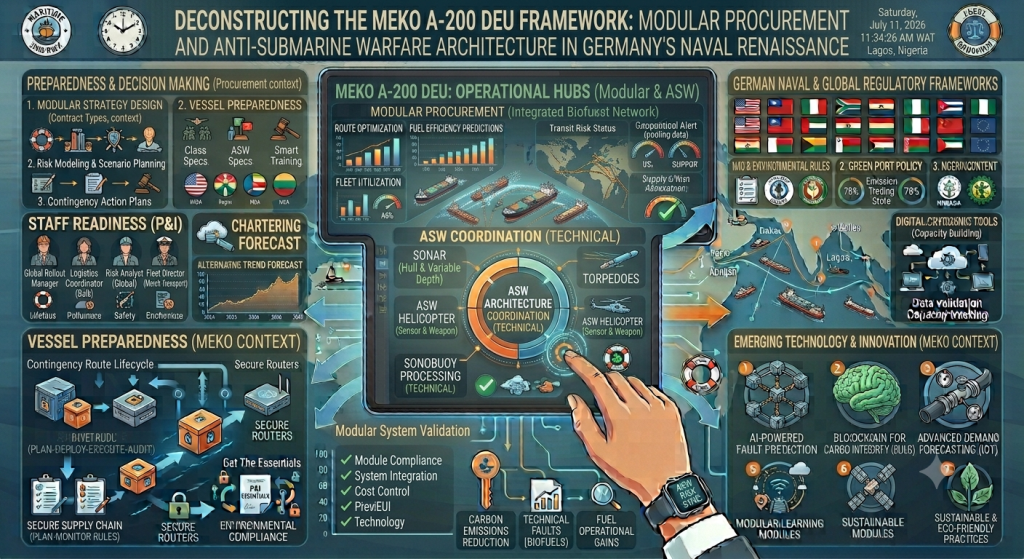
The geopolitical realities facing Northern Europe have fundamentally altered the defense strategies of Baltic littoral states. For the German Navy (Deutsche Marine), this shift culminated in mid-2026 with a decisive structural realignment of its surface combatant procurement strategy. On June 24, 2026, the German Federal Ministry of Defence officially announced the termination of the ambitious yet troubled F126 Niedersachsen-class frigate program. Driven by escalating projected completion costs approaching €18 billion, continuous schedule slippages, and complex disputes over prime contractor integrations, Berlin made a major tactical pivot.
On July 8, 2026, the Budget Committee of the German Bundestag (Haushaltsausschuss) formally cleared the alternative framework: the immediate procurement of four firm MEKO A-200 DEU frigates (designated as the F128 class) from thyssenkrupp Marine Systems (TKMS), with an option for an additional four units to be exercised by the end of 2026. This dynamic €11.6 billion restructuring represents more than just a change in hull size; it is a fundamental shift toward modular procurement speed, strict configuration control, and specialized Anti-Submarine Warfare (ASW) capability designed to meet NATO’s collective defense standards.
The F126 Cost Spiral and the Strategic Shift
The F126 program was originally envisioned as the largest surface warship project in postwar German history, with vessels displacing over 10,550 metric tons. Designed as multi-role, highly flexible expeditionary platforms, the ships were meant to handle everything from intense open-ocean combat to stabilization missions through swappable payload modules. However, the program struggled with complex technical requirements, software integration issues, and coordination challenges between international designers and local yards.
When contractor handovers threatened to push initial deliveries past 2031 while driving the cost-to-complete close to double the original €10 billion budget, the Ministry of Defence moved to protect public funds and maintain operational readiness.
[Traditional F126 Approach] ──► 10,550+ Ton Multi-Role Giant (High Complexity)
│
▼ (The 2026 Realignment)
│
[MEKO A-200 DEU Framework] ──► 3,950 Ton Focused ASW Platform (Rapid Build)
├──► Standardized TKMS Hull Platform
├──► Modular System Integration (MEKO® Architecture)
└──► Fixed NATO Interoperability Baseline
The MEKO A-200 DEU offers a clear alternative. Displacing approximately 3,950 metric tons—less than half the size of the planned F126—the F128 class is built on a mature, internationally proven hull design. This change helps mitigate technical risks and allows TKMS to target an accelerated first delivery as early as 2029, directly addressing NATO capability deadlines in the Baltic and North Sea theaters.
Technical Anatomy: Armed and Optimized for the Baltic Theater
The MEKO® (Mehrzweck-Kombination / Multi-Purpose Combination) design philosophy developed by TKMS is centered on structural modularity. Every major system group—including functional weaponry clusters, electronic warfare suites, and sensor arrays—is integrated into standardized weapon stations and electronic spaces. This architectural approach decouples the physical construction of the hull from the specialized integration of its electronic and combat systems.
Modular Weaponry and Sensor Layout
The German specific DEU configuration integrates a balanced combat loadout designed for high-intensity maritime deterrence and localized sea-lane protection:
- Main Gun and Close-In Weapon Systems (CIWS): Outfitted with a primary 127mm naval gun mount for surface engagement and naval gunfire support, supplemented by advanced short-range platforms like the Rheinmetall Air Defence SeaSnake 30mm system for close-in defense.
- Missile and Air Defense Suites: Equipped with a vertical launch system (VLS) optimized for RIM-162 Evolved Sea Sparrow Missiles (ESSM) to provide robust, multi-layered local air defense against modern anti-ship cruise missiles.
- The ASW Combat Backbone: The core focus of the F128 is under-water warfare. The platform integrates a high-performance hull-mounted sonar alongside an Atlas Elektronik active/passive variable depth towed sonar array, giving the vessel clear acoustic detection capabilities against modern conventional diesel-electric submarines operating in shallow, acoustically complex Baltic waters.
Propulsion and Acoustic Silencing
The MEKO A-200 DEU utilizes a specialized CODAG-WARP (Combined Diesel and Gas turbine-Waterjet and Refined Propeller) propulsion matrix. This configuration combines highly efficient diesel engines for long-range cruising with a central gas turbine driving a waterjet for rapid sprints up to 29 knots.
For the critical anti-submarine mission, the propulsion arrangement allows the vessel to operate under strict acoustic silencing protocols. By routing cruising power through isolated, double-resilient mounted diesel-generator sets, the ship significantly reduces its radiated noise signature, preventing detection by hostile submarine acoustic sensors during tracking operations.
B2B Compliance: Industrial Conditions and Configuration Control
The Bundestag Budget Committee’s approval of the MEKO A-200 DEU program came with strict, legally binding operational provisos. These conditions create a complex compliance landscape for prime contractors, sub-tier defense suppliers, and marine engineers across Germany.
[ Bundestag Budget Committee Mandate ]
│
┌────────────────┴────────────────┐
▼ ▼
[ Anti-Configuration Creep ] [ Supply Chain Safeguards ]
│ │
▼ ▼
Strict Freeze on Technical Mandatory Re-engagement of
Design Additions (<5% Margin) Displaced F126 Subcontractors
1. Mitigating Design and Configuration Creep
A recurring challenge in German naval procurement has been the tendency to introduce mid-project capability changes, which can delay schedules and drive up costs. To prevent this on the F128 program, the Bundestag has placed strict limits on design modifications.
The baseline design provided by TKMS is treated as a locked technical standard, with navy-requested additions capped at approximately 5% of the total contract value. Any subsequent engineering changes must undergo a rigorous risk and cost evaluation, preventing the creeping requirements that disrupted the F126 program.
2. Supply Chain Safeguards for Domestic Shipyards
To protect the domestic industrial base, the budget resolution stipulates that subcontractors and regional shipyard sites affected by the F126 cancellation must receive priority consideration for the construction of the four firm MEKO ships. This mandate requires TKMS to carefully balance its primary manufacturing capacities—such as its core facilities in Kiel—with specialized regional yards like Stahlbau Nord and other Northern German hull construction sites.
For B2B maritime suppliers, this requires strict alignment with TKMS’s standardized manufacturing frameworks, international quality controls, and NATO classification standards.
4. NATO Interoperability and Operational Reality
The rapid transition to the MEKO A-200 DEU framework directly addresses Germany’s defense obligations under NATO’s collective security architecture. The geographic focus of the Deutsche Marine has shifted back to securing sea lines of communication across the North Atlantic and maintaining maritime deterrence within the Baltic Sea.
The Baltic Submarine Challenge
The Baltic Sea is a challenging environment for anti-submarine operations. Its shallow depths, varying salinity layers, and complex underwater topography create acoustic conditions that allow modern diesel-electric submarines to easily mask their presence.
By procuring a larger fleet of eight smaller, agility-focused F128 frigates rather than four to six massive multi-role vessels, the German Navy can maintain a more persistent presence across key maritime chokepoints.
| Feature | F126 Program (Cancelled) | MEKO A-200 DEU (F128 Class) |
| :— | :— | :— |
| **Primary Mission Focus** | Multi-Role Expeditionary / Global Stabilization | Focused Anti-Submarine Warfare (ASW) |
| **Displacement** | 10,550+ Metric Tons | ~3,950 Metric Tons |
| **Aviation Capacity** | Dual NH90 Sea Tiger Helicopters | Single NH90 Sea Tiger / UAV Mix |
| **Hull Modularity** | Large Flex-Space Mission Modules | Standardized MEKO Containerized Slots |
| **Procurement Strategy** | Bespoke Design Evolution | Proven Export Hull Platform |
While the smaller MEKO hull accommodates a single NH90 Sea Tiger ASW helicopter instead of the two planned for the F126, the modular hangar design compensates for this by providing flexible space for autonomous underwater vehicles (AUVs) and unmanned aerial vehicles (UAVs). This capability allows the F128 to deploy distributed sensor networks to counter underwater threats effectively.
Technical FAQ: Navigating the F128 Procurement Framework
Q1: Why was the MEKO A-200 DEU designated as an ASW frigate rather than a general multi-role surface combatant?
The strategic intent of the pivot was to address a specific capability gap in sub-surface defense within Northern Europe. While the F126 design tried to balance long-range expeditionary capability with multiple mission modules, the MEKO A-200 DEU prioritizes a optimized acoustic hull form, integrated towed-array sonars, and dedicated lightweight torpedo launch systems. This focused approach ensures the vessel can integrate directly into NATO active submarine-hunting task groups.
Q2: How does MEKO modular containerization simplify mid-life maintenance and technology retrofits?
Traditional warship designs require cutting through the primary hull structure to replace obsolete electronics or weaponry during a mid-life overhaul. The MEKO architecture avoids this by housing sensors and combat equipment in standardized, structurally isolated enclosures with uniform power, cooling, and data interfaces. Upgrading a radar or missile controller simply involves exchanging the modular container, reducing shipyard downtime from years to a matter of weeks.
Q3: What specific propulsion benefits does the CODAG-WARP arrangement provide during active submarine hunting?
During an active ASW search, reducing self-radiated noise is critical to maximizing sonar performance. The CODAG-WARP system allows the ship to decouple its main propellers and run solely on its waterjet or auxiliary electric propulsion systems driven by resiliently mounted diesel generators. This significantly lowers the vessel’s acoustic signature, allowing the onboard sonars to detect weak return signals without being drowned out by machinery noise.
Q4: What are the primary structural differences between the German MEKO A-200 DEU and existing international variants?
While international export variants have prioritized surface-to-surface missile capabilities, the German DEU variant features an updated stealth hull form designed to reduce infrared and radar signatures. It also includes an advanced tactical data-link suite for network-enabled operations within NATO task forces, and specialized structural enhancements to support the NH90 Sea Tiger helicopter in northern winter conditions.
Q5: How will the cancellation of the F126 impact German shipyards that were already building the initial hulls?
The transition creates a complex restructuring process for regional shipyards. To mitigate the economic impact, the Bundestag’s strict procurement provisos require TKMS to distribute hull fabrication and outfitting contracts across northern German yard networks, such as Wolgast and the Peene-Werft infrastructure. This approach helps maintain local specialized manufacturing jobs while transitioning assembly lines to the new F128 platform.
Strategic Takeaways for Defense Infrastructure Partners
The rapid deployment of the MEKO A-200 DEU framework offers valuable lessons for modern naval procurement and defense supply chains:
- Prioritize Platform Maturity Over Bespoke Complexity: Choosing a proven, stable hull form significantly reduces early design risks, helps control budgets, and accelerates delivery timelines.
- Enforce Strict Design Freezes: Setting clear limits on mid-project configuration changes prevents requirement creep and keeps complex defense programs on track.
- Design for Modular Lifecycles: Integrating modular systems from the start ensures that naval platforms can quickly adapt to changing threats throughout their operational lifetimes without requiring expensive structural overhauls.
Technical Marine Engineering Support with Oitha Marine
Navigating modern maritime regulations, industrial standards, and technical supply chains requires experienced operational support. At Oitha Marine, our specialist divisions provide comprehensive technical advisory, fuel management, and marine logistics solutions tailored to the evolving needs of commercial and defense support fleets.
Ensure your maritime logistics and technical workflows meet the highest industry standards. Contact our engineering support team today at oithamarine.com or visit Oitha Marine Technical Insights to schedule an operational consultation.
For a detailed visual analysis of how this major naval transition reshapes maritime defense strategy across Northern Europe, see this insightful overview of the German Navy MEKO A-200 DEU procurement shift. This breakdown deconstructs the operational advantages of opting for a larger fleet of focused anti-submarine warfare frigates over high-risk, multi-role megaships.
Recent Comments