
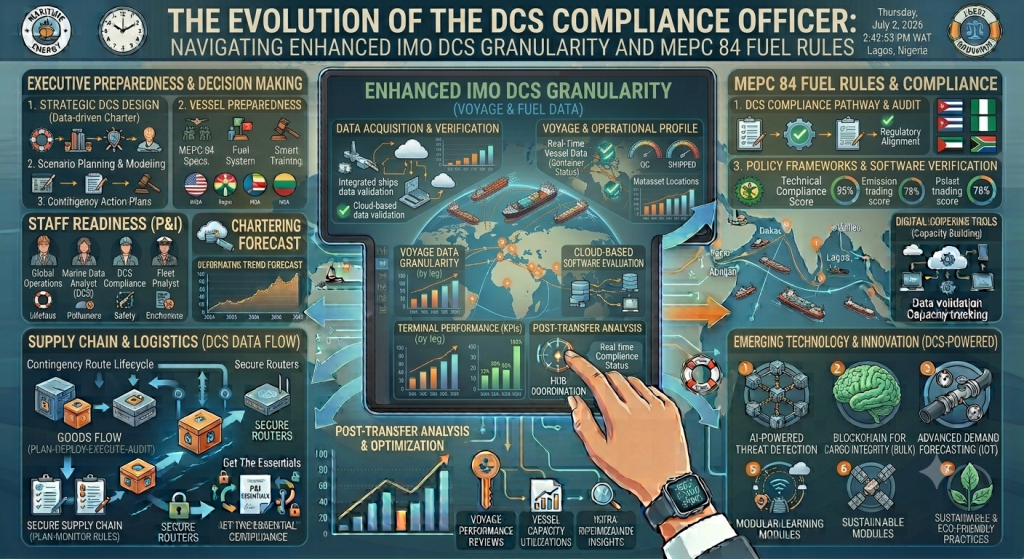
The maritime regulatory environment is undergoing a fundamental structural transformation. Shipboard emissions monitoring has shifted from simple, aggregate year-end data compilation into a highly granular, legally binding, continuous operational risk management process. At the center of this shift is a newly critical corporate role: the DCS Compliance Officer.
Historically, managing the International Maritime Organization’s Data Collection System (IMO DCS) was viewed by many ship operators as a secondary administrative exercise. Shipboard personnel filled out conventional noon reports, shore-based staff aggregated the total fuel fuel oil consumption metrics, and a classification society verified the numbers to issue a routine annual Statement of Compliance (SoC).
However, regulatory changes that took effect on January 1, 2026 (mandated by MEPC 81 amendments to Appendix IX of MARPOL Annex VI), combined with the strict mass-weighted accounting framework enforced at MEPC 84, have changed this landscape entirely.
Today, data accuracy directly impacts a vessel’s Carbon Intensity Indicator (CII) rating, commercial charterparty viability, and compliance with emerging regional carbon pricing mechanisms like the EU Emissions Trading System (EU ETS). This comprehensive technical brief examines the evolving responsibilities of the DCS Compliance Officer, deconstructs the mechanics of enhanced data granularity, and outlines operational strategies for integrating sustainable biofuel for maritime shipping under the newest MEPC 84 protocols.
1. The Architectural Shift: Defining “Enhanced Granularity” in IMO DCS
The regulatory frameworks enforced since January 2026 have moved the industry past basic noon-reporting models. The current IMO DCS framework demands deep structural granularity across three core reporting pillars: fuel consumption by machinery type, precise voyage event segmentation, and standardized cargo transport metrics.
Varuna Marine Services
[Traditional DCS Reporting] ──► Global Annual Fuel Mass (VLSFO / MGO)
│
▼ (Structural Transition)
│
[Enhanced 2026 Granularity] ──► Split by Machinery (ME / AE / Boiler / Others)
├──► Voyage Phase (Under Way vs. Not Under Way)
├──► Operational Event Markers (BOSP / EOSP)
└──► Shore Power Infrastructure Logging (kWh)
Machinery-Specific Fuel Splitting
Vessels are no longer permitted to report a single total fuel mass consumed per voyage. The DCS Compliance Officer must ensure the ship’s data collection systems systematically isolate and report fuel consumption across four distinct internal consumer groups defined within the vessel’s updated SEEMP Part II (Ship Energy Efficiency Management Plan):
- Main Engines (ME)
- Auxiliary Engines (AE)
- Boilers
- Others (such as specialized inert gas generators or cargo pumps, though insignificant consumers like small emergency generators or incinerators can be grouped systematically where appropriate).
This requires the deployment of continuous fuel flow meters or highly disciplined tank-stripping protocols to map exact fuel burn rates to specific machinery units.
Maritime Cyprus
Voyage Event Markers: The Demise of Noon-Only Reporting
The traditional approach of aggregating data based strictly on 24-hour noon intervals has been deprecated. Under the current framework, data reporting must follow a strict berth-to-berth methodology, requiring explicit event logging for:
- BOSP (Begin of Sea Passage): The exact timestamp and GPS coordinate where the vessel reaches its targeted transit speed.
- EOSP (End of Sea Passage): The exact point where the vessel begins decelerating from transit speed to approach a pilot station, anchorage, or berth.
Any operational deviations that interrupt a standard transit—such as anchoring, executing ship-to-ship (STS) transfers, or navigating specific canal passages—must be demarcated by an EOSP event when transit speed is broken, and a subsequent BOSP event when the sea voyage resumes. Consequently, fuel oil consumption and distance traveled must be explicitly partitioned into “Under way” and “Not under way” legs.
Port Call Purpose and Shore Power Integration
To improve global data quality, the DCS framework now integrates specific port call purpose classifications utilizing standardized codes from the IMO Compendium. Furthermore, to accurately track cold-ironing initiatives, vessels equipped to receive onshore power supply (OPS) must meticulously log all shore power received, measured precisely in kilowatt-hours (kWh).
2. The MEPC 84 Mass-Weighted Trap: Biofuel Accounting Frameworks
While the enhanced DCS granularity rules dictate where and when fuel is consumed, the Marine Environment Protection Committee’s eighty-fourth session (MEPC 84) and the revised MEPC.1/Circ.905/Rev.1 guidance dictate how alternative fuels are mathematically accounted for in the emissions ledger.
For fleet managers utilizing biofuel for maritime shipping as a drop-in decarbonization mechanism, MEPC 84 represents a significant accounting shift.
The historical method allowed bunker suppliers to calculate the aggregate carbon conversion factor () of a fuel blend using an energy-weighted approach based on the Lower Calorific Value (LCV) of the respective components. The current regulatory framework requires that the carbon conversion factor of marine biofuel blends be calculated using a strict mass-weighted average.
The Mass-Weighted Mathematical Formulation
The aggregate carbon conversion factor () for any multi-component marine fuel blend is determined strictly by its physical mass fractions, calculated as follows:

Where:
represents the verified mass fraction of fuel component
within the total blend (
).
is the specific, certified carbon conversion factor of fuel component
expressed in metric tons of
per metric ton of fuel (
).
The Sustainability and Verification Bar
To apply a lower or near-zero value to the biogenic portion of a blend within the IMO DCS database, the DCS Compliance Officer must verify that the alternative fuel complies with two mandatory criteria:
- International Certification Scheme: The biofuel must carry a valid certification from an IMO-recognized body (such as the International Sustainability and Carbon Certification – ISCC).
- Well-to-Wake (WtW) Greenhouse Gas Savings: The biofuel must achieve an absolute Well-to-Wake GHG emissions reduction of at least 65% against the international fossil Marine Gas Oil (MGO) baseline value of
. This places a hard ceiling on the fuel’s emissions intensity at
.
Critical Regulatory Compliance Note
If a vessel bunkers a marine biofuel blend that lacks an accompanying, fully verified Proof of Sustainability (PoS), or if the biogenic feedstock fails to achieve the 65% WtW reduction threshold, the regulations dictate that the biogenic portion must be assigned a value exactly equal to its equivalent fossil fuel type.
Without certified verification, a B30 blend (30% biofuel, 70% VLSFO) will be recorded as 100% fossil VLSFO for annual DCS reporting, eliminating its intended regulatory benefit for the vessel’s CII profile.
3. Core Responsibilities of the Modern DCS Compliance Officer
Given this complex regulatory intersection, the modern DCS Compliance Officer operates as a cross-departmental coordinator, linking shipboard engineers, software vendors, fuel procurement teams, and class verifiers.
| Operational Domain | Core Technical Mandate | Risk Matrix |
| Data Integrity & Automation | Transition the fleet away from manual Excel inputs to automated, sensor-driven Electronic Logbooks (ELBs). | Intermittent telemetry drops; mismatched timestamping across automated noon software. |
| Bunker Quality Assurance | Audit bunker procurement streams to ensure physical mass flow meter (MFM) metrics align with the mass fractions on the BDN. | Supplier failure to deliver valid Proof of Sustainability (PoS) certifications. |
| Cross-Framework Harmonization | Reconcile daily IMO DCS telemetry stream with regional EU MRV data models to prevent reporting discrepancies. | Exposure to corporate financial penalties under regional carbon pricing schemes (EU ETS). |
| Continuous Audit Preparedness | Maintain an unbroken, auditable digital trail of fuel transfers, BDNs, and continuous flow meter calibration logs. | Delays in securing the annual Statement of Compliance (SoC) by the May 31 deadline. |
4. Technical Risks & On-Board Realities of Biofuel Integration
When executing a decarbonization strategy using biofuel for maritime shipping, the DCS Compliance Officer’s responsibilities extend beyond data logging into the domain of physical shipboard asset protection. Fatty Acid Methyl Esters (FAME) possess distinct chemical and physical characteristics that differ fundamentally from traditional mineral-based petroleum distillates and residual fuels.
1. Oxidative Degradation and Filter Clogging
FAME contains unsaturated hydrocarbon chains characterized by reactive carbon-carbon double bonds. When exposed to oxygen, trace catalytic metals (such as copper or iron piping), and elevated temperatures in storage tanks, these molecules undergo autoxidation. This chain reaction causes the fuel to polymerize, forming insoluble gums, organic resins, and heavy sludges that can quickly blind fuel filters and centrifuge disks during transit.
2. Hygroscopic Attraction and Microbial Attack
FAME is highly hygroscopic, absorbing and retaining significantly higher concentrations of dissolved water than conventional VLSFO. This moisture triggers hydrolytic cleavage, breaking down the ester bonds to generate free fatty acids (FFAs), which increases the fuel’s Total Acid Number (TAN).
Elevated acid levels can accelerate the chemical corrosion of fuel pumps and injector nozzles. Furthermore, accumulation of free water at the bottom of storage tanks creates an ideal environment for microbial proliferation, resulting in biological slimes that can cause sudden fuel system starvation.
[ Water Ingress / Hygroscopic Absorption ]
│
▼
[ Hydrolytic Cleavage ]
│
┌──────────────────────┴──────────────────────┐
▼ ▼
[ Free Fatty Acids Formed ] [ Microbial Proliferation ]
│ │
▼ ▼
[ Elevated TAN / Fuel Pump Corrosion ] [ Biological Slime / Filter Blinding ]
3. Elastomer Dissolution
High-concentration bio-bunkers act as aggressive chemical solvents when exposed to conventional sealing materials. Standard nitrile rubber (NBR) and low-fluorine synthetic compounds can swell, soften, and degrade over time. Technical teams must verify that all fuel system gaskets, O-rings, and flexible fuel lines are retrofitted with highly fluorinated elastomers, such as Viton (FKM) or polytetrafluoroethylene (PTFE).
5. Technical FAQ: Navigating DCS and Marine Biofuel Compliance
Q1: How does the enhanced granularity of IMO DCS directly affect a vessel’s Carbon Intensity Indicator (CII) calculation?
The actual calculation formula for the attained annual operational CII remains based on total annual emissions divided by total transport work (distance multiplied by capacity). However, the enhanced granularity requirements ensure that the data fed into this calculation is highly accurate and verifiable. Isolating fuel oil consumption by specific machinery type (ME, AE, Boilers) prevents arbitrary data smoothing, allowing flag Administrations and Port State Control (PSC) to verify that the logged emissions directly correspond to the vessel’s recorded operational profile.
Q2: What are the specific carriage requirements for bunker barges transporting high-concentration biofuel for maritime shipping?
Carriage requirements are dictated by the volume fraction of the biofuel within the blend, governed by the intersection of MARPOL Annex I and Annex II:
- Blends containing
biofuel are carried under the regulatory framework of MARPOL Annex I (conventional oil regulations).
- Blends containing
but
biofuel fall under MARPOL Annex II regulations and require a chemical tanker certification (Type 2 or Type 3) under specialized entries.
- Blends containing
biofuel require a full Type 2 chemical tanker with comprehensive Annex II compliance.
However, current IMO interim provisions allow conventional Annex I bunker vessels to carry blends up to B30 (30% biofuel content) to maintain local port supply chain liquidity.
Q3: What concrete steps should a DCS Compliance Officer take if an automated sensor stream drops telemetry mid-voyage?
The officer must ensure the vessel’s approved SEEMP Part II outlines clear, automated data-gap fallback procedures. If electronic flow meters or automated telemetry systems fail mid-voyage, the shipboard engineering crew must immediately transition to verified manual fallback reporting. This includes executing daily physical tank soundings, manual logbook entries, and recording fuel consumption via engine counter readings. These manual data sets must be explicitly flagged in the final DCS submittal to maintain a fully auditable data trail for the Recognized Organization (RO).
Q4: Why is the transition to a mass-weighted calculation considered fairer for tracking actual greenhouse gas reductions?
The previous energy-weighted methodology relied heavily on the Lower Calorific Value (LCV) of individual fuel batches, which can vary across feedstocks. This introduced mathematical variability when aggregating diverse alternative fuel types into a single fleet ledger. Mandating a strict mass-weighted average aligns the emission factors directly with the physical weight of the fuel delivered via the Bunker Delivery Note (BDN) and tracked by Mass Flow Meters (MFM). This removes abstract calculation variances and provides a clear, verifiable baseline for carbon accounting.
Q5: Can a vessel burn a bio-bunker blend if the Proof of Sustainability (PoS) indicates a Well-to-Wake reduction of only 60%?
Yes, the vessel can safely consume the fuel from a mechanical standpoint. However, from a regulatory compliance perspective, that specific biofuel fraction will fail to meet the mandatory 65% WtW greenhouse gas reduction threshold required under the updated IMO guidance. Consequently, for the annual DCS submission and subsequent CII calculations, the flag Administration will disallow any carbon reduction claims for the biogenic component. The entire mass of that biofuel fraction will be penalized and calculated using the standard emission factor of its fossil equivalent.
6. Strategic Takeaways for Forward-Looking Fleet Operators
The role of the DCS Compliance Officer has transitioned from a backend administrative function into a vital component of proactive commercial fleet management. Navigating this landscape requires clear operational priorities:
- Invest in Digital Data Infrastructure: Move away from manual spreadsheet systems. Deploy integrated electronic logbooks and real-time telemetry systems capable of automated BOSP/EOSP event tagging and continuous machinery-specific fuel splitting.
- Establish Rigid Procurement Controls: Ensure your bunker broking and supply agreements explicitly mandate the delivery of valid, IMO-compliant Proof of Sustainability (PoS) certifications alongside the physical fuel.
- Implement Strict Shipboard Management Protocols: Train engine room crews on the physical characteristics of FAME, ensuring continuous tank dewatering, strict storage time limits, and systematic elastomer compatibility audits are integrated into standard workflows.
By building robust compliance frameworks and partnering with technically proficient logistics providers, shipowners can successfully protect their vessels’ asset value, maintain regulatory compliance, and navigate the maritime industry’s ongoing energy transition.
Partner with Oitha Marine for Technical Compliance
At Oitha Marine, our technical teams understand the practical complexities of fuel management, compliance documentation, and secure transshipment logistics. We provide comprehensive bunker brokerage, fuel quality verification, and operational guidance tailored to your fleet’s specific trading profile.
Ensure your fleet remains fully compliant under the latest IMO frameworks. Contact our technical compliance division today at oithamarine.com or visit Oitha Marine Technical Insights to schedule an operational consultation.
Recent Comments