
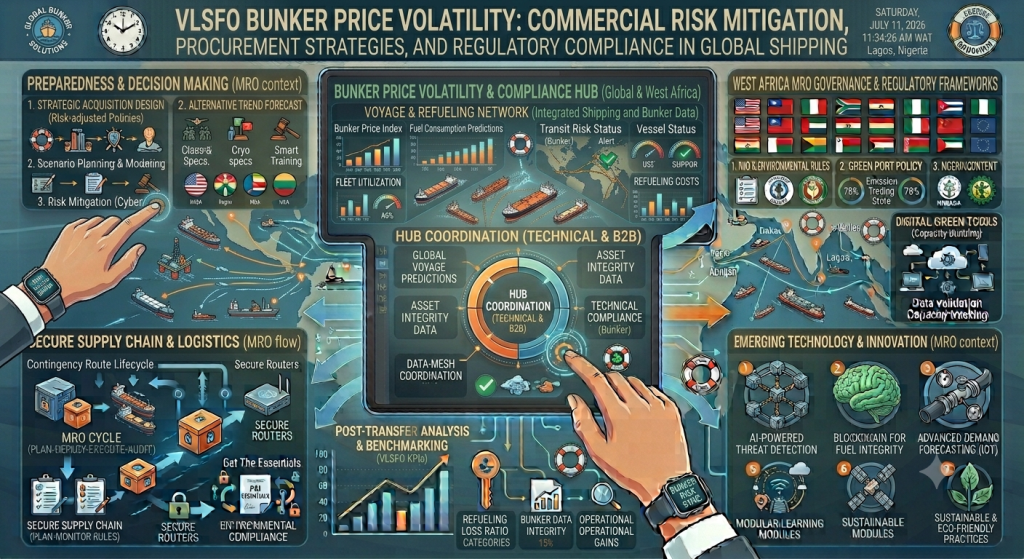
For corporate executives, bunkering procurement managers, and technical fleet superintendents, marine fuel capital expenditure represents the largest single component of a vessel’s total operational cost structure (OPEX). Very Low Sulfur Fuel Oil (VLSFO)—the 0.50% mass-by-mass maximum sulfur marine residual fuel mandated by the International Maritime Organization (IMO) under MARPOL Annex VI—serves as the baseline energy source for over 45% of the global merchant fleet.
[ Brent / WTI Crude Oil Market ]
│
▼
[ Refinery Distillate / Residual Output ]
│
▼
[ VLSFO Blending Component Sourcing ]
│
┌───────────────────────────┴───────────────────────────┐
▼ ▼
[ Global Primary Hubs ] [ Regional Supply Placements ]
(Singapore, Rotterdam, Fujairah) (Lagos Offshore STS, Lome Anchorage)
│ │
└───────────────────────────┬───────────────────────────┘
▼
[ Vessel Main Engine Combustion ]
Because marine fuel costs are tied directly to international crude oil benchmarks (such as ICE Brent and NYMEX WTI), changes in global oil production, refinery utilization rates, and geopolitical stability can cause large, unexpected changes in VLSFO bunker prices. For shipowners operating bulk carriers, container vessels, and tankers across global transport lanes, managing the financial risks of VLSFO price swings is essential to protecting corporate profit margins.
Global VLSFO Bunker Pricing Fundamentals and Hub Structural Metrics
The daily cost of VLSFO is calculated using index-linked physical price assessments at primary bunkering locations worldwide. Each hub operates under distinct structural parameters that determine regional spot pricing variations:
A. Singapore (The Benchmark Asian Marine Hub)
As the largest bunkering port in the world, Singapore controls a substantial share of global VLSFO transactions. Pricing trends in Singapore are heavily influenced by the volume of low-sulfur component imports arriving from the Middle East and the West, combined with regional regional cargo flows. The port’s extensive barge infrastructure allows operators to benefit from economies of scale, maintaining highly competitive premiums relative to raw crude oil futures.
B. Rotterdam (The Primary Northern European Gateway)
Rotterdam serves as the pricing baseline for the European market. VLSFO prices here are closely tied to regional refining margins and the supply of residual fuel oil coming from local refineries. Pricing dynamics are also affected by regional emissions policies, such as the European Union Emissions Trading System (EU ETS) and strict FuelEU Maritime compliance limits.
C. Fujairah (The Strategic Middle Eastern Anchorage)
Located outside the Strait of Hormuz, Fujairah’s bunker market depends heavily on regional crude production rates and the processing capacity of Middle Eastern refineries. Geopolitical developments in the Persian Gulf and changes in shipping traffic along major trade routes can cause sudden shifts in Fujairah’s spot bunker pricing.
3. The Hi-Lo Spread: Scrubber Payback Dynamics
The difference in price between High Sulfur Fuel Oil (HSFO 3.5% sulfur) and VLSFO (0.50% sulfur)—commonly known as the Hi-Lo Spread—is a key factor in maritime financial planning.
[ High Spread: >$150/MT ] [ Low Spread: <$80/MT ]
┌──────────────────────────────┐ ┌──────────────────────────────┐
│ • Accelerates Scrubber ROI │ │ • Delays Scrubber Payback │
│ • Favors Capesize/VLCC CapEx │ │ • Benefits Direct VLSFO Burn │
└──────────────────────────────┘ └──────────────────────────────┘
When the Hi-Lo spread widens significantly (e.g., exceeding $150 per metric ton), vessels equipped with Open-Loop or Closed-Loop Exhaust Gas Cleaning Systems (scrubbers) realize substantial operational cost savings by burning lower-cost HSFO. Conversely, when the spread narrows below $80 per metric ton, the financial advantage of operating expensive scrubber hardware decreases, favoring vessels that directly consume compliant VLSFO.
Technical Telemetry: Optimizing Fuel Management via Digital Pipelines
To control overall fuel expenditures, modern shipping lines use real-time digital tracking systems to monitor fuel intake and optimize onboard engine performance.
[ Coriolis Mass Flow Meters ] ──► [ Edge Telemetry Loggers ] ──► [ Fleet Control Center ]
• Verifies Fuel Density • Normalizes Engine Loads • Automated eBDN Auditing
• Detects Aeration (“Cappuccino”) • Tracks Specific Consumption • Continuous Fuel Apportionment
- Coriolis Mass Flow Meters: Installed directly on bunker manifolds, these meters measure the true mass of the fuel during delivery. This helps prevent volume distortions caused by temperature changes or intentional aeration—often referred to as the “cappuccino effect.”
- Edge Telemetry Loggers: Onboard systems collect real-time data on engine speed, shaft torque, and fuel temperature, matching fuel consumption with active vessel speed.
- Fleet Control Center: Cloud-based software analyzes performance metrics across the fleet, allowing managers to optimize sailing speeds and instantly audit digital bunker delivery notes (eBDN).
Regional Focus: West African Bunkering and Logistics
Procuring VLSFO within West African maritime zones—primarily across the Lagos offshore anchorage and the Lome Ship-to-Ship (STS) positions—involves unique operational conditions compared to primary global hubs:
- Logistics and Supply Chain Structure: Because regional refining infrastructure is limited, West African VLSFO supplies depend heavily on imported offshore product tankers or targeted outputs from regional complexes like the Dangote Refinery. This can lead to local supply constraints and higher baseline costs.
- The Ship-to-Ship Premium: Bunkering in the Gulf of Guinea typically requires specialized offshore STS operations. These movements carry extra expenses, including dedicated security escort vessels, localized port authority fees, and specialized marine insurance riders.
- Quality Monitoring Protocols: Due to the variety of components used in regional fuel blending, technical superintendents must carefully monitor incoming fuel batches. Testing parameters should focus on viscosity profiles, pour points, and calculated carbon aromaticity index (CCAI) levels to prevent fuel stability issues inside the vessel’s settling tanks.
Technical Specifications: Managing the Risks of ISO 8217 Compliance
VLSFO is not a single chemical substance; it is a blended product made by mixing heavy residual fuels with low-sulfur distillates. This manufacturing process creates specific technical challenges that ship engineers must manage carefully:
A. Stability and Sludge Formation
If the components used to blend VLSFO are chemically incompatible, the fuel can become unstable over time. This instability causes heavy carbon residues and asphaltenes to separate from the liquid blend, leading to thick sludge that can clog fuel filters, block purifiers, and cause sudden engine shutdowns.
B. Cat Fines and Abrasive Wear
Refinement processes often leave behind small, highly abrasive aluminum and silicon particles known as catalytic fines (cat fines). If the fuel treatment system does not filter these particles out effectively, they can score cylinder liners, damage fuel injection pumps, and cause premature engine wear.
C. Total Sediment Potential (TSP)
Under ISO 8217 guidelines, the Total Sediment Potential of compliant VLSFO must not exceed 0.10% by mass. Chief engineers must verify these values on laboratory analysis sheets before shifting fuel loads into the main storage tanks.
7. Strategic Risk Management: B2B Financial Hedging Instruments
To manage the financial risks of volatile VLSFO spot prices, corporate financial teams use structured paper market derivatives. These tools help stabilize long-term fuel costs:
[ Corporate Treasury Risk Mitigation ]
│
┌──────────────────────────┴──────────────────────────┐
▼ ▼
[ Fixed-For-Floating Swaps ] [ Call Option Caps ]
• Locks in a flat per-tonne rate • Creates a firm ceiling price
• Eliminates exposure to spot spikes • Retains downside savings flexibility
• Requires missing lower pricing drops • Demands upfront premium payments
- Fixed-For-Floating Bunker Swaps: A fleet operator can lock in a set price per metric ton for a specified volume over a fixed time frame. If spot prices rise above the agreed rate, the swap contract compensates the operator for the difference, providing predictable fuel expenses.
- Call Option Caps: By paying an upfront premium for call options, a shipowner can establish a firm price ceiling for future fuel purchases. This protects the company from large market spikes while allowing it to purchase cheaper spot fuel if prices decline.
Technical FAQ: Procurement, Metrics, and Compliance
Q1: How does the Calculated Carbon Aromaticity Index (CCAI) affect VLSFO performance?
CCAI is an indicator used to assess the ignition quality of marine residual fuels. A higher CCAI value indicates a longer ignition delay during combustion. If a engine burns VLSFO with an elevated CCAI value, it can experience delayed combustion, high peak pressures, and increased mechanical stress on the pistons and cylinder heads.
Q2: What specific steps should the engine crew take if a VLSFO batch fails the ISO 8217 sulfur limit?
If an independent laboratory analysis shows the fuel’s sulfur content exceeds the 0.50% statutory limit (accounting for the 95% confidence boundary under ISO 4259), the ship owner must file a formal non-compliance report. The vessel should notify its flag-state administration and the destination port authority via a formal Fuel Oil Non-Availability Report (FONAR) before entering controlled waters.
Q3: How do new ISO 8217 standards address the introduction of biofuels into VLSFO streams?
Modern maritime specifications include designated parameters for bio-blended marine fuels. These frameworks cover fuel mixes containing fatty acid methyl esters (FAME) or hydrotreated vegetable oils (HVO) blended into traditional VLSFO, ensuring the final product maintains adequate thermal stability and does not cause accelerated microbial growth during long-term storage.
Q4: Why does VLSFO require more precise storage temperature management than legacy HSFO?
VLSFO blends often contain higher concentrations of paraffinic components, which can give the fuel a higher pour point. If the storage tank temperature drops below the fuel’s pour point, wax crystals will begin to form rapidly. This wax accumulation can block transfer pumps and make the fuel difficult to move, requiring engine crews to maintain storage temperatures at least 10°C above the pour point.
Q5: Can the use of electronic Bunker Delivery Notes (eBDN) reduce port turnaround times?
Yes. Electronic Bunker Delivery Notes streamline the verification process by instantly linking mass flow data with port customs systems. This digital transfer speeds up documentation clearance, reduces the administrative workload for the ship’s crew, and helps prevent errors or disputes over the delivered fuel quantities.
Strategic Summary for Fleet Operations Groups
Managing VLSFO procurement effectively requires a balance of technical oversight and financial risk management:
- Optimize Purchasing Timing Across Key Hubs: Coordinate bunkering schedules between primary global ports to take advantage of lower baseline premiums and competitive regional pricing spreads.
- Enforce Strict Laboratory Pre-Testing: Never allow a new batch of VLSFO to be used before verifying its stability, cat fine levels, and total sediment potential via independent fuel testing.
- Utilize Financial Hedging to Stabilize Budgets: Use structured swaps and options to hedge against crude oil market volatility, protecting corporate cash flows from unexpected energy price spikes.
Industrial Bunkering Sourcing and Operational Advisory with Oitha Marine
Navigating the complexities of global bunker markets, fuel quality management, and international environmental compliance requires specialized maritime expertise. At Oitha Marine, we support enterprise fleet owners, commercial operators, and institutional shipping groups with professional fuel procurement strategy, technical fuel quality tracking, regulatory compliance management, and marine risk management solutions.
Protect your fleet operations from volatile bunker markets and ensure full compliance with modern maritime standards. Contact our technical management desk today at oithamarine.com or visit Oitha Marine Technical Insights to schedule a professional consultation.
Recent Comments