
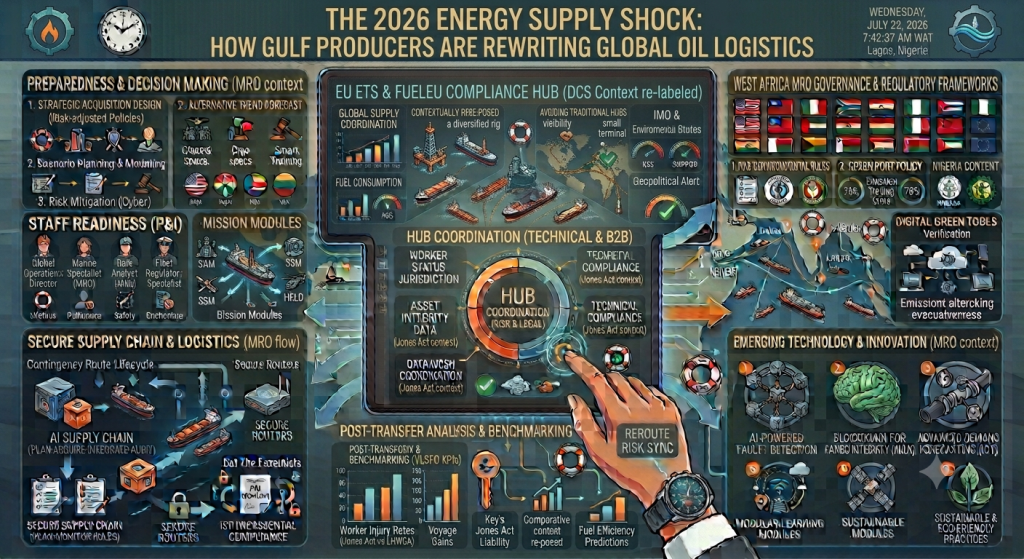
The structural realignment of crude oil supply chains initiated by Gulf Cooperation Council (GCC) producers in response to persistent maritime chokepoint volatility constitutes the single greatest disruption to global energy logistics in 2026. For institutional investors holding maritime assets and C-Suite executives managing downstream energy portfolios in the USA, UK, Singapore, and the UAE, failure to proactively mitigate the resulting liabilities—ranging from invalidated insurance covers to punitive environmental tax surcharges—will result in catastrophic capital erosion.
The Economic Impact: Trapped Capital and Compressed Yields
The optimized, just-in-time logistics models of the previous decade have collapsed under the weight of 2026’s geopolitical reality. Gulf producers, led by Saudi Arabia and the UAE, have responded to chokepoint insecurity not by increasing production, but by aggressively rerouting flows via pipelines to alternative terminals outside the Persian Gulf and Red Sea chokepoints. This creates an immediate economic bifurcation in the tanker market, profoundly impacting balance sheets and the internal rate of return (IRR) on maritime investments.
For entities holding interests in modern very large crude carriers (VLCCs), particularly those leveraged via Senior Secured Debt & Mezzanine Financing, the rerouting implies a bifurcated market. Vessels optimized for traditional short-haul routes via the Strait of Hormuz now face underutilization, dragging down daily time-charter equivalent (TCE) rates and threatening the ability to service highly structured debt obligations.
Conversely, long-haul voyages around the Cape of Good Hope, while keeping tonnage employed, inflate voyage costs by an estimated 25% to 40% due to fuel consumption and extended off-hire periods. This cost cannot always be passed on to charterers under existing contracts.
[2026 Macroeconomic Rerouting Pathway]
Gulf Crude —> Pipeline to Red Sea/Oman Terminals —> Avoids Chokepoints
Gulf Crude —> Cape of Good Hope Diversion —> Increases Voyage OPEX by 40%
The resulting margin compression is exacerbated by the rising costs of risk transfer. Institutional investors must recognize that standard hull and cargo insurance pricing has been superseded by complex, region-specific additional premiums (APs). Standard P&I cover is facing stress from the heightened probability of incidents in crowded, alternative shipping lanes.
Publicly traded entities and massive asset managers face a secondary economic threat: ESG Disclosure Liability. The rerouting of oil logistics around the Cape of Good Hope massively inflates the Scope 3 emissions profile of downstream energy companies and the Scope 1 emissions of shipowners. Failure to accurately project, track, and report this environmental data under corporate sustainability directives (such as Europe’s CSRD) can lead to regulator enforcement actions, shareholder lawsuits, and a general sell-off of ‘green-labeled’ capital.
The Compliance/Legal Framework: JWLA-032, OFAC, and the Carbon Tax Matrix
The contemporary legal environment is no longer just a framework for arbitration; it is a matrix of financial penalties designed to enforce Western geopolitical and environmental policy.
The Insurance Trigger: Joint War Committee Circulars
The pricing of risk in energy logistics in 2026 is entirely governed by the latest advisories from London’s underwriting community. Institutional investors must ensure their portfolios comply with the latest Joint War Committee (JWC) Circulars, most notably the activation of the JWLA-032 parameter.
JWLA-032 did not merely raise war risk premiums; it fundamentally altered the ‘listed areas’ definitions for hull war, piracy, and terrorism. The inclusion of wider expanses of the Indian Ocean and Red Sea requires immediate notification and hefty additional premiums (APs) for vessels transiting these zones. Entering these newly defined JWC Listed Areas without pre-authorization invalidates hull coverage, leaving the asset owner and financiers completely exposed to an unhedged Asset Seizure & Hull War Risk event.
[JWC Breach Scenario]
Vessel Enters Red Sea (JWLA-032 Zone) —> (No Underwriter Notification) —> Coverage VOIDED —> Hull Seizure Event —> Total Loss on Balance Sheet
The Algorithmic Friction: Red Sea AI Liability
Furthermore, the heavy reliance on AI-driven navigation liability in the Red Sea has created a fresh wave of legal disputes. Major fleets have automated voyage plotting to counter GPS spoofing and electronic warfare threats near chokepoints. However, Admiralty law is built around human accountability. If an AI optimization engine directs a vessel into a contested zone resulting in damage, standard P&I defense are under stress. Determining fault between the ship manager, the AI developer, and the hull insurer is generating massive, unprecedented Arbitration & Litigation Costs that must be reserved on the balance sheet.
Environmental Enforcement: IMO 2026 and EU ETS Phase-In
While geopolitical friction reroutes the molecules, environmental regulations tax the voyage. IMO 2026 metrics for Carbon Intensity Indicator (CII) are now in full force, penalizing inefficient voyages.
Most critical for 2026 are the EU ETS Phase-In costs for methane slip. If thererouted logistics chain involves LNG-fueled tonnage (even as dual-fuel), regulators are no longer accepting generic emissions factors. The EU requires strict accounting for unburnt methane (methane slip), treating it as 28 times more potent than . Owners operating these vessels face punishing EUA (European Union Allowance) surrender obligations that were not budgeted for when the vessels were ordered. Legally proving actual engine slip performance rather than regulatory defaults is the only pathway to mitigating this cash drain.
Sanctions: Absolute OFAC Compliance
Finally, the migration of logistics hubs to the Gulf and alternative African transshipment points requires absolute OFAC Sanctions Compliance. Grey-market activity, including ship-to-ship (STS) transfers, dark fleet movements, and deceptive AIS (Automatic Identification System) manipulation, is rampant in the wake of the logistics shock. OFAC applies strict liability; inadvertent exposure to cargo from a sanctioned regime will result in the immediate blacklisting of the vessel, the freezing of US-dollar accounts, and the default of senior debt facilities.
[Strict Liability Contamination]
Grey Market Fuel Hub (OFAC Zone) —> Supplies Bunker Fuel to Tanker —> Tanker Asset Arrested by Regulators
Strategic Recommendations for the C-Suite
To shield institutional capital against these intersecting operational and regulatory risks, the C-Suite must shift from reactive posture to predictive restructuring.
I. Dynamic Risk Transfer: Integration of Parametric Hedges
Legacy indemnity insurance is insufficient against 2026 volatility. Traditional war risk requires a lengthy loss adjustment process during which cash is trapped and debt is serviced. Executives must immediately integrate specialized risk solutions.
Forward-thinking risk managers are now utilizing customized instruments that bypass the loss adjustment process entirely. If a cargo requires transit via a high-friction zone defined by Joint War Committee (JWC) Circulars, a parallel policy can be structured to pay out automatically based on objective, third-party data points—such as a canal closure, a specified wait-time threshold, or regional kinetic activity markers. This guarantees immediate operational liquidity, satisfying debt service requirements and mitigating the cascading costs of logistical delays.
II. Asset Portfolio Re-Rating and DSCR Buffering
Institutional investors must stress-test their maritime portfolios against a prolonged disruption scenario. This involves re-rating all tonnage optimized for legacy short-haul Gulf routes. Boards should mandate a minimum 15% cash liquidity buffer on all highly leveraged assets utilizing Senior Secured Debt & Mezzanine Financing to manage unexpected voyage OPEX spikes or sudden hikes in Additional Premiums (APs). If current assets cannot maintain Debt Service Coverage Ratios (DSCR) under 2026 volatility, these assets should be divested while the secondary market remains liquid.
III. Implementation of Algorithmic Governance and Emissions Verification
CEOs must address the structural data gaps. First, establish a human-in-the-loop audit process for all AI-driven voyage routing to clearly define navigation liability in contested corridors, thereby lowering prospective Arbitration & Litigation Costs. Second, invest in verified, real-time onboard methane slip monitoring for any modern tonnage. Do not accept regulatory default multipliers. Verifying low-slip engine performance is the only legal mechanism available to neutralize the full financial penalty of the expanding EU ETS tax matrix in 2026 energy markets.
Targeted Ad-Slot Hook: Need for Specialized Underwriting & Risk Advisory
Mitigating systematic risk in the 2026 energy market requires deep integration of technical, legal, and financial expertise. Generic risk-management protocols are fundamentally equipped to manage the complexity of evolving Joint War Committee (JWC) Circulars, regional carbon taxes, and aggressive sanctions enforcement. Institutional investors and vessel owners must rely on top-tier Professional Advisory Services to audit their compliance protocols, ensure accurate ESG disclosures, and retain specialized counsel for potential multi-jurisdictional disputes. Furthermore, safeguarding high-leverage assets from catastrophic cash drains requires securing bespoke, Specialized Insurance Cover from elite global underwriting syndicates. These tailored products, including custom war-risk additional premium wrappers and specialized carbon emissions coverage, are essential to preserve the IRR of your maritime portfolio against unavoidable operational upside volatility.
FAQ: 2026 Shipping and GCC Logistics Shocks
Q: Why does the rerouting of Gulf oil logistics increase the risk of ESG Disclosure Liability for shipowners? A: Diversions around the Cape of Good Hope add 10 to 14 days to a standard voyage, doubling the fuel consumption and emissions of the trip. Corporate directors must now report Scope 1 emissions under mandatory sustainability frameworks (e.g., EU CSRD, SEC rules). Publicly available satellite data easily tracks voyage deviations; if a company fails to accurately project and report this massive increase in its annual emissions footprint, it faces strict liability for greenwashing, regulator fines, and shareholder lawsuits.
Q: How does the JWLA-032 circular impact the pricing of maritime risk transfer? A: JWLA-032 is the formal notification that London underwriters have fundamentally recalibrated the risk matrix in response to chokepoint friction. It expands the definitions of ‘Listed Areas,’ meaning vessels transiting alternative energy routes in the Indian Ocean, Red Sea, and Persian Gulf must pay mandatory War Risk Additional Premiums (APs). Traditional, low-cost war risk cover has essentially evaporated; institutional sponsors must now budget for dynamic, high-cost premiums to maintain compliance with their senior debt facilities.
Q: Are standard Force Majeure clauses sufficient to cover the economic costs of the 2026 GCC logistics shift? A: Absolutely not. While Force Majeure may excuse a delay in cargo delivery, it rarely excuses the shipowner from their primary operational obligations to crew and financiers. Under most modern charterparties and Admiralty law, the shipowner is liable for the increased daily operating expenses (OPEX) of a Cape of Good Hope diversion. If the asset cannot generate revenue during the extension, standard clauses do not preserve the balance sheet. This is why Arbitration & Litigation Costs are surging as owners and charterers fight over the allocation of rerouting costs.
Q: What is the specific financial threat of “Grey Market Contamination” to legitimate operators? A: Grey markets are opaque networks involving unsanctioned and sanctioned entities sharing bunkering facilities, transshipment hubs, and logistics technology. OFAC applies strict liability; if a vessel unknowingly sources fuel from an STS provider or uses a hub contaminated by sanctioned molecules, the entire corporate asset can be designated under secondary sanctions. This triggers immediate Asset Seizure & Hull War Risk events, invalidates all primary and mezzanine financing, and effectively destroys the equity value of the asset.
Recent Comments