
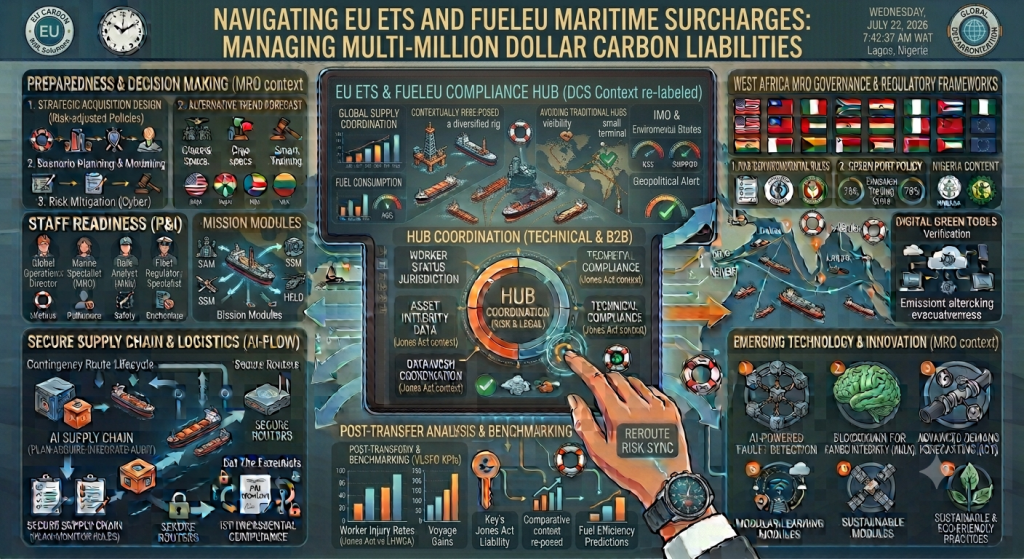
The regulatory landscape governing international shipping has fundamentally shifted from soft environmental guidelines to rigid, multi-billion-dollar legal mandates. With the full implementation of the European Union Emissions Trading System (EU ETS) for maritime transport and the enforcement of the FuelEU Maritime regulation, regional carbon accounting is actively dictating global ocean trade economics.
For supply chain executives, maritime lawyers, logistics directors, and institutional investors based in Tier-1 nations—including the United States, Canada, the United Kingdom, and Australia—these European directives are far from localized issues. Because the EU frameworks apply a 50% liability rule to all voyages originating from or terminating at European ports, non-EU cargo owners moving goods across Transatlantic, Asia-Europe, and Far East trade lanes are absorbing massive compliance pass-through surcharges.
This whitepaper breaks down the regulatory mechanics, financial calculations, charterparty risk allocations, and operational mitigation strategies required to navigate European maritime carbon liabilities.
The EU ETS Phased Rollout and Structural EUA Dynamics
The inclusion of the maritime sector within the EU ETS (Directive 2003/87/EC) establishes a cap-and-trade architecture that forces shipping companies to surrender European Union Allowances (EUAs) for every metric ton of verified carbon dioxide (), methane (
), and nitrous oxide (
) emitted.
Florence School of Regulation – European University Institute
[Phase-In Obligations for Verified Emissions]
2024: 40% Surrender ➔ 2025: 70% Surrender ➔ 2026+: 100% Full Compliance
Scope and Geographic Liability
The geographic reach of the EU ETS depends strictly on the voyage profile:
- 100% Liability: Voyages between two EU/EEA ports, including emissions generated while at berth in an EU port.
- 50% Liability: Voyages connecting an EU/EEA port with a non-EU port (e.g., Port of New York/New Jersey to Port of Rotterdam, or Port of Shanghai to Hamburg).
Transatlantic Voyage: Port of NY/NJ ➔ Port of Rotterdam
Total Voyage Emissions: 1,000 MT CO2
EU ETS Geographic Liability (50% Rule): 500 MT CO2
2026 Surrender Obligation (100% Phase-in): 500 EUAs required
If EUA market prices average €80 per allowance, a single Transatlantic crossing generates a direct financial tax of €40,000. For an ultra-large container vessel executing 10 to 12 rotations per year, annual EU ETS compliance costs easily top several million dollars per vessel—an operational expenditure that carriers pass directly down to beneficial cargo owners (BCOs) via itemized “EU ETS Surcharges.”
FuelEU Maritime: Well-to-Wake (WtW) Mechanics and Penalty Calculations
While the EU ETS taxes absolute carbon emissions, the FuelEU Maritime regulation (Regulation EU 2023/1805) targets the greenhouse gas intensity of the energy used onboard ships. It enforces a progressively tightening baseline, measuring emissions on a comprehensive Well-to-Wake (WtW) lifecycle accounting basis that incorporates Well-to-Tank (fuel production/distribution) and Tank-to-Wake (combustion) emissions.
[FuelEU GHG Intensity Reduction Targets vs. 2020 Baseline (91.16 gCO2e/MJ)]
2025-2029: -2% ➔ 2030-2034: -6% ➔ 2035-2039: -14.5% ➔ 2050: -80%
The Financial Math of FuelEU Non-Compliance
Ships using conventional Heavy Fuel Oil (HFO) or Very Low Sulfur Fuel Oil (VLSFO) naturally exceed the mandated baseline intensity. If a vessel ends the reporting year with a negative compliance balance, it incurs a direct financial penalty calculated against its non-compliant energy usage.
The regulatory penalty is fixed at €2,400 per metric ton of VLSFO-equivalent non-compliant fuel energy used.
FuelEU Penalty Formula = (Compliance Deficit in gCO2e / Actual GHG Intensity) × (€2,400 / 41,000 MJ)
Because this penalty scales linearly with fuel consumption, long-distance trade corridors connecting Asia, North America, and Australia to Europe face compounding annual financial liabilities unless vessels transition to bio-methanol, green ammonia, or e-LNG blends.
Flexibility Mechanisms: Pooling, Banking, and Borrowing
To cushion this cost, FuelEU Maritime provides specific flexibility mechanisms:
- Banking: Ships with a positive compliance balance (using zero-emission energy) can bank surplus credits for future years.
- Borrowing: Ships with a minor deficit can borrow an advance compliance surplus from the following year (capped at 2%), subject to a 10% interest penalty on the borrowed amount.
- Pooling: Ships can combine their compliance balances into a corporate or multi-owner pool. Highly efficient dual-fuel vessels can offset the deficits of conventional ships within the same pool, enabling commercial operators to manage fleet-wide compliance at a significantly lower net cost.
Legal Shifting of Carbon Liability: BIMCO Clauses and Charterparty Disputes
The operational responsibility for purchasing EUAs or paying FuelEU penalties rests legally with the registered shipowner or the ISM Code ship manager. However, under commercial time charterparties, the charterer dictates the vessel’s speed, route, cargo load, and fuel selection.
Bernhard Schulte Shipmanagement
To resolve this commercial disconnect, BIMCO (the Baltic and International Maritime Council) developed standardized contract clauses:
[Contract Structure]
Shipping Line / Shipowner
│
├── (BIMCO ETS Clause) ➔ Transfers EUA purchase liability to Time Charterer
│
└── (Green Surcharge) ➔ Passes carbon tax liability down to BCO / Freight Forwarder
Key Legal Mechanics under BIMCO ETS Clauses
- Mandatory Timely Transfer: The charterer is contractually required to monitor and transfer the exact number of verified EUAs to the shipowner’s designated carbon account on a monthly or quarterly basis.
- Off-Hire Exposure: If the charterer fails to surrender the required EUAs, the shipowner retains the legal right to suspend performance or declare the vessel off-hire until the financial liability is cleared.
- Disputes Over FuelEU Pooling: In long-term charters, dispute risks arise over who owns the economic value of a vessel’s surplus compliance balance under FuelEU Maritime—the owner who invested millions in a dual-fuel ship, or the charterer who paid a premium for green fuel.
Regional Gateway Realities across Tier-1 Corridors
The economic absorption of European carbon taxes varies across primary international trade lanes interfacing with major European gateways like Rotterdam, Hamburg, Antwerp, and Felixstowe.
US East Coast & Canada Transatlantic Lanes
Transatlantic trade routes connecting North American hubs (Port of New York/New Jersey, Virginia, Port of Montreal) to Northern Europe carry a high proportion of high-value industrial and agricultural cargo. Because transatlantic voyages are shorter than transpacific loops, the 50% liability rule means carbon taxes represent a larger percentage of total ocean freight costs. Shippers are seeing carbon surcharges integrated into baseline contract negotiations, forcing corporate buyers to re-calculate landed costs.
UK Coastal & Domestic Realities
Following Brexit, the United Kingdom operates its own independent UK Emissions Trading System (UK ETS). The UK ETS expanded its scope to include domestic maritime transport for vessels of 5,000 Gross Tonnes and above.
Voyage Emissions: Exempt from UK ETS (0% surrender obligation for voyage)
Port Stay in Great Britain: 100% surrender obligation under UK ETS
This dual-regulatory environment forces carriers operating across the English Channel and North Sea to manage two independent compliance frameworks (EU ETS and UK ETS), adding administrative overhead and legal complexity.
Australia and Asia-Europe Long-Haul Corridors
For Australian exporters shipping raw materials or agriculture to Europe via transshipment hubs in Singapore or Malaysia, the geographic distances involved mean total carbon liabilities per TEU are among the highest globally. The long voyage lengths generate massive absolute emissions, resulting in significant carbon surcharge penalties at European discharge ports.
Strategic Risk-Mitigation Framework for Supply Chain Leaders
To protect corporate balance sheets from unmanaged carbon surcharges, B2B shippers and logistics directors must implement a proactive compliance mitigation strategy.
[Legacy Model: Passive Acceptance of Variable Surcharges]
⬇
[Modern Model: Audit ➔ Index ➔ Optimize ➔ Pool]
- Conduct Fleet Carbon Audits: Audit the specific vessel strings deployed by your primary ocean carriers. Prioritize allocations on modern, highly efficient container vessels or dual-fuel assets that incur lower carbon surrender obligations per container unit.
- Establish Surcharge Transparency: Refuse unindexed, “flat-rate” environmental surcharges during annual contract negotiations. Require carriers to calculate EU ETS fees using transparent, publicly audited formulaic models tied directly to verified MRV (Monitoring, Reporting, and Verification) data and market EUA spot prices.
- Leverage Scope 3 Carbon Accounting Platforms: Implement enterprise carbon tracking software compliant with the GHG Protocol. Tracking Well-to-Wake emissions allows corporate sustainability teams to document legitimate emissions reductions, satisfying regulatory requirements and shareholder mandates across North American, UK, and Australian markets.
Insightful Conclusion: The 3-to-5-Year Market Outlook
Regional carbon pricing is no longer an isolated European experiment; it is the catalyst for a global restructuring of maritime commerce. As the EU ETS reaches full compliance integration and FuelEU Maritime penalties scale upward, other Tier-1 nations—including the UK, Canada, and East Asian trading partners—are evaluating equivalent regional carbon levies.
Over the next three to five years, the cost of ocean transport will be defined by carbon efficiency. The gap between fossil-fuel-dependent fleets and green-fuel-enabled shipping networks will widen, creating a distinct two-tier freight market. Organizations that proactively master carbon accounting, audit carrier surcharges, and optimize supply chain routes will preserve their margins, while those relying on passive procurement will absorb compounding financial liabilities.
Deep-Dive FAQ Section
How is an EU Allowance (EUA) price calculated into a shipper’s ocean freight invoice?
Carriers calculate EU ETS surcharges using a formula based on the vessel’s fuel consumption, the total verified carbon emissions generated on the trade lane, the 50% or 100% geographic liability factor, and the average market price of EU Allowances (EUAs) traded on carbon exchanges. This total carbon cost is divided by the ship’s active container capacity (utilized TEUs) to establish a standardized surcharge per container (e.g., $25 to $70 per FEU depending on route length and EUA prices).
What is the structural difference between the EU ETS and FuelEU Maritime?
The EU ETS is an absolute cap-and-trade system that taxes a shipping company for every ton of greenhouse gas emitted by requiring them to purchase and surrender carbon allowances. FuelEU Maritime, by contrast, is a fuel-intensity regulation that sets a maximum threshold for the annual average greenhouse gas intensity of energy used onboard a ship. While EU ETS penalties fluctuate based on allowance market trading prices, FuelEU penalties are fixed based on a ship’s specific compliance balance deficit.
How do BIMCO clauses protect shipowners and charterers in carbon compliance disputes?
BIMCO clauses establish a clear legal mechanism for passing financial carbon liabilities to the party controlling the vessel’s commercial operations. Under a BIMCO ETS clause, the time charterer—who dictates voyage routes, speeds, and port calls—is legally required to calculate and reimburse the shipowner with the corresponding number of EUAs or cash equivalents within a specified timeframe, preventing the shipowner from absorbing unmanaged carbon tax liabilities.
Can a non-EU company be held directly liable for EU ETS or FuelEU penalties?
Direct regulatory liability rests with the registered shipowner, ISM manager, or commercial vessel operator registered in the EU database. However, non-EU importers, exporters, and BCOs are held indirectly liable through commercial contracts. Carriers integrate carbon pass-through clauses into standard Bills of Lading and service agreements, legally transferring the underlying financial cost of EUAs and FuelEU non-compliance penalties directly onto the cargo owner.
Recent Comments