
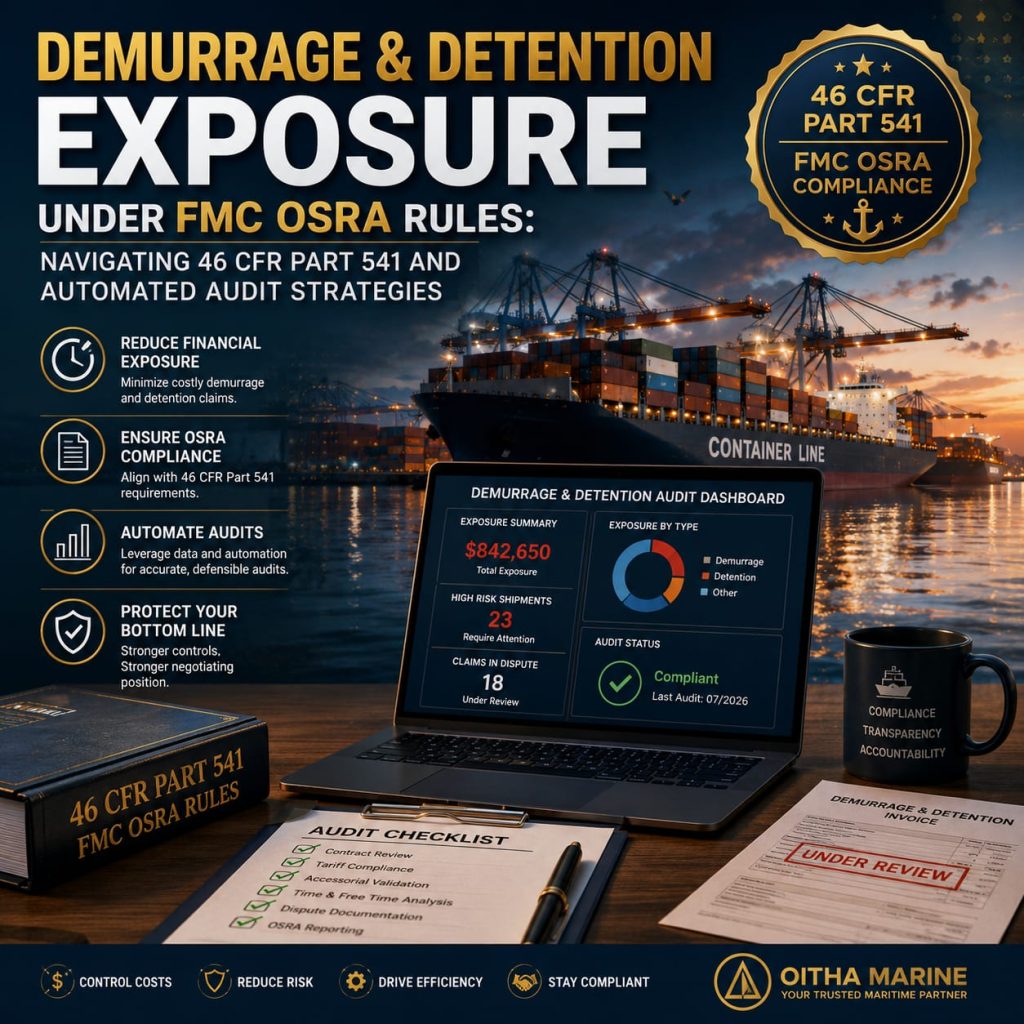
For beneficial cargo owners (BCOs), freight forwarders, and logistics directors operating across primary ocean gateways in the United States, Canada, the UK, and Australia, container equipment access fees represent one of the most volatile unbudgeted operational expenditures. Historically treated by ocean carriers and marine terminal operators (MTOs) as lucrative profit centers, Demurrage and Detention (D&D) charges surged to multi-billion-dollar annual figures during recent supply chain bottlenecks.
In response to systemic industry complaints regarding vague, punitive, and unverifiable invoices, regulatory bodies—led by the US Federal Maritime Commission (FMC)—enacted transformative oversight. The implementation of the Ocean Shipping Reform Act of 2022 (OSRA 2022) and the codification of 46 CFR Part 541 established strict legal frameworks governing invoice contents, mandatory 30-day issuance windows, and explicit billing certifications.
[Legacy Carrier Practice: Vague Invoices + Multi-Party Billing]
⬇
[FMC 46 CFR Part 541 Mandate: 30-Day Hard Window + Mandatory Invoice Data + Certified Auditability]
However, regulatory protection alone does not insulate BCOs from financial loss. Shifts in Earliest Return Dates (ERDs), rail chassis availability deficits, and terminal gate congestion continue to generate unauthorized fee accruals. This whitepaper provides a comprehensive legal, financial, and operational analysis of D&D exposure, evaluating regulatory compliance requirements under FMC rules and detailing an automated audit framework to eliminate invalid container penalties.
Deconstructing the Financial Mechanics: Demurrage vs. Detention
To establish effective corporate controls, supply chain organizations must maintain strict operational distinctions between demurrage and detention. While both fees are calculated on a per-container, per-day (per diem) basis, they represent entirely different operational friction points within the intermodal network.
┌─────────────────────────────────────────────────────────────────────────┐
│ CONTAINER FLOW ARCHITECTURE │
├──────────────────────────────────┬──────────────────────────────────────┤
│ DEMURRAGE EXPOSURE │ DETENTION EXPOSURE │
│ (Inside Terminal Gates) │ (Outside Terminal Gates) │
├──────────────────────────────────┼──────────────────────────────────────┤
│ Vessel Discharge │ Gate-Out Empty/Full │
│ ➔ [Free Time Window] │ ➔ [Free Time Window] │
│ ➔ Terminal Yard Dwell │ ➔ Facility Unloading / Drayage Dwell │
│ ➔ Gate-Out Pick Up │ ➔ Empty Return to Depot/Terminal │
└──────────────────────────────────┴──────────────────────────────────────┘
Demurrage: Marine Terminal Space Utilization
Demurrage applies to full containers remaining inside the marine terminal or intermodal rail yard beyond the agreed Last Free Day (LFD). It functions as a land-use penalty assessed by VOCCs (Vessel-Operating Common Carriers) or MTOs to prevent terminal gridlock.
Southern Star Navigation
- Import Demurrage: Begins accruing when a container is discharged from the vessel, made available, and exceeds its allotted free time without being gated out.
- Export Demurrage: Accrues when a loaded container is gated into the terminal prior to the scheduled vessel loading window or when an Earliest Return Date (ERD) is moved by the carrier without adequate notice.
Detention: Equipment Holding Beyond Terminal Gates
Detention (frequently billed as “Per Diem”) applies to the container unit itself once it leaves the terminal gates. It is designed to incentivize the rapid return of empty equipment to the carrier’s pool.
- Import Detention: Accrues when an importer picks up a loaded container but fails to return the empty unit to a designated marine terminal or inland depot within the contractual free-time window.
- Export Detention: Accrues when an exporter pulls an empty container from a depot for loading but delays returning the full unit to the marine terminal beyond the allowed free days.
Escalating Tiered Rate Structures
Carriers structure D&D fees using aggressive escalating tiers to force compliance. A standard ocean tariff does not apply a flat daily fee; instead, it compounds dramatically the longer the delay persists:
| Free-Time & Dwell Status | Duration | Representative Tier Rate (Per FEU / Day) | Operational Impact |
| Contractual Free Time | Days 1 – 4 | $0 | Standard Cargo Processing |
| Tier 1 Penalty | Days 5 – 8 | $250 / Day | Initial Delay Surcharge |
| Tier 2 Penalty | Days 9 – 12 | $450 / Day | Severe Margin Erosion |
| Tier 3 Penalty (Max Tier) | Days 13+ | $750+ / Day | Critical Financial Loss |
For an enterprise importer moving 5,000 FEUs annually, an unmanaged 3-day average dwell excess across just 10% of their volume can result in over $1.5 million in unnecessary operational expenses.
The Legal Enforcement Framework: FMC 46 CFR Part 541 and OSRA Mandates
In the United States, the Federal Maritime Commission fundamentally altered the legal dynamics of container billing by enacting 46 CFR Part 541 under the authority of OSRA 2022. This regulation establishes enforceable billing standards that protect BCOs, consignees, and non-vessel-operating common carriers (NVOCCs) from arbitrary charges.
[Key Provisions of FMC 46 CFR Part 541]
├── 1. The 30-Day Hard Issuance Deadline (Non-compliance cancels payment obligation)
├── 2. Mandatory Invoice Content (BL#, Container#, Availability Date, LFD, Rate Tier)
├── 3. Strict Billing Privity Limits (Prohibits billing party without direct contract)
└── 4. Mandatory 30-Day Dispute Resolution Protocol
The 30-Day Hard Invoice Issuance Window
Under 46 CFR § 541.7, billing parties (VOCCs, MTOs, and NVOCCs) must issue D&D invoices within 30 calendar days of the date on which the charge was last incurred.
Charge Accrual Stops (Day 0) ➔ 30-Day Issuance Deadline ➔ Day 31+ (Payment Obligation Eliminated)
If an invoice is issued on Day 31 or later, the billed party is entirely relieved of any legal obligation to pay the fee. For NVOCCs passing through charges, the NVOCC must issue its invoice within 30 days of the issuance date of the invoice received from the VOCC.
Mandatory Invoice Data Elements and Automatic Invalidation
Under 46 CFR § 541.6, an invoice must contain precise data points to be legally enforceable. Under 46 CFR § 541.5, the failure to include any required data element automatically eliminates the billed party’s obligation to pay. Mandatory elements include:
- Container Identification: Specific container number(s) and Bill of Lading (BL) number.
Southern Star Navigation
- Port/Terminal Context: Port of discharge and specific terminal facility.
- Milestone Timestamps: Container availability date, Earliest Return Date (ERD), free-time start and end dates, and specific charged dates.
- Rate Calculations: Applicable tariff rule or service contract clause, total allowed free time, and breakdown of daily rates applied.
- Certification Statement: A formal statement certifying that the charges comply with FMC rules and that the billing party’s own performance did not cause or contribute to the delay.
Contractual Privity and Dispute Timelines
The FMC rule dictates that D&D invoices may only be issued to parties in direct contractual privity with the billing entity (i.e., the contracted shipper or consignee). Ocean carriers are prohibited from issuing D&D invoices to motor carriers (drayage truckers) unless the trucker directly contracted with the ocean carrier for ocean transportation or storage.
Furthermore, billed parties must be granted at least 30 calendar days from the invoice issuance date to submit a request for mitigation, refund, or waiver. Once a dispute is filed, the billing party must attempt to resolve the matter within 30 calendar days.
Operational Root Causes of Unauthorized D&D Accumulation
Despite federal regulations, D&D charges continue to accrue due to systemic operational friction points across major container gateways like Los Angeles/Long Beach, New York/New Jersey, Vancouver, London Gateway, and Melbourne.
[Systemic Intermodal Friction]
├── Terminal Gate Congestion & Appointment System Exhaustion
├── Dual-Transaction Mandates & Empty Return Location Closures
├── Rail Chassis Deficits & Inland Terminal Dwell
└── Unannounced Earliest Return Date (ERD) Shifts
Appointment System Failures and Terminal Gate Closures
At primary marine terminals, importers are frequently required to secure a gate appointment before a drayage driver can pick up an available container. When terminals experience severe congestion, appointment slots often fill up completely for days.
If a container sits on the dock past its LFD because the terminal had zero available pickup appointments, carriers historically assessed demurrage anyway. Under FMC precedent (specifically the Incentive Principle), assessing demurrage when a shipper is physically prevented from picking up cargo is considered an unreasonable practice because the fee cannot fulfill its purpose of incentivizing freight fluidity.
Empty Return Depots and Dual-Transaction Lockouts
Detention fees frequently accumulate when motor carriers attempt to return empty containers but are turned away. Common triggers include:
- Depot Capacity Caps: Marine terminals or off-dock depots capping empty returns due to yard saturation.
- Dual-Transaction Mandates: Terminals refusing to accept an empty return unless the drayage truck is simultaneously picking up an imported container.
- Split Depot Returns: Carriers instructing truckers to return empty equipment to an off-dock facility miles away from the original discharge terminal, exhausting drayage hours-of-service (HOS) limits.
Chassis Shortages and Intermodal Rail Disconnects
Inland rail ramps (such as Chicago, Memphis, or Dallas in the US, or Toronto in Canada) often suffer from localized chassis shortages. When an import container is discharged onto a rail ramp but no chassis is available, the container cannot gate out, driving up daily storage fees. BCOs must track whether the chassis pool operator, rail provider, or ocean carrier maintains primary responsibility under intermodal service agreements.
Regional Gateway Rules: USA, Canada, UK, and Australia
While the US maintains a highly formalized regulatory structure via the FMC, BCOs operating across other Tier-1 jurisdictions must navigate distinct regional legal frameworks.
[Global D&D Regulatory Comparison]
├── UNITED STATES: FMC 46 CFR Part 541 / OSRA 2022 (Statutory Rules & Invalidations)
├── CANADA: Canadian Transportation Agency (CTA) / Commercial Contractual Terms
├── UNITED KINGDOM: British International Freight Association (BIFA) / Common Law Unreasonable Penalties
└── AUSTRALIA: Freight & Trade Alliance (FTA) / ACCC Oversight & Port Competition Policy
United States: Federal Statutory Oversight
The US features the world’s most aggressive regulatory framework. The FMC actively investigates charge complaints under 46 U.S.C. § 41310, ordering civil penalties and mandatory refunds for non-compliant D&D billing practices.
Canada: CTA Framework and Port Gateway Rules
In Canada, the Canadian Transportation Agency (CTA) oversees rail and marine terminal operations under the Canada Transportation Act. While Canada lacks a direct equivalent to FMC Part 541, the CTA evaluates dispute complaints regarding “unreasonable” terminal tariffs at major ports like Vancouver and Montreal. Canadian importers must rely heavily on negotiated service contract terms to establish extended free time.
United Kingdom: Common Law Principles and BIFA Terms
In the UK, D&D charges are governed by general contract law, maritime common law, and the standard trading conditions of the British International Freight Association (BIFA). UK courts evaluate demurrage claims under the legal doctrine of penalties—if a carrier’s per diem charge is deemed extravagant or disproportionate compared to a genuine pre-estimate of loss, it can be challenged in court.
Australia: ACCC Oversight and FTA Advocacy
In Australia, the Australian Competition and Consumer Commission (ACCC) monitors port competition and stevedore landside charges across major hubs like the Port of Melbourne, Sydney (Port Botany), and Brisbane. Industry bodies like the Freight & Trade Alliance (FTA) actively lobby for regulatory caps on stevedore access fees and terminal operator charges, forcing ocean carriers to justify infrastructure levies.
Strategic Risk Mitigation: Deploying Automated Freight Audit Frameworks
To eliminate unauthorized D&D expenditure, enterprise supply chain organizations must transition from manual invoice approvals to automated Freight Audit and Payment (FAP) workflows integrated with real-time container visibility platforms.
┌────────────────────────────────────────────────────────────────────────┐
│ AUTOMATED D&D AUDIT WORKFLOW │
├────────────────────────────────────────────────────────────────────────┤
│ 1. INTAKE & TIMESTAMPING │
│ Capture Invoice Metadata & Date Received (Start 30-day clock) │
│ │
│ 2. DATA ELEMENT VALIDATION │
│ Verify § 541.6 compliance (BL#, Container#, LFD, Availability) │
│ │
│ 3. EVENT MILESTONE RECONCILIATION │
│ Cross-reference API timestamps (Port Availability vs. Gate-out) │
│ │
│ 4. DISPUTE GENERATION OR PAYMENT APPROVAL │
│ Automatically auto-reject non-compliant invoices within 30 days │
└────────────────────────────────────────────────────────────────────────┘
Establishing an Automated 4-Step Audit Protocol
- Intake Timestamping (Day 0–1): Record the exact date an invoice is received via EDI or portal. Verify whether the invoice date falls within the statutory 30-day window from the last accrued charge date.
- Structural Data Audit (Day 1–3): Programmatically audit the invoice for missing required data fields under 46 CFR § 541.6. If any mandatory field or certification is missing, automatically generate a rejection notice citing 46 CFR § 541.5.
- Milestone Reconciliation (Day 3–7): Cross-reference billed dates against independent container tracking APIs. Reconcile terminal availability dates, appointment booking attempt logs, customs hold release timestamps, and physical gate-in/gate-out events.
- Evidence-Backed Dispute Filing (Day 7–14): If charges accrue due to terminal closures, lack of appointments, or erroneous LFD calculations, submit a formal dispute package supported by digital evidence (e.g., portal screenshots, appointment denial logs, terminal gate notices) within the 30-day dispute window.
Evidence Preservation Protocols
To win D&D disputes before ocean carriers or the FMC, BCOs must mandate that their drayage partners maintain real-time digital proof of operational barriers. Required evidence includes:
- Timed screenshots showing zero available terminal pickup appointments during free time.
Southern Star Navigation
- Automated GPS geofence logs documenting drayage trucks waiting in terminal queues.
- Official terminal advisories announcing gate closures, system outages, or empty return rejections.
Insightful Conclusion: The 3-to-5-Year Market Outlook
The management of demurrage and detention has evolved from an administrative nuisance into a disciplined legal and data-driven discipline. As regulatory enforcement under the FMC matures and other Tier-1 jurisdictions evaluate tighter landside transportation oversight, ocean carriers can no longer rely on unverified, late-issued D&D invoices to boost operational margins.
Over the next three to five years, competitive advantage will belong to importers and exporters that integrate automated freight audit technology, enforce strict contractual free-time terms, and maintain digital evidence repositories. Organizations that proactively assert their statutory rights under frameworks like 46 CFR Part 541 will successfully insulate their operational budgets, while passive shippers will continue to absorb multi-million dollar penalties.
Deep-Dive FAQ Section
What happens if an ocean carrier issues a D&D invoice on Day 31 after the charges stop accruing?
Under FMC rule 46 CFR § 541.7, ocean carriers, MTOs, and NVOCCs must issue demurrage or detention invoices within 30 calendar days of the date on which the charges were last incurred. If an invoice is issued on Day 31 or later, the billed party is legally relieved of any obligation to pay the invoice. The shipper should issue a formal rejection notice citing 46 CFR § 541.7(a).
Can a drayage trucker be billed directly for demurrage or detention by an ocean carrier?
Under 46 CFR Part 541, an ocean carrier or marine terminal operator can only issue D&D invoices to a party that is in direct contractual privity with them for the ocean transportation or storage of the cargo (typically the contracted shipper or consignee). Carriers are prohibited from billing drayage motor carriers directly unless the motor carrier contracted directly with the ocean carrier for ocean transportation or storage.
What invoice data omissions automatically eliminate the obligation to pay a D&D fee?
Under 46 CFR § 541.5, the omission of any mandatory data element required by § 541.6 eliminates the billed party’s obligation to pay. Mandatory elements include the container number, Bill of Lading number, port of discharge, container availability date, allowed free time, start and end dates of charged days, rate breakdown, dispute contact details, and mandatory compliance certifications.
How does the FMC “Incentive Principle” apply if a marine terminal has no pickup appointments available? The FMC’s Incentive Principle establishes that demurrage and detention charges are only lawful if they act as a financial incentive to promote freight fluidity. If an importer is physically unable to pick up a container because the marine terminal has no available gate appointments before the Last Free Day, the charge fails to promote fluidity. Billed parties can dispute these charges by providing documented proof of appointment unavailability.
Recent Comments