
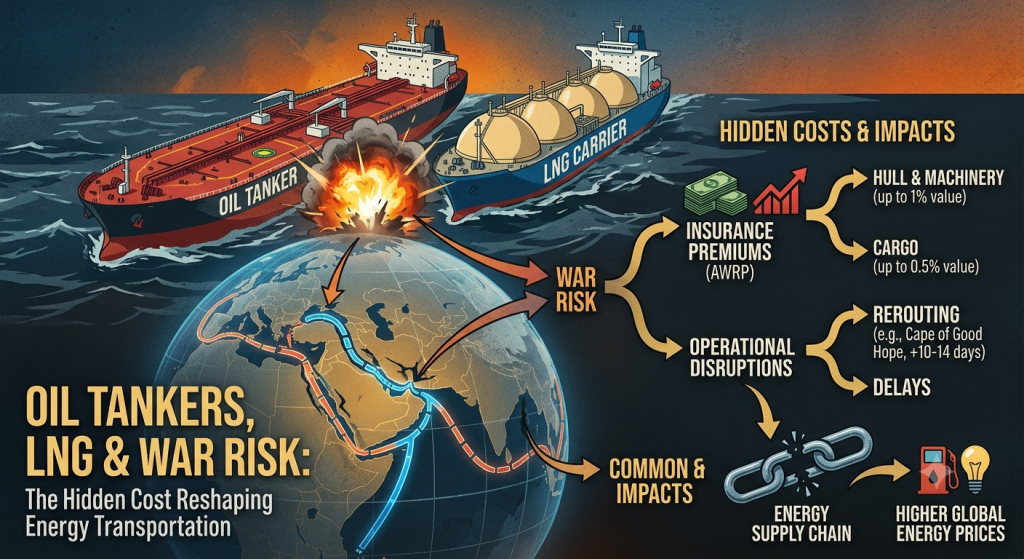
Navigating global energy supply chains in 2026 requires managing unprecedented operational volatility, where compounded maritime geopolitical threats and aggressive regulatory enforcement directly threaten corporate capital reserves. For energy executives and institutional investors, unmitigated exposure to war risk surcharges, shadow-fleet sanctions, and carbon-pricing mechanisms now represents an immediate threat to asset solvency, debt covenant compliance, and net asset value (NAV).
The Economic Impact: Balance Sheet Erosion & ROI Degradation
The global energy transportation sector has transitioned into a hyper-complex risk environment. Volatility in the Middle East, black-sea trade disruptions, and high-seas vessel interdictions have fundamentally rewritten the cost structure of seaborne crude oil and Liquefied Natural Gas (LNG). For institutional asset managers, private equity funds funding maritime capital expenditures, and energy commodity traders, the traditional risk-adjusted return models no longer capture the systemic costs of maritime disruption.
+———————————————————————–+
| STRUCTURAL COST INFLATION ENGINE |
+———————————————————————–+
| |
| Geopolitics & War Risk Premiums |
| • Hull War Risk Breach Premiums (0.5% – 1.2% VDV) |
| • AI Navigation Liability & Spoofing Indemnities |
| |
| │ |
| ▼ |
| |
| Regulatory & Environmental Compliance |
| • EU ETS Methane Slip surcharges (28x GWP multiplier) |
| • OFAC Sanctions Due Diligence & P&I Coverage Gaps |
| |
| │ |
| ▼ |
| |
| Capital & Balance Sheet Impact |
| • DSCR Debt Covenant Breaches (< 1.20x) |
| • Impairment of Mezzanine & Senior Secured Capital Stack |
| |
+———————————————————————–+
1: The Anatomy of Insurance Hikes: Hull War Risk & Breach Premiums
The primary cost multiplier for crude carriers (VLCCs, Suezmaxes) and LNG vessels transiting high-risk corridors is the escalation of Asset Seizure & Hull War Risk policies. Under standard maritime insurance structures, a vessel’s annual Hull & Machinery (H&M) cover explicitly excludes acts of war, terrorism, and political detentions. To traverse areas defined by underwriting syndicates as high-risk, shipowners must procure additional Breach Premiums (Additional Premiums, or APs).
In 2026, Breach Premiums for transiting the Southern Red Sea, the Bab-el-Mandeb Strait, or the Persian Gulf range between 0.5% and 1.2% of the vessel’s insured hull value per 7-day transit window. For a modern, dual-fuel 174,000 cbm LNG carrier valued at $250 million, a single 1.0% AP surcharge generates an immediate, unbudgeted operational expenditure of $2,500,000 per voyage.
When combined with primary P&I (Protection & Indemnity) war risk surcharges and crew double-pay bonuses required by maritime labor unions for high-risk transits, the daily operating expenses (OPEX) of an LNG carrier can spike from a baseline of $15,000–$18,000 per day to over $350,000 per day.
2. Capital Stack Vulnerability: Senior Secured Debt & Mezzanine Financing
This operational expense explosion directly impacts the balance sheet of shipowning Special Purpose Vehicles (SPVs) and their institutional backers. Maritime debt structures rely heavily on syndicated loans, incorporating Senior Secured Debt & Mezzanine Financing collateralized by the vessel asset value and long-term Time Charter Equivalent (TCE) cash flows.
Typical Maritime Capital Structure Under Stress:
+—————————————————+
| Equity / Sponsor Capital | <- First Loss Position
| (Subject to ESG Disclosure Liability Impairment) |
+—————————————————+
| Mezzanine Financing | <- Subordinated Debt
| (Yield compression via unbudgeted Breach APs) |
+—————————————————+
| Senior Secured Debt | <- Collateralized by H&M
| (At risk of DSCR covenant default < 1.15x) | and Cash Flows
+—————————————————+
When war risk surcharges, rerouting costs around the Cape of Good Hope (+10 to 14 days transit duration, adding $1.2M to $1.8M in bunker fuel expense), and carbon penalties hit simultaneously, the SPV’s Debt Service Coverage Ratio (DSCR) collapses. Senior debt covenants typically require a minimum DSCR of 1.20x to 1.35x.
If unbudgeted war risk APs cut net operating income, SPVs face immediate covenant breaches. This triggers technical defaults, elevates interest rate margins across subordinated mezzanine tiers, and forces lenders to demand cash sweeps or collateral top-ups from fund sponsors.
3. Parametric Insurance Premiums as Capital Protections
To prevent structural debt default, forward-thinking CFOs and treasury teams are abandoning traditional indemnity-based policies in favor of structured derivatives and Parametric Insurance Premiums. Parametric triggers—tied to verifiable, independent data points such as satellite-verified AIS dark spots, localized GPS spoofing density, or official naval strike designations—pay out liquidated indemnities within 48 to 72 hours of a defined trigger event, bypassing months of traditional loss adjustment.
While parametric coverage secures liquidity to service senior debt obligations during vessel detentions or rerouting, the market pricing for these structures has surged. Risk syndicates now price parametric war risk triggers at elevated rates, adding another fixed fee to the operator’s capital outlay.
The Compliance and Legal Framework: Regulatory Traps in 2026
The legal landscape governing energy transport has shifted from traditional maritime law into a dynamic regulatory matrix enforced by international bodies, national treasuries, and regional environmental agencies.
+———————————————————————————–+
| 2026 MARITIME COMPLIANCE TRIANGLE |
+———————————————————————————–+
| |
| OFAC / Sanctions Regimes |
| • Shadow Fleet Due Diligence |
| • Price-Cap Attestation Rules |
| |
| / \ |
| / \ |
| / \ |
| / \ |
| / \ |
| / \ |
| / \ |
| JWC Underwriting Rules \_______________ EU ETS & Environmental Scope |
| • JWLA-032 Listed Areas • 100% Phase-In Compliance |
| • Strict Territorial Limits • Methane Slip (28x GWP Multiplier) |
| |
+———————————————————————————–+
1. Joint War Committee (JWC) Directives & The JWLA-032 Impact
The Lloyd’s Market Association (LMA) and International Underwriting Association (IUA) Joint War Committee (JWC) Circulars dictate the global geography of maritime war risk. The implementation of the JWLA-032 circular updated the designated Areas of Perceived Enhanced Risk, expanding underwriting notification requirements across critical maritime choke points.
Under the terms established by JWLA-032:
- Expanded Geographic Boundaries: The circular redefined strict coordinates for the Southern Red Sea, the Gulf of Aden, Indian Ocean transit zones, and offshore oil infrastructures.
- Automatic Exclusions & Mandatory Breach Notices: Vessels entering JWLA-032 defined waters automatically trigger the cancellation of standard hull war risk cover. Shipowners must issue advance notice to lead underwriters to negotiate specific AP terms prior to entering the boundary.
- Strict Liability for Warranties: Failure to provide timely notice under JWLA-032 framework renders the policy void ab initio. If a vessel suffers a drone attack or sea-mine strike within an unnotified JWLA-032 zone, underwriters bear zero indemnity liability. The resulting loss—potentially a total loss of $150M+ for a Suezmax or $250M+ for an LNG carrier—falls entirely on the shipowner and its senior lenders.
2. OFAC Sanctions Compliance & Shadow Fleet Contagion
Enforcement by the U.S. Treasury’s Office of Foreign Assets Control (OFAC), alongside EU and UK authorities, has made OFAC Sanctions Compliance a primary board-level liability issue. The proliferation of the non-aligned “shadow fleet”—over 800 aging, under-regulated crude and product tankers operating without International Group (IG) P&I cover—poses severe legal and financial risks to mainstream energy operators.
Key enforcement shifts in 2026 include:
- Strict Liability for STS (Ship-to-Ship) Transfers: Energy traders and charterers engaging in STS transfers must verify the origin and ownership of every barrel. Merely relying on signed attestation letters is no longer a valid legal defense against OFAC enforcement actions.
- Secondary Sanctions and Asset Seizures: Vessels found to have transacted with sanctioned entities, or to have carried oil sold above established price-cap thresholds using western financial or maritime services, face immediate asset freezes. Financial institutions holding senior mortgages on these vessels must block transactions, leading to instantaneous default and multi-million-dollar Arbitration & Litigation Costs.
- P&I Policy Invalidate Mechanisms: International Group P&I Clubs enforce standard sanctions clauses. If a vessel unknowingly violates OFAC regulations, its primary liability cover—including environmental pollution, wreck removal, and third-party death/injury cover up to $3.1 billion—is automatically rescinded.
SANCTIONS CONTAGION CASCADE:
Unverified STS Transfer
│
▼
OFAC Designation / Violation Detected
│
▼
IG P&I Coverage Instantly Suspended
│
▼
Vessel Detained / Arrested in Port
│
▼
Senior Secured Lenders Declare Default
│
▼
Multi-Year Arbitration & Litigation Costs
3. EU ETS 2026 Phase-In: The Methane Slip Financial Penalty
Environmental legislation has converged with risk underwriting. On January 1, 2026, the European Union’s Emissions Trading System (EU ETS) reached its final phase-in milestone for maritime transport, expanding to 100% allowance surrender obligations for all CO₂ equivalent emissions on intra-EU voyages, and 50% for extra-EU voyages arriving at or departing from EU ports.
Critically, 2026 marks the first year that the EU ETS scope incorporates methane () and nitrous oxide (
) emissions. This regulatory shift specifically penalizes LNG carriers operating dual-fuel engine architectures (e.g., low-pressure Otto-cycle engines) prone to unburned fuel exhaust, known as methane slip.
Methane’s Financial Equation Under EU ETS
Under the revised EU ETS rules, methane is penalized based on its Global Warming Potential (GWP), rated at 28 times that of CO₂ over a 100-year timescale.
For an LNG carrier burning 50 metric tons of LNG per day with a baseline unmeasured default methane slip of 3.1%:


At an EU Allowance (EUA) carbon price of €85 ($92) per ton of :

Over a 20-day transit, default methane slip penalties alone add nearly $80,000 in unbudgeted compliance costs per voyage, over and above standard carbon allowance obligations.
Operators failing to measure, verify, and report actual engine-specific slip rates using certified Continuous Emissions Monitoring Systems (CEMS) will be forced to pay conservative default rates, destroying chartering margin competitiveness.
+——————————————————————————-+
| 2026 EU ETS METHANE SLIP MATRIX |
+——————————————————————————-+
| |
| Engine Architecture Default Slip % CO2e Multiplier Financial Exposure |
| ——————– ————– ————— —————— |
| Low-Pressure Otto Cycle 3.1% 28x HIGH |
| Medium-Speed Dual Fuel 1.0% 28x MEDIUM |
| High-Pressure Diesel (HPSS) 0.2% 28x LOW |
| |
+——————————————————————————-+
4. AI-Driven Navigation Liability in High-Risk Corridors
The rapid deployment of automated, algorithmic, and AI-assisted navigation systems—intended to optimize fuel efficiency and assist crew watchkeeping—has introduced new legal liabilities, particularly in electronic warfare environments like the Southern Red Sea and Persian Gulf.
Geopolitical adversaries and non-state actors operating in these areas deploy sophisticated signal manipulation tools:
- GNSS Spoofing & Meaconing: Falsifying GPS signals to trick vessel position sensors, causing AI automated routeing systems to deviate into hostile territorial waters or off-grid areas.
- AIS Alteration: Spoofing Automatic Identification System data to misrepresent vessel identity or location, triggering unintended sanctions flags.
When an AI navigation system makes autonomous micro-steering adjustments based on corrupted sensor inputs, leading to a grounding, collision, or territorial intrusion, standard maritime defense claims under the Hague-Visby Rules (“error in navigation”) are increasingly challenged by charterers and cargo underwriters.
Courts in London and Singapore now analyze whether shipowners exercised due diligence to ensure cyber-worthiness. If an owner fails to equip an automated bridge with spoof-detection systems or fails to enforce manual crew intervention protocols, the owner faces non-limitable liability for negligence, rendering standard liability caps under the LLMC (Limitation of Liability for Maritime Claims) void.
5. ESG Disclosure Liability: The SEC, CSRD, and Capital Markets Focus
Institutional investors allocating capital to energy shipping companies face heightened scrutiny under mandatory sustainability reporting regimes, including the European Union’s Corporate Sustainability Reporting Directive (CSRD) and U.S. SEC climate disclosure mandates.
ESG Disclosure Liability occurs when an energy shipper or shipowner understates carbon exposure, misrepresents sanctions-risk mitigation, or fails to disclose material exposure to war risk surcharges in statutory filings. If an undisclosed transit through a JWLA-032 zone results in an uninsured asset seizure or massive EU ETS penalty, institutional investors possess grounds for class-action securities litigation against corporate directors for breaching fiduciary duties.
Comparative Risk Analysis: Energy Sector Financial Exposures
To visualize how these multi-dimensional risks impact specific asset classes across energy transportation, consider the following risk exposure breakdown for typical commercial operations in 2026:
| Asset / Vessel Class | Primary War Risk Exposure | Primary Compliance / Legal Trap | Financial / Balance Sheet Impact | Recommended Risk Mitigation Instrument |
| VLCC Crude Tanker (300,000 DWT) | Drone/Missile strikes & High-Seas Asset Seizure in Strait of Hormuz | OFAC sanctions violations via illegal STS transfers & shadow fleet interactions | Sudden loss of P&I indemnity; Breach APs adding $150k/day; Senior debt default | Combined Hull War Risk AP cover + OFAC Sanctions Warranty Indemnity |
| LNG Carrier (174,000 cbm Dual-Fuel) | High replacement value asset ($250M+) targeted in narrow choke points | EU ETS Methane slip penalties (28x GWP) + JWLA-032 warranty cancellation | Methane slip surcharges adding $80k/voyage; Uninsured loss exposing Mezzanine capital | Parametric War Risk policies + Engine-specific certified CEMS slip verification |
| Product Tanker (MR2 50,000 DWT) | Piracy, boarding, and crew detention in West Africa / Gulf of Guinea | Non-compliance with BIMCO War Risks / Sanctions clauses in Charter Parties | Unrecovered demurrage costs; High Arbitration & Litigation Costs | BIMCO CONWARTIME 2013 integration + Political Risk / Kidnap & Ransom (K&R) cover |
| Floating Storage & Regasification Unit (FSRU) | Fixed geopolitical target status in localized coastal conflict zones | ESG Disclosure Liability regarding localized environmental emissions and safety | Asset write-down; Accelerated debt repayment demands from institutional investors | Long-term War Risk Fixed-Rate Buyouts + Political Violence & Sabotage Coverage |
Strategic Recommendations: Actionable Steps for Executives
To insulate corporate capital, maintain compliance, and protect debt-servicing capability in this complex operating landscape, energy executives, charterers, and asset owners must execute a proactive, multi-tiered risk management strategy.
EXECUTION ROADMAP FOR C-SUITE & BOARD DIRECTORS:
Step 1: Financial Stress-Testing
└─ Model JWLA-032 APs ($2.5M/transit) + EU ETS Methane ($85/t) against DSCR limits (>1.20x).
Step 2: Legal Infrastructure Overhaul
└─ Integrate BIMCO CONWARTIME 2013, OFAC Strict Liability clauses & Cyber-Safety protocols.
Step 3: Dual-Tranche Risk Transfer
└─ Layer standard P&I/War Cover with Parametric Triggers to guarantee 72-hr liquidity.
Recommendation 1: Conduct Immediate Portfolio-Wide Financial Stress-Testing
Energy CFOs and asset managers must audit all active vessel charter parties and vessel-backed debt structures against compound downside scenarios.
- Audit Operational DSCR Limits: Stress-test cash flows assuming a sustained 100% increase in Breach Premiums under JWLA-032 guidelines, combined with full EU ETS methane slip allowance surcharges. Ensure the resulting net operating income maintains a DSCR above 1.25x to prevent senior lender covenant calls.
- Quantify Cape of Good Hope Rerouting Exposure: Establish dynamic financial models comparing the cost of paying elevated Parametric Insurance Premiums and breach APs for direct choke-point transits versus the additional bunker fuel, charter hire, and operational costs of long-distance rerouting.
Recommendation 2: Restructure Charter Parties & Contracting Frameworks
Standard maritime charter parties written prior to 2024 leave dangerous gaps regarding regulatory cost allocation and war risk options. Legal teams must immediately upgrade all charter contracts:
- Incorporate BIMCO CONWARTIME 2013 & SANCTIONS CLAUSES: Ensure charter parties explicitly grant owners the absolute right to refuse orders to enter JWLA-032 listed areas without charterer indemnification for all breach APs, extra insurance fees, and crew costs.
- Contractual Allocation of EU ETS Allowance Liability: Insert strict clauses shifting the financial responsibility of procuring and surrendering EU Allowances (EUAs)—including methane slip surcharges—directly to the time charterer. The clause must require charterers to transfer EUAs to the owner’s EU Maritime Operator Holding Account (MOHA) monthly.
- Establish AI and Cyber-Safety Protocol Warranties: Update bridge management procedures to establish clear legal standards for manual crew override when navigating in GPS-spoofing environments, preserving the owner’s defense rights under international carriage of goods laws.
Recommendation 3: Implement a Dual-Tranche Insurance & Risk-Transfer Strategy
Relying solely on traditional, indemnity-based P&I and Hull & Machinery policies leaves companies exposed to prolonged payout delays, coverage disputes, and policy cancellations during geopolitical crises.
- Tranche 1 (Primary Indemnity): Secure high-limit Asset Seizure & Hull War Risk policies with reputable syndicates, ensuring explicit endorsement of pre-agreed transit terms for JWC listed zones.
- Tranche 2 (Parametric Liquidity): Layer primary coverage with parametric risk transfer contracts tied to vessel detention, choke-point closure, or physical strike events. This structure guarantees rapid liquidity to cover ongoing debt service, charter hire obligations, and immediate Arbitration & Litigation Costs while primary claims undergo loss adjustment.
- Verify Methane Slip Rates: Invest in verified, continuous emissions measurement technology on dual-fuel assets to replace conservative EU ETS default slip factors with actual lower measured rates, generating direct annual savings across European trade routes.
Institutional Advisory & Specialized Risk Underwriting
The economic margin for error in maritime energy transportation has eliminated the viability of passive risk management. As geopolitical flashpoints expand JWC listed boundaries and stringent environmental mandates add carbon liability to operational costs, failing to align insurance structures, capital covenants, and legal frameworks can lead to rapid financial distress.
Protecting balance sheets from unpredictable asset seizures, OFAC penalties, and unbudgeted war surcharges demands structured underwriting and institutional foresight. Executive leadership teams, fund managers, and corporate boards operating across the USA, UAE, Singapore, and the UK must actively engage Professional Advisory Services and arrange Specialized Insurance Cover engineered specifically for high-risk maritime operations. By structuring customized parametric liquidity hedges, executing rigorous sanctions compliance audits, and securing tailored syndicate coverages, energy leaders can insulate their assets, uphold fiduciary obligations to investors, and maintain uninterrupted capital flow through the world’s most turbulent trade routes.
Frequently Asked Questions (FAQ)
What is the financial impact of the JWC JWLA-032 circular on energy transport?
The JWC JWLA-032 circular defines high-risk maritime zones where standard war risk insurance is invalid without explicit underwriter notification and additional breach premiums. Transiting these zones can add 0.5% to 1.2% of a vessel’s hull value in operational expenses per transit, creating multi-million-dollar cost overruns for LNG carriers and oil tankers.
How does the 2026 EU ETS update affect LNG shipping costs?
Starting in 2026, the EU ETS requires 100% allowance surrenders for maritime emissions and officially includes methane () and nitrous oxide (
). Because methane has a Global Warming Potential 28 times higher than
, unmeasured “methane slip” in LNG engines adds thousands of dollars in daily carbon penalties unless shipowners accurately measure and report actual slip rates.
How do war risk surcharges affect maritime senior debt and mezzanine financing?
Unbudgeted war risk breach premiums and rerouting expenses directly lower a shipowner’s Net Operating Income (NOI). This reduction can push the Debt Service Coverage Ratio (DSCR) below required covenant thresholds (typically < 1.20x), triggering technical loan default, elevating mezzanine interest rates, and risking asset foreclosure.
What is the benefit of Parametric Insurance in high-risk energy transport?
Unlike traditional indemnity insurance, which can take months to investigate and settle claims, parametric insurance pays out pre-agreed liquidity within 48 to 72 hours of a verified trigger event (such as GPS spoofing, satellite-confirmed detention, or choke-point closure). This rapid payout ensures that debt service and operational costs remain fully funded.
Recent Comments