
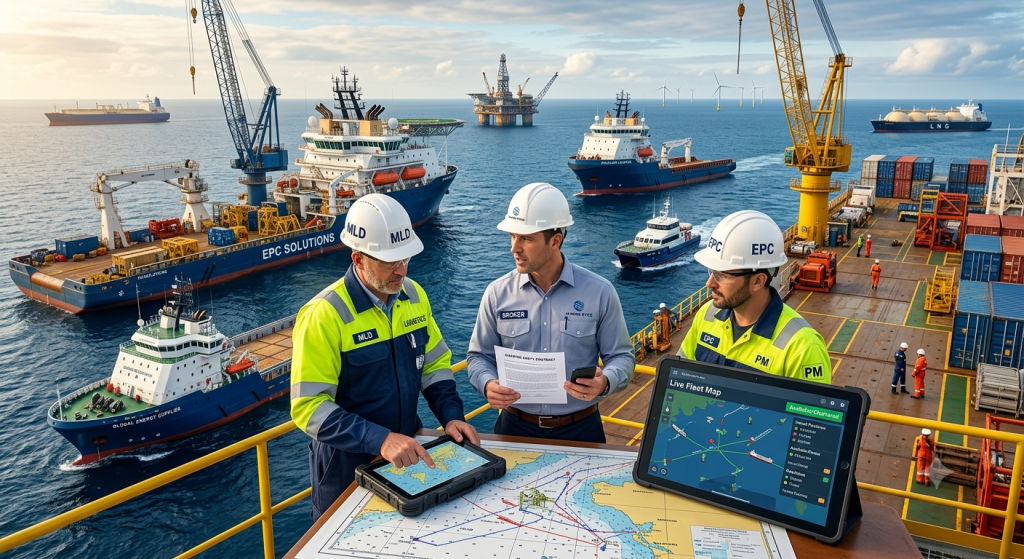
In high-stakes offshore energy campaigns, securing the right marine assets is a critical driver of operational uptime, environmental safety, and project profitability. Whether managing hook-up and commissioning (HUC), subsea installation, jacket decommissioning, or specialized freight movements across international trade corridors, partnering with an expert marine ship broker bridge the gap between asset owners and charterers.
Navigating the complexities of vessel availability, technical suitability, and international vetting standards—such as those set by the Oil Companies International Marine Forum (OCIMF) and the International Marine Contractors Association (IMCA)—demands deep technical insight.
This comprehensive guide examines the strategic role of professional shipping brokerage, technical vetting, and asset procurement for offshore energy majors, engineering procurement and construction (EPC) contractors, and marine logistics directors.
The Strategic Role of a Modern Offshore Ship Broker
A marine ship broker is far more than a middleman facilitating contracts. In modern offshore oil, gas, and renewable sectors, a broker acts as a technical advisor, risk strategist, and market intelligence specialist.
[ The Integrated Brokerage Ecosystem ]
│
┌──────────────────────────────┼──────────────────────────────┐
▼ ▼ ▼
[ Asset Sourcing & Matchmaking ] [ Technical Vetting & Risk ] [ Commercial & Contractual ]
• Heavy Lift Crane Barges • OCIMF / OVIQ / OVMSA • BIMCO Supplytime Framework
• Accommodation Barges (AWBs) • IMCA Marine Inspection • Dayrate Negotiations
• Platform Supply Vessels (PSVs) • Dynamic Positioning (DP) • Fuel & Off-Hire Terms
• RoRo & Automotive Logistics • Class Society Verification • Dispute Resolution Support
A. Market Access and Asset Sourcing
The global offshore fleet is diverse and highly fragmented. High-spec vessels—such as 800-tonne heavy lift crane barges, 300-pax accommodation work barges, and Dynamic Positioning (DP2/DP3) support vessels—are rarely listed on public exchanges. A specialized ship broker maintains real-time visibility over global fleet deployments, upcoming off-charter dates, yard schedules, and unutilized deck space across major energy basins.
B. Mitigating Operational and Financial Risks
Unplanned downtime, non-compliance with regional maritime laws, or selecting a vessel with inadequate station-keeping capabilities can halt an offshore project, costing operators tens of thousands of dollars per day in off-hire losses. A technical broker evaluates vessel specifications against project site criteria—such as water depth, seabed soil conditions, dynamic wave limits, and deck loading constraints—before a charter party agreement is signed.
C. Commercial Negotiation and Contractual Integrity
Utilizing standard maritime frameworks, primarily BIMCO (Baltic and International Maritime Council) contract standards like SUPPLYTIME, ship brokers structure clear terms regarding dayrates, mob/demob fees, maintenance standby, fuel specifications, off-hire clauses, and liability distribution.
Technical Asset Breakdown: Matching Fleet Capabilities to Field Demands
Different offshore operations demand specialized vessel designs. A professional broker assists clients in auditing technical specifications across primary vessel classes.
A. Accommodation Work Barges (AWBs)
Essential for offshore hook-up, commissioning, maintenance, and platform shutdown campaigns, AWBs function as floating hotels and support bases.
- Personnel Capacities: Scaling from 100-pax technical teams up to 300-pax field workforces.
- Access Systems: Outfitted with motion-compensated telescopic gangways (“walk-to-work” systems) rated for continuous personnel transfers up to Significant Wave Heights (
) of 2.5 meters or more.
- Helidecks: CAP 437 compliant landing pads supporting heavy offshore transport helicopters (e.g., Sikorsky S-92, Super Puma).
- Station-Keeping: 8-point or 12-point mooring architectures with High Holding Power (HHP) anchors designed for close-proximity platform operations.
B. Heavy Lift Crane Barges (HLVs) & Submersible Vessels
Designed for offshore platform installation, jacket placement, subsea manifold positioning, and decommissioning lifts.
- Lifting Capacities: Revolving pedestal cranes ranging from 200 tonnes up to 800+ tonnes with dual-hoist functionality for module upending.
- Clear Deck Space: Reinforced decks engineered for
to
uniform loads, enabling the transport of heavy structural skids, piling templates, and subsea spools.
- Submersible Capabilities: Variable ballast systems enabling submerged float-on/float-off operations for heavy cargo and salvage activities.
C. Specialized Freight & Automotive Logistics (RoRo / Heavy Transport)
For large-scale infrastructure projects requiring the movement of rolling stock, project cargo, or automotive fleets, freight shipping brokers structure charter solutions utilizing Roll-on/Roll-off (RoRo) and general cargo vessels.
- Cargo Operations: Stern/side ramp loading for heavy wheeled cargo, oversized trailers, and breakbulk components.
- Route Optimization: Coordinating multi-port calls, transshipment hubs, and inland logistics integration.
Marine Vetting, Governance, and Regulatory Compliance
Offshore energy majors maintain zero-tolerance policies regarding safety and environmental performance. Ship brokers streamline compliance by pre-auditing vessels against key industry frameworks:
[ Marine Compliance Framework ]
│
┌─────────────────────────────────┼─────────────────────────────────┐
▼ ▼ ▼
[ Class Society Integrity ] [ Industry Vetting Standards ] [ Environmental & Safety ]
• IACS Members (ABS, BV, DNV) • OCIMF OVIQ / OVMSA • MARPOL Annex I – VI
• Class Notations (CRC, DP, BWT) • IMCA eCMID Inspections • Ballast Water Management (BWM)
• In-Water Survey (IWS) • Flag State Requirements • SOLAS LSA / FFE Certifications
- IACS Classification Notations: Ensuring the vessel holds active status with International Association of Classification Societies (IACS) members such as ABS, Bureau Veritas, or DNV, with specific notations for crane integrity, accommodation safety, and dynamic positioning.
- OCIMF & OVIQ Inspections: Utilizing the Offshore Vessel Inspection Database (OVID) and Offshore Vessel Information Questionnaire (OVIQ) to review vessel structural history, machinery maintenance logs, and bridge procedures.
- IMCA eCMID Audits: Conducting standardized Common Marine Inspection Document (eCMID) checks performed by accredited marine surveyors to confirm operational readiness.
- Environmental Compliance: Verifying adherence to IMO regulations, including Ballast Water Management (BWM) conventions, MARPOL low-sulfur fuel compliance, and onboard sewage treatment capacities.
The Chartering Lifecycle: From Inquiry to Execution
Partnering with an experienced freight and shipping broker simplifies asset procurement into a structured, transparent process:
[ The 6-Stage Chartering Lifecycle ]
│
[Stage 1] Project Requirement & Site Condition Scoping
└─► [Stage 2] Global Asset Sourcing & Longlisting
└─► [Stage 3] Technical Audit & Vetting Pre-Screening
└─► [Stage 4] Commercial Negotiation & BIMCO Structuring
└─► [Stage 5] Mobilization, On-Hire Survey & Delivery
└─► [Stage 6] Operational Support & Post-Charter Reconciliation
- Stage 1: Technical Scoping: Defining water depths, soil conditions, lift weight envelopes, POB requirements, and operational duration.
- Stage 2: Fleet Screening: Shortlisting available vessels using global databases and direct owner relationships.
- Stage 3: Compliance & Vetting: Verifying class certificates, OVIQ/eCMID audit reports, and safety records.
- Stage 4: Contractual Finalization: Negotiating dayrates, off-hire thresholds, weather downtime clauses, and mobilization terms under standard BIMCO frameworks.
- Stage 5: Delivery & On-Hire Survey: Conducting joint independent condition and bunker surveys prior to field deployment.
- Stage 6: Operational Monitoring: Assisting with ongoing charter administration, extensions, and final off-hire reconciliations.
Frequently Asked Questions (FAQ)
Q1: What is the difference between a ship broker and a freight shipping broker?
A ship broker typically focuses on the chartering, sale, and purchase of entire vessels (such as offshore support vessels, tugs, barges, and tankers) for operational campaigns. A freight shipping broker generally specializes in arranging the transport of specific cargoes, project machinery, containerized freight, or automotive cargo on commercial vessel routes, matching cargo owners with available vessel capacity.
Q2: Why should an energy major use a ship broker instead of contacting vessel owners directly?
Ship brokers provide independent market transparency, access to unlisted assets, technical vetting expertise, and strong contractual leverage. Owners often prioritize brokers who bring pre-vetted, qualified inquiries, while charterers benefit from a broker’s ability to compare competing fleet options objectively to secure optimal commercial and technical terms.
Q3: How do brokers handle BIMCO contract negotiations for offshore charters?
Brokers utilize standardized BIMCO contracts (such as SUPPLYTIME for offshore support vessels or BARCON for bareboat charters) as a balanced foundation. They draft tailored special clauses (rider clauses) addressing site-specific weather risk allocation, local content requirements, fuel quality testing, and dynamic positioning performance standards.
Q4: What role does a broker play if a vessel breaks down during a charter?
The broker acts as an intermediary during operational disputes. Utilizing the off-hire and breakdown clauses in the charter party agreement, the broker helps clarify liability, calculate off-hire dayrate deductions, and, if necessary, locate replacement tonnage to minimize project interruption.
Q5: How are shipping brokers compensated in B2B chartering deals?
Brokers are typically compensated via a standard brokerage commission—usually calculated as a percentage of the agreed daily hire or freight rate paid by the vessel owner upon successful execution and payment of the charter. There are no upfront fees for the charterer.
Strategic Asset Procurement with Oitha Marine
Navigating offshore vessel procurement requires a balance of technical expertise, regulatory knowledge, and market access. Whether chartering heavy lift crane barges, accommodation work vessels, or arranging complex cargo shipping logistics, Oitha Marine provides end-to-end brokerage, vessel vetting, and marine logistics support tailored to international energy and maritime standards.
Streamline your offshore asset procurement today. Contact our chartering desk at oithamarine.com or visit Oitha Marine Technical Insights to request a custom vessel availability assessment for your upcoming offshore campaign.
Recent Comments