
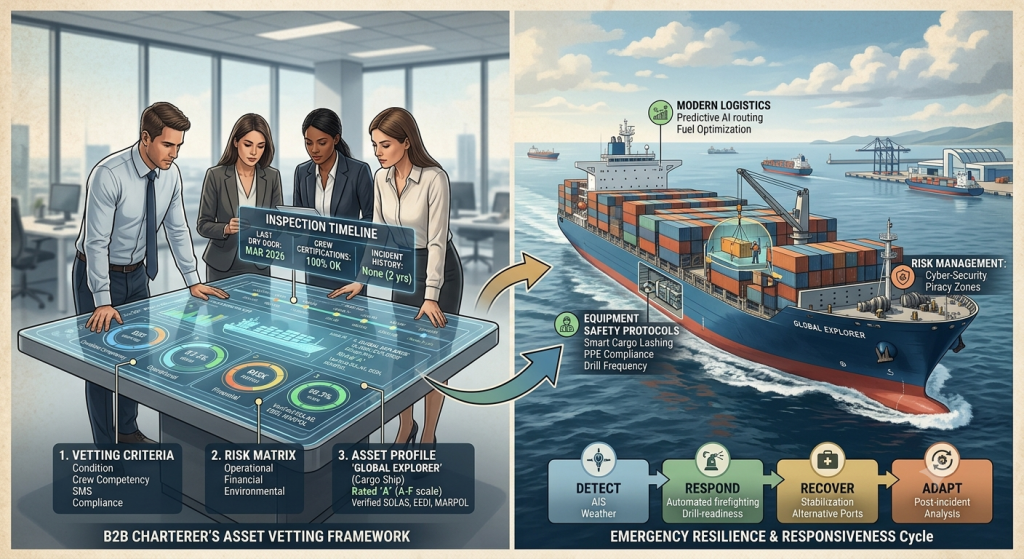
Global supply chains rely heavily on ocean freight, with bulk maritime transport carrying over 80% of world trade by volume. However, recent catastrophic incidents—including the Baltimore Harbor cargo ship bridge collision, the tragic loss of the vehicle carrier Morning Midas off the coast of Alaska, and recurring electric vehicle (EV) battery fires—have highlighted severe operational hazards facing ocean freight carriers today.
For energy majors, automotive logistics directors, global traders, and Engineering, Procurement, and Construction (EPC) firms, selecting the right cargo ship and structuring resilient shipped as cargo agreements requires rigorous technical due diligence, dynamic risk assessment, and proactive charter party structuring.
This guide provides a comprehensive B2B framework for auditing fleet integrity, mitigating cargo hazards, and navigating multimodal transport corridors.
1. Navigating Major Maritime Casualties: Lessons for Charterers
Recent high-profile maritime casualties emphasize why technical pre-vetting is a mandatory prerequisite before committing high-value cargo shipped overseas.
[ Major Maritime Casualty Risk Vectors ]
│
┌──────────────────────────────────────┼──────────────────────────────────────┐
▼ ▼ ▼
[ Structural & Navigational ] [ Thermal & Chemical Hazards ] [ Infrastructure Interruption ]
• Total Power Blackouts • Lithium-Ion EV Thermal Runaway • Bridge & Terminal Collisions
• Mechanical Steering Failure • Inert Gas System Failures • Port Channel Blockades
• Anchor & Station-Keeping Losses • Rapid Flame Spread Across Decks • Supply Chain Rerouting Costs
A. The Baltimore Harbor Cargo Ship Incident: Power Loss & Navigation Risks
The Baltimore Harbor casualty demonstrated how a catastrophic loss of electrical power and propulsion on a fully laden container cargo ship can lead to immediate infrastructure disruption.
- Key Takeaway: Charterers must verify that candidate vessels maintain redundant emergency generator capabilities, active Class society dynamic positioning notations, and compliance with International Maritime Organization (IMO) SOLAS (Safety of Life at Sea) steering standards.
B. Electric Vehicle (EV) Cargo Fires: The Morning Midas Precedent
The loss of the vehicle carrier Morning Midas off the coast of Alaska brought the extreme danger of transport fires back to the forefront of maritime logistics. Carrying thousands of vehicles—including electric vehicles (EVs) powered by high-density lithium-ion batteries—the ship suffered an uncontrollable fire that originated near the car decks.
[ EV Thermal Runaway Escalation Pipeline ]
│
[Stage 1] Battery Cell Short-Circuit / Thermal Ignition
└─► [Stage 2] Rapid Heat Accumulation (> 1,000°C) & Off-Gassing
└─► [Stage 3] Ineffectiveness of Standard CO2 Suppression Systems
└─► [Stage 4] Fire Propagation to Adjacent Wheeled Cargo
└─► [Stage 5] Structural Deck Buckling & Water Ingress from Firefighting
- Thermal Runaway Hazards: Lithium-ion battery fires produce self-sustaining oxygen, rendering traditional carbon dioxide (
) smothering systems ineffective.
- Structural Compromise: Intense heat weakens deck plates, while heavy firefighting water accumulation creates free-surface effect instability, ultimately risking capsizing and vessel loss.
2. Technical Vetting Checklist for Cargo Vessels
Before booking cargo ships for breakbulk, project cargo, or automotive fleets, chartering teams must evaluate technical metrics across key parameters:
| Technical Audit Vector | Verification Standard | Key Risk Addressed |
| Fire Suppression Ratings | Deluge water spray systems & high-expansion foam | Uncontrollable EV thermal runaway & deck fires |
| Structural & Deck Strength | Class-certified uniform load rating ( | Deck collapse under heavy machinery/project cargo |
| Machinery & Propulsion | Dual-fuel generators & emergency switchboard redundancy | Power blackouts in restricted navigational channels |
| Cargo Lashings & Securing | IMO Cargo Securing Manual (CSM) compliance | Shift of cargo during heavy North Pacific/North Atlantic weather |
| Multimodal Intermodal Links | ISO/Intermodal rail loading clearance (cargo rail ship) | Bottlenecks during port-to-rail intermodal transfers |
3. Multimodal Supply Chains: Integrating Cargo Rail & Ocean Freight
Modern logistics demands seamless integration between maritime transportation and land-based rail networks (cargo rail ship operations). Connecting ocean transport with intermodal rail corridors requires precise synchronization:
[ Multimodal Intermodal Flow ]
│
[Sea Segment] Ocean Freight Cargo Vessel Arrival at Port Terminal
└─► [Port Segment] Gantry Crane / RoRo Ramp Discharge Operations
└─► [Rail Segment] Intermodal Double-Stack Rail & Heavy Freight Link
└─► [Inland Segment] Final Destination Industrial Delivery
- Terminal Infrastructure: Ensuring arrival ports feature direct railhead connectivity eliminates double-handling charges and delays.
- Standardized Securing: Securing heavy machinery or containerized cargo to withstand both multi-axis sea swell motions and longitudinal rail shock forces.
4. Operational Risk Mitigation in Charter Parties
When negotiating charter party contracts (such as BIMCO GENCON or SUPPLYTIME), charterers must incorporate clear rider clauses to protect commercial interests:
Important Charter Clause Considerations:
- EV Handling Protocols: Mandate state-of-charge (SoC) restrictions (typically below 30%) for all electric vehicles accepted as cargo.
- Off-Hire Deductions: Ensure immediate off-hire status triggers if a vessel is detained due to non-compliance with Port State Control (PSC) or Class safety directives.
- General Average (GA) Protection: Require owners to maintain full P&I insurance backing to insulate charterers from unfair General Average contributions in the event of salvage operations.
5. Frequently Asked Questions (FAQ)
Q1: Why are electric vehicle fires on cargo ships more dangerous than standard car fires?
Electric vehicle fires are caused by thermal runaway within lithium-ion battery cells. These fires burn at extreme temperatures (exceeding 1,000°C), release toxic gases, produce their own oxygen, and are immune to standard marine fire suppression systems, making them exceptionally difficult to extinguish at sea.
Q2: What safety measures should be confirmed before shipping cargo on RoRo vessels?
Charterers should verify that the vessel features localized water-drenching systems, active thermal monitoring cameras on vehicle decks, strict battery state-of-charge limits for EVs, and active IMCA or Class safety certificates.
Q3: How do multimodal “cargo rail ship” networks optimize project freight?
Integrating ocean cargo ships directly with freight rail lines minimizes port dwell times, reduces inland freight costs, and enables efficient transshipment of heavy industrial components directly from fabrication yards to inland project sites.
Secure Reliable Cargo & Heavy Transport Vessel Chartering
Finding verified, safe, and fully compliant vessel capacity in today’s complex maritime market requires specialized broker expertise.
Client Immediate Action Note:
Clients sourcing for cargo ships, RoRo car carriers, heavy lift barges, or specialized project freight vessels should contact the Oitha Marine Chartering Desk for an immediate response.
- Email Direct: oithamarine.com
- Official Website: Oitha Marine Technical Insights
Recent Comments