
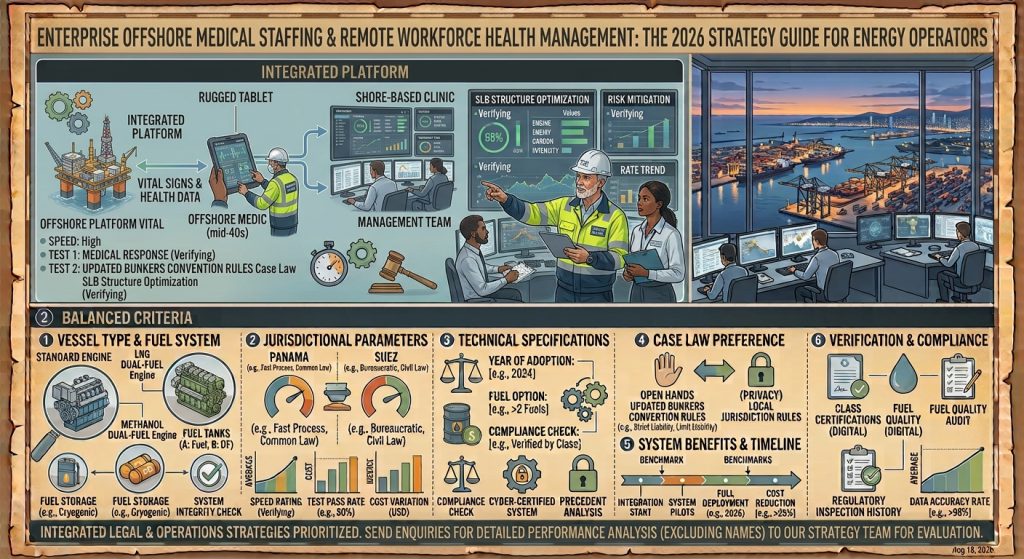
The Strategic Value of Advanced Medical Support
In high-hazard maritime environments—from deepwater drillships in the Gulf of Mexico to North Slope production platforms and emerging offshore wind substations along the Atlantic Seaboard—operational continuity hinges on workforce health and safety. Every hour of unpredicted downtime on a Tier-1 floating production storage and offloading (FPSO) unit costs operators tens of thousands of dollars. More critically, an unmanaged medical emergency or an unnecessary Medical Evacuation (Medevac) triggers immense regulatory scrutiny, logistical complexity, and financial exposure.
For Energy, Health, Safety, and Environment (EHS) directors, procurement officers, and Offshore Installation Managers (OIMs), deploying top-tier offshore medics and integrated remote healthcare solutions is not merely an operational line item—it is an enterprise risk management imperative.
This strategic guide outlines how energy operators can optimize offshore clinic operations, ensure stringent compliance with the Bureau of Safety and Environmental Enforcement (BSEE) and U.S. Coast Guard (USCG) standards, and leverage specialized remote medical staffing to mitigate costly Medevacs while maintaining peak productivity.
1. The Economics of Remote Healthcare: Risk Mitigation & Cost Avoidance
To evaluate the return on investment (ROI) of enterprise offshore medical solutions, corporate leadership must look beyond direct staffing fees to total risk exposure.
+———————————————————————–+
| OFFSHORE CLINIC ROLES |
+———————————————————————–+
| Occupational Hygiene | Trauma & Life Support | Regulatory Audit |
+———————————————————————–+
|
v
+———————————————————————–+
| PRIMARY RISK MITIGATION |
+———————————————————————–+
| • Preventable Medevac Reductions (Avg. $30,000–$80,000 Per Flight) |
| • Reduced OSHA Recordable Incident Rates (TRIR Minimization) |
| • BSEE & USCG Regulatory Audit Defense & Hazard Prevention |
+———————————————————————–+
The Financial Impact of Avoidable Medevacs
An offshore Medevac utilizing private commercial rotorcraft or coordinated maritime transport is extremely expensive. Direct chartering costs, specialized aviation crews, and emergency landing logistics typically range between $30,000 and $80,000 per flight. When factored alongside platform shutdown protocols or lost shift capacity, a single unnecessary evacuation imposes a massive financial hit.
Advanced offshore medical providers deploy practitioners capable of delivering autonomous, high-level clinical management. By treating minor trauma, managing localized infectious outbreaks, and stabilizing non-critical illness aboard the asset under expert guidance, top-tier medics prevent over 70% of unnecessary onshore transfers.
Optimizing Total Recordable Incident Rates (TRIR)
Safety records directly govern an energy operator’s eligibility to bid on major offshore blocks and retain insurance coverage. Experienced offshore medics operate with a deep understanding of standard occupational health frameworks.
Through precise wound management, conservative first-aid classifications, and proactive workplace health audits, certified remote practitioners maintain workforce health while preventing minor injuries from escalating into OSHA-recordable incidents.
2. Structural Requirements: Scopes of Practice for Offshore Medical Personnel
Procuring medical staffing for isolated installations requires matching practitioner capabilities with asset risk profiles. Depending on crew size, distance from shore, and technical hazard levels, energy contractors deploy three distinct tiers of remote clinical practitioners.
| Practitioner Classification | Baseline Qualifications | Primary Scope & Clinical Capabilities | Best-Fit Asset Deployment |
| Advanced Offshore Paramedic (NREMT-P) | NREMT-P, 3–5 Yrs High-Acuity 911/Trauma, Advanced Cardiac Life Support (ACLS), Pre-Hospital Trauma Life Support (PHTLS) | Advanced airway management, emergency trauma stabilization, primary care, potable water/hygiene audits | Drillships, semi-submersible rigs, production platforms (GOM) |
| Offshore Registered Nurse (RN / BSN) | BSN/RN, 5+ Yrs ER/ICU, Certified Occupational Health Nurse (COHN) or Emergency Nursing Certification | Complex clinical diagnostics, long-term wound care, advanced pharmacology administration, chronic disease management | Accommodation units (“flotels”), mega-construction vessels |
| Advanced Remote Practitioner (PA / NP / MD) | Licensed Physician Assistant, Nurse Practitioner, or Medical Doctor | Full diagnostic authority, advanced minor surgical procedures, prescribing autonomy under Topside oversight | Ultra-deepwater, remote international assets, high-density rigs |
3. Regulatory Frameworks & Compliance Standards (U.S. Continental Shelf)
Deploying offshore healthcare providers within the United States Outer Continental Shelf (OCS) requires compliance with a matrix of federal regulations and international maritime standards.
U.S. OFFSHORE COMPLIANCE MATRIX
|
+———————————–+———————————–+
| | |
v v v
BSEE USCG TSA
(Environmental Hygiene & (Merchant Mariner (Transportation Worker
Industrial Safety Audits) Credentials / MMC) Identification Credential)
1. Bureau of Safety and Environmental Enforcement (BSEE)
BSEE enforces strict safety protocols on OCS facilities. Medical officers are responsible for maintaining regulatory compliance logs, auditing Safety Data Sheets (SDS) for chemical exposure handling, and supervising platform hygiene standards.
2. United States Coast Guard (USCG) & Maritime Law
On dynamic positioning vessels, drillships, and mobile offshore drilling units (MODUs), medical staff must hold valid USCG Merchant Mariner Credentials (MMC) where applicable. Furthermore, clinic infrastructure must conform to standard international maritime medical chest regulations.
3. Federal Security Approvals
All deployed clinical personnel must undergo rigorous background checks to hold an active Transportation Worker Identification Credential (TWIC) issued by the Transportation Security Administration (TSA), granting them seamless access to secure marine terminals and helicopter transit facilities.
4. Integrated Topside Medical Support: The 24/7 Telehealth Safety Net
Even the most highly qualified remote medic cannot operate in total isolation. An effective enterprise medical staffing deployment relies on a robust Topside Medical Advisory System.
+——————————————————————–+
| OFFSHORE CLINIC |
| (Autonomous On-Site Medic / Practitioner) |
+——————————————————————–+
|
| High-Speed Satellite / Telehealth
v
+——————————————————————–+
| 24/7 TOPSIDE MEDICAL CENTER |
| (Emergency Medicine Physicians / Diving Specialists) |
+——————————————————————–+
|
+——————+——————+
| |
v v
+——————————+ +——————————+
| ON-SITE TREATMENT & | | COORDINATED MEDEVAC |
| STABILIZATION PROTOCOL | | (USCG / Private Air Charter) |
+——————————+ +——————————+
Strategic Benefits of Topside Advisory Systems
- Real-Time Teleconsultation: Through secure satellite feeds and digital diagnostics (electrocardiograms, vital sign telemetry), on-site medics consult directly with board-certified Emergency Medicine and Hyperbaric Physicians.
- Controlled Substance Oversight: Topside physicians provide the legal prescription backing required for advanced pharmacological interventions, ensuring compliance with DEA protocols.
- Medevac Triaging & Authorization: Before ordering a multi-thousand-dollar evacuation, the topside physician conducts an independent clinical review to confirm if a transfer is medically necessary or if the patient can be safely managed aboard.
5. Industrial Health, Hygiene, and Occupational Safety Integration
Modern offshore medics deliver continuous value through proactive health, safety, and environmental (HSE) administrative support.
PROACTIVE OFFSHORE CLINIC DUTIES
|
+——————————–+——————————–+
| | |
v v v
Potable Water Testing Occupational Hygiene Communicable Disease
& Food Safety Audits & Ergonomic Screening Vector Prevention
Key Administrative & Preventive Health Responsibilities
- Potable Water Quality Testing: Weekly microbiological and chemical testing of the platform’s fresh water generation systems to prevent waterborne bacterial outbreaks.
- Food Safety & Galley Sanitation Audits: Conducting systematic inspections of food storage, refrigeration, and preparation areas to eliminate foodborne illness hazards.
- Occupational Health Surveillance: Tracking industrial noise exposures, monitoring respiratory protection programs, and screening for repetitive strain injuries among rig workers.
- Outbreak Containment & Vector Control: Managing rapid testing and isolation procedures for communicable respiratory or gastrointestinal illnesses in tight living quarters.
6. Sourcing Enterprise Remote Medical Solutions: Vendor Evaluation Framework
When selecting a remote healthcare staffing vendor or turnkey medical contractor, procurement managers should evaluate potential partners against a standardized operational score matrix.
VENDOR SELECTION EVALUATION CRITERIA
|
+——————-+————+————+——————-+
| | | |
v v v v
Licensure & Topside Physician Inventory & Compliance &
Certifications Response Time Logistics Control HSE Integration
(OPITO/NREMT) (< 15 Minutes) (Narcotics/Airways) (TRIR/BSEE)
Key Procurement Metrics
- Licensure Verification: Guarantees that all deployed paramedics and nurses possess active NREMT-P, state licenses, and certified OPITO BOSIET/HUET safety training.
- Topside Physician Response Times: Ensures dedicated physician availability with guaranteed response speeds under 15 minutes for critical emergencies.
- Supply Chain and Formulary Control: Capabilities for stocking, auditing, and replenishing offshore clinic narcotics, advanced airway gear, and AEDs across complex marine supply lines.
- Custom Rotational Logistics: Flexible staffing models (e.g., 14/14 or 28/28 rotations) that align with regional maritime transport systems in Gulf Coast hubs like Houma, Lafayette, and Galveston.
Frequently Asked Questions for Corporate Operations Managers
How does deploying a dedicated offshore medic reduce an operator’s total liability?
A dedicated medic provides immediate, professional emergency response during the critical “golden hour” following trauma. Beyond life-saving stabilization, the medic ensures proper clinical documentation, minimizes unnecessary emergency evacuations, and enforces preventive health measures that maintain asset compliance and limit legal exposure.
What is the standard turn-around time for deploying remote medical staff?
Leading remote healthcare vendors maintain pre-credentialed pools of offshore medics capable of deploying within 24 to 48 hours for emergency coverage, while standard long-term contract deployments are typically finalized within 1 to 2 weeks.
Can remote healthcare providers manage hyperbaric and dive medical emergencies?
Yes. Specialized remote healthcare providers staff practitioners trained in hyperbaric medicine and dive safety protocols. In addition, Topside support systems feature specialized diving medicine physicians (DMAC-certified) to manage decompression sickness and arterial gas embolisms for commercial diving installations.
Recommended Next Steps for Enterprise Fleet & Offshore Asset Managers
Optimizing your asset’s medical preparedness requires a detailed audit of your current emergency response plans, clinical supply chains, and staffing contracts. To discuss custom medical solutions tailored to your specific offshore footprint:
Recent Comments