
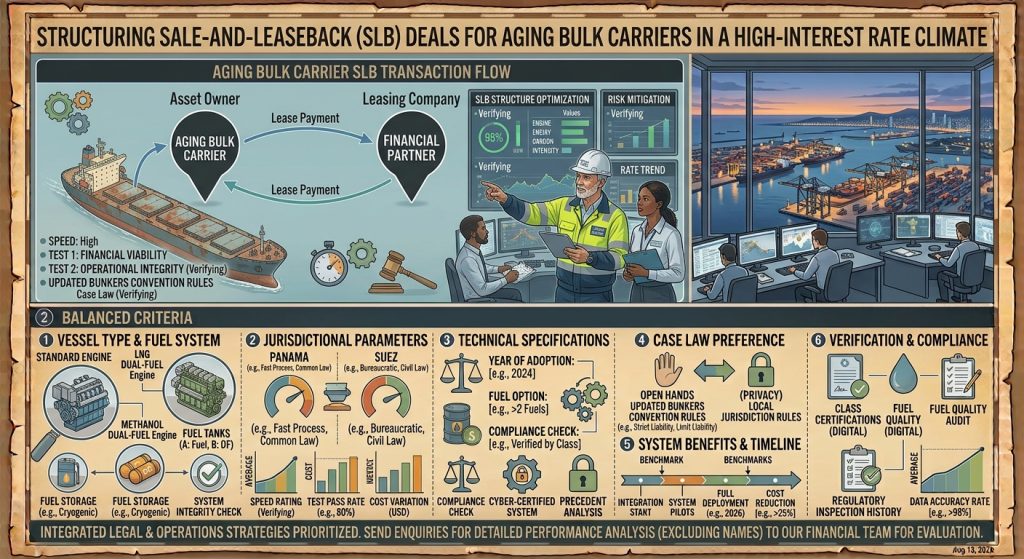
Traditional first-lien mortgage bank debt for mid-to-late life bulk carriers (12 to 18 years old) has tightened significantly across European and Western commercial banks. Driven by stringent Basel IV capital requirements, ESG/Poseidon Principles compliance mandates, and heightened residual value risk assessments for non-eco tonnage, commercial lenders have progressively lowered loan-to-value (LTV) limits and shortened amortization profiles for aging dry bulk assets.
To unlock tied-up equity, finance secondhand acquisitions, or execute capital-intensive drydocking and ballast water treatment system (BWTS) / energy efficiency (EEXI/CII) retrofits, shipowners are relying heavily on Sale-and-Leaseback (SLB) structures. Dominated by Chinese state-owned and Japanese leasing institutions, these financial vehicles bridge the liquidity gap for Supramax, Ultramax, Panamax, and Capesize bulkers operating in volatile dry bulk markets.
+——————————————————————-+
| SALE-AND-LEASEBACK (SLB) STRUCTURING MATRIX |
+———————————-+——————————–+
|
+———————-+———————-+
| |
v v
+————————————+ +————————————+
| LESSEE (ORIGINAL SHIPOWNER) | | LESSOR (LEASING HOUSE / SPV) |
+————————————+ +————————————+
| • Bareboat Charterer (Operator) | | • Legal Title Holder |
| • Pays Daily Bareboat Hire (SOFR) | <—–> | • Special Purpose Vehicle (SPV) |
| • Retains Technical & Commercial | Bareboat | • Demands MII, MAP, & Mortgage |
| Management Responsibilities | Charter| • Grants Repurchase Option / Oblig. |
+————————————+ +————————————+
Key commercial, legal, and operational realities governing SLB transactions for aging bulkers include:
- Pricing & Leverage Dynamics: While traditional bank debt pricing sits around SOFR + 2.25% to 3.25% at conservative LTVs (40%–55%), alternative Chinese leasing structures offer higher LTVs (65% to 80%) at SOFR + 3.25% to 4.75%, incorporating flexible purchase options or mandatory purchase obligations tailored to the vessel’s remaining economic lifespan.
- Residual Value & Amortization Mechanics: Lessors mitigate the residual value risk of aging steel by requiring aggressive balloon amortization, targeting a net book value at lease expiry that reflects conservative scrap valuations ($350–$420 per light displacement ton, LDT).
- Insurance & Registration Hurdles: In an SLB structure, legal title transfers to a Special Purpose Vehicle (SPV) controlled by the lessor. This shift alters Bareboat Charter Registration (BBCR) requirements, necessitating dual-flag approvals, updated Protection and Indemnity (P&I) club entry entries designating the lessor as co-assured, and mandatory Mortgagee Interest Insurance (MII) and Mortgagee Additional Perils (MAP) coverage funded by the lessee.
- Carbon Regulations & CII Depreciation: Under IMO Carbon Intensity Indicator (CII) regulations and EU Emissions Trading System (EU ETS) mandates, aging non-eco bulkers face operational downgrades. Lessors incorporate strict environmental covenant clauses requiring mandatory speed/consumption monitoring or energy-saving device (ESD) retrofits as conditions of default.
The Commercial Imperative: Why Traditional Bank Debt Leaves Aging Bulkers Behind
Commercial shipping banks operating under the Poseidon Principles framework track the carbon intensity of their loan portfolios against international decarbonization targets. Consequently, financing appetite for 12–18 year old bulkers—which typically lack eco-engine designs, electronic fuel injection, and optimized hull forms—has contracted.
+————————————+————————————+————————————+
| Structural Parameter | Traditional Commercial Bank Debt | Chinese / Japanese Leasing (SLB) |
+————————————+————————————+————————————+
| Typical LTV Limit (12-18 yr vessel)| 45% – 55% of Fair Market Value | 65% – 80% of Fair Market Value |
| Benchmark Reference Rate | Term SOFR (USD) | Term SOFR (USD) / Fixed Options |
| Average Margin / Spread | SOFR + 2.25% to 3.25% | SOFR + 3.25% to 4.75% |
| Tenor / Term Length | 3 to 5 Years | 3 to 7 Years (Up to 20-22 yrs age) |
| Repayment Profile | Straight-line to residual balloon | Customized bareboat hire schedule |
| Residual Value Target (End of Term)| Conservative scrap value + buffer | Near scrap value ($350-$400/LDT) |
| Environmental Covenants (Poseidon) | Strict (Annual CII alignment) | Moderate to High (EEXI/CII clauses)|
| Execution Speed | 8 to 12 Weeks | 4 to 8 Weeks |
+————————————+————————————+————————————+
For a shipowner operating a 14-year-old Panamax bulk carrier valued at $18.0 million USD, a traditional bank may offer a maximum loan of $9.0 million USD (50% LTV). In contrast, an SLB provider will structure a bareboat lease facility of up to $13.5 million USD (75% LTV).
Even though the pricing spread on the SLB is 100 to 150 basis points higher, the additional $4.5 million USD in capital release provides essential liquidity to support fleet renewal, working capital, or drydocking obligations.
Financial Architecture of an SLB Deal for Aging Steel
The Bareboat Charter Rate Structure
In an SLB transaction, the original owner (now the Lessee) sells the vessel to a Special Purpose Vehicle (SPV) owned by the leasing company (the Lessor). The Lessor immediately charters the vessel back to the Lessee under a Bareboat Charterparty (typically based on an adjusted BIMCO BARECON 2001 or BARECON 2017 form).
The bareboat hire payable by the Lessee consists of two distinct components:

Where the interest component is calculated dynamically as:

+———————————————————————————–+
| SLB CAPITAL FLOW & BAREBOAT HIRE MECHANICS |
+———————————————————————————–+
| 1. ACQUISITION PHASE: |
| Lessor (SPV) pays Purchase Price ($18.0M) to Lessee -> Vessel Title Transfers |
| Lessee injects Equity / Retains Down Payment ($4.5M) -> Net Facility = $13.5M |
+———————————————————————————–+
│
v
| 2. OPERATIONAL / LEASE PHASE (5-Year Term): |
| Lessee operates vessel under Bareboat Charter |
| Lessee pays Monthly Bareboat Hire = Principal Repayment + (SOFR + Spread) |
+———————————————————————————–+
│
v
| 3. UNWIND / TERMINATION PHASE: |
| End of Year 5: Remaining Principal = Estimated Scrap Value ($4.2M) |
| Lessee exercises Purchase Option / Obligation -> Title Transfers Back to Lessee |
+———————————————————————————–+
Scrap Value Anchor & Amortization Tail
When structuring a lease for a vessel approaching its 20th year, lessors focus on the demolition floor value. Bulk carriers are valued fundamentally on their Light Displacement Tonnage (LDT).
Illustrative Calculation:
Consider a Supramax bulk carrier with an LDT of 10,500 metric tons.
If conservative scrap pricing is set at $380 USD per LDT, the baseline scrap value floor is:

If the lease principal at start is $12,000,000 USD over a 5-year tenor, the leasing house will structure the monthly principal repayments so that the residual balance at Year 5 matches or sits slightly below the $3.99 million USD scrap floor. This eliminates unhedged residual asset exposure for the lessor.
Legal, Registration, and Regulatory Mechanics
Executing an SLB deal requires a clear separation between legal ownership and operational management. This division alters flag administration and insurance structures.
+———————————————————————————–+
| BAREBOAT CHARTER REGISTRATION (BBCR) |
+———————————————————————————–+
| UNDERLYING REGISTER (Lessor’s Flag) BAREBOAT REGISTER (Lessee’s Flag) |
| • Holds Legal Title & Ownership • Holds Operational & Navigation |
| • Records Lessor’s Mortgage • Issues Safe Manning Certificate |
| • Common Flags: Hong Kong, Panama, • Common Flags: Liberia, Marshall |
| Singapore, Marshall Islands Islands, Panama, Malta |
+———————————————————————————–+
Bareboat Charter Registration (BBCR)
Because the leasing house SPV becomes the legal owner, the vessel is registered on the primary register under the lessor’s preferred flag jurisdiction (often Hong Kong, Singapore, Panama, or the Marshall Islands).
However, to maintain operational consistency and crew agreements, the vessel is parallel-registered on a Bareboat Charter Register (BBCR) in the lessee’s chosen jurisdiction.
- The underlying register records ownership and the lessor’s security interest.
- The bareboat register governs daily operational compliance, safety certificates, and crew nationality requirements under STCW standards.
Insurance Protocols: Protecting Lessor & Lessee Interests
Insuring an aging bulk carrier under a bareboat SLB structure requires specific endorsements to protect both the financial asset holder (Lessor) and the commercial operator (Lessee).
+———————————–+———————————+———————————+
| Insurance Coverage Type | Primary Purpose | Who Pays / Who Holds Policy |
+———————————–+———————————+———————————+
| Hull & Machinery (H&M) | Physical damage to hull/engine | Paid by Lessee; Lessor named as |
| | | Loss Payee under Loss Payable |
| | | Clause |
+———————————–+———————————+———————————+
| Protection & Indemnity (P&I) | Third-party liability, pollution,| Paid by Lessee; Lessor named as |
| | cargo claims, crew injury | Co-Assured with waiver of |
| | | subrogation |
+———————————–+———————————+———————————+
| Mortgagee Interest Insurance (MII)| Protects lessor if H&M claim is | Paid by Lessee; Held directly |
| | denied due to lessee breach | by Lessor |
+———————————–+———————————+———————————+
| Mortgagee Additional Perils (MAP)| Covers pollution/confiscation | Paid by Lessee; Held directly |
| | liabilities exceeding P&I limits| by Lessor |
+———————————–+———————————+———————————+
P&I Club Entry Adjustments
Under standard International Group (IG) P&I Club rules, the bareboat charterer (Lessee) enters the vessel into the Club. The lessor (SPV) must be named as a Co-Assured or Joint Member.
P&I Clubs issue a specific endorsement ensuring that:
- The lessor is protected against third-party liabilities arising from operational defaults or major oil spill pollution incidents.
- The Club waives rights of subrogation against the lessor.
- The Club undertakes to notify the lessor if the lessee fails to pay P&I calls, preventing unexpected cancellation of cover.
Mortgagee Interest Insurance (MII) & MAP
Even though the lessor holds legal title rather than a mortgage, standard SLB documentation requires the lessee to pay for Mortgagee Interest Insurance (MII) and Mortgagee Rights Insurance (MRI).
If the vessel suffers a Total Loss but the primary Hull & Machinery underwriters refuse the claim—for example, due to the lessee operating the vessel out of class, unseaworthiness, or a breach of navigation warranties—the MII policy pays out directly to the lessor to cover the outstanding lease principal.
CII & Environmental Covenants in Aging Bulker Leases
As the IMO’s Carbon Intensity Indicator (CII) framework enforces annual operational efficiency targets, aging bulkers face a high risk of falling into D or E ratings.
+———————————————————————————–+
| CII PERFORMANCE DEGRADATION & REMEDIATION |
+———————————————————————————–+
| YEAR 1-2: Vessel achieves ‘C’ Rating -> Full Compliance |
+———————————————————————————–+
│
v
| YEAR 3: Vessel drops to ‘D’ Rating for 3 consecutive years OR ‘E’ for 1 year |
+———————————————————————————–+
│
v
| MANDATORY LEASE COVENANT TRIGGER: |
| • Lessee must present Corrective Action Plan (CAP) within 30 days. |
| • Mandatory installation of Energy Saving Devices (ESD) e.g., boss cap fins, |
| silicone hull coatings, or engine power limitation (EPL). |
| • Failure to improve rating allows Lessor to adjust LTV ratios or demand |
| additional cash collateral. |
+———————————————————————————–+
Lessors protect their asset values by embedding Environmental Covenants into the bareboat charterparty:
- Data Sharing Obligations: The lessee must provide continuous fuel consumption, distance sailed, and emissions tracking data (via IMO DCS and EU MRV monitoring frameworks).
- Corrective Action Plans (CAP): If an aging bulker receives an ‘E’ rating in a single year or a ‘D’ rating for three consecutive years, the charterparty obligates the lessee to fund energy efficiency retrofits (e.g., Engine Power Limitation, high-performance anti-fouling paint, or duct installations) during the next scheduled drydocking.
Technical & Commercial Operational Comparison
To illustrate the financial realities facing a shipowner evaluating debt alternatives for a 15-year-old Capesize bulk carrier () valued at $24.0 million USD, consider the structural breakdown below:
+——————————————–+———————–+———————–+
| Cost & Structural Parameter | Commercial Bank Loan | Chinese SLB Facility |
+——————————————–+———————–+———————–+
| Base Leverage / Loan Amount (USD) | $12,000,000 (50% LTV) | $18,000,000 (75% LTV) |
| Equity Required from Shipowner (USD) | $12,000,000 | $6,000,000 |
| Interest Rate Pricing | SOFR + 2.75% | SOFR + 4.10% |
| Facility Term | 3 Years | 5 Years |
| Annual Capital Amortization (USD) | $2,400,000 / year | $2,520,000 / year |
| Balloon Payment at Expiry (USD) | $4,800,000 | $5,400,000 (Scrap Floor)|
| Upfront Arrangement / Legal Fees | 1.00% ($120,000) | 1.50% ($270,000) |
| MII / MAP Insurance Overhead (Annual) | $15,000 | $28,000 |
| Operational Control Retained by Owner? | Yes (Full) | Yes (Under Bareboat) |
+——————————————–+———————–+———————–+
Commercial Takeaway
The Chinese SLB structure requires $6.0 million USD less upfront equity from the shipowner. In exchange, the owner pays a higher margin and elevated transaction overhead.
In a strong dry bulk charter market where spot or time-charter rates yield high daily cash flow, allocating less equity upfront yields a significantly higher Return on Equity (ROE), making the SLB structure highly attractive despite elevated interest costs.
Tactical Guidance for Shipowners & Finance Superintendents
+————————————————-+
| SLB STRUCTURING RECOMMENDATIONS |
+————————+————————+
|
+—————————–+—————————–+
| |
v v
+————————–+ +————————–+
| LESSEE OPTIMIZATION | | RISK MITIGATION |
+————————–+ +————————–+
| • Negotiate Purchase | | • Fix interest rate via |
| Options (not Oblig.) | SOFR Swaps |
| • Secure flexible early | | • Ensure drydocking cost |
| prepayment rights | carve-outs in charter |
| • Pre-align P&I & Flag | | • Maintain strict CII |
| registration protocols | operational buffers |
+————————–+ +————————–+
Key Structuring Recommendations
- Differentiate Purchase Options vs. Purchase Obligations: Ensure the charterparty grants the lessee an option to repurchase the vessel at designated intervals rather than an absolute obligation, providing flexibility if dry bulk asset values drop unexpectedly.
- Hedge Interest Rate Volatility: Because lease hire is pegged to dynamic Term SOFR, deploy Interest Rate Swaps (IRS) or caps to fix the interest component, protecting cash flow against interest rate spikes.
- Incorporate Drydocking Reserve Accounts Carefully: Lessors often demand that lessees pay into a locked Drydocking Reserve Account ($1,000–$2,000/day) to cover upcoming 15-year or 20-year special surveys. Negotiate to replace cash reserves with a P&I/Class confirmation mechanism if your fleet management track record is strong.
Commercial Agency and Support Services from Oitha Marine
Navigating sale-and-leaseback transactions, coordinating flag state transfers, and maintaining vessel performance across major shipping lanes requires local operational support:
- Port Agency & Husbandry Clearances: On-the-ground support for vessel calls, flag state inspections, crew changes, and official registry documentation across key transit ports.
- Marine Procurement & Technical Supply: Sourcing certified engine components, energy-saving retrofit hardware, and drydocking stores to ensure compliance with lessor technical covenants.
- Commercial Brokerage & Chartering Guidance: Analytical support for evaluating charter party terms, bareboat agreements, and dry bulk market positioning.
Seeking expert agency support, technical supply coordination, or commercial assistance for your fleet operations? Contact Oitha Marine to discuss your requirements.
Frequently Asked Questions (FAQ)
1. What is a Sale-and-Leaseback (SLB) structure in shipping finance?
A Sale-and-Leaseback (SLB) is a financial transaction where a shipowner sells a vessel to a financier or leasing house Special Purpose Vehicle (SPV) and immediately charters it back under a long-term bareboat charter. The original owner retains technical and commercial management while paying regular lease hire to the lessor.
2. Why do shipowners use SLBs instead of traditional bank loans for aging bulkers?
Traditional commercial banks restrict loan-to-value (LTV) ratios to 40%–50% for bulkers over 12 years old due to residual value risks and Poseidon Principles carbon mandates. SLB providers (such as Chinese leasing houses) offer higher leverage (65%–80% LTV), longer repayment terms, and faster execution times.
3. What is the typical pricing structure for an SLB on a 15-year-old bulk carrier?
SLB pricing is typically calculated as Term SOFR + margin, where the margin ranges between 3.25% and 4.75% depending on the vessel’s age, LTV, charter coverage, and owner track record. Monthly bareboat hire includes both the interest margin and a principal amortization component.
4. Who holds legal ownership of the ship during an SLB agreement?
Legal title is held by the Lessor (the leasing company’s SPV) throughout the duration of the bareboat charterparty. The original shipowner (Lessee) reacquires legal title only after exercising a purchase option or fulfilling a mandatory purchase obligation at the end of the lease term.
5. How does an SLB structure affect a shipowner’s Protection and Indemnity (P&I) cover?
The lessee enters the vessel into their P&I Club, but the lessor (SPV) must be named as a Co-Assured or Joint Member. The policy includes a waiver of subrogation against the lessor and an undertaking by the Club to inform the lessor if premiums are unpaid.
6. What is Bareboat Charter Registration (BBCR) and why is it necessary in SLB deals?
BBCR allows a vessel to be registered simultaneously on two flags: the Underlying Register (where the lessor records legal title and mortgages) and the Bareboat Register (which governs operational flag state rules, crew nationality, and navigation safety certificates under the lessee’s control).
7. What happens if an aging bulk carrier receives a poor CII rating under an SLB contract?
Most modern SLB contracts contain environmental covenants requiring the lessee to maintain a compliant Carbon Intensity Indicator (CII) rating. If the vessel receives a ‘D’ or ‘E’ rating, the lessee is typically obligated to implement an approved Corrective Action Plan (CAP) and fund energy efficiency retrofits at their own expense.
8. What is Mortgagee Interest Insurance (MII) and who pays for it in an SLB?
MII protects the lessor’s financial interest if the vessel suffers a total loss and primary Hull & Machinery (H&M) insurers deny the claim due to a breach by the lessee (e.g., unseaworthiness). In SLB structures, the lessee pays the premium, but the policy directly covers the lessor.
Structuring an alternative financing deal, vessel delivery, or flag state transfer for your bulk carrier fleet?
Navigating complex sale-and-leaseback transactions demands seamless operational execution, port agency support, and technical readiness across global shipping corridors. Oitha Marine provides end-to-end ship agency, procurement, and commercial support tailored for shipowners, operators, and financiers.
Contact Oitha Marine Commercial Team Today to discuss your operational and fleet requirements.
Recent Comments