
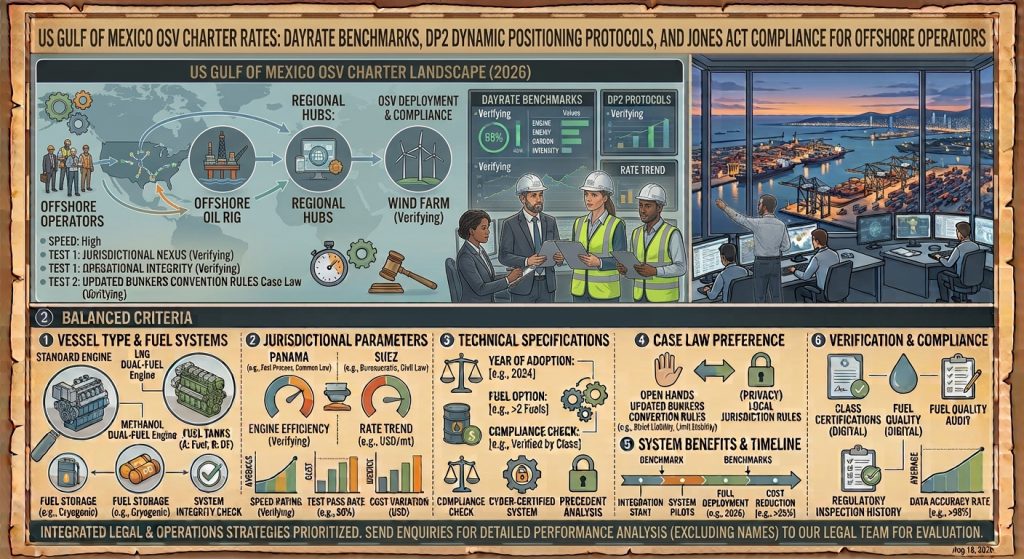
The offshore support vessel (OSV) sector in the US Gulf of Mexico (GoM) represents one of the most operationally complex and highly regulated capital-equipment markets in international maritime trade. As deepwater exploration accelerates across the Mississippi Canyon, Green Canyon, and Walker Ridge blocks, charterers, vessel operators, and institutional investors face a structural supply-side bottleneck. The combined pressures of aging fleet demographics, strict cabotage enforcement under the Merchant Marine Act of 1920 (46 U.S.C. § 55102 – “The Jones Act”), and escalating technical requirements for Dynamic Positioning Class 2/3 (DP2/DP3) systems have pushed term dayrates for high-specification Platform Supply Vessels (PSVs) and Anchor Handling Tug Supply (AHTS) units into elevated territory.
Simultaneously, global regulatory directives—most notably the European Union’s Ecodesign for Sustainable Products Regulation (ESPR EU 2024/1781)—are reshaping cross-border B2B maritime supply chains. While ESPR originates within the EU, its mandate for a traceable Digital Product Passport (DPP) Registry, Unique Product Identifiers (UID), and granular Material Composition & Bill of Materials (BOM) verification directly impacts Tier-1 exporters, equipment manufacturers, and logistics operators across the United States, Canada, the United Kingdom, and Australia who supply global offshore energy sectors.
This whitepaper delivers a comprehensive corporate framework evaluating deepwater OSV dayrate economics, DP2 operational standards, Jones Act compliance, and the architectural integration of DPP metadata into automated market surveillance and customs clearance workflows.
MAIN BODY ARCHITECTURE
GLOBAL MARITIME COMPLIANCE & ASSET ARCHITECTURE
┌─────────────────────────────────────────┐ ┌─────────────────────────────────────────┐
│ US GOV CABOTAGE & MARITIME LAW │ │ EU ESPR REGULATORY ARCHITECTURE │
│ • Merchant Marine Act (Jones Act) │ │ • Regulation (EU) 2024/1781 (ESPR) │
│ • 43 U.S.C. § 1333 (OCSLA Scope) │ │ • Scope 3 LCA & Material BOM Data │
└────────────────────┬────────────────────┘ └────────────────────┬────────────────────┘
│ │
└───────────────────────────┬─────────────────────────────┘
│
▼
┌───────────────────────────────────────────────────────────────────────────────────────────────────┐
│ OFFSHORE VESSEL FLEET DISPATCH │
│ • DP2/DP3 Redundancy Standards (USCG / IMO MSC/Circ.1580) │
│ • Dayrate Benchmark Execution ($28,000 – $48,000+/day) │
└────────────────────────────────────────────────┬──────────────────────────────────────────────────┘
│
▼
┌───────────────────────────────────────────────────────────────────────────────────────────────────┐
│ DECENTRALIZED ENTERPRISE DATA BRIDGE │
│ • Digital Product Passport (DPP) Data Node Execution │
│ • UID Generation (GS1/EPCIS Verification) │
│ • Machine-Readable Customs Clearance Integration │
└───────────────────────────────────────────────────────────────────────────────────────────────────┘
1. Statutory & Operational Scope of US Gulf OSV Caboting: The Jones Act & OCSLA Framework
The economic foundation of offshore vessel chartering in the US Gulf of Mexico is dictated by the Jones Act (46 U.S.C. § 55102), which mandates that all maritime transportation of merchandise between U.S. points must occur on vessels that are:
- U.S.-built (requiring structural steel fabrication and assembly within U.S. shipyards),
- U.S.-flagged and registered under U.S. coastwise documentation,
- U.S.-owned (minimum 75% equity ownership by U.S. citizens at every corporate tier), and
- U.S.-crewed (100% of licensed officers and at least 75% of unlicensed mariners holding U.S. Merchant Mariner Credentials).
This statutory regime extends beyond coastlines via the Outer Continental Shelf Lands Act (OCSLA, 43 U.S.C. § 1333). OCSLA establishes U.S. jurisdiction over all installations, safety zones, and devices permanently or temporarily attached to the seabed of the Outer Continental Shelf for resource exploration and production.
Holland & Knight+ 1
+—————————————————————————————————+
| JONES ACT VS. FOREIGN FLAGGED OSV PERMISSIBILITY |
+———————————+——————————–+——————————–+
| OPERATIONAL ACTIVITY | JONES ACT VESSEL (U.S.-FLAG) | FOREIGN-FLAG OSV (WITH WAIVER) |
+———————————+——————————–+——————————–+
| Direct Supply Transport (Port | Fully Permitted | Prohibited (Civil Penalty |
| to Deepwater Rig) | | Equal to Cargo Value) |
+———————————+——————————–+——————————–+
| Subsea Equipment Installation | Permitted | Heavily Restricted; Requires |
| (Laying Pipe / Cable to Seabed) | | CBP Specific Exemption Ruling |
+———————————+——————————–+——————————–+
| Heavy Lift Foundation Scour | Permitted | Prohibited if Loading Material |
| Protection | | at U.S. Ports (HQ H309186) |
+———————————+——————————–+——————————–+
| Pure Station-Keeping / ROV | Permitted | Conditionally Permitted (No |
| Inspection (No Cargo Transfer) | | Merchandise Movement) |
+———————————+——————————–+——————————–+
Under recent Customs and Border Protection (CBP) interpretations—specifically administrative rulings reinforcing HQ H309186—the movement of equipment, scour protection, and subsea structures from a domestic port to a specific seabed location on the Outer Continental Shelf constitutes coastwise trade. Any breach results in severe commercial enforcement, including forfeiture of merchandise or civil penalties equivalent to the commercial value of the cargo transported.
For multinational energy majors operating in Houston, Aberdeen, Perth, and Calgary, compliant vessel chartering demands meticulous scrutiny of vessel construction logs, owner entity structures, and crew documentation before contract execution.
2. Deepwater Dayrate Benchmarks & DP2/DP3 Technical Integration
The market dynamics for Jones Act-compliant offshore support vessels exhibit severe price inelasticity due to capped fleet capacity and multi-year construction lead times. High-specification Platform Supply Vessels featuring clear deck spaces exceeding , liquid mud capacities exceeding 15,000 barrels, and Dynamic Positioning Class 2 (DP2) or Class 3 (DP3) certifications are securing elevated daily charter rates.
Riviera Maritime Media
Deepwater OSV Dayrate Benchmarks (US Gulf of Mexico)
+—————————————————————————————————+
| 2026 DEEPWATER OSV DAYRATE BENCHMARKS |
+——————————-+————————+——————-+———————-+
| VESSEL CLASS | TECHNICAL SPEC | TERM DAYRATE RANGE| SPOT MARKET RANGE |
+——————————-+————————+——————-+———————-+
| Large PSV (>4,000 DWT) | DP2, >900 m² Deck | $28,000 – $36,000 | $38,000 – $48,000+ |
| High-HP AHTS (>16,000 BHP) | DP2/DP3, 200t+ BP | $35,000 – $45,000 | $50,000 – $65,000 |
| Subsea Construction (MPSV) | DP3, 150t Crane, Moonpool $55,000 – $75,000| $80,000 – $110,000 |
+——————————-+————————+——————-+———————-+
Technical Redundancy & DP2 System Protocols
Dynamic Positioning protocols dictate vessel safety during close-proximity operations alongside deepwater drillships, Semi-Submersibles, and Floating Production Storage and Offloading (FPSO) units. Per IMO MSC/Circ.1580 guidelines and U.S. Coast Guard (USCG) federal inspection standards, DP2 vessels must maintain operational capability despite any single active failure.
The system architecture requires complete physical and electrical isolation:

- Power Systems: Split-bus switchboards configured such that the loss of a single generator set, main engine, or bus section does not cause a total loss of station-keeping capability.
- Thruster Configuration: Independent azimuth thrusters and tunnel thrusters powered across separate electrical loops, capable of counteracting maximum expected environmental forces (3-knot current, 60-knot wind, and 4-meter significant wave heights).
- Position Reference Sensors: Minimum of three independent reference systems operating on distinct physical principles—typically combining DGPS/GLONASS, Hydroacoustic Position Reference (HPR), and Laser/Radar-based relative positioning systems (e.g., CyScan or Fanbeam).
- Consequence Analysis Software: Continuous real-time automated computing that simulates the hypothetical loss of the most critical thruster or generator, immediately warning dynamic positioning operators (DPOs) if the remaining online assets cannot maintain position inside the designated safety envelope.
3. Cross-Border Compliance Integration: Aligning US OSV Logistics with EU ESPR (2024/1781) & Global DPP Registries
While Jones Act and USCG regulations govern domestic marine operations, international capital allocation and equipment procurement are bound by global ESG mandates. The European Parliament’s Ecodesign for Sustainable Products Regulation (ESPR EU 2024/1781) introduces legal mandates for industrial equipment, maritime replacement components, and specialized marine subassemblies shipped internationally.
Exporters based in North America, the UK, and Australia shipping maritime machinery, replacement thrusters, and specialized drill-string components to global offshore sites must integrate their supply chains with the EU Digital Product Passport (DPP) Registry.
+—————————————————————————————————+
| ESPR DATA INTEGRATION FOR GLOBAL MARITIME EQUIPMENT |
+———————————-+—————————————————————-+
| ESPR MANDATE REQUIREMENT | MARITIME SUPPLY CHAIN ARCHITECTURAL IMPACT |
+———————————-+—————————————————————-+
| Unique Product Identifier (UID) | Every subsea valve, thruster component, and umbilical must |
| | carry a machine-readable ISO/IEC 15459 data carrier (2D Matrix)|
+———————————-+—————————————————————-+
| Material Composition & BOM | Declarations of all metallic alloys, rare earths, and |
| | polymers used in offshore asset fabrication. |
+———————————-+—————————————————————-+
| Scope 3 Life Cycle Assessment | Standardized calculation of embodied carbon from raw material |
| | extraction through vessel deployment and decommissioning. |
+———————————-+—————————————————————-+
| Decentralized Data Architecture | OEMs must maintain verifiable enterprise data nodes accessible |
| | via standardized API calls by EU Automated Market Surveillance. |
+———————————-+—————————————————————-+
Decentralized Enterprise Data Architecture vs. Central DPP Registry
The ESPR legal framework avoids centralized storage of sensitive commercial secrets. Instead, it relies on a hybrid decentralized data architecture:
- Central EU DPP Registry: Stores top-level metadata, the Unique Product Identifier (UID), product category flags, and public conformity certificates.
- Decentralized Enterprise Nodes: Maintained by the equipment manufacturer or marine logistics supplier (hosted on secure corporate infrastructure in Tier-1 jurisdictions). These nodes house detailed Bill of Materials (BOM) data, Scope 3 Life Cycle Assessment (LCA) calculations, and repair histories.
- Machine-Readable Customs Declarations: As goods enter destination ports or cross maritime jurisdictions, port authorities execute automated market surveillance queries. Custom brokers embed the UID string within standard Single Administrative Documents (SAD) or automated export systems (AES).
Failure to reconcile physical equipment tags with digital DPP records creates severe border detention risks, leading to immediate vessel off-hire events and compounding demurrage charges.
4. Step-by-Step Corporate Roadmap for Establishing DPP Audit Readiness and Jones Act Governance
To mitigate operational, legal, and financial exposure, offshore vessel charterers, shipyards, and logistics management companies must execute a structured compliance program.
1
Conduct Jones Act Asset and Cabotage Audit
Scope: Corporate Equity, Vessel Registry, and Crew Certifications
1.Conduct Jones Act Asset and Cabotage Audit:Scope: Corporate Equity, Vessel Registry, and Crew Certifications.
Verify the citizenship chain of all vessel-owning entity layers up to the ultimate parent entity to ensure compliance with the 75% U.S. citizen ownership threshold. Audit all vessel certificates of documentation (CODs) for coastwise endorsements, and review Master and Officer Merchant Mariner Credentials (MMCs) for USCG compliance.
2
Deploy DP2/DP3 Technical Maintenance & Failure Modes Governance
Scope: System Redundancy and Dynamic Positioning Audits
2.Deploy DP2/DP3 Technical Maintenance & Failure Modes Governance:Scope: System Redundancy and Dynamic Positioning Audits.
Execute annual DP trials per IMCA M 139 standards. Implement a continuous Failure Modes and Effects Analysis (FMEA) update protocol for all control systems, thruster power networks, and position reference sensors. Ensure real-time consequence analysis logging is archived for compliance inspection.
3
Map Multi-Tier Supply Chains to Material BOM Level
Scope: Component Provenance and Scope 3 LCA Baseline Data
3.Map Multi-Tier Supply Chains to Material BOM Level:Scope: Component Provenance and Scope 3 LCA Baseline Data.
Engage Tier-1 through Tier-4 equipment suppliers to extract full material composition profiles for all marine equipment. Establish standardized data collection templates for embodied carbon accounting to satisfy Scope 3 LCA requirements under ISO 14040/14044 standards.
4
Establish Enterprise Digital Product Passport (DPP) Node Architecture
Scope: API Integration with EU Central Registry
4.Establish Enterprise Digital Product Passport (DPP) Node Architecture:Scope: API Integration with EU Central Registry.
Build a decentralized enterprise data node capable of serving machine-readable data via secure REST APIs. Issue ISO/IEC-compliant Unique Product Identifiers (UIDs) embedded in 2D DataMatrix carriers for all high-value offshore marine spares and modules.
5
Integrate Automated Customs and Port Agency Verification Workflows
Scope: Border Detention Risk Elimination
5.Integrate Automated Customs and Port Agency Verification Workflows:Scope: Border Detention Risk Elimination.
Embed UID validation into standard bill of lading generation, port agency disbursement accounting, and customs filing software. Conduct simulated automated market surveillance audits to confirm that custom declarations match corresponding digital passport records prior to port departure.
INSIGHTFUL CONCLUSION: 3-TO-5-YEAR STRATEGIC OUTLOOK
The offshore maritime economy in the US Gulf of Mexico and broader global basins is entering an era of structural transformation. Over the next 3 to 5 years, the historic barrier between domestic cabotage management and international regulatory compliance will dissolve.
Vessel operators in Tier-1 nations face a bifurcated market: assets that are fully Jones Act-compliant and equipped with high-efficiency DP2/DP3 hybrid-electric propulsion systems will command peak charter dayrates and enjoy near-100% utilization. Conversely, legacy tonnage operating on inefficient fossil-fuel architectures without digital compliance capabilities will encounter escalating insurance surcharges, regulatory penalties, and commercial exclusion by major energy charterers.
Furthermore, as the EU ESPR framework matures and influence spreads to regulatory bodies in North America and Australia, the implementation of Digital Product Passports will become standard across commercial trade. Maritime enterprises that proactively integrate decentralized data storage architectures, automated customs verification, and rigid cabotage governance today will secure an unassailable competitive advantage in global deepwater commerce.
DEEP-DIVE FAQ SECTION
Q1: What constitutes a Jones Act violation during offshore subsea construction, and how does U.S. Customs and Border Protection (CBP) determine non-compliance?
Answer: A Jones Act violation occurs whenever a non-coastwise-qualified (foreign-built, foreign-flagged, or foreign-owned) vessel transports merchandise between two U.S. points, which includes subsea infrastructure attached to the Outer Continental Shelf (OCS). CBP determines non-compliance by evaluating the points of lading (loading) and unlading (discharge or installation).
If a foreign vessel picks up equipment, pipe, or scour protection rock at a U.S. port and deposits it onto the OCS seabed, CBP considers this an illegal movement of merchandise under 46 U.S.C. § 55102. Penalties include civil fines equal to the monetary value of the merchandise transported or total forfeiture of the cargo.
Q2: What is the technical difference between DP1, DP2, and DP3 systems, and why do deepwater charterers in the Gulf of Mexico mandate DP2 at minimum?
Answer: The distinctions lie in system redundancy and fault tolerance under IMO MSC/Circ.1580 guidelines:
- DP1: Has no central redundancy requirement. A single failure of a generator, thruster, or control loop can cause an immediate loss of position (drive-off or drift-off).
- DP2: Requires complete redundancy such that no single active failure (generator, main switchboard, thruster, or dynamic positioning controller) causes a loss of station-keeping capability.
- DP3: Requires DP2 redundancy plus physical fire and flood separation. Components must be isolated across separate watertight compartments and A-60 fire-rated bulkheads.
Deepwater operators mandate DP2 at a minimum because vessels operate within the 500-meter safety zone of multi-billion-dollar drillships and production platforms. A loss of position could lead to catastrophic collisions, marine oil spills, and asset loss.
Q3: How does the EU Ecodesign for Sustainable Products Regulation (ESPR EU 2024/1781) legally impact a US-based or Australian OSV operator?
Answer: Although ESPR is an EU regulation, its legal reach extends globally through supply chain origin rules. If a US or Australian vessel operator purchases, refurbishes, or exports marine equipment, engine components, or specialized subsea tools that enter the EU market or are deployed on EU-flagged/chartered assets, those products must comply with ESPR standards.
This requires assigning a Unique Product Identifier (UID) linked to a Digital Product Passport (DPP), disclosing material compositions, and providing verified Scope 3 Life Cycle Assessment (LCA) data. Non-compliant equipment faces immediate border detention at EU ports.
Q4: Why are deepwater OSV dayrates in the US Gulf of Mexico significantly higher than in foreign offshore basins like Southeast Asia or West Africa?
Answer: The dayrate premium in the US Gulf of Mexico is driven by structural supply limitations established by the Jones Act. Foreign OSV fleets can easily mobilize across unconstrained international waters (such as Southeast Asia or West Africa) to balance supply and demand shifts.
In contrast, the US Gulf market is strictly restricted to U.S.-built vessels. Because constructing a new DP2-class PSV in a U.S. shipyard costs over $35 million—significantly higher than Asian shipyard build costs—and takes multiple years, the U.S. fleet cannot expand rapidly. When deepwater drilling activity surges, limited available vessel tonnage drives spot and term dayrates upward.
Q5: What technical data must be embedded into a Digital Product Passport (DPP) for heavy marine machinery?
Answer: A robust DPP for heavy marine equipment must include:
- Basic Product Identity: Unique Product Identifier (UID), Global Trade Item Number (GTIN), manufacturer location, and date of assembly.
- Material Composition: Complete Bill of Materials (BOM) detailing critical raw materials, alloy compositions, and hazardous substance declarations (RoHS/REACH compliance).
- Environmental Footprint: Scope 3 LCA metrics, including total embodied carbon (
) per lifecycle phase.
- Operational & Technical Manuals: Repairability indices, spare parts schematics, and disassembly instructions for end-of-life recycling.
- Conformity Verification: Machine-readable digital signatures validating third-party safety and environmental certifications (e.g., DNV, ABS, or Lloyd’s Register class certificates).
Recent Comments