
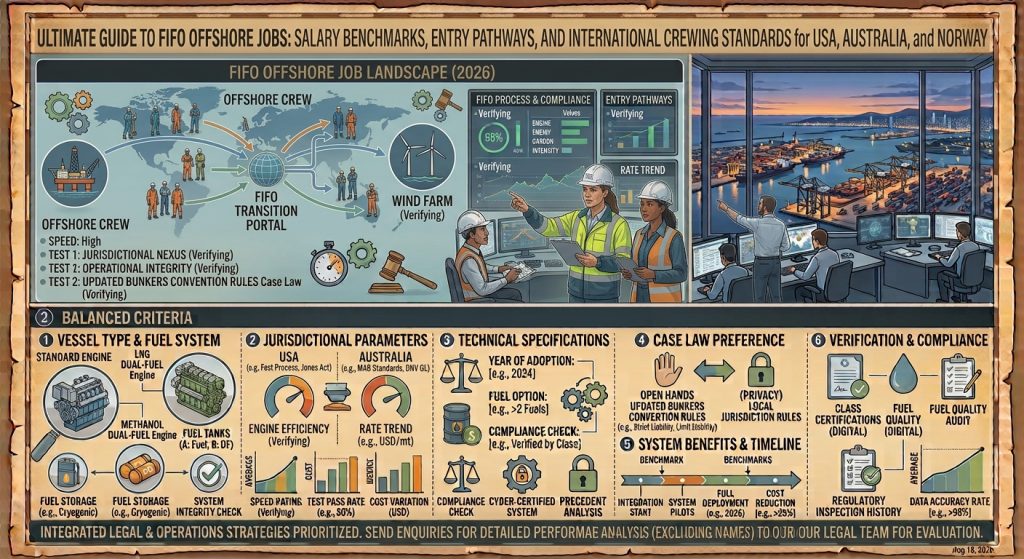
Fly-In Fly-Out (FIFO) offshore rotational employment represents one of the most lucrative yet demanding career tracks in global energy, marine logistics, and offshore construction. Whether operating in the Gulf of Mexico (USA), the North Sea (Norway and the UK), or the North West Shelf (Australia), securing fifo offshore jobs requires navigating strict international maritime compliance, technical safety certifications, and specialized crewing channels.
For asset owners, offshore contractors, and prospective maritime personnel, understanding the operational mechanics of rotational schedules—including fifo offshore jobs no experience pathways and technical trade entry points—is essential for optimizing offshore labor deployment.
This comprehensive guide details compensation benchmarks, regional entry rules for international applicants, safety standards, and actionable career pathways across global offshore energy basins.
1. What Are FIFO Offshore Jobs? Operational Mechanics and Schedules
In maritime and offshore energy sectors, a Fly-In Fly-Out (FIFO) arrangement means workers are transported via commercial flights and helicopter shuttles directly to an offshore asset—such as a Dynamic Positioning (DP) drillship, semi-submersible rig, Platform Support Vessel (PSV), or Accommodation Work Barge (AWB).
[ The FIFO Operational Cycle ]
│
[Phase 1] Flight Mobilization to Regional Transit Hub (e.g., Houston, Perth, Aberdeen)
└─► [Phase 2] Helicopter / Crew Transfer Vessel (CTV) Transit to Offshore Asset
└─► [Phase 3] Active Offshore Rotation (12-Hour Daily Shifts for 14 to 28 Days)
└─► [Phase 4] De-Mobilization Transfer & Paid Leave (Rest & Recuperation)
Common Rotational Roster Structures:
- 2 Weeks On / 2 Weeks Off (14/14): Common in the U.S. Gulf of Mexico and coastal shelf operations.
- 3 Weeks On / 3 Weeks Off (21/21): Standard across North Sea operations in Norway and the UK.
- 4 Weeks On / 4 Weeks Off (28/28): The global standard for international deepwater drillships, heavy-lift construction, and remote Australian operations.
2. Salary Benchmarks: How Much Do FIFO Offshore Jobs Pay?
Compensation in the offshore sector is structured around base day rates, field allowances, hazard pay, and paid leave cycles. Pay levels vary based on technical skill, safety responsibility, and geographic location.
Offshore Day Rates and Annual Compensation Breakdown
| Job Role / Discipline | Experience Level | Average Day Rate (USD) | Estimated Annual Salary (USD) | Key Operational Focus |
| Roustabout / Deckhand | Entry-Level (No Exp.) | $250 – $400 | $55,000 – $75,000 | Deck maintenance, cargo slinging, cleaning, crane support. |
| Offshore Steward / Galley Hand | Entry-Level (No Exp.) | $220 – $350 | $48,000 – $65,000 | Accommodation housekeeping, galley assistance, sanitation. |
| Roughneck / Floorhand | Mid-Level (1-3 Yrs) | $350 – $550 | $75,000 – $100,000 | Drill floor pipe handling, iron roughneck operation. |
| Rig Welder / Fabricator | Skilled Trade | $500 – $850 | $105,000 – $145,000 | High-pressure structural and pipe welding (AWS/Class certified). |
| Subsea & Hydraulic Tech | Specialist | $650 – $1,100 | $130,000 – $190,000 | Blowout preventer (BOP) maintenance, hydraulic winches. |
| DP Operator (DPO) / Officer | Licensed Maritime | $700 – $1,300 | $140,000 – $220,000 | Dynamic positioning control on drillships and AWBs. |
| Offshore Rig Medic / Nurse | Medical Specialist | $500 – $900 | $95,000 – $150,000 | Trauma care, emergency response, offshore occupational health. |
| Offshore Installation Manager (OIM) | Senior Leadership | $1,200 – $2,200+ | $230,000 – $380,000+ | Total operational command, regulatory and safety authority. |
Note: In Australia, entry-level salaries for fifo offshore jobs australia range between AUD $90,000 to AUD $130,000 per year, while specialized engineers and supervisors can earn AUD $250,000 to AUD $400,000+ annually.
3. How to Land Entry-Level FIFO Offshore Jobs with No Experience
Breaking into the offshore industry without direct sea time requires targeting entry-level positions that focus on deck logistics, facility maintenance, or hospitality services.
[ Entry-Level Progression Pipeline ]
│
[Step 1] Secure Baseline Medical & Safety Certifications (BOSIET, STCW, OGUK/ENG1)
└─► [Step 2] Obtain Port and Biometric Clearances (TWIC, Passport, Flag State Seaman’s Book)
└─► [Step 3] Target Gateway Roles (Roustabout, Galley Hand, Material Handler)
└─► [Step 4] Apply via Vetted Offshore Crewing Agencies & Contractor Portals
└─► [Step 5] Accumulate On-Board Sea Time & Transition to Technical Skilled Trades
Strategic Gateway Roles for Beginners:
- Offshore Roustabout: The most common starting point. Roustabouts manage deck loading, handle cargo rigging, operate pressure washers, and assist drill crews during operations.
- Offshore Galley Steward: Manages living quarters onboard accommodation barges and rigs. Ideal for candidates with hospitality, commercial cleaning, or culinary backgrounds.
- Offshore Rig Medic / Nurse: Registered nurses (fifo offshore jobs nurse) with emergency room or paramedic experience can transition directly offshore without prior maritime service, commanding high daily rates.
- Maintenance Trainee: Individuals with land-based diesel mechanic, electrical, or structural welding backgrounds can secure entry-level maintenance roles on offshore assets.
4. International Mobility: Can Americans Work FIFO Jobs in Australia, Norway, and Europe?
Cross-border mobility is common in global maritime operations, but international hiring depends on flag-state rules, visa regulations, and work authorization.
[ Global Regulatory & Visa Matrix ]
│
┌───────────────────────────────────┼───────────────────────────────────┐
▼ ▼ ▼
[ United States (USCG Zone) ] [ Australia (NOPSEMA Zone) ] [ Norway & UK (North Sea) ]
• TWIC Card Required • Subclass 400 / 482 Visa • Equinor & Offshore Norge Standards
• USCG Merchant Mariner Credential • Offshore Maritime Worker Visa • Working Environment Act (AML)
• OPA 90 & Jones Act Frameworks • Maritime Union Alignment • Norwegian Petroleum Directorate
A. Working in Australia as a Foreign National (e.g., U.S. Citizens)
- Visa Requirements: U.S. citizens cannot simply fly to Australia on a tourist visa to work FIFO. Employers must sponsor foreign candidates under temporary work visas, such as the Temporary Work (Short Stay Specialist) visa (Subclass 400) or the Temporary Skill Shortage visa (Subclass 482).
- Skill Shortage Focus: Sponsorship is generally reserved for high-skill roles, including DP Operators, Subsea Engineers, Rig Welders, and Crane Operators, rather than entry-level roustabout roles.
B. Working in Norway and European Waters
- Norwegian Continental Shelf (NCS): Known for strict labor standards under the Norwegian Petroleum Directorate.
- Requirements: Non-EU candidates require valid work permits, recognized STCW/OPITO safety qualifications, and a Norwegian Maritime Authority (NMA) Medical Certificate.
5. Non-Negotiable Safety Certifications and Medical Credentials
Prior to mobilizing to any offshore installation, every crew member must hold valid safety certifications and medical clearances.
| Certificate / Qualification | Issuing Body | Primary Purpose & Validity |
| BOSIET with HUET | OPITO | Basic Offshore Safety Induction and Emergency Training, including Helicopter Underwater Escape Training with CA-EBS (Compressed Air Emergency Breathing System). Valid 4 years. |
| STCW Basic Safety | IMO / Flag State | Mandatory for all vessel crew members; covers personal survival, fire prevention, elementary first aid, and personal safety. |
| OGUK / ENG1 Medical | Offshore Energies UK / MCA | Comprehensive medical examination evaluating physical fitness, cardiovascular health, hearing, and vision for offshore work. |
| TWIC Card | U.S. TSA / Coast Guard | Transportation Worker Identification Credential required for access to all secure U.S. maritime facilities and ports. |
| MIST | OPITO | Minimum Industry Safety Training; covers risk assessment, working at heights, and hazardous substance management. |
6. Frequently Asked Questions (FAQ)
Q1: What is a FIFO offshore job?
A FIFO (Fly-In Fly-Out) offshore job is a work arrangement where employees are flown via commercial airlines and offshore helicopters to work on remote marine assets—such as oil rigs, drillships, or accommodation barges—for a fixed period (e.g., 14 or 28 days), followed by an equal period of paid rest at home.
Q2: How much can you make on an oil rig with no experience?
Entry-level offshore workers—such as roustabouts, deckhands, and galley stewards—typically earn between $48,000 and $75,000 per year (or $220 to $400 per day), depending on the operating region, shift length, and overtime allowances.
Q3: Are FIFO offshore jobs dangerous?
Offshore installations involve high-pressure machinery, heavy lifts, and harsh marine environments. However, strict international safety regulations—enforced by bodies such as the U.S. Coast Guard, Australia’s NOPSEMA, and Norway’s Petroleum Safety Authority—have significantly reduced injury rates. Compliance with BOSIET, STCW, and personal protective equipment (PPE) standards is strictly enforced onboard.
Q4: Can Americans get FIFO offshore jobs in Australia?
Yes, but U.S. citizens must hold an appropriate Australian work visa (such as a Subclass 400 or Subclass 482 visa) sponsored by an offshore employer. Visa sponsorship is primarily awarded to experienced technical specialists, engineers, and licensed marine officers due to local labor regulations.
Q5: How do I apply for entry-level FIFO offshore jobs?
To apply successfully:
- Complete your basic safety training (BOSIET with HUET and STCW).
- Obtain a valid OGUK/ENG1 offshore medical and TWIC card.
- Apply directly through vetted crewing agencies, vessel operators (e.g., Edison Chouest, Tidewater, Hornbeck), and drilling contractors (e.g., Transocean, Valaris, Diamond Offshore).
Crewing & Offshore Asset Support with Oitha Marine
Managing global offshore campaigns requires qualified crew placement, technical vessel vetting, and charter support. Oitha Marine connects offshore asset owners, EPC contractors, and certified maritime personnel across global energy corridors.
Crewing & Placement Desk Notice:
Qualified seafarers, technical specialists, and entry-level personnel seeking offshore placements can submit their credentials directly to our crewing team.
- Submit Credentials: oithamarine.com
- Explore Technical Insights: Oitha Marine Offshore Operations Portal
Recent Comments