
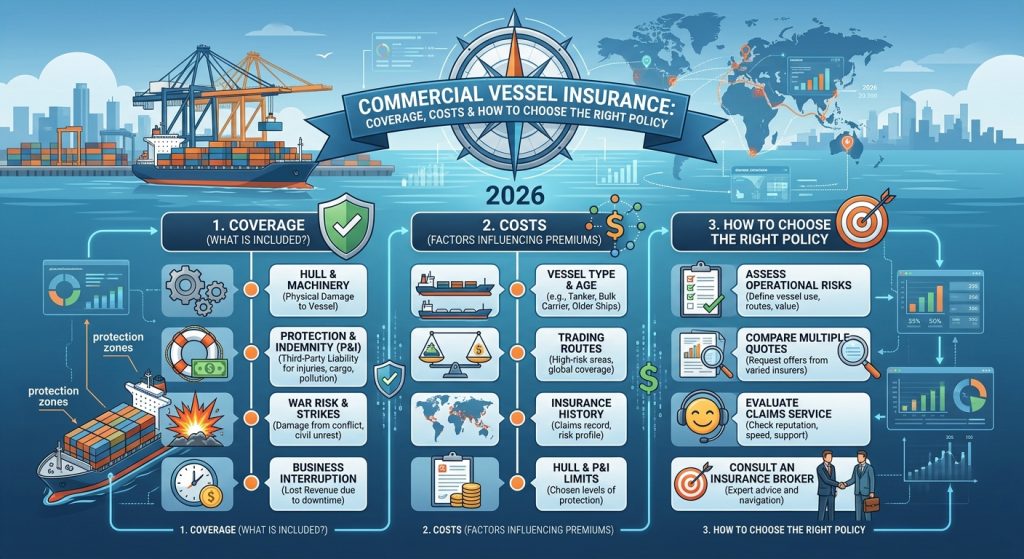
Commercial vessel insurance is an important risk-management consideration for businesses that own, operate, charter, or manage vessels for commercial purposes. From cargo ships and offshore support vessels to commercial fishing boats, passenger vessels, workboats, and charter fleets, the right insurance programme can help businesses manage financial exposure arising from physical damage, third-party liability, accidents, and certain maritime incidents.
However, commercial vessel insurance is not a single, standardised policy. Coverage depends on the vessel’s intended use, operating area, construction, age, value, crew arrangements, contractual obligations, and the risks the business needs to manage. A policy suitable for a coastal workboat may not be appropriate for an ocean-going cargo vessel or an offshore support operation.
For shipowners, fleet managers, marine contractors, charterers, and maritime procurement teams, understanding these differences is essential before selecting an insurance provider or renewing an existing policy.
This guide explains what commercial vessel insurance covers, the principal types of marine insurance, the factors affecting premiums, and the practical steps businesses can take to evaluate coverage. It also outlines important considerations for companies operating in the United States, Canada, and the United Kingdom.
Important: Insurance terms, exclusions, compulsory requirements, and available products vary by insurer and jurisdiction. This article provides general educational information, not legal advice, an insurance quotation, or a guarantee of coverage. Businesses should confirm their requirements with appropriately licensed or authorised insurance professionals and relevant maritime authorities.
What Is Commercial Vessel Insurance?
Commercial vessel insurance is a category of marine insurance designed to protect businesses against specified financial losses associated with vessels used for commercial activities.
Depending on the policy structure, insured risks may include damage to the vessel, liability for injuries or property damage, certain pollution-related liabilities, and other exposures associated with maritime operations.
Commercial vessel insurance may be relevant to businesses involved in:
- Commercial shipping and freight transportation.
- Offshore energy and marine construction.
- Commercial fishing and seafood transportation.
- Passenger transportation and ferry services.
- Tugboat, towing, and harbour operations.
- Vessel chartering and commercial yacht operations.
- Marine surveying, maintenance, and support services.
- Dredging, salvage, and other specialist marine activities.
The appropriate insurance arrangement depends on the operation rather than the vessel’s appearance alone. Two similar-looking boats may require substantially different coverage if one is used for private recreation and the other carries paying passengers or performs commercial work.
For this reason, businesses should disclose the vessel’s actual use, operating territory, cargo or equipment carried, passenger capacity, and any unusual activities when obtaining quotations.
Why Commercial Vessel Insurance Matters to Maritime Businesses
Commercial vessels are valuable operational assets, but their exposure extends beyond the cost of repairing or replacing a damaged hull.
An accident may interrupt revenue, damage another vessel, injure a crew member, affect cargo, or create environmental and contractual liabilities. Some incidents may involve multiple parties, jurisdictions, insurers, and legal proceedings.
Commercial vessel insurance can form part of a broader business continuity and risk-management programme.
1. Protecting operational assets
Hull damage, machinery failure resulting from an insured event, collision, grounding, fire, and other covered incidents can generate significant repair costs.
Hull and machinery insurance may help manage specified physical-damage exposures, subject to policy wording, deductibles, exclusions, and applicable conditions.
2. Managing third-party liability
A vessel may cause damage to another ship, a port facility, a pier, or other property. An accident may also result in claims for bodily injury or death.
Protection and indemnity insurance and other marine liability arrangements may address certain liabilities, depending on the policy and the circumstances.
3. Supporting contractual and regulatory obligations
Charter agreements, port access arrangements, customer contracts, lenders, and applicable laws may require evidence of particular insurance coverage or financial security.
Appropriate documentation can help businesses demonstrate that relevant requirements have been addressed. Nevertheless, holding an insurance policy does not automatically satisfy every contractual or statutory requirement.
4. Improving business continuity planning
An insured loss may still create downtime, deductibles, uninsured expenses, and cash-flow pressure.
Businesses should therefore consider insurance alongside maintenance programmes, emergency response plans, spare-parts availability, operational procedures, and financial reserves.
What Does Commercial Vessel Insurance Cover?
The exact protection available depends on the policy wording. Common commercial marine insurance components include the following.
Hull and machinery insurance
Hull and machinery insurance is designed to cover specified physical damage to an insured vessel and, where included, its machinery and equipment.
Depending on the terms, covered events may include certain collisions, groundings, fires, and other insured marine casualties.
Businesses should review:
- The agreed or insured value of the vessel.
- The valuation basis used for a total loss.
- Whether machinery and onboard equipment are included.
- Deductibles applicable to different types of claims.
- Navigation limits and permitted operating areas.
- Survey, maintenance, and seaworthiness requirements.
- Exclusions involving wear and tear, corrosion, or mechanical breakdown.
A policy should not be assumed to cover every machinery failure or every cause of physical damage.
Protection and indemnity (P&I) insurance
Protection and indemnity insurance generally addresses specified third-party liabilities arising from vessel ownership or operation.
Depending on the policy or P&I arrangement, covered exposures may include certain crew or passenger liabilities, third-party property damage, cargo-related liabilities, and pollution liabilities.
P&I coverage is particularly relevant to shipowners, commercial operators, and businesses whose contracts expose them to maritime liability claims.
However, not every P&I arrangement provides identical protection. Some liabilities may be excluded, restricted, subject to separate limits, or insured under different policies.
Businesses should confirm whether the proposed cover is suitable for their vessel type, operating model, and contractual responsibilities.
Commercial vessel liability insurance
Commercial vessel liability insurance is a broader description for insurance addressing specified legal liabilities associated with commercial vessel operations.
Depending on the business, relevant exposures may include third-party bodily injury, property damage, collision liability, and other claims arising from insured activities.
The term does not necessarily describe one universal policy. Liability protection may be included in a marine package, arranged through a P&I policy, or purchased through other specialised insurance arrangements.
When comparing quotations, identify the actual insured liabilities rather than relying solely on a policy’s marketing name.
Vessel pollution insurance
Vessel pollution insurance addresses specified pollution-related liabilities, subject to its terms and applicable law.
Pollution incidents may involve fuel spills, oil releases, hazardous substances, or other pollutants. Depending on the circumstances, businesses may face response costs, third-party claims, environmental damage claims, and regulatory obligations.
Pollution cover is especially important to assess for tankers, offshore support vessels, fuel-carrying vessels, and operations involving environmentally sensitive areas.
Not every marine liability policy covers every pollution exposure. Businesses should confirm applicable limits, exclusions, deductibles, reporting obligations, and any required certificates of financial responsibility.
Commercial fishing vessel insurance
Commercial fishing vessel insurance is designed around the operational risks of fishing businesses.
Depending on the policy, coverage may include hull and machinery, specified liability exposures, and certain fishing-related equipment.
A fishing operation should disclose the type of fishing conducted, gear carried, seasonal activity, crew arrangements, operating waters, and whether the vessel participates in activities such as charter fishing.
Standard commercial vessel insurance may not automatically cover specialised fishing equipment, catch, or every type of fishing operation.
Passenger vessel insurance
Passenger vessel insurance is relevant to ferries, tour boats, water taxis, excursion vessels, and other businesses transporting passengers.
Important considerations include passenger capacity, the nature of the service, operating routes, safety procedures, and applicable passenger liability requirements.
Businesses should confirm that the policy accurately reflects the number and type of passengers carried and the activities undertaken.
Passenger-related insurance requirements can be jurisdiction-specific. Operators should verify the rules applicable to their vessel and route before commencing operations.
How Much Does Commercial Vessel Insurance Cost?
There is no single price for commercial vessel insurance. Premiums are determined by the risks presented, the scope of coverage requested, and the terms an insurer is willing to offer.
A small commercial workboat operating in sheltered waters may have a different risk profile from a large cargo vessel travelling internationally. Consequently, general online price estimates may not provide a reliable basis for budgeting an individual operation.
Key factors affecting commercial vessel insurance premiums
1. Vessel value
The insured value influences the potential cost of a physical-damage claim. Businesses should provide accurate valuation information and understand whether the policy uses agreed value, actual cash value, or another valuation basis.
2. Vessel type and construction
A cargo ship, commercial fishing vessel, passenger boat, tug, and offshore support vessel have different operational exposures. Construction, design, machinery, and specialist equipment may also affect underwriting.
3. Vessel age and condition
Age, maintenance history, survey findings, machinery condition, and evidence of repairs may influence underwriting decisions.
A vessel’s age alone does not determine whether cover is available or affordable.
4. Operating area
Coastal, inland, offshore, and international operations can involve different navigational and environmental exposures. Insurers may apply navigation limits, geographical restrictions, or additional conditions.
5. Commercial activity
Passenger transportation, towing, fishing, cargo carriage, and offshore support work create different risks. The insurer needs to understand the actual activity being insured.
6. Claims history
Previous losses, claims frequency, incident severity, and corrective measures may influence the underwriting assessment.
7. Liability limits and deductibles
Higher liability limits may increase the premium, while higher deductibles can reduce it in some circumstances. Businesses should compare the premium savings with the amount they would need to pay following a loss.
8. Safety and risk controls
Documented maintenance, crew training, safety management, incident reporting, and suitable operating procedures may support a stronger underwriting submission. Their effect on premiums depends on the insurer and the risk.
How to obtain a meaningful commercial vessel insurance quotation
Businesses should prepare a consistent information pack before approaching insurers or marine insurance brokers.
Typically, the information may include:
- Vessel name, registration, type, dimensions, and gross tonnage where applicable.
- Construction year, builder, vessel value, and survey documentation.
- Intended commercial use and operating territory.
- Machinery details, maintenance records, and loss history.
- Crew numbers, passenger capacity, and relevant qualifications.
- Cargo, fishing equipment, or specialist equipment carried.
- Required hull, liability, pollution, and other coverage limits.
- Charter agreements, customer contracts, or lender requirements.
- Existing insurance schedules and relevant claims information.
The insurer may request additional information depending on the vessel and operation.
Comparing quotations on a like-for-like basis is essential. A lower premium may reflect a higher deductible, narrower navigation limits, lower liability limits, or more exclusions rather than a better overall deal.
How to Choose the Right Commercial Vessel Insurance Policy
Choosing insurance should be a structured procurement and risk-management decision, not simply a search for the lowest premium.
Step 1: Identify the vessel’s actual risk profile
Document the vessel’s use, routes, operating environment, machinery, crew, passengers, and commercial contracts.
Be precise about activities that may fall outside ordinary commercial navigation, including towing, salvage, offshore work, or specialised fishing.
Step 2: Separate asset protection from liability protection
Hull and machinery insurance addresses specified physical damage to the vessel. Liability insurance addresses specified legal liabilities to others.
These are different exposures. A business should not assume that insuring the hull automatically provides sufficient third-party liability protection.
Step 3: Review coverage limits and exclusions
Examine the policy schedule, wording, endorsements, deductibles, warranties, exclusions, and conditions.
Ask how the policy treats machinery breakdown, pollution, wreck removal, cargo-related liabilities, crew injuries, and loss-of-hire exposures where relevant.
Do not rely solely on a summary brochure or a verbal assurance.
Step 4: Verify insurer and intermediary credentials
Check the insurer’s financial standing and the relevant licensing or authorisation of the insurer and intermediary in the jurisdiction concerned.
For complex or international risks, businesses may benefit from a marine insurance broker with experience in the relevant vessel class and trade.
Confirm who will handle claims, how incidents must be reported, and which documentation is required.
Step 5: Check contractual requirements
Charterers, vessel owners, lenders, ports, and commercial customers may specify minimum insurance limits, additional insured arrangements, waivers, or evidence of insurance.
Have the relevant contract and policy wording reviewed together. A policy may not automatically satisfy a contractual requirement simply because its headline limit appears sufficient.
Step 6: Evaluate claims handling and service
Consider the insurer’s claims process, reporting requirements, access to marine surveyors, emergency contacts, and arrangements for assessing repairs.
For a commercial fleet, claims coordination and response times can materially affect operational disruption.
Step 7: Reassess coverage at renewal
Review the insurance programme when a vessel changes ownership, operating territory, commercial activity, value, or charter arrangements.
Fleet expansion, new equipment, changes in passenger capacity, and changes to contractual obligations may also require updated cover.
Commercial Vessel Insurance Requirements in the US, Canada, and UK
Commercial vessel insurance requirements vary according to the vessel’s flag, tonnage, use, cargo, passenger capacity, operating waters, and applicable legislation.
There is no universal rule that every commercial vessel in every jurisdiction must carry the same insurance policy.
United States
Certain vessels operating in US waters are subject to federal financial-responsibility requirements, including requirements associated with oil pollution and hazardous-substance liability.
For example, the US Coast Guard administers the Certificate of Financial Responsibility (COFR) programme for applicable vessels. Businesses should review the requirements for their specific vessel and operations through the US Coast Guard National Pollution Funds Center.
The applicable requirements depend on the legislation and circumstances involved. A general commercial marine insurance policy should not be assumed to satisfy a COFR requirement without confirmation.
Canada
Canadian marine liability requirements may apply to particular vessels and activities.
For example, Canada’s passenger-ship insurance regulations establish liability insurance requirements for specified passenger transportation operations. The relevant rules and exceptions depend on the activity and legal circumstances.
Operators should consult Transport Canada’s marine safety guidance and the applicable legislation before determining which insurance arrangements are required.
United Kingdom
UK maritime insurance requirements can include compulsory insurance certificates for specified liabilities.
The Maritime and Coastguard Agency explains how shipowners and operators can apply for certificates relating to particular pollution, passenger, and wreck-removal liabilities, depending on the vessel and applicable requirements.
See the official UK government guidance on compulsory civil and passenger liability insurance certificates.
Businesses operating across borders should confirm both the requirements of the vessel’s flag state and the requirements applicable to the waters, ports, and commercial activities involved.
These examples are not an exhaustive legal checklist. Regulatory requirements can change, so obtain current advice for the specific vessel and operation.
Common Commercial Vessel Insurance Mistakes to Avoid
Even an established maritime business can have gaps in its insurance arrangements if its operations change or the policy is not reviewed carefully.
Underinsuring the vessel
An outdated vessel valuation may leave a business with inadequate protection following a major loss. Review valuations and understand how the insurer determines claim payments.
Assuming all liabilities are covered
Hull insurance does not automatically cover every third-party liability. Confirm the relationship between hull, P&I, pollution, passenger, and other liability policies.
Failing to disclose operational changes
New routes, additional passengers, different cargo, towing activities, or a change in vessel use may affect cover. Notify the insurer or broker of material changes and obtain confirmation where necessary.
Ignoring exclusions and warranties
Policy exclusions and conditions can be as important as the headline coverage limit. Understand maintenance obligations, survey requirements, navigation restrictions, and claims notification conditions.
Choosing on premium alone
A cheaper policy may offer less protection or impose higher out-of-pocket costs. Compare the scope and quality of cover rather than price alone.
Leaving certificates and records out of date
Maintain an organised record of policies, certificates, endorsements, survey reports, renewal dates, and claims contacts. This can support compliance checks and reduce delays during renewals or incidents.
A Practical Commercial Vessel Insurance Checklist
Before purchasing or renewing cover, use the following checklist to guide discussions with your insurance broker or provider.
Confirm the vessel’s ownership, registration, and commercial use.
Document the operating area, routes, cargo, passengers, and crew.
Establish an appropriate vessel valuation.
Assess hull and machinery protection requirements.
Identify third-party liability and P&I requirements.
Review pollution, wreck-removal, and other specialist exposures.
Verify applicable legal and contractual insurance requirements.
Compare policy limits, deductibles, exclusions, and conditions.
Check insurer and intermediary credentials.
Confirm claims reporting procedures and emergency contacts.
Record renewal dates and review arrangements when operations change.
This checklist is a starting point rather than a substitute for a vessel-specific insurance assessment.
Frequently Asked Questions About Commercial Vessel Insurance
1. What is commercial vessel insurance?
Commercial vessel insurance is marine insurance arranged for vessels used in business activities. Depending on the policy, it may cover specified physical damage, third-party liabilities, and other risks associated with commercial vessel operations.
2. What does commercial vessel insurance typically cover?
Potential coverage includes hull and machinery damage, specified third-party liabilities, and certain pollution-related exposures. Passenger, crew, equipment, cargo, and loss-of-hire protection may require specific policy provisions or separate arrangements. The policy wording determines what is actually covered.
3. How much does commercial vessel insurance cost?
The premium depends on factors such as vessel value, type, age, condition, operating territory, commercial activity, claims history, coverage limits, and deductibles. An insurer or qualified marine insurance broker can provide a more reliable estimate after reviewing the vessel’s details.
4. Is commercial vessel insurance legally required?
Requirements depend on the jurisdiction, vessel type, tonnage, activities, cargo, passengers, and applicable laws. Some vessels are subject to compulsory insurance or financial-responsibility requirements for specific liabilities. Businesses should verify the rules that apply to their individual operation.
5. What is the difference between hull insurance and P&I insurance?
Hull insurance generally addresses specified physical damage to the vessel and covered machinery. Protection and indemnity insurance generally addresses specified third-party liabilities arising from vessel ownership or operation. The two forms of cover address different risks and may be arranged separately.
6. Does commercial vessel insurance cover pollution?
Some marine insurance policies provide specified pollution-related protection, but coverage varies. Businesses should review pollution exclusions, limits, response costs, applicable liabilities, and any separate certificates or financial-responsibility requirements.
7. Can a commercial fishing vessel be insured?
Yes, commercial fishing vessels can be eligible for specialist marine insurance, subject to underwriting and the terms offered. The insurer will typically need details about fishing methods, equipment, vessel condition, operating waters, crew, and claims history.
8. Is passenger vessel insurance different from commercial boat insurance?
Passenger operations can create distinct liability exposures and may be subject to specific insurance requirements. Passenger capacity, routes, service type, and applicable regulations should be disclosed when arranging cover.
9. Does commercial vessel insurance cover machinery breakdown?
Not necessarily. Coverage depends on the policy wording and the cause of the breakdown. Some physical-damage policies exclude wear and tear or certain mechanical failures, while other arrangements may provide specific machinery-related protection. Confirm the scope with the insurer.
10. What information is needed for a commercial vessel insurance quote?
Insurers commonly request vessel identification and specifications, valuation, construction and survey information, intended use, operating area, crew and passenger details, claims history, and requested limits. Additional documents may be required for specialised or international operations.
11. Can one insurance policy cover an entire commercial fleet?
Some insurers offer fleet insurance arrangements, subject to underwriting. Fleet policies can simplify administration, but businesses should verify the vessels insured, applicable limits, individual deductibles, navigation restrictions, and any vessel-specific conditions.
12. How can a business compare commercial vessel insurance quotes?
Compare the insured risks, limits, deductibles, exclusions, valuation terms, navigation limits, policy conditions, insurer credentials, and claims procedures. A meaningful comparison uses equivalent coverage requirements rather than headline premiums alone.
13. What is vessel pollution insurance?
Vessel pollution insurance is protection for specified pollution-related liabilities associated with a vessel. Its scope depends on the policy, applicable law, and the nature of the operation. Certain vessels may also require evidence of financial responsibility or specific compulsory insurance certificates.
14. When should commercial vessel insurance be renewed or reviewed?
Review cover before renewal and whenever the vessel’s ownership, value, operating territory, cargo, passenger capacity, or commercial activity changes. Significant contractual or regulatory changes should also trigger a review.
Conclusion: Build a Commercial Vessel Insurance Programme Around Your Risks
Commercial vessel insurance is most effective when it reflects the vessel’s actual operations, the business’s contractual commitments, and the liabilities it may face.
For shipowners, operators, charterers, fleet managers, and marine contractors, the key is to understand the difference between physical-damage cover and liability protection, identify specialist exposures, review exclusions carefully, and confirm applicable legal requirements.
A well-prepared insurance submission, accurate vessel information, documented risk controls, and a structured comparison of policy terms can help businesses make more informed decisions.
Rather than selecting a policy solely on price, maritime businesses should evaluate the coverage provided, the limitations imposed, the insurer’s credentials, and the claims process. Where operations cross international borders or involve specialised risks, advice from an appropriately qualified marine insurance professional is particularly important.
OithaMarine.com is committed to providing practical marine industry information to help vessel owners, operators, and maritime businesses better understand commercial risks and make informed decisions. For a specific insurance requirement, consult a qualified insurance professional and verify the applicable regulatory guidance before placing cover.
Editorial and compliance note
This article is intended for general educational purposes. It does not constitute legal, financial, or insurance advice and does not represent an offer to arrange insurance. Coverage is subject to the actual policy wording, insurer acceptance, applicable exclusions and conditions, and relevant laws and regulations.
Official references
Recent Comments