
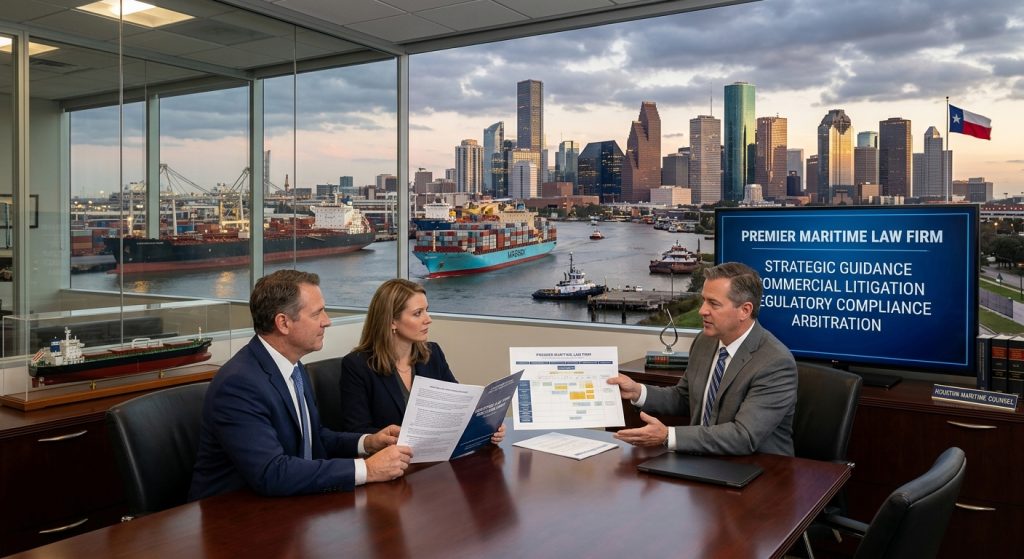
Author: Senior Maritime Compliance & Legal Editorial Team
Published by: Oitha Marine | Maritime Logistics & Chartering Intelligence
Executive Summary
In the high-stakes world of international shipping and offshore commerce, commercial disputes do not respect borders, office hours, or predictable timelines. When a vessel experiences a catastrophic allision in the Houston Ship Channel, a cargo contamination dispute threatens a multi-million-dollar voyage charter, or a complex financing covenant defaults across international jurisdictions, the calibre of legal representation retained by the enterprise dictates its survival and profitability. With high-intent keyword auctions for premier legal services commanding cost-per-click rates averaging $100.00 to $413.81+, the commercial legal market reflects a stark reality: elite maritime legal counsel is a high-value, indispensable corporate asset.
This comprehensive guide examines the structural criteria required to evaluate and retain a top-tier maritime law firm, explores the core practice areas essential to modern commercial fleet operations, and outlines a rigorous framework for managing legal risk in the Gulf Coast maritime sector.
1. The Expanding Mandate of Modern Maritime Law Firms
Maritime law has evolved far beyond traditional nineteenth-century salvage and collision disputes. Today’s commercial maritime law firm operates as a multidisciplinary corporate powerhouse, blending deep admiralty jurisprudence with international trade law, environmental compliance, commercial litigation, and corporate finance.
Core Pillars of Modern Maritime Legal Practice:
- Admiralty Litigation and Casualty Response: Immediate emergency response to marine casualties, oil spills, groundings, and structural allisions under strict federal scrutiny.
- Commercial Transactional Support: Drafting, vetting, and negotiating complex charter parties (BIMCO, Asbatime), ship sale and purchase (S&P) agreements, and marine financing documents.
- Regulatory Compliance and Enforcement Defense: Navigating stringent United States Coast Guard (USCG), Environmental Protection Agency (EPA), and Customs and Border Protection (CBP) regulations.
- Maritime Arbitration and Dispute Resolution: Managing London (LMAA), New York (SMA), and Singapore arbitration proceedings concerning demurrage, off-hire, and cargo loss.
2. Key Criteria for Evaluating a Premier Maritime Law Firm
Selecting outside counsel to protect multi-million-dollar marine assets requires a rigorous vetting protocol. Shipowners, charterers, and P&I Club executives should evaluate prospective maritime law firms against four critical benchmarks:
[Commercial Maritime Enterprise] │ ├──> 1. Admiralty Specialization ───> [Federal Maritime Court & Arbitration Fluency] ├──> 2. 24/7 Casualty Response ─────> [Rapid Deployment of Surveyors & Forensic Experts] ├──> 3. Global Network Integration ─> [P&I Correspondence & Cross-Border Liens] └──> 4. Commercial Acumen ──────────> [Balancing Litigation Risk with Bottom-Line Profit]A. Deep Domain Specialization in Federal Admiralty Jurisprudence
A general corporate litigator, regardless of how accomplished in state courts, lacks the specialized knowledge required to navigate federal admiralty rules. A true maritime law firm possesses exhaustive fluency in Supplemental Rules for Admiralty or Maritime Claims and Asset Forfeiture Actions (specifically Rules B, C, and E governing vessel attachments and arrests in rem).
B. Round-the-Clock Emergency Casualty Response Capabilities
Marine accidents occur at all hours. An elite maritime firm maintains a 24/7/365 emergency response desk capable of deploying marine surveyors, forensic naval architects, and experienced casualty counsel to the scene within hours of an incident in the Houston Ship Channel or Gulf of Mexico.
C. Integration with International P&I Clubs and Hull Underwriters
Because the maritime industry relies heavily on mutual insurance structures (Protection & Indemnity Clubs) and commercial hull underwriters, premier maritime law firms maintain established relationships and approved-panel status with major international P&I clubs, ensuring seamless coordination of defense strategies and fee structures.
3. Anatomy of High-Value Maritime Legal Engagements
Commercial operators frequently require specialized legal intervention across several high-risk operational domains:
1. Complex Charter Party Disputes and Demurrage Litigation
Time and voyage charter agreements are rife with potential friction points. Disputes regarding vessel speed and bunker consumption performance, safe port warranties, ice clauses, and demurrage calculations frequently escalate into formal arbitration. Specialized maritime counsel ensure that charter party wordings are drafted defensively to minimize ambiguity and protect owner and charterer interests.
2. Vessel Arrests and Maritime Liens (In Rem Actions)
When commercial counterparties default on bunker supplies, repair invoices, or charter hire, time is of the essence. Under U.S. maritime law, the right to assert a maritime lien and arrest a debtor’s vessel in rem provides extraordinary leverage. A skilled maritime law firm can file an expedited complaint, secure a warrant of arrest, and have the U.S. Marshals Service seize the vessel before it steams beyond U.S. territorial waters.
3. Environmental Investigations and OPA 90 Defense
Federal investigations following an accidental discharge of oil or hazardous substances under the Oil Pollution Act of 1990 (OPA 90) carry severe civil and criminal penalties under the Act to Prevent Pollution from Ships (APPS). Having experienced defense counsel present during USCG and EPA marine board of investigation interviews is essential to safeguarding corporate officers and vessel masters against self-incrimination.
4. Strategic Risk Mitigation for Shipowners and Charterers
Proactive collaboration with specialized legal counsel enables commercial operators to construct resilient operational frameworks that prevent disputes before they materialize:
- Standardizing Contractual Indemnities: Utilizing updated BIMCO and industry-standard clauses that clearly allocate risk, force majeure, and environmental liabilities between owners, charterers, and terminal operators.
- Implementing Crew Safety and Compliance Audits: Conducting regular legal audits of onboard Safety Management Systems (SMS) and training logs to ensure absolute compliance with ISM and ISPS codes.
- Establishing Prompt Dispute Resolution Protocols: Creating internal escalation matrices that involve legal counsel at the earliest sign of commercial disagreement, preventing minor operational disputes from degenerating into costly litigation or arbitration.
5. Frequently Asked Questions (FAQ)
Q1: What differentiates a specialized maritime law firm from a general commercial litigation firm?
A: Specialized maritime law firms focus exclusively on admiralty and maritime jurisprudence, including federal limitation of liability actions, vessel arrests in rem, marine insurance mechanics, and international shipping conventions. General commercial litigation firms lack familiarity with the unique procedural rules, international treaties, and industry customs governing maritime commerce.
Q2: How does a maritime law firm assist in vessel arrest proceedings?
A: When a vessel owner or supplier is owed unpaid debts (such as for bunker fuel, repairs, or charter hire), a maritime law firm can rapidly prepare an in rem complaint and motion for warrant of arrest under Supplemental Rule C. Once signed by a federal judge, the U.S. Marshals Service executes the seizure, compelling the vessel owner or its underwriters to post adequate security or bond to release the ship.
Q3: Why are P&I Club relationships critical when selecting a maritime law firm?
A: Protection & Indemnity (P&I) Clubs provide liability cover for shipowners. Law firms approved by and experienced with P&I Club procedures understand the nuances of mutual insurance defense, tripartite attorney-client relationships, and cost-containment frameworks expected by global marine underwriters.
Q4: When should a commercial shipping company retain outside maritime counsel?
A: Ideally, maritime counsel should be retained proactively to draft and vet standard charter party contracts, agency agreements, and corporate safety policies. In a reactive scenario, counsel must be contacted immediately upon the occurrence of a marine casualty, allision, cargo damage claim, or formal notice of arbitration.
Conclusion
In the demanding commercial ecosystem of Houston and the wider Gulf Coast, partnering with an elite maritime law firm is a strategic necessity. By combining rigorous admiralty expertise, round-the-clock casualty response, and sophisticated commercial acumen, maritime enterprises can successfully navigate complex legal hurdles, protect valuable fleet assets, and maintain a competitive edge in global shipping markets.
Disclaimer
This article is published by Oitha Marine for informational and educational purposes only and does not constitute formal legal advice. Readers facing specific maritime legal disputes, charter party conflicts, or regulatory investigations should consult directly with a qualified, licensed admiralty and maritime attorney in their respective jurisdiction.
Recent Comments