
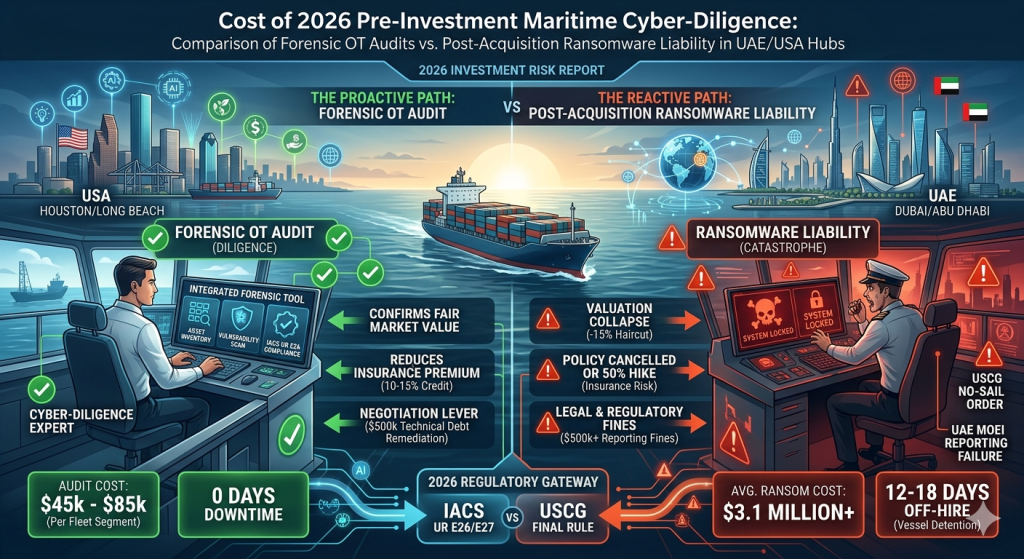
For institutional investors, the maritime “Cyber Gap” has become an existential risk. In 2026, the average cost of a maritime ransomware attack has surged to $3.1 million, while the cost of a forensic pre-investment audit remains a fraction of that figure. This audit examines the “Expensive Problem” of Technical Debt—the hidden cost of upgrading legacy Operational Technology (OT) to meet 2026 standards.
1. The Anatomy of Pre-Investment Cyber-Diligence (2026 Standards)
In 2026, “Cyber-Diligence” has evolved beyond a simple IT questionnaire. Investors now mandate a Forensic OT Audit, which inspects the “Ship-Shore” interface and the internal vessel control networks (Propulsion, Navigation, and Cargo handling).
The Three Pillars of a 2026 Forensic Audit:
- Asset Inventory Discovery: 2026 audits use passive network monitoring to identify every connected sensor. Legacy fleets often have “mystery” devices—unpatched PLCs (Programmable Logic Controllers) from 2015 that are invisible to standard IT scans.
- Vulnerability Gap Analysis (UR E26/E27): Compliance with the International Association of Classification Societies (IACS) Unified Requirements is now the benchmark. Audits quantify the cost to bring a vessel from “Legacy Status” to “E26 Resilient.”
- Network Segmentation Integrity: 2026 forensics verify if a breach on the crew’s Starlink Wi-Fi can pivot into the Engine Room. In 40% of pre-investment audits, “Flat Networks” are discovered, representing a catastrophic liability.
2. Comparison: Forensic Audit vs. Ransomware Liability
| Cost Category | Forensic Pre-Investment Audit (One-Time) | Post-Acquisition Ransomware Event (Per Incident) |
| Direct Financial Outlay | $45,000 – $85,000 (Per Fleet Segment) | $3,100,000 (Average 2026 Ransom) |
| Operational Downtime | 0 Days (Performed during due diligence) | 12–18 Days (Total Vessel Lock-out) |
| Legal & Regulatory Fines | $0 | $500,000+ (USCG/UAE MOEI Reporting Fines) |
| Insurance Impact | Reduces Premium by 10-15% | Policy Cancellation or 50% Hike |
| Asset Valuation | Confirms “Fair Market Value” | -15% Valuation “Haircut” on Resale |
The “Hidden” Liability: The 2026 USCG Final Rule
Investors in the USA must account for the 2026 USCG Cybersecurity Final Rule. If a newly acquired vessel enters US waters and is found to have unpatched, “critically vulnerable” OT systems, the USCG now has the authority to issue “No-Sail” orders. The cost of a vessel sitting idle in Houston or Long Beach is roughly $50,000/day, making the $45k audit a logical “insurance policy” in its own right.
3. Regional Focus: The UAE “Digital Gateway” and M&A Activism
The UAE has positioned itself as the global hub for Autonomous and Smart Shipping. However, with this connectivity comes increased exposure.
- The UAE Cyber-Mandate: Under the MOEI 2026 Maritime Strategy, all vessels registered under the UAE flag must demonstrate “Cyber-Hardened” navigation systems. Investors acquiring UAE assets without a forensic audit risk inheriting “Digitally Decayed” vessels that cannot clear local classification.
- M&A Activism: In 2026, we are seeing a rise in “Cyber-Activism” from limited partners (LPs). Investors are demanding that PE firms prove they didn’t “overpay for a liability” by skipping the OT audit during the acquisition of Middle Eastern logistics startups.
4. The ROI of “Technical Debt” Remediation
When an audit identifies $500,000 in required cyber-upgrades (Technical Debt), the investor gains a powerful negotiating lever. Investor Strategy Note: “In 2026, if our forensic audit reveals that a 5-vessel fleet requires $1M in IACS E26 retrofitting, we immediately deduct that $1M from the purchase price. The audit doesn’t just protect us; it pays for itself 10x over at the closing table.”
Frequently Asked Questions (FAQ)
1. Is a standard IT audit enough for a 2026 maritime acquisition?
No. Standard IT audits focus on emails and servers. Maritime risk is in the OT (Operational Technology). A 2026 forensic audit must look at the ECDIS (Electronic Chart Display), AIS, and Integrated Bridge Systems. If your auditor doesn’t know the difference between NMEA 0183 and an Ethernet packet, they are the wrong firm.
2. Can I get Cyber Insurance in 2026 without a forensic audit?
Technically yes, but it is “Empty Coverage.” In 2026, most underwriters (Lloyd’s, Gard) have “Cyber-Resilience Warranties.” If an attack occurs and the insurer discovers you acquired a vessel with “known unpatched vulnerabilities” (which an audit would have found), they will deny the claim based on a breach of warranty.
3. How long does a pre-investment forensic OT audit take?
For a single vessel, the on-site forensic collection takes 48 to 72 hours. The data analysis and “Valuation Risk Report” take another 7 to 10 days. In a fast-moving M&A environment, this can be performed concurrently with the physical hull survey.
4. What is the “Ransomware-as-a-Service” (RaaS) threat in 2026?
In 2026, AI-driven RaaS kits specifically target Satellite-linked industrial controllers. These kits scan for ships with exposed Starlink ports. Once they find a vulnerability, they can lock the ship’s steering or ballast systems. The “Forensic Audit” checks for these specific “open doors” that automated hacker bots exploit.
5. Why are UAE and USA hubs more expensive for cyber-liability?
Both regions have high regulatory transparency. In the USA, the USCG requires reporting of incidents within 12 hours. In the UAE, the Cyber Security Council has strict notification mandates. The legal fees associated with managing these government disclosures after an attack often exceed the actual ransom payment.
Final Strategist’s Conclusion: The “Cyber-Clean” Premium
In 2026, the most liquid maritime assets are “Cyber-Clean.” Investors who prioritize forensic OT audits during the pre-investment phase aren’t just managing risk; they are manufacturing value. A fleet with a “Clean Bill of Cyber-Health” commands a 5-7% premium in the secondary market and significantly lower insurance “calls.”
Don’t buy a Trojan Horse. Audit the OT.
Recent Comments