
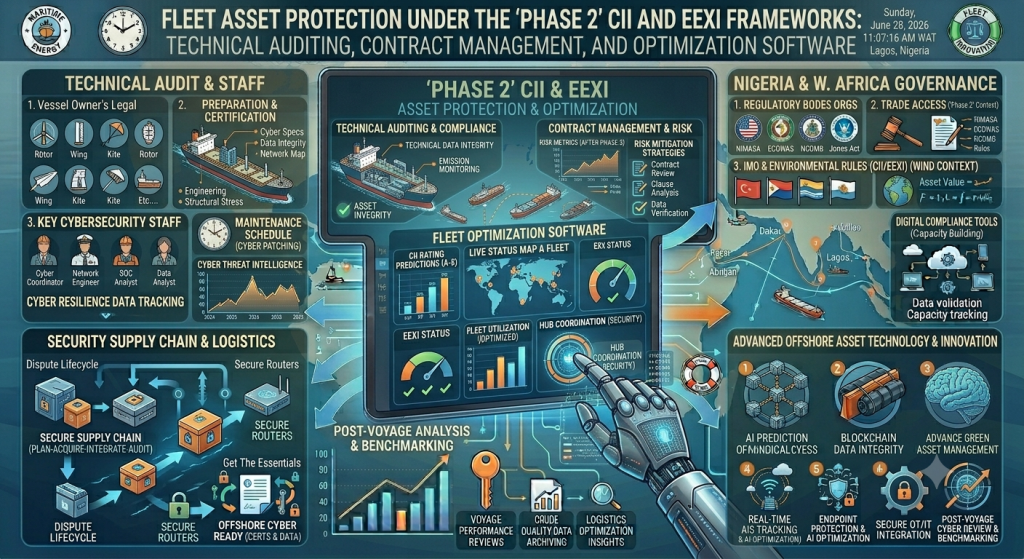
The regulatory framework governing international maritime emissions has transitioned into a highly litigious operational phase. The International Maritime Organization’s (IMO) dual mandates—the technical Energy Efficiency Existing Ship Index (EEXI) and the operational Carbon Intensity Indicator (CII)—are no longer distant engineering hurdles.
Entering the “Phase 2” regulatory era, the baseline limits for operational carbon emissions have tightened significantly. The annual carbon intensity reduction factor () has accelerated to a strict 11% reduction relative to the 2019 baseline.
For shipowners, commercial operators, and asset managers, structural underperformance under these frameworks is no longer just an environmental reporting issue—it directly causes the commercial devaluation of vessels. Hulls rated poorly face limited chartering potential, increased exposure to Port State Control (PSC) detentions, and exclusion from institutional marine financing under the Poseidon Principles.
This analysis details the technical compliance mechanics of the Phase 2 carbon intensity regime, the commercial allocation of regulatory risks in charter agreements, and the deployment of optimization software to protect vessel marketability.
Technical Mechanics: Deconstructing EEXI and CII
While often discussed together as the IMO’s “alphabet soup” of regulations, EEXI and CII measure entirely different parameters of a vessel’s environmental footprint.
EEXI: The Structural Technical Baseline
The EEXI is a one-time structural index that measures the theoretical design efficiency of a vessel over 400 Gross Tonnage (GT). It calculates the specific grams of emitted per cargo ton-mile based strictly on the ship’s installed machinery, auxiliary systems, and hull design.
By this phase of implementation, most active vessels have established their mandatory EEXI Technical Files. However, passive technical compliance solutions—primarily Engine Power Limitation (EPL) or Shaft Power Limitation (SHL)—are hitting operational limits. While mechanical de-rating successfully drops a vessel’s design profile to meet the required index, it permanently reduces the ship’s maximum operational speed. This leaves operators vulnerable when navigating severe weather or responding to urgent commercial schedules.
CII: The Live Operational Grade
The CII is a live, dynamic metric calculated annually for ships of 5,000 GT and above. It measures a vessel’s actual, real-world operational carbon intensity over an entire calendar year using the Attained Annual Operational CII formula:
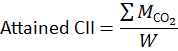
Where represents the total mass of
emitted from burning fuel onboard, and
represents the annual transport work, traditionally calculated using the vessel’s deadweight tonnage (DWT) multiplied by the total distance traveled underway (
).
Based on this calculation, vessels are graded from A (Major Superior) down to E (Inferior).
The Phase 2 Enforcement Matrix and Port State Control Risk
The transition into the current compliance year alters the consequences for underperforming assets. The tolerance windows for inefficient vessels have effectively closed.
[Phase 2 CII Compliance Enforcement Loop]
│
├─► Grade D (Three Consecutive Years) ──┐
│ ├─► Mandatory SEEMP Part III Revision
├─► Grade E (Single Year Performance) ──┘ (Strict PSC Audit Prerequisite)
│
└─► Non-Compliance / Audit Failure ─────► Loss of Statement of Compliance (SoC)
& Commercial De-rating
Vessels that receive a Grade D rating for three consecutive years, or a Grade E rating in a single year, face immediate regulatory penalties. The vessel’s Ship Energy Efficiency Management Plan (SEEMP) Part III must be completely revised to include a mandatory, audited Corrective Action Plan.
This plan must outline the exact operational modifications or technical retrofits the ship will deploy to achieve a passing profile (Grade C or better).
International Maritime Organization
Port State Control and the SoC
Under updated PSC guidelines, inspectors are directly targeting data consistency within the IMO Data Collection System (DCS). A vessel that fails to maintain its verified Statement of Compliance (SoC) for the SEEMP Part III can be cited with major non-conformities, resulting in:
- Immediate Port Detentions: Holding vessels at port gates until corrected plans are formally certified by the recognized organization (RO).
- Charter Defalcation: Violating vessel-readiness warranties, allowing charterers to place the ship off-hire or terminate long-term contracts without penalty.
Commercial Law: Managing Liabilities in Time Charters
The operational nature of the CII calculation creates significant legal friction between shipowners and time charterers. Because a vessel’s annual grade depends heavily on how it is operated—including speeds chosen, routing paths, and time spent idling at congested ports—disputes regularly arise regarding who bears the financial liability for a deteriorating rating.
To allocate these risks, the industry relies on the BIMCO CII Operations Clause for Time Charter Parties, which establishes a structured framework:
| Contractual Dimension | Charterer Obligations & Rights | Owner Rights & Protections |
| Operational Planning | Must operate the vessel within an agreed “Target CII” boundary; responsible for choosing efficient routes and speeds. | Retains the right to review, audit, and reject voyage instructions that would cause the vessel to fall into Grade D or E. |
| Data Transparency | Entitled to receive daily electronic fuel and emissions data from the vessel’s monitoring systems. | Must provide verified, clean data inputs gathered directly from calibrated digital mass flow meters. |
| Remedial Action | Must adjust voyage profiles (e.g., ordering slow steaming) if live software analytics show the ship is tracking toward a non-compliant grade. | Can refuse commercial employment orders if the charterer fails to deliver an updated operational plan following a rating warning. |
The Port Congestion Dispute Vulnerability
A major point of commercial litigation involves port waiting times. When a charterer orders a vessel to an exceptionally congested terminal, the ship continues to burn fuel in auxiliary boilers and generators while sitting stationary at anchor.
Because the vessel is consuming fuel without logging distance (), its operational efficiency drops significantly. Advanced legal agreements now contain custom clauses that isolate port idling emissions from the vessel’s base charter rating, preventing owners from being penalized for structural port delays beyond their control.
Software Solutions: Automated Fleet Analytics and Optimization
Manual data tracking via legacy spreadsheets cannot handle the data speeds required for Phase 2 compliance. Enterprise fleets are deploying automated Vessel Performance Monitoring Software (VPMS) linked directly to onboard sensors to manage their regulatory exposure.
[Automated Cloud Optimization Architecture]
│
├─► Onboard Sensors (Coriolis Flow Meters, GPS, Shaft Power)
│ │
│ ▼ (Edge Telemetry Upload via LEO Satellite)
│
└─► Cloud Analytics Platform
│
├─► Real-Time Predictive CII Trajectory Modeling
├─► Automated SEEMP Part III Performance Alerts
└─► Dynamic Voyage Speed & Trim Optimization Engine
These software platforms combine real-time sensor data with predictive machine learning algorithms to provide critical operational capabilities:
- Predictive Trajectory Modeling: Rather than waiting for year-end reporting, the platform runs continuous simulations to project the vessel’s final annual CII grade based on current fuel consumption, weather forecasts, and remaining charter days.
- Dynamic Speed and Trim Optimization: Software models calculate the most efficient combinations of speed, hull trim, and ballast distribution for specific sea states, giving the bridge crew actionable adjustments to minimize fuel consumption per mile.
- Automated SEEMP Audit Trails: The platform automatically aggregates, formats, and verifies data collected under the IMO DCS guidelines. This provides an unalterable, digital audit trail that can be sent directly to class surveyors, accelerating the annual verification process.
Frequently Asked Questions (FAQ)
How are emissions calculations adjusted for low-carbon alternative fuels?
Under updated IMO guidelines, the carbon emission factor () used in the CII calculation varies based on the verified fuel type used. While traditional residual fuel oil carries a high factor of
grams of
per gram of fuel, sustainable bio-blends, e-methanol, and green ammonia feature significantly lower or zero-rated operational
values. This allows owners to improve an underperforming vessel’s rating by switching to alternative fuels without requiring major structural retrofits.
What technical interventions can upgrade an EEXI-compliant ship without reducing speed?
If an Engine Power Limitation (EPL) framework restricts a vessel’s commercial speed too severely, owners can deploy physical Energy Saving Devices (ESDs). These include retrofitting high-efficiency propeller bosses, installing pre-swirl ducts to optimize water flow into the propeller, applying low-friction silicone hull coatings, or integrating auxiliary Wind-Assisted Propulsion Systems (WAPS). These physical modifications improve the ship’s base hydrodynamic efficiency, allowing it to meet EEXI targets while preserving its commercial speed profile.
Esenyel Partners
Who pays for the fuel used during a mandatory CII corrective action sea trial?
Under standard BIMCO frameworks, if a vessel is forced to undergo technical modifications or specific sea trials to correct a regulatory rating drop caused by normal operational wear, the owner covers those technical costs and the associated fuel burn. However, if the rating decline is proven to result directly from a charterer’s persistent breach of optimal routing and speed instructions, the charterer can be held financially responsible for the remedial expenses and lost charter time.
Recent Comments