
The global maritime industry is facing a critical structural deficit: a severe and worsening shortage of qualified seafaring labor. While commercial conversations regularly focus on fleet decarbonization and automated vessel hardware, the “People Pillar” remains the single most critical point of operational vulnerability. High turnover rates, escalating recruitment costs, and a shrinking talent pipeline of younger officers mean that crew retention has transformed from a human resources initiative into a core component of fleet profitability.
In 2026, modern seafarers are no longer willing to tolerate prolonged digital isolation or archaic, paper-heavy workflows. Shipowners, ship management companies, and crew managers are increasingly evaluated by the digital quality of life they provide onboard.
To protect fleet operational readiness and reduce costly crew churn, enterprise operators are rolling out technical interventions focused on three distinct areas: high-bandwidth satellite internet, continuous digital health infrastructure, and automated administrative workflows.
The High-Speed Connectivity Standard: LEOS vs. Legacy Satellite Arrays
The single most influential factor in a modern seafarer’s choice of employer is onboard internet access. Providing highly restricted, slow, text-only email connections is no longer sufficient to attract or retain top-tier officers and crew.
To meet this demand, fleet operators are transitioning away from high-latency, expensive legacy Geostationary (GEO) satellite networks to Low Earth Orbit (LEO) satellite constellations (such as Starlink Maritime and Eutelsat OneWeb).

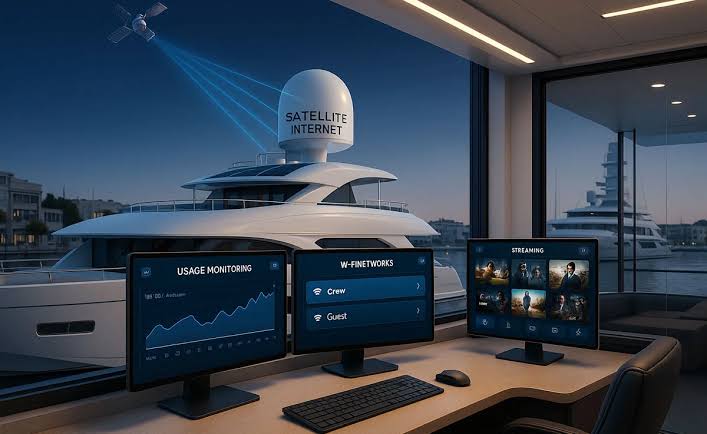
Modern Maritime LEO Satellite Connectivity and Bandwidth Allocation Setup. Source: Marine Data Solutions
The operational and psychological differences between these two orbital architectures are stark:
- Latency & Throughput: LEO networks operate at altitudes of roughly 550km to 1,200km, dropping network latency to less than 50 milliseconds (compared to greater than 600 milliseconds for GEO satellites sitting at 35,786km). This enables seamless, real-time video calls, cloud computing, and streaming video services.
- The Psychological ROI: Low-latency connectivity fundamentally mitigates the emotional toll of isolation at sea. It allows crew members to maintain immediate, daily contact with their families, stream personal media during off-watch hours, and access online educational resources—directly correlating with a measurable drop in early contract terminations.
Strategic Bandwidth Segmentation
To prevent crew web browsing from interfering with mission-critical vessel data, fleet IT managers must deploy strict Quality of Service (QoS) rules at the router level. Onboard networks must be segregated into distinct, virtual channels to ensure critical navigational systems retain priority access:
[Total Shipboard LEO Bandwidth Allocation]
│
├─► Channel 1: Navigation & Operational OT (20% Allocation – Protected Priority)
│
├─► Channel 2: Ship’s Business & Administrative IT (30% Allocation)
│
└─► Channel 3: Crew Welfare, Streaming & Personal Wi-Fi (50% Allocation – Dynamic Rate Limiting)
Remote Digital Health Monitoring and Telemedicine Infrastructure
Extended commercial voyages regularly put crew members days or weeks away from physical shore-based hospital networks. Historically, handling medical events at sea relied on basic shipboard medicine chests and crackly voice consultations with shoreside emergency services.
In 2026, advanced Digital Health Monitoring Systems (DHMS) are becoming standard requirements in charter-party agreements to protect crews and reduce multi-million dollar route diversions.
Modern onboard medical packages integrate connected IoT medical diagnostic equipment (such as digital stethoscopes, automated blood pressure cuffs, blood glucose meters, and mobile 12-lead ECG monitors) directly with secure cloud-based maritime telemedicine hubs.
| Telemedicine Component | Technical Capabilities | Concrete Operational Value |
| Connected IoT Diagnostic Hardware | Real-time transmission of vitals, blood chemistry metrics, and cardiac telemetry via encrypted satellite links. | Replaces inaccurate, subjective descriptions with precise clinical objective data for shoreside physicians. |
| Asynchronous Video Consultation Platform | Secure, compressed HD video storage designed to operate reliably even over fluctuating satellite connections. | Allows shoreside medical specialists to conduct visual evaluations of trauma or dermatological conditions. |
| Integrated Electronic Health Records (EHR) | Centralized, encrypted database storing crew medical histories, allergies, and vaccination logs. | Ensures immediate compliance with global port health authorities and international port state control (PSC). |
Eliminating Unnecessary Route Diversions
The financial ROI of an onboard digital health suite is immediate. A single emergency vessel diversion to drop off an injured or sick seafarer can easily cost a shipowner anywhere from $40,000 to over $150,000 in additional marine fuel, lost charter days, and port penalties.
By utilizing real-world diagnostic arrays, shoreside medical teams can accurately distinguish between minor ailments that can be managed onboard and true medical emergencies that require immediate evacuation, eliminating unnecessary operational interruptions.
Eradicating the Cognitive Burden: Automated Administrative Workflows
A frequently overlooked cause of seafarer burnout is the heavy administrative workload placed on ship officers. The modern bridge and engine control room have become bogged down by endless data entry tasks, port customs documentation, environmental logs, and safety compliance paperwork. This bureaucratic overload causes severe cognitive fatigue, taking focus away from safe watchkeeping duties and accelerating burnout.
To combat this, leading ship management companies are deploying Unified Ship-Shore Smart Applications designed to automate routine logging tasks:
- Automated Noon-Report Generation: Instead of manually typing complex data into spreadsheet templates, modern vessel performance software automatically extracts telemetry directly from integrated automation systems (such as fuel flow meters, GPS coordinates, and shaft power meters), formatting and sending the report to shoreside stakeholders with a single click.
- Digital Port State Documentation: Software platforms automatically compile crew manifests, port arrival documents, and health declarations, matching the custom formatting required by local port authorities worldwide to eliminate redundant data entry.
- Optical Character Recognition (OCR) for Inventories: Shipboard inventory counts for spare parts and provisions can be managed via mobile tablet applications using OCR scanning, automatically updating the central planned maintenance system (PMS) without tedious manual entry.
Reducing this digital friction restores hours of meaningful rest and operational focus to officers, making life at sea far more sustainable over long-term contracts.
Frequently Asked Questions (FAQ)
Is high-speed LEO satellite internet a mandatory requirement under international maritime law?
Currently, international frameworks like the Maritime Labour Convention (MLC, 2006) do not explicitly mandate high-speed broadband internet for crew members. However, the latest 2022 amendments to the MLC state that shipowners must provide seafarers with reasonable, cost-effective access to ship-to-shore communications, including internet access where practicable. While not strictly written as a hard technical speed requirement in the text, high-speed access has become an essential commercial standard for any company looking to attract talent.
How do shipowners protect crew data privacy when implementing digital health monitoring?
All onboard digital health platforms must strictly comply with global data protection frameworks, such as the European Union General Data Protection Regulation (GDPR) and the Health Insurance Portability and Accountability Act (HIPAA). Crew health metrics gathered by onboard IoT sensors are encrypted both at rest and during satellite transmission. This medical data is restricted only to certified shoreside medical providers and the vessel’s master, preventing access by unauthorized commercial charterers or corporate office staff.
What is the average cost to upgrade a merchant vessel to LEO satellite connectivity?
While flat panel LEO antenna hardware packages are relatively inexpensive (typically ranging from $2,500 to $5,000 per terminal), total commercial enterprise maritime installations usually cost between $10,000 and $25,000. This includes ruggedized mounting brackets, dual-antenna configurations to prevent mast blockages, specialized marine-grade power delivery units, and high-security enterprise network firewalls. However, these upfront capital expenses are quickly offset by lower monthly data costs compared to legacy GEO satellite contracts.
Recent Comments