
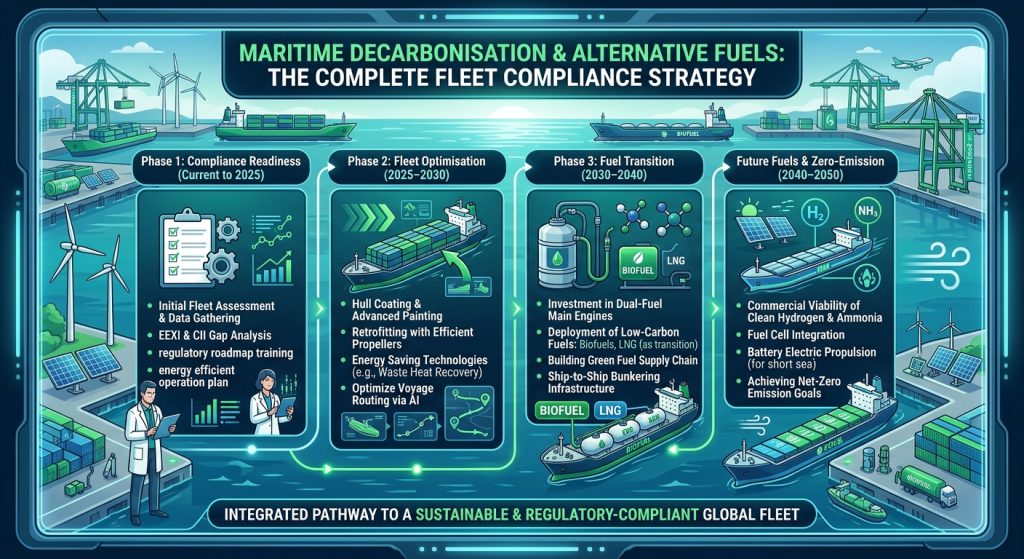
Navigating global decarbonisation requires balancing regulatory mandates, vessel capital expenditure (CapEx), fuel availability, and well-to-wake lifecycle carbon accounting.
Shipping accounts for roughly 3% of global anthropogenic greenhouse gas (GHG) emissions. Driven by international climate targets and regional enforcement regimes, decarbonisation has transitioned from a corporate sustainability goal to a primary driver of commercial vessel viability, charter party terms, and fleet valuation.
┌────────────────────────────────────────────────────────┐
│ REGULATORY PRESSURE DRIVING DECARBONISATION │
└───────────────────────────┬────────────────────────────┘
│
┌─────────────────────────────────┼────────────────────────────────┐
│ │ │
┌────────┴─────────┐ ┌────────┴─────────┐ ┌────────┴────────┐
│ IMO 2030 / 2050 │ │ EU ETS │ │ FuelEU Maritime │
│ GHG Targets │ │ (Full Phase-In) │ │ Intensity Caps │
└──────────────────┘ └──────────────────┘ └─────────────────┘
This technical guide provides shipowners, marine engineers, and sustainability directors with a strategic analysis of regulatory enforcement, alternative fuel engineering, economic realities, and regional bunkering infrastructure across key trade lanes.
1. Regulatory Drivers: IMO, EU ETS, and FuelEU Maritime
Fleet operators face an overlapping stack of global and regional regulations designed to make fossil-fuel-only operations economically unsustainable.
IMO 2030 / 2050 Revised Strategy
The International Maritime Organization (IMO) targets:
- 2030 Checkpoint: At least a 20% (striving for 30%) absolute reduction in total annual GHG emissions compared to 2008 baselines.
- 5–10% Fuel Mandate: Zero or near-zero GHG emission fuels must account for at least 5% (striving for 10%) of energy used by international shipping by 2030.
- Net-Zero Checkpoint: Absolute net-zero GHG emissions from international shipping by or around 2050.
- Carbon Intensity Indicator (CII): Requires annual carbon intensity reductions (
through
rating). Vessels rated
for three consecutive years or
for one year must submit a formal Corrective Action Plan within their SEEMP Plan (Part III).
EU ETS (Emissions Trading System)
The maritime sector’s integration into the EU ETS requires shipping companies to surrender EU Allowances (EUAs) for verified carbon emissions:
- 100% Surrender Coverage: Applies to 100% of emissions for intra-EU/EEA voyages and port calls, and 50% of emissions for voyages starting or ending outside the EU/EEA.
- Multi-Gas Scope: In addition to carbon dioxide (
), the regulatory framework explicitly incorporates methane (
) and nitrous oxide (
). Methane carries a global warming potential ~28 times higher than
, exposing dual-fuel LNG operators with unaddressed “methane slip” to direct carbon tax liabilities.
FuelEU Maritime Regulation
While the EU ETS taxes absolute emissions, FuelEU Maritime mandates a progressive reduction in the annual Greenhouse Gas (GHG) Intensity of energy used on board (measured in ):
- Mandated Reductions vs. 2020 Baseline (
):
- 2025–2029:
- 2030–2034:
- 2035–2039:
- 2040–2044:
- 2050:
- 2025–2029:
- Non-Compliance Penalty: Fixed at approximately €2,400 per metric ton of VLSFO-equivalent energy deficit, with escalating multipliers for consecutive years of non-compliance.
2. Comparative Matrix: Alternative Marine Fuels
Evaluating alternative marine fuels requires examining volumetric density, storage complexity, and lifecycle emissions.
| Fuel Type | Volumetric Energy Density (vs. HFO) | Storage & Handling Conditions | Well-to-Wake (WtW) GHG Reduction Potential | Primary Technology Readiness Level (TRL) | Main Technical Challenge |
| Liquefied Natural Gas (LNG) | ~60% | Cryogenic Liquid ( | ~15–20% (Fossil) / ~80%+ (Bio-LNG) | TRL 9 (Commercial) | Methane slip ( |
| Green Methanol ( | ~45% | Liquid at Ambient Temp (Low Flashpoint) | ~65–95% (e-Methanol or Bio-based) | TRL 8–9 (Commercial Expansion) | Low volumetric energy density; bunkering supply availability |
| Green Ammonia ( | ~30% | Liquid under pressure (17 bar) or refrigerated ( | ~90–100% (Zero carbon molecule) | TRL 6–7 (Pilot / Engine Testing) | Extreme toxicity to humans and marine life; |
| Liquid Hydrogen ( | ~25% | Deep Cryogenic Liquid ( | ~90–100% (Renewable Electrolysis) | TRL 5–6 (Prototypes) | Extreme volumetric footprint; boil-off loss; high flammability |
| Biofuels (B30 / B100 FAME or HVO) | ~90–95% | Ambient Liquid (Drop-in replacement) | ~60–85% (Dependent on feedstock) | TRL 9 (Commercial) | Feedstock sustainability verification (ILUC risks) & cost |
3. Deep-Dive Engineering & Operational Fuel Profiles
Green Methanol ()
Methanol has captured a significant share of dual-fuel newbuild orders, particularly in the container sector.
- Engineering Advantages: Liquid at room temperature and pressure, requiring simpler modifications to conventional fuel tanks than cryogenic fuels. Low flashpoint (
) systems require double-walled fuel lines, inert gas blanketing, and nitrogen purging systems.
- Engine Integration: Utilizes high-pressure direct injection (e.g., MAN Energy Solutions ME-LGIM engines) with a small diesel pilot injection (~5%) to ignite the methanol air mixture.
- Operational Trade-off: Requires roughly
the storage volume of conventional Heavy Fuel Oil (HFO) for equivalent energy output, resulting in a loss of cargo space unless offset by optimized route bunkering.
[Methanol Storage Tank]
│
▼
[Nitrogen Inerting & Blanket System]
│
▼
[Low-Flashpoint Fuel Supply System (LFSS) @ 10-13 bar]
│
▼
[High-Pressure Booster Injection Pump @ ~600 bar]
│
▼
[MAN ME-LGIM Dual-Fuel Main Engine]
Green Ammonia ()
Ammonia contains zero carbon atoms, eliminating from tailpipe (Tank-to-Wake) emissions entirely.
- Engineering Challenges: Extreme toxicity. Immediate Danger to Life or Health (IDH) threshold is low (~300 ppm). Engine rooms require double-walled fuel piping with emergency negative-pressure ventilation, dedicated absorption scrubbers to process vented gases, and advanced leak detection systems.
- Combustion Dynamics: Slow burning velocity and low flammability require pilot fuel injection. Unburned ammonia in exhaust gas requires Selective Catalytic Reduction (SCR) systems to eliminate both toxic
slip and nitrous oxide (
)—a greenhouse gas ~265–273 times more potent than
.
LNG, Bio-LNG, and Synthetic LNG
LNG provides immediate local pollutant reductions (,
, particulate matter) and lower carbon intensity than traditional heavy fuels.
- The Methane Slip Challenge: Unburned methane escaping combustion chambers is subject to EU ETS carbon pricing. Low-pressure 2-stroke Otto-cycle engines experience higher slip than high-pressure Diesel-cycle engines (e.g., ME-GI).
- Mitigation Pathway: Shipowners are adopting high-pressure dual-fuel injection, oxidation catalysts, and blending Bio-LNG or e-LNG into existing supply chains to reduce lifecycle GHG intensity.
4. Well-to-Wake (WtW) Accounting & The “Green Premium”
Regulations under FuelEU Maritime and the IMO GHG Intensity framework do not measure Tank-to-Wake (TtW) stack emissions alone. They evaluate Well-to-Wake (WtW) lifecycle emissions, divided into two distinct components:

- Well-to-Tank (WtT): Emissions generated during feedstock extraction, processing, synthesis, refining, transport, and bunkering.
- Tank-to-Wake (TtW): Emissions released on board during fuel storage, conversion, and combustion in engines or boilers.
┌────────────────────────────────────────────────────────────────────────┐
│ WELL-TO-WAKE (WtW) LIFECYCLE │
├───────────────────────────────────┬────────────────────────────────────┤
│ WELL-TO-TANK (WtT) STAGE │ TANK-TO-WAKE (TtW) STAGE │
├───────────────────────────────────┼────────────────────────────────────┤
│ Feedstock Extraction / Energy │ Onboard Fuel Storage & Handling │
│ Chemical Processing / Synthesis │ Engine Fuel Injection & Combustion │
│ Bunkering Logistics & Transport │ Stack Exhaust Emissions (GHGs) │
└───────────────────────────────────┴────────────────────────────────────┘
Critical Compliance Reality: A vessel burning “Grey Methanol” (synthesized from fossil natural gas) may achieve clean TtW combustion, but its high WtT emissions score results in higher net WtW penalties under FuelEU Maritime than burning standard VLSFO. True compliance requires e-fuels (synthesized via renewable hydrogen and captured ) or certified biogenic fuels.
Economic Realities: The Green Premium Gap
Zero-emission e-fuels currently carry a cost multiplier relative to conventional marine fuels ( to
on an energy-equivalent basis).
Conventional VLSFO: [ $600 – $700 / Metric Ton ]
Bio-Methanol: [ $1,100 – $1,400 / MT Equivalent ]
e-Methanol: [ $1,800 – $2,400 / MT Equivalent ]
Green Ammonia: [ $1,200 – $1,600 / MT Equivalent ]
As EU ETS carbon prices and FuelEU Maritime penalties increase, the cost gap between fossil fuels and green alternatives will narrow.
5. Regional Infrastructure & Bunkering Networks
The operational viability of any alternative fuel depends on local port bunkering infrastructure.
[Rotterdam / Antwerp]
• Green Methanol & Bio-LNG Hubs
• Strict EU ETS & FuelEU Enforcement
│
▼
[Suez Canal] ──► [Port of Fujairah / Jebel Ali (UAE)]
• $1B+ Clean Energy Bunkering Investment
• Green Ammonia Export Terminals
│
▼
[Singapore / East Asia]
• Methanol Stem Operations
• LNG Ship-to-Ship Transfers
- United States (US Gulf Coast): Significant expanding production of green hydrogen, ammonia, and bio-feedstocks. Ports like Houston and Corpus Christi are developing bunkering infrastructure to support export and domestic shipping corridors.
- Europe (Rotterdam, Antwerp, Hamburg): Active alternative fuel bunkering hubs. Regulatory pressure from EU directives makes North Europe the primary testing ground for dual-fuel methanol and bio-LNG vessel calls.
- United Arab Emirates (Fujairah & Dubai/Jebel Ali): Positioned at the intersection of East-West trade, the UAE is investing in clean fuel bunkering networks. Fujairah and Jebel Ali are developing infrastructure for green ammonia and methanol stems to remain primary bunkering hubs.
- Canada (Vancouver & St. Lawrence Seaway): Pushing green shipping corridors, focusing on shore power (cold iron) infrastructure and clean fuel integration for coastal and trans-Pacific trades.
6. Strategic Compliance Roadmap for Shipowners
To maintain vessel asset value, charterability, and regulatory compliance, fleet operators can follow a phased strategy:
Short-Term (2026–2028): Operational Optimization & Drop-In Blends
- Install Energy Efficiency Devices (EEDs): Retrofit hull air lubrication systems, ESD ducts, hub caps with fins, and high-performance silicone hull coatings to lower fuel consumption.
- Deploy Wind-Assisted Propulsion (WAPS): Install Rotor Sails or rigid wings to reduce main engine load by 5% to 15% on favorable ocean trade routes.
- Utilize Biofuel Blends: Drop in B20 or B30 FAME/HVO blends to lower fleet GHG intensity without requiring main engine CapEx modifications.
- Methane Slip Mitigation: Upgrade software and combustion hardware on low-pressure dual-fuel LNG engines to reduce methane slip exposure under EU ETS.
Mid-Term (2028–2030): Dual-Fuel Retrofits & Off-Take Agreements
- Execute Dual-Fuel Conversions: Convert mid-life 2-stroke engines to run on methanol or LNG/Bio-LNG during major drydocking cycles.
- Secure Off-Take Contracts: Lock in long-term supply agreements for green e-methanol or bio-LNG to protect against supply deficits and price spikes.
- Leverage FuelEU Pooling: Pool vessel performance within fleets or across alliances to balance underperforming legacy ships with ultra-low-emission dual-fuel assets.
Long-Term (2030+): Native Zero-Emission Fleet Renewal
- Deploy Native Zero-Carbon Newbuilds: Build vessels designed specifically for green ammonia or hydrogen, featuring integrated safety, inerting, and exhaust treatment systems.
- Complete Cold Ironing Integration: Ensure entire fleet is equipped for Onshore Power Supply (OPS) to eliminate berth emissions and avoid port-use penalties.
Frequently Asked Questions (FAQ)
1. How does methane slip affect EU ETS compliance costs for LNG-fuelled ships?
Methane slip is unburned methane escaping the combustion chamber. In the EU ETS framework, methane emissions are converted to carbon dioxide equivalents () using a Global Warming Potential factor. Ships experiencing significant slip must purchase and surrender additional EU Allowances (EUAs), increasing operating costs.
2. What is the difference between EU ETS and FuelEU Maritime?
The EU ETS is a cap-and-trade market requiring companies to buy carbon allowances for absolute emissions (,
,
). FuelEU Maritime is a regulatory standard that sets decreasing limits on the yearly average Greenhouse Gas (GHG) energy intensity (
) used on board. Non-compliance with FuelEU results in fixed financial penalties.
3. Can I use standard bio-marine fuels without modifying my engine?
Yes. Biofuel blends such as FAME (Fatty Acid Methyl Esters) and HVO (Hydrotreated Vegetable Oil) up to B30 (and in some cases B100 HVO) act as drop-in fuels. They generally require minimal engine modification, though operators must monitor fuel filter clogging, seal compatibility, and storage stability.
4. Why is green methanol gaining more orders than green ammonia?
Green methanol technologies, engine designs, and handling rules are commercially established, and methanol remains liquid at room temperature. Ammonia carries safety challenges due to extreme toxicity, requires complex safety systems, and engine technologies are still undergoing final marine testing and commercial scale-up.
5. What is “Compliance Pooling” under FuelEU Maritime?
FuelEU Maritime allows shipping companies to pool the performance of multiple ships. Over-compliant vessels (e.g., green methanol-powered ships with a surplus) can offset under-compliant vessels (e.g., standard HFO ships with a deficit), helping the combined fleet meet compliance targets without paying penalties.
Need expert guidance on fleet carbon compliance, EU ETS strategy, or alternative fuel retrofits? Contact the technical advisors at Oitha Marine to optimize your fleet’s decarbonisation roadmap.
Recent Comments