
Navigating international supply chains requires absolute clarity on risk, cost allocation, and regulatory compliance. Selecting the wrong commercial terms can instantly erase profit margins through unexpected demurrage, unpaid import tariffs, or misallocated transit liabilities.
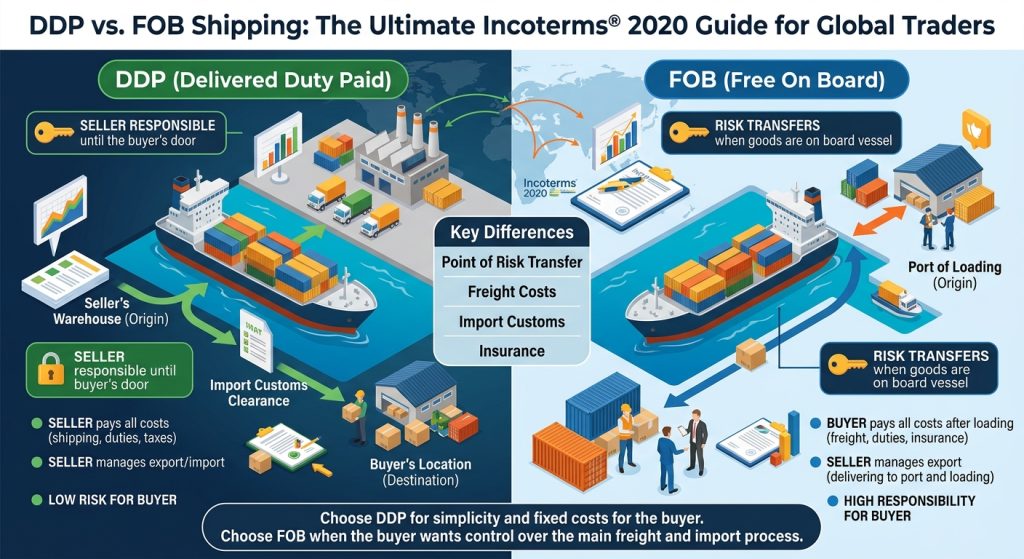
Under the International Chamber of Commerce (ICC) Incoterms® 2020 framework, Free on Board (FOB) and Delivered Duty Paid (DDP) represent the two polar extremes of buyer vs. seller responsibility.
- FOB places primary operational control and transit risk on the buyer once cargo is loaded at the origin port.
- DDP places maximum obligation, customs compliance, and financial liability on the seller until goods arrive at the buyer’s doorstep.
This analysis breaks down the legal, financial, and operational differences between DDP and FOB shipping across key trade lanes in the United States, United Kingdom, Canada, and the United Arab Emirates.
What is FOB (Free on Board)?
FOB (Free on Board) is a rule reserved exclusively for sea and inland waterway transport. Under FOB terms, the seller fulfills their delivery obligation when the cargo is loaded on board the vessel nominated by the buyer at the named port of shipment.
[Seller’s Warehouse] ──► [Inland Transit] ──► [Export Customs] ──► [On Board Vessel] │ ──► [Ocean Freight] ──► [Import Customs] ──► [Final Delivery]
◄────────────────────────────── SELLER RESPONSIBILITY ──────────────────────────────► │ ◄───────────────────────────── BUYER RESPONSIBILITY ────────────────────────────►
▲
RISK TRANSFER POINT
Key Seller Obligations Under FOB
- Export Logistics: Inland transport from factory/warehouse to the origin port.
- Customs Clearance: Filing export documentation and paying export duties/licenses in the origin country.
- Terminal Handling Charges (Origin THC): Paying port loading fees until the goods pass over the ship’s rail and rest safely on board.
Key Buyer Obligations Under FOB
- Main Carriage: Booking and paying for main ocean freight.
- Cargo Insurance: Securing marine cargo insurance from the origin port onward (optional, but highly recommended).
- Import Formalities: Handling destination customs clearance, paying import tariffs, national taxes (e.g., VAT/GST), and local drayage to the final warehouse.
Critical Maritime Nuance: The ICC explicitly advises against using FOB for containerized cargo handed over to a carrier at a inland terminal or container freight station (CFS) prior to loading onto a vessel. In these scenarios, Free Carrier (FCA) should be used to avoid creating an operational gap where risk has passed in theory, but the seller retains physical custody of the container.
What is DDP (Delivered Duty Paid)?
DDP (Delivered Duty Paid) is a multimodal rule applicable to any mode of transport (sea, air, rail, road, or intermodal). DDP places maximum obligation on the seller, requiring them to handle every step of the supply chain from origin to final destination, including clearing goods through import customs and paying all applicable duties and taxes.
[Seller’s Warehouse] ──► [Export Customs] ──► [Main Freight] ──► [Import Customs & Duties] ──► [Arrival at Buyer’s Door] │ ──► [Unloading]
◄───────────────────────────────────────────────── SELLER RESPONSIBILITY ─────────────────────────────────────────────────► │ ◄── BUYER ──►
▲
RISK TRANSFER POINT
Key Seller Obligations Under DDP
- End-to-End Transit: Booking and paying for inland transport, export clearance, ocean/air freight, destination port handling, and final truck delivery.
- Import Customs & Tariff Liability: Acting as (or appointing) the legal Importer of Record (IOR). Paying all customs duties, tariffs, entry fees, and non-refundable local taxes.
I.C.E. Transport+ 1
- Transit Risk: Bearing all risk of loss or damage until cargo arrives at the designated place of destination, ready for unloading.
ICC Academy – International Chamber of Commerce
Key Buyer Obligations Under DDP
- Take Delivery: Assisting with local delivery access and unloading the cargo from the arriving transport vehicle at their facility (unless contractually agreed otherwise under DPU terms).
ICC Academy – International Chamber of Commerce
- Local Information: Providing import licenses or local tax ID numbers if required by foreign customs authorities.
DDP vs. FOB: Direct Comparison Matrix
| Operational / Legal Factor | FOB (Free on Board) | DDP (Delivered Duty Paid) |
| Applicable Transport Modes | Sea and Inland Waterway only | Any Mode / Multimodal (Air, Sea, Road, Rail) |
| Point of Risk Transfer | Loaded on board vessel at origin port | Upon arrival at named destination (before unloading) |
| Main Ocean/Air Freight | Arranged & Paid by Buyer | Arranged & Paid by Seller |
| Cargo Insurance | Buyer’s option & expense | Seller’s risk (Must cover to destination) |
| Export Clearance | Handled & Paid by Seller | Handled & Paid by Seller |
| Import Customs Clearance | Handled & Paid by Buyer | Handled & Paid by Seller |
| Import Duties & Taxes | Paid by Buyer | Paid by Seller |
| Importer of Record (IOR) | Buyer (or local agent) | Seller (or authorized local broker) |
| Destination Terminal Fees | Paid by Buyer | Paid by Seller |
Deep-Dive Analysis: Financial, Risk, and Compliance Differences
1. Freight Rate Control and Pricing Transparency
- Under FOB: The buyer maintains complete visibility over ocean freight rates, security surcharges, fuel adjustment factors (BAF), and transit routes. Buyers with significant volume can leverage their own freight forwarder service contracts to lower unit transportation costs.
- Under DDP: The seller quotes an all-inclusive price per unit. To protect against spot-market volatility, exchange rate shifts, and destination demurrage, sellers frequently apply a 10–20% risk premium on shipping and handling fees.
2. Importer of Record (IOR) and Jurisdictional Hurdles
Executing DDP shipments across major global trade hubs introduces regulatory compliance challenges that many cross-border sellers overlook:
- United States (CBP): A foreign seller under DDP must act as a Non-Resident Importer (NRI) and purchase a foreign single-entry or continuous customs bond. Furthermore, Partner Government Agencies (PGAs) like the FDA or EPA often mandate a domestic U.S. entity to hold product approvals.
- United Kingdom (HMRC): Following Brexit, executing DDP into the UK requires an EORI number registered with HMRC. Sellers must also register for UK Value Added Tax (VAT) to clear customs and pay import VAT, which can trigger complex foreign tax reporting obligations.
- Canada (CBSA): Foreign sellers can participate in the Non-Resident Importer (NRI) program under the Canada Border Services Agency. However, Goods and Services Tax (GST) and Harmonized Sales Tax (HST) obligations must be carefully handled to avoid double taxation.
- United Arab Emirates (Dubai Customs): Foreign entities cannot directly act as Importers of Record within the UAE mainland without a commercial license issued by the Department of Economy and Tourism (DET) or a designated free zone authority (e.g., JAFZA). Sellers must contract a licensed UAE customs broker or local agent to execute DDP entries.
3. Exposure to Demurrage, Detention, and Port Storage
Supply chain bottlenecks often reveal the true cost differences between these terms:
- In an FOB transaction, if cargo is held at the destination port due to delayed customs clearance or missing import documents, the buyer pays all accrued demurrage and storage charges.
- In a DDP transaction, because the seller is legally responsible for clearing customs and coordinating door delivery, all demurrage, detention, and customs hold penalties fall on the seller.
When to Use FOB vs. DDP: Strategic Recommendations
┌──────────────────────────────────────────────┐
│ Evaluating Supply Chain Capabilities │
└──────────────────────┬───────────────────────┘
│
Is the seller able to act as foreign
Importer of Record (IOR) safely?
/ \
/ \
YES NO
/ \
Is the buyer seeking a hands-off, Use FOB
turnkey import solution (e.g. e-com)? (or FCA / DAP)
/ \
YES NO
/ \
Use DDP Use FOB
(Delivered Duty Paid) (Free on Board)
Choose FOB Shipping If:
- You are an experienced importer with direct contracts with shipping lines or international freight forwarders.
- You import high volumes / FCL (Full Container Load) freight and want to maximize scale economies on freight rates.
- You want full control over supply chain visibility, cargo routing, and carrier selection.
- Your country restricts non-resident entities from clearing customs or reclaiming input VAT.
Choose DDP Shipping If:
- You run an e-commerce brand or B2B supply model where buyers demand zero customs involvement and predictable landed costs.
- Your customer lacks importing experience, lacks customs broker relationships, or refuses to handle freight logistics.
- You are shipping high-value sample goods, small LCL consignments, or urgent spare parts via express air freight.
- The seller has an established overseas footprint, local tax registrations, and proven customs clearance brokers in the destination country.
Incoterms® 2020 Quick Reference Summary
| Incoterm Rule | Mode of Transport | Export Customs | Main Freight | Point of Risk Transfer | Import Customs & Duties | Best Suited For |
| EXW (Ex Works) | Any Mode | Buyer | Buyer | At Seller’s Factory / Warehouse | Buyer | Experienced buyers with local freight agents |
| FCA (Free Carrier) | Any Mode | Seller | Buyer | Handed to carrier at named place | Buyer | Containerized, air freight & multimodal cargo |
| FOB (Free on Board) | Ocean / Waterway | Seller | Buyer | Loaded on board ocean vessel | Buyer | Bulk, breakbulk, and non-containerized cargo |
| CIF (Cost, Insurance & Freight) | Ocean / Waterway | Seller | Seller | Loaded on board vessel (Seller buys insurance) | Buyer | Commodity trading & Letter of Credit (L/C) sales |
| DAP (Delivered at Place) | Any Mode | Seller | Seller | Arrived at destination (Unloaded by Buyer) | Buyer | Buyers wanting door delivery without customs hassle |
| DDP (Delivered Duty Paid) | Any Mode | Seller | Seller |
Frequently Asked Questions (FAQ)
1. Who pays for cargo insurance under DDP vs. FOB?
Under FOB, neither party is contractually mandated by Incoterms® 2020 to purchase insurance. However, because the buyer bears transit risk once the cargo is loaded on board, the buyer should secure ocean cargo insurance. Under DDP, the seller bears all risk to the destination door. While DDP does not mandate insurance purchase explicitly, the seller absorbs all financial loss if cargo is lost or damaged in transit.
2. Can DDP be used for air freight shipments?
Yes. DDP is a multimodal term suitable for air freight, sea freight, courier networks, rail, and road transport. FOB, however, is strictly limited to ocean and inland waterway transport.
3. What is the difference between DDP and DAP (Delivered at Place)?
Under DAP (Delivered at Place), the seller delivers the goods to the destination address, but the buyer handles import customs clearance and pays all import duties, tariffs, and local taxes. Under DDP, the seller assumes full legal and financial responsibility for import customs clearance and duty payments.
4. What happens if a foreign seller cannot clear customs under DDP terms?
If a seller signs a DDP contract but is legally unable to act as the Importer of Record or obtain local clearance authority, the cargo will be held at customs. Demurrage and storage fees will accumulate daily. In such cases, the contract must be amended to DAP or FCA, transferring import clearance duties to the buyer.
5. Why is FOB often considered risky for container shipping?
For container cargo, goods are typically delivered to a port terminal or container yard days before being loaded onto a ship. Under FOB, the seller retains risk while the container sits at the port until it is physically loaded on board. If damage occurs during terminal handling prior to vessel loading, disputes arise over when risk passed. The ICC recommends using FCA (Free Carrier) for container freight to transfer risk at the point of terminal receipt.
Recent Comments