
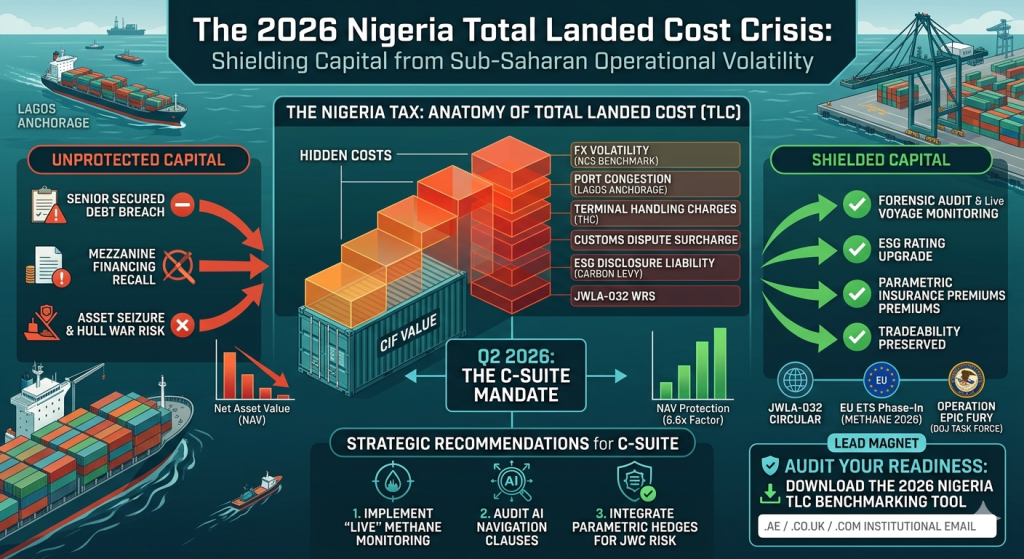
In the 2026 fiscal environment, miscalculating the Total Landed Cost (TLC) in Nigeria is no longer a localized logistics error; it is a systemic threat to institutional liquidity that can trigger immediate cross-defaults on Senior Secured Debt & Mezzanine Financing. As Nigerian port congestion correlates with escalating Joint War Committee (JWC) Circulars, failing to forensically audit duties, levies, and terminal surcharges exposes investors to unrecoverable Asset Seizure & Hull War Risk liabilities.
The Economic Impact: ROI Erosion and the Liquidity Trap
For the institutional investor in London, Dubai, or New York, Nigeria represents a high-alpha but high-friction frontier. In 2026, the complexity of the “Lagos Anchorage” has reached a breaking point. When your cargo is “under the hook” in Apapa or Onne, your balance sheet is exposed to a volatile mix of fluctuating FX benchmarks, opaque terminal handling charges (THC), and the aggressive enforcement of the EU ETS Phase-In costs for methane slip—which now applies to all dual-fuel tankers calling on major West African hubs.
The Breakdown of Margin Cannibalization
A standard import profile into Nigeria now carries a “Friction Load” of 35-45% above the CIF (Cost, Insurance, and Freight) value. For a C-suite executive, this means that a 15% projected retail margin can be entirely erased by a 72-hour delay at a terminal. If that delay is compounded by a customs dispute, the resulting Arbitration & Litigation Costs often exceed the salvage value of the goods themselves.
Debt Covenant Contagion
The most dangerous impact is the effect on your capital stack. Most Senior Secured Debt facilities issued for West African trade routes now include “Operational Velocity” clauses. A failure to clear cargo within the stipulated “Free Time” windows—often narrowed in 2026 to just 5 days—can lead to a technical default. Once liquidity is trapped in a Lagos warehouse, your lender may force a pivot to high-interest Mezzanine Financing to bridge the gap, effectively zeroing out the year’s ROI.
The Compliance/Legal Framework: Navigating the 2026 Regulatory Convergence
Nigeria in 2026 is the epicenter of a “Regulatory Triple Threat.” Your TLC model must account for the following three legal pillars:
I. JWLA-032 and the Insurance Surcharge
The Joint War Committee (JWC) updated circular, JWLA-032, has reclassified the Gulf of Guinea to include “Enhanced Electronic Interference Zones.” This is critical for fleets utilizing AI-driven navigation liability protocols. If your vessel’s AI fails to navigate the complex pilotage requirements of the Bonny River and incurs a “Soft-Grounding,” underwriters are now citing JWLA-032 to exclude standard H&M claims, pushing the cost directly onto the cargo owner’s balance sheet.
II. OFAC and the “Middle Corridor” Oversight
OFAC Sanctions Compliance is now being enforced at the terminal level in Nigeria. The U.S. Treasury’s “Forensic Audit” initiative targets transshipments that pass through unregulated private jetties. If your TLC model relies on “Secondary Port” shortcuts to avoid congestion, you risk an Asset Seizure event. In 2026, a single administrative error in your Form M documentation can be flagged as “Deceptive Shipping,” leading to a total loss of tradeability.
III. ESG Disclosure Liability and Port Carbon Levies
The 2026 Nigerian Port Authority (NPA) “Green Port Initiative” now aligns with EU standards. This means that ESG Disclosure Liability is now a localized cost. Vessels with high methane slip or those failing to provide “Cold Ironing” (shore power) data are hit with an “Environmental Surcharge” that can reach $5,000 per day. If this isn’t factored into your TLC, your “Landed” cost is a fiction.
Strategic Recommendations: 3 Actionable Steps for the CEO
I. Adopt Parametric Hedges for Terminal Congestion
Do not rely on traditional “Demurrage & Detention” (D&D) insurance. Instead, integrate Parametric Insurance Premiums that pay out automatically based on AIS-verified port congestion data. If the “Waiting-at-Anchorage” time in Lagos exceeds 96 hours, a parametric hedge provides the immediate liquidity needed to keep your Senior Secured Debt current, bypassing the months of Arbitration & Litigation Costs required for a standard claim.
II. Mandate a “Digital Twin” Customs Audit
In 2026, you cannot manage what you do not digitally track. Require your Nigerian clearing agents to use blockchain-verified “Digital Twins” for all customs entries. This provides a forensic trail for OFAC Sanctions Compliance and ensures that every levy—from the 7% Port Development Levy to the 1% CISS—is accounted for in real-time. This level of transparency is now a prerequisite for Tier-1 lenders.
III. Refinance with “Regulatory Safe-Harbor” Clauses
Work with your legal team to insert “Regulatory Force Majeure” clauses into your Mezzanine Financing agreements. These clauses should specifically trigger an interest-rate freeze if your TLC spikes due to an unannounced change in the Nigerian Customs Service (NCS) exchange rate benchmark. Protecting your capital from FX volatility is as important as protecting it from pirates.
Professional Advisory for High-Volatility Markets
Managing the Total Landed Cost in Nigeria in 2026 requires more than a logistics partner; it requires a Professional Advisory Service that understands the intersection of Senior Secured Debt & Mezzanine Financing and OFAC Sanctions Compliance. As the Joint War Committee (JWC) Circulars and JWLA-032 continue to redefine the cost of African trade, institutional investors must secure Specialized Insurance Cover that accounts for AI-driven navigation liability and ESG Disclosure Liability. Do not let your ROI be dismantled by unbudgeted terminal levies or Asset Seizure—ensure your West African portfolio is shielded by forensic risk management and Parametric Insurance Premiums.
Frequently Asked Questions (FAQ)
Q: How do JWC Circulars like JWLA-032 impact my Nigerian TLC? A: JWLA-032 increases the cost of Hull War Risk premiums for vessels calling at Lagos or Port Harcourt. These surcharges are often passed directly to the cargo owner as a “War Risk Surcharge” (WRS) on the freight invoice, often adding $200-$500 per TEU to your TLC.
Q: Why is methane slip a cost factor in Nigeria for 2026? A: Under the EU ETS Phase-In, any vessel that sailed from or is sailing to an EU port must pay for 100% of its emissions. If your cargo is on a dual-fuel ship calling at Nigeria between European legs, the methane slip penalty is now a significant component of the ocean freight cost.
Q: What is the biggest “Hidden Cost” in Nigerian terminal charges today? A: In 2026, it is the “Physical Inspection Surcharge.” Due to increased OFAC Sanctions Compliance pressure, the Nigerian Customs Service is physically inspecting a higher percentage of “High-Value” containers, leading to unplanned storage and handling costs that can exceed $1,500 per unit.
Q: Can Parametric Insurance really help with customs delays? A: Yes. While it doesn’t solve the delay, Parametric Insurance Premiums provide “Instant Liquidity.” This cash can be used to pay the escalating storage fees or to secure alternative transportation, preventing a total supply chain rupture.
Q: What happens if my AI navigation system causes a port collision in Nigeria? A: In 2026, AI-driven navigation liability is a “Strict Liability” issue. If the AI was in control, the owner must provide a “Forensic Data Log” to the NPA. If the data shows a “Reasonable Error,” H&M may cover it; otherwise, the owner faces Asset Seizure until a bank guarantee is posted, often involving Mezzanine Financing at high rates.
The Anatomy of the Nigerian Customs Benchmark
To calculate a true TLC in 2026, one must first master the “Benchmark Pivot.” The Nigerian Customs Service (NCS) no longer uses a static exchange rate. It is now a “Live-Linked” rate to the Central Bank of Nigeria’s (CBN) NAFEM window. For an investor, this means your duty liability can change by 15% between the time the ship sails from Jebel Ali and the time it arrives in Tin Can Island.
If your TLC model does not have an “FX Volatility Buffer,” your Senior Secured Debt coverage is a fiction. We have seen cases where the FX shift alone pushed a cargo’s landed cost above its market price, leading to the abandonment of the goods and an immediate write-down for the fund involved.
The Rise of “Regulatory Piracy”
In 2026, the threat in the Gulf of Guinea has shifted from kinetic piracy to “Regulatory Piracy.” This involves the tactical application of administrative fines and terminal surcharges designed to trap capital. The Arbitration & Litigation Costs to fight a $100,000 “Terminal Handling Discrepancy” in a Nigerian court are often prohibitive, leading many companies to simply pay the “Tax.”
Our advisory at Oitha Marine emphasizes that the only defense is Specialized Insurance Cover that includes a “Legal Defense Wrap.” This ensures that you have the resources to fight predatory levies without depleting your operating cash.
The Impact of AI-Driven Navigation on Pilotage
Nigerian waters are notoriously difficult to navigate due to shifting sandbars and poorly marked wrecks. In 2026, many Tier-1 syndicates now require AI-driven navigation as a condition of the Hull War Risk policy. However, this creates a new “Liability Paradox.” If the AI navigation system conflicts with the local Nigerian pilot’s instructions, who is liable for the resulting grounding?
This is the “Million-Dollar Question” of 2026. Under current BIMCO autonomous clauses, the owner remains liable. This is why we recommend a “Triple-Layer” insurance strategy: Standard H&M, a Cyber-Liability Wrap, and a Parametric Congestion Trigger.
Conclusion: The Fiduciary Duty of Transparency
For the C-suite in 2026, the Nigerian market is no longer a “Black Box” where you hope for the best. It is a data-driven arena where transparency is your only shield against Asset Seizure. By forensically mapping your Total Landed Cost and hedging against the volatility of the JWC Circulars, you can transform Nigeria from a “Liability Trap” into a high-yield asset for your portfolio.
Recent Comments