
In the Q2 2026 fiscal landscape, the convergence of “deceptive shipping” enforcement and aggressive carbon pricing has transformed vessel operating expenses into potential balance sheet wipeouts. Investors must move beyond traditional indemnity models to address the immediate threats of technical default on Senior Secured Debt & Mezzanine Financing triggered by non-compliance with the latest Joint War Committee (JWC) Circulars.
The Economic Impact: The Erosion of Net Asset Value (NAV)
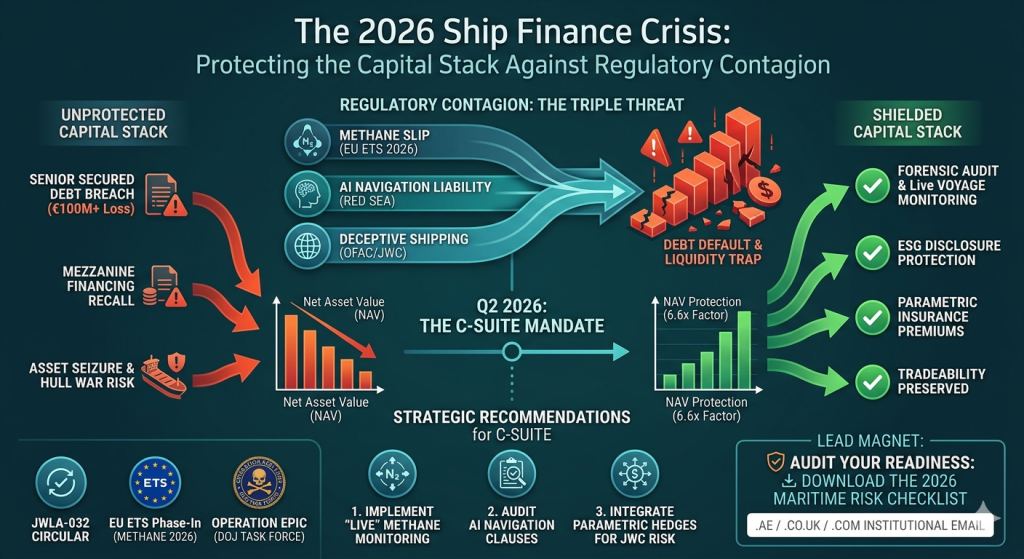
For the institutional investor in London, Dubai, or Houston, the “Million-Dollar Problem” of 2026 is the sudden illiquidity of maritime assets under new regulatory stress tests. We are no longer dealing with simple operational delays; we are witnessing the structural devaluation of fleets that fail to account for the “Regulatory Triple Threat”: Methane slip, AI liability, and kinetic war risk.
The Debt Service Coverage Ratio (DSCR) Trap
The entry into force of the EU ETS Phase-In costs for methane slip has added an unbudgeted $12,000 to $20,000 per day to the operating costs of dual-fuel tankers. For a leveraged fleet, this opex spike compresses margins to the point of breaching DSCR covenants. Once a breach is declared, Senior Secured Debt providers—increasingly risk-averse in the 2026 high-rate environment—are frequently calling for immediate equity injections or forcing a pivot to predatory Mezzanine Financing to maintain liquidity.
The Illiquidity of “Flagged” Assets
The financial impact of a vessel being listed under JWLA-032 cannot be overstated. When a ship enters a zone designated by the Joint War Committee (JWC) Circulars, and that transit is flagged for poor OFAC Sanctions Compliance (even if inadvertent), the asset becomes functionally “frozen.” You cannot sell it, you cannot refinance it, and your Asset Seizure & Hull War Risk premiums will spike by 400% overnight. This “Contagion” effectively erodes the Net Asset Value (NAV) of the entire fund.
The Compliance/Legal Framework: Navigating the 2026 Directives
The legal architecture of maritime risk has shifted from “post-event indemnity” to “pre-emptive strict liability.” To protect your capital, you must understand the interplay between these three 2026 pillars:
I. The JWLA-032 and the Kinetic Exclusion
The latest JWLA-032 circular has expanded the definition of “War Risk” to include areas of electronic interference. This is critical for fleets using AI-driven navigation in the Red Sea. If an autonomous system reroots a vessel into a contested zone and a kinetic event occurs, underwriters are now citing “systemic negligence” to deny claims. This leaves the owner solely responsible for Arbitration & Litigation Costs that can exceed $5 million before a single witness is called.
II. OFAC’s “Forensic” Turn
OFAC Sanctions Compliance in 2026 is no longer about checking a list; it is about “Forensic AIS Auditing.” The U.S. Treasury is now utilizing satellite-derived AI to identify “meandering patterns” common in shadow-fleet ship-to-ship (STS) transfers. If your vessel is even adjacent to these patterns, you risk Asset Seizure. The burden of proof has shifted to the shipowner, requiring expensive digital safe-harbor documentation to avoid a total capital loss.
III. ESG Disclosure Liability and Methane Slip
Under the 2026 IMO “Green Clause” revisions, methane slip is treated with a 28x multiplier compared to . Misreporting these figures isn’t just a fine; it is an ESG Disclosure Liability. For a publicly traded entity or a fund with green mandates, a methane-slip audit failure can trigger a mass divestment event, cratering the stock price or the fund’s valuation.
Strategic Recommendations: 3 Actionable Steps for the CEO
I. Restructure Your Insurance with Parametric Triggers
Traditional H&M and P&I are failing to provide liquidity fast enough for 2026 disruptions. CEOs should shift a portion of their risk budget into Parametric Insurance Premiums. These policies pay out automatically based on objective data—such as a port closure or a GPS jamming event—bypassing the years of Arbitration & Litigation Costs typical of indemnity claims. This ensures the Senior Secured Debt stays current even during a black-swan event.
II. Conduct an “AI-Liability” Audit
If you are operating AI-driven navigation in high-risk zones, you must secure a “Technological Indemnity” from your software provider. Ensure your BIMCO clauses are updated to reflect the 2026 “Autonomous Rider,” which clearly delineates liability between the code-developer and the shipowner. Without this, you are assuming a 100% liability for an algorithm’s decision.
III. Implement Forensic “Actuals” for Emissions
Stop relying on “estimated” methane slip. Install high-fidelity sensors that provide “Live Voyage Monitoring.” By presenting verified data to your underwriters and lenders, you can negotiate “Compliance Discounts” on your premiums and satisfy the ESG Disclosure Liability requirements of your Senior Secured Debt providers.
Specialized Advisory for the 2026 Risk Cycle
As the maritime industry navigates the most volatile regulatory cycle in decades, the need for Professional Advisory Services has never been more acute. From ensuring OFAC Sanctions Compliance in the “Middle Corridor” to managing the complex interplay of Senior Secured Debt & Mezzanine Financing, owners require Specialized Insurance Cover that goes beyond standard boiler-plate policies. Whether you are facing a Hull War Risk event or navigating the escalating Arbitration & Litigation Costs of a methane-slip dispute, Oitha Marine provides the forensic expertise to shield your capital. Leverage our Parametric Insurance Premiums and technical audits to prevent Asset Seizure and ensure your fleet remains tradeable in an era of strict Joint War Committee (JWC) Circulars.
Extended Forensic Audit: The “Million-Dollar” Deep Dive
The Hidden Cost of “Algorithmic Negligence”
In 2026, the maritime industry finally hit the “Liability Wall” regarding autonomous systems. For years, the narrative was that AI would reduce human error. However, the Red Sea crisis of 2025-2026 proved that AI creates its own class of “Systemic Error.”
When an AI-driven vessel optimizes for fuel efficiency and inadvertently enters a “Dark Zone” defined by the JWLA-032, the underwriter’s first move is to declare the voyage “unseaworthy by design.” This is a catastrophic legal position. It voids the H&M cover, meaning that in the event of a collision or seizure, the owner has zero recourse. The resulting Arbitration & Litigation Costs to prove that the AI was “behaving reasonably” are often higher than the value of the ship itself.
The 2026 Mezzanine Financing Pivot
We are seeing a massive shift in the capital stack for mid-market tankers. Because of the EU ETS Phase-In costs for methane slip, traditional commercial banks are trimming their exposure to older dual-fuel tonnage. This has opened the door for Mezzanine Financing—private credit funds that are willing to take the risk, but at interest rates of 12-15%.
For a CEO, this creates a “Debt Trap.” The high cost of mezzanine debt, combined with the escalating Parametric Insurance Premiums needed to hedge against port congestion and war risk, means that the vessel must operate at 95% utilization just to break even. One detention for an OFAC Sanctions Compliance audit, and the entire fiscal house of cards collapses.
Asset Seizure and the “Sanctions Proxy”
In the USA and UK, the Department of Justice and the Treasury have begun using “Environmental Non-Compliance” as a proxy for sanctions enforcement. If a vessel is found to be grossly misreporting its methane slip, it is immediately flagged for a “Deep Audit.” During this time, the vessel is subject to Asset Seizure. Even if the ship is eventually cleared, the Loss of Hire (LOH) is rarely covered by traditional Hull War Risk policies, which require a “Kinetic Act of War” to trigger. This “Regulatory Arrest” is the 2026 version of a pirate hijacking—clean, legal, and financially devastating.
At oitha marine we provide: Private Funding & Capital Solutions for Maritime Assets | www.oithamarine.com
Frequently Asked Questions (FAQ)
Q: How do the new JWC Circulars specifically impact my 2026 premiums? A: The circulars, notably JWLA-032, now incorporate “Non-Kinetic Interference.” If your route takes you through a zone with known GPS spoofing, your underwriter may require a specific “Cyber-War Rider” or increase your daily premium by up to 5%, regardless of whether you are actually attacked.
Q: Can Parametric Insurance Premiums actually replace traditional H&M? A: No, they are a “Liquidity Wrap.” Traditional H&M covers the physical hull; Parametric Insurance Premiums provide immediate cash flow to pay your Senior Secured Debt while the H&M claim is tied up in the 24-month Arbitration & Litigation cycle.
Q: What is the primary trigger for Asset Seizure in 2026? A: Beyond direct sanctions, the primary trigger is now “Deceptive Shipping Evidence.” This includes turning off AIS in sensitive zones or “Inexplicable Deviation” from AI-optimized routes that align with known shadow-fleet transshipment points.
Q: How does Methane Slip affect my ESG Disclosure Liability? A: If you are an institutional investor, you are likely bound by SFDR (Europe) or SEC (USA) climate disclosures. In 2026, if your fleet’s actual methane slip is 2% higher than your “Estimated” disclosure, you can be sued for “Greenwashing,” which triggers a “Morality Clause” in many Mezzanine Financing agreements, leading to an immediate loan recall.
Q: Why is AI navigation in the Red Sea considered a “Financing Risk”? A: Because of “Predictability Liability.” Lenders want to know exactly where the asset is. If an AI decides to “Self-Route” into a high-risk corridor to save 4 hours of fuel, and that route leads to a Hull War Risk event, the lender views that as an unauthorized change in the “Risk Profile” of the loan.
Final Advisory Note:
The 2026 maritime market does not reward “Wait and See.” The convergence of ESG Disclosure Liability, OFAC Sanctions Compliance, and JWLA-032 means that your risk management must be as live and as data-driven as the vessels you operate. Shield your capital, verify your AI, and secure your liquidity before the next circular is published.
Recent Comments