
The maritime industry in 2026 is defined by a single word: Volatility. For US retailers sourcing from China, the “Total Landed Cost” (TLC)—the final price of a product once it reaches the warehouse door—is no longer a static number. It is a moving target influenced by aggressive new legislative triggers, shifting carbon mandates, and a complete overhaul of US tariff authorities.
As of April 2026, the trade relationship between the world’s two largest economies has entered a “High-Friction Era.” This article explores the specific 2026 tariff updates and provides a strategic roadmap for retailers to protect their margins.
1. The 2026 Tariff Shift: From IEEPA to Section 122
The most significant development in early 2026 was the US Supreme Court’s ruling that invalidated the previous administration’s use of the International Emergency Economic Powers Act (IEEPA) for broad-based tariffs. However, any hopes for a “tariff-free” spring were quickly dashed.
The 150-Day Universal Surcharge
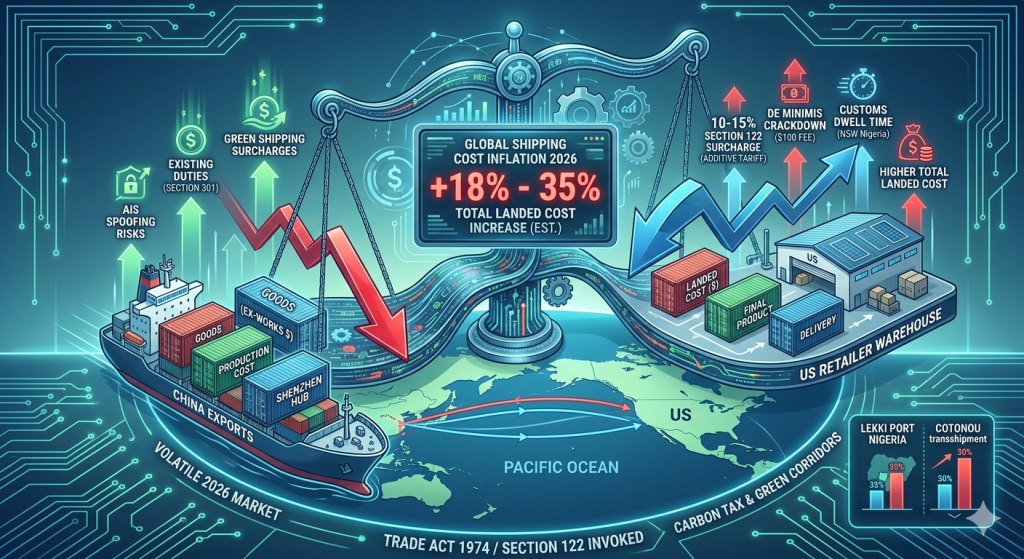
In late February 2026, the US administration invoked Section 122 of the Trade Act of 1974. This provides the authority to impose a temporary 10% to 15% universal tariff to address balance-of-payment deficits.
- Current Status: Most goods from China are currently subject to a 10% Section 122 surcharge, which is scheduled to undergo a Congressional review or extension by July 2026.
- Retail Impact: This is an “additive” tax. It sits on top of existing Section 301 duties, meaning some consumer electronics and textiles are now seeing effective duty rates exceeding 35% to 40%.
2. Beyond the Headline Rate: Breaking Down Total Landed Cost
For a modern retailer, the “Price per Unit” at the factory in Shenzhen is only 60% of the story. To calculate the 2026 Total Landed Cost, you must factor in four critical “invisible” costs that have spiked this year.
A. The De Minimis Crackdown
For years, e-commerce giants used the “De Minimis” (Section 321) loophole to ship packages under $800 duty-free. As of 2026, new regulations have effectively ended this for Chinese postal shipments.
- The 2026 Reality: Almost all B2C shipments from China now face a flat $100 fee or a 54% duty rate, regardless of value. This has fundamentally broken the “drop-shipping” model for low-margin retail.
B. New Section 301 “Overcapacity” Investigations
In March 2026, the USTR initiated fresh investigations into “Structural Excess Capacity.” This targets 16 economies, with China at the center.
- The Risk: Categories like EV parts, solar modules, and legacy semiconductors are facing “prohibitive” duties that can reach 100% to 125%. If your retail product contains these components, your TLC could double overnight.
C. Maritime Carbon Surcharges
While not a “tariff” in the legal sense, the Green Shipping Corridors and the expansion of the UK/EU Emissions Trading System (ETS) have created a “Carbon Leakage” effect.
- The Cost: Carriers are passing down “Green Fuel Surcharges” to offset 2026 emissions quotas. Expect to add $150–$300 per FEU (Forty-foot Equivalent Unit) to your freight bill for “Carbon Compliance.”
3. Regional Logistics Trends: US-China Lane Performance
Despite the trade friction, the physical movement of goods remains robust, though pricing has decoupled from historical norms.
| Route | April 2026 Spot Rate (per 40HQ) | 2025 Average | Trend |
| China to US West Coast | $2,850 – $3,100 | $2,100 | 📈 Increasing |
| China to US East Coast | $3,200 – $3,600 | $2,900 | 📈 Stable |
| China to Gulf Coast | $3,800 – $4,200 | $3,400 | ⚠️ Volatile |
Data reflect 2026 carrier filings and fuel adjustment factors.
4. Strategic Mitigation: How Retailers Are Fighting Back
Top-tier retailers are no longer just “accepting” these costs. They are using three specific strategies to lower their 2026 Landed Cost.
I. Duty Drawback Programs
If you import components from China, assemble them in the US, and then export the finished product to Canada or Mexico, you may be eligible for a 99% refund of your 2026 tariffs. In a high-tariff environment, duty drawback is no longer optional—it is a survival mechanism.
II. Bonded Warehousing
By using a Customs Bonded Warehouse, retailers can delay the payment of the 10% Section 122 surcharge until the moment the product is actually sold and enters the US market. This preserves cash flow, which is vital given current 2026 interest rates.
III. The “China Plus One” Logistics Pivot
Smart retailers are shifting the final stage of production to Vietnam or Malaysia. Under “Rules of Origin” laws, if enough “substantial transformation” happens outside of China, the product may qualify for a lower tariff rate, even if the primary components are Chinese.
5. Conclusion: The Retail Outlook for H2 2026
The “Golden Age” of cheap, frictionless Chinese imports is over. However, the 2026 landscape offers opportunities for those who master Logistics Intelligence. Total Landed Cost is no longer a math problem for the accounting department; it is a competitive advantage for the C-suite.
To remain profitable, US retailers must:
- Audit HTS codes monthly to catch new Section 301 “Overcapacity” triggers.
- Factor a 15% “policy buffer” into all 2026-2027 procurement budgets.
- Leverage the 2026 vessel overcapacity to negotiate lower base freight rates to offset the rising tariff costs.
FAQ: 2026 US-China Tariffs & Shipping
1. Is the 10% universal tariff on Chinese goods permanent?
No. It was implemented under Section 122, which is limited to 150 days unless extended by Congress. The current window expires in July 2026, though most analysts expect a “rolling extension” through the end of the year.
2. Can I still use the $800 De Minimis exemption for my e-commerce store?
Technically, the $800 limit still exists for most countries, but as of February 2026, specific “Administrative Orders” have suspended this for nearly all postal and express shipments originating from China and Hong Kong. You should expect to pay duties on every package.
3. How do I calculate my Total Landed Cost in 2026?
The formula is:
In 2026, you must ensure “Customs Duties” includes both the base rate, Section 301, and the new Section 122 surcharge.
4. Are ocean freight rates expected to crash in late 2026?
Unlikely. While there is a global surplus of ships, carriers are using “Slow Steaming” and aggressive blank sailings to keep rates above the $2,500 floor for the Trans-Pacific lane.
5. What is the “Overcapacity Investigation” and why does it matter?
The USTR is investigating if China is producing too many goods (like batteries and electronics) at subsidized prices. If the investigation concludes by May 2026, we could see triple-digit tariffs on specific high-tech retail categories by Q3 2026.
Recent Comments