
For nearly four years, the “Just-In-Time” (JIT) inventory model—the gold standard of lean manufacturing—was treated as a relic of a bygone era. Following the systemic shocks of the early 2020s, the maritime and logistics world pivoted aggressively toward “Just-In-Case” (JIC), a strategy defined by massive safety stocks, overflowing warehouses, and a “hoard at all costs” mentality.
However, as of April 2026, a quiet revolution is happening in US distribution centers. Facing high interest rates, a 15% spike in overhead, and the arrival of “Agentic AI,” American retailers and manufacturers are asking a critical question: Can we afford to be this heavy?
The answer is a sophisticated return to lean principles. These Inventory Management Trends 2026 suggest that JIT isn’t just returning; it’s being reborn as “Antifragile JIT,” a model that prioritizes US Supply Chain Resilience without the bloat.
1. The Financial Pressure: Why “Just-In-Case” is No Longer Sustainable
In 2024 and 2025, US firms pulled massive amounts of inventory forward to get ahead of shifting tariffs. This led to a “bullwhip effect” that clogged West Coast ports and sent storage rates to record highs.
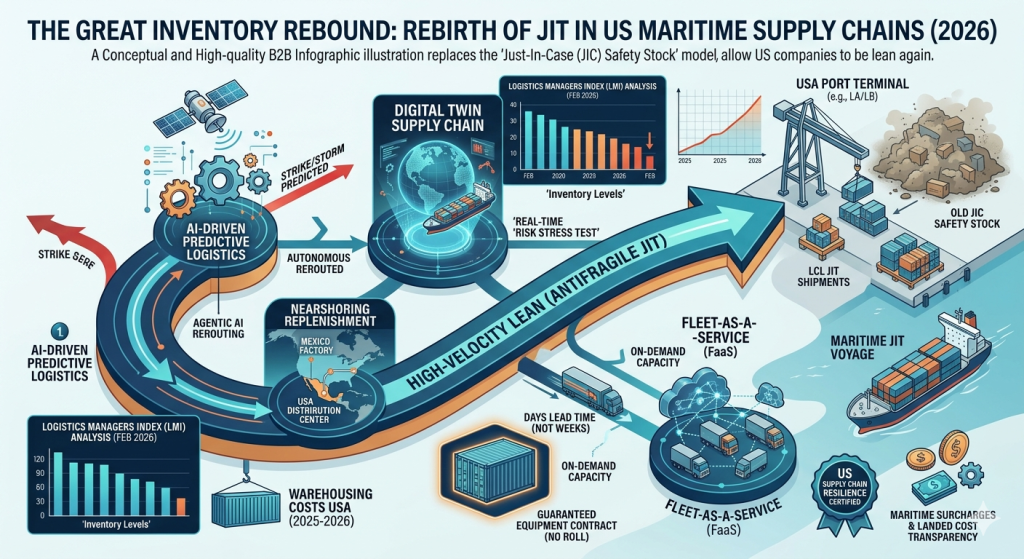
By mid-2026, the economic reality has changed. According to the latest Logistics Managers Index (LMI) Analysis, inventory levels are beginning to contract as firms aggressively move toward leaner, faster-moving stock cycles. The primary drivers are:
- Capital Costs: With interest rates remaining “higher for longer,” tying up millions of dollars in unsold inventory sitting in a San Pedro warehouse is a drain on liquidity.
- Warehousing Costs USA: Warehouse utilization in the US hit a one-year high in February 2026. Space is at a premium, and “dead stock” is now a liability that can sink a mid-sized retailer’s quarterly earnings.
2. The Technology Catalyst: How AI Made JIT Safe Again
The primary reason JIT failed in the past was a lack of visibility. You couldn’t run lean if you didn’t know where your ship was. In 2026, the “visibility gap” has been closed by the rapid adoption of AI in Logistics.
Agentic AI & Predictive Logistics
In 2026, we have moved beyond simple tracking. “Agentic” AI models now act as autonomous dispatchers. If a strike is predicted at the Port of Savannah or a storm is brewing in the Atlantic, these systems don’t just alert a human—they automatically reroute the “lean” shipment to a secondary port before the delay even occurs.
Digital Twin Supply Chains
Top-tier US retailers are now using “Digital Twins”—virtual replicas of their entire supply chain. This allows them to run “stress tests” on their Just-In-Time vs Just-In-Case 2026 models daily. They can calculate exactly how many days of buffer they need for a specific SKU based on real-time maritime congestion data.
3. The Maritime Factor: Surcharges and Shipping Reliability
A major hurdle for JIT in the US has always been the unpredictability of ocean freight. However, the arrival of Maritime Surcharges and Landed Cost transparency tools has changed the game.
Shippers are now using “Guaranteed Equipment” contracts. While these come with a premium, they allow for a JIT flow because the retailer knows their container won’t be “rolled” to a later vessel. This certainty is the bedrock upon which the 2026 lean model is built.
4. The Hybrid Model: “JIT for Me, But Not for Thee”
A controversial trend emerging in 2026 is the Bifurcated Inventory System. Large “Downstream” firms (big-box retailers) are forcing JIT back onto the map for themselves while requiring their “Upstream” suppliers to maintain the safety buffers.
- Retailers: Keeping shelves lean to maximize cash flow and respond to rapid 2026 consumer trend shifts.
- Suppliers: Bearing the brunt of the storage costs and “Just-In-Case” buffers.
- The Result: A supply chain that looks lean at the consumer end but is supported by a massive “shock absorber” of inventory held by manufacturers and wholesalers.
5. Nearshoring: The Secret Ingredient of 2026 JIT
JIT is inherently difficult when your lead time is 45 days across the Pacific. To make JIT work in 2026, US companies have accelerated Nearshoring to Mexico and Canada. By moving production closer to the US border, lead times drop from weeks to days, allowing for true “Daily Replenishment” models that were impossible when sourcing solely from distant Asian hubs.
Conclusion: The 2026 Verdict
Is JIT returning? Yes, but it is no longer “Blind JIT.” The 2026 version of Just-In-Time is data-heavy, AI-driven, and regionally focused. Shippers have realized that while holding zero inventory is dangerous, holding too much is a slow death for profitability. The winners of the 2026 maritime and logistics season will be those who can maintain “High-Velocity Lean”—using technology to replace physical piles of stock with digital certainty.
FAQ: The 2026 Inventory Revolution
1. What is the difference between JIT and JIC in 2026?
Just-In-Time (JIT) focuses on receiving goods only as they are needed for sale or production, minimizing storage costs. Just-In-Case (JIC) involves keeping a large “safety stock” buffer to protect against supply chain disruptions. In 2026, most companies use a “Hybrid” approach based on the criticality of the item.
2. Why are US companies moving back to lean inventory now?
The primary drivers are the high cost of capital (interest rates) and skyrocketing Warehousing Costs USA. Carrying excess inventory has become too expensive for the average balance sheet to support, prompting a return to Inventory Management Trends 2026 that favor speed.
3. Does JIT increase the risk of stockouts during port strikes?
In the old model, yes. In 2026, however, AI in Logistics and diversified port strategies allow companies to run lean without the same level of risk. They use “predictive rerouting” to avoid bottlenecks before they happen, enhancing US Supply Chain Resilience.
4. How do Maritime Surcharges and Landed Cost affect inventory decisions?
When surcharges are high, companies often try to ship in bulk to save on freight. However, if the “Landed Cost” (which includes the cost of holding that stock) exceeds the freight savings, the company will pivot back to smaller, JIT-style shipments.
5. What does a Logistics Managers Index (LMI) Analysis tell us about 2026?
The LMI currently shows a “contraction” in inventory levels but an “expansion” in warehousing prices. This data point is the “smoking gun” proving that US businesses are actively trying to empty their warehouses and return to a leaner JIT model.
Recent Comments