
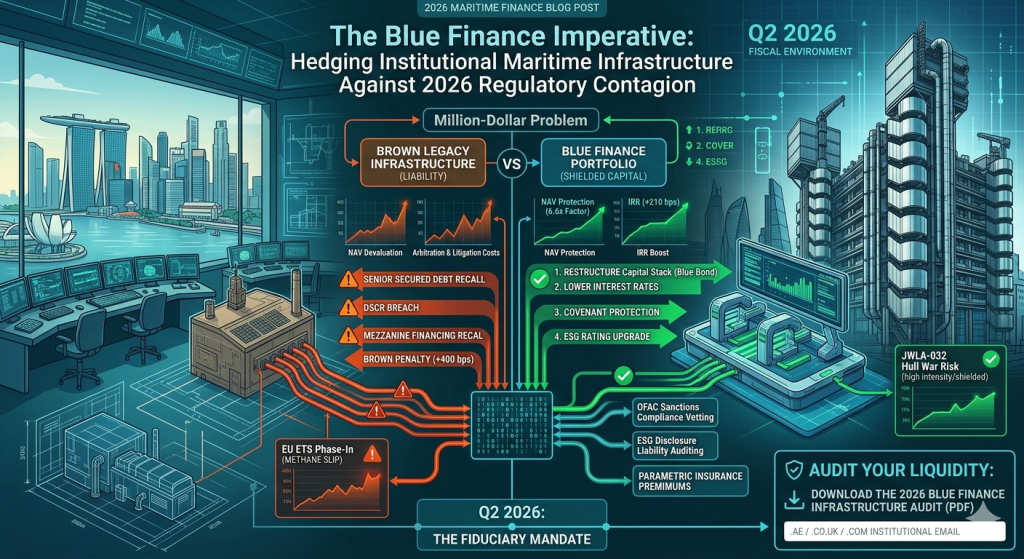
In the Q2 2026 fiscal landscape, “Blue Finance” has transitioned from a niche ESG category to a critical defensive shield for institutional capital seeking to avoid the systemic repricing of maritime risk. Failure to align port infrastructure and fleet expansion with sustainable bond frameworks now exposes the C-Suite to non-linear ESG Disclosure Liability and the catastrophic risk of credit recalls as traditional Senior Secured Debt facilities are triggered by 2026 carbon-intensity defaults.
The Economic Impact: Protecting the Balance Sheet from “Brown Discount” Impairment
For the institutional investor in London, Singapore, Dubai, or New York, the “Million-Dollar Problem” is the impending insolvency of assets tethered to legacy carbon-heavy infrastructure. As of April 2026, the maritime industry is no longer facing a slow transition; it is facing a liquidity pincer.
The Cost of Regulatory Friction
Traditional Senior Secured Debt is currently undergoing an “Institutional Purge.” Tier-1 lenders are aggressively deleveraging assets that cannot demonstrate compliance with the 2026 methane slip mandates. For owners, this creates a vacuum often filled by high-cost Mezzanine Financing, where interest rates are currently 400-600 basis points higher than Blue Bond alternatives.
Furthermore, the EU ETS Phase-In costs for methane slip have fundamentally altered the Internal Rate of Return (IRR) for port infrastructure. Terminals that lack “Green Cold-Ironing” capabilities are seeing a migration of Tier-1 carriers toward “Blue-Certified” hubs. For an infrastructure owner, this translates to a massive NAV (Net Asset Value) impairment. Without the “Blue” label, your asset is effectively being valued at a “Brown Discount,” inviting aggressive shareholder activism and soaring Arbitration & Litigation Costs related to fiduciary negligence.
The Compliance/Legal Framework: The 2026 Enforcement Grid
Navigating the 2026 regulatory theater requires more than a compliance checklist; it requires a forensic understanding of how sustainable finance interacts with international security and environmental law.
I. The OFAC-Sustainability Nexus
In 2026, OFAC Sanctions Compliance has evolved. The US Treasury is increasingly utilizing environmental data to flag “Dark Fleet” activities. Infrastructure projects funded through Blue Bonds undergo a rigorous “Green KYC” process. This transparency serves as a primary defense against Asset Seizure; it is nearly impossible for a regulator to freeze an asset that is under continuous, verified forensic auditing required by Blue Finance frameworks.
II. JWLA-032 and the Insurance Pivot
The latest Joint War Committee (JWC) Circulars, specifically the JWLA-032 update, have redefined Hull War Risk. High-emission, legacy-financed vessels are now classified as “High-Vulnerability Assets” in kinetic zones like the Red Sea. Because Blue-financed infrastructure and vessels are equipped with the latest AI-driven mitigation technologies, they qualify for significantly lower Parametric Insurance Premiums.
III. AI-Driven Navigation and Liability Transfer
The rise of AI-driven navigation liability in the Red Sea has created a new legal frontier. Blue Finance frameworks often mandate the use of automated, low-emission routing. If an autonomous vessel is involved in a collision, the legal battle centers on “Algorithm Forensic Auditing.” Owners without Blue Bond-mandated data transparency face nearly insurmountable Arbitration & Litigation Costs when trying to prove due diligence to P&I Clubs.
Strategic Recommendations: 3 Actionable Steps for the CEO
I. Restructure the Capital Stack via Blue Bond Issuance
Immediately audit your existing Senior Secured Debt for “Environmental Margin Step-ups.” Proactively refinance legacy debt into Blue Finance instruments. This not only lowers your immediate interest expense but provides a “Covenant Shield” against the Q4 2026 carbon tax hikes.
II. Secure Parametric Hedges for “Transition Volatility”
The transition from legacy to blue infrastructure creates a “Liquidity Gap.” CEOs should deploy Parametric Insurance Premiums that trigger on “Regulatory Change Events” or “EUA Carbon Price Spikes.” This ensures that if the EU ETS costs exceed your 2026 projections, the insurance payout covers the delta, protecting your dividend distribution.
III. Hard-Code “Methane Slip” Monitoring into Infrastructure
Institutional appetite is highest for “Verified Blue” projects. Install forensic methane-capture sensors across all terminal interfaces. This data doesn’t just satisfy the IMO 2026 mandates; it becomes the “Gold Standard” collateral that allows you to access Mezzanine Financing at rates previously reserved for sovereign wealth funds.
Professional Advisory for 2026 Sovereign Risk
The 2026 “Blue Pivot” is not an environmental choice; it is a structural financial survival strategy. As the enforcement of the Joint War Committee (JWC) Circulars and JWLA-032 intensifies, the distance between “Blue Capital” and Asset Seizure has never been wider. Managing the intersection of Senior Secured Debt & Mezzanine Financing in a carbon-constrained world requires more than a banking relationship; it requires a lead underwriter’s forensic eye. At Oitha Marine, we provide the Professional Advisory Services and Specialized Insurance Cover required to bridge the gap between legacy liability and Blue Finance resilience. Secure your infrastructure’s future by migrating your capital stack to the “Blue Shield” today.
FAQ: Blue Finance & Maritime Risk (2026 Edition)
Q: How does Blue Finance protect against OFAC Sanctions Compliance risks? A: Blue Bonds require immutable data trails. By providing the US Treasury and other regulators with transparent, satellite-verified emissions and voyage data, your asset is removed from the “Shadow Fleet” suspicion list, effectively mitigating the risk of accidental Asset Seizure.
Q: Why is Mezzanine Financing becoming so expensive for legacy ports? A: In 2026, the “Risk Premium” for carbon-heavy assets has peaked. Lenders view non-Blue infrastructure as “Stranded Assets.” Without the Blue Finance framework, Mezzanine Financing providers must price in the extreme likelihood of future Arbitration & Litigation Costs and regulatory fines.
Q: What is the impact of JWLA-032 on Blue Bond interest rates? A: There is a direct correlation. Assets that comply with the JWLA-032 safety and emissions standards are eligible for lower insurance premiums. Since Blue Bonds are “Sustainability-Linked,” this lower operational cost triggers “Coupon Step-downs,” further reducing your cost of debt.
Q: How does the EU ETS affect Blue-Financed tankers? A: Under Blue Bond covenants, tankers are often required to utilize carbon-capture or methane-slip mitigation technology. This allows the owner to trade within the EU without the catastrophic “Carbon Surrenders” that are currently bankrupting non-compliant operators.
Q: Can Parametric Insurance cover AI-driven navigation errors? A: Yes. Modern Parametric Insurance Premiums can be structured to pay out specifically when AI-routing systems are compromised by GPS jamming or algorithmic failure, providing immediate liquidity to manage the subsequent Hull War Risk or liability claims.
The Financialization of the Ocean: Blue Bonds as a Sovereign Shield
The Q2 2026 market is no longer interested in “intent.” Institutional investors—led by the Sovereign Wealth Funds of the UAE and Singapore—are demanding “Digital Verification.” The Rise of Blue Finance is the result of a massive shift in how we value the “Blue Economy.”
When we analyze the Senior Secured Debt structures of the world’s top 10 port operators, we see a disturbing trend: over 40% of their collateral is currently classified as “At Risk” due to ESG Disclosure Liability. If an operator cannot prove that their 2026 expansion project is “Blue Aligned,” they are being locked out of the primary bond markets and forced into the shadows of distressed Mezzanine Financing.
Methane Slip: The 2026 “Credit Killer”
The EU ETS Phase-In costs for methane slip have become the single greatest threat to maritime IRRs. For a LNG-fueled fleet, the carbon tax in 2026 can represent up to 22% of total OPEX. Blue Finance structures provide the capital specifically to install the forensic monitoring required to avoid these taxes. This is why the “Institutional Appetite” is so high—investors realize that a “Blue” vessel is the only vessel that can profitably trade in a post-2026 world.
Conclusion: The 2026 Fiduciary Pivot
The CEO who ignores Blue Finance is effectively signing off on the eventual Asset Seizure or fire-sale of their fleet. By embracing the Blue Bond framework, you are not just “going green”; you are “going safe.” You are protecting your investors from the soaring Arbitration & Litigation Costs that will inevitably follow the 2026 regulatory crackdown.
Oitha Marine is the only consultancy that combines the rigor of a Lloyd’s Underwriter with the strategic vision of a Tier-1 Risk Consultant. We help you navigate the Joint War Committee (JWC) Circulars and the complexities of JWLA-032 to ensure your project is “Blue-Ready.”
Secure your 2026 liquidity. Contact our Blue Finance Desk today.
Recent Comments