
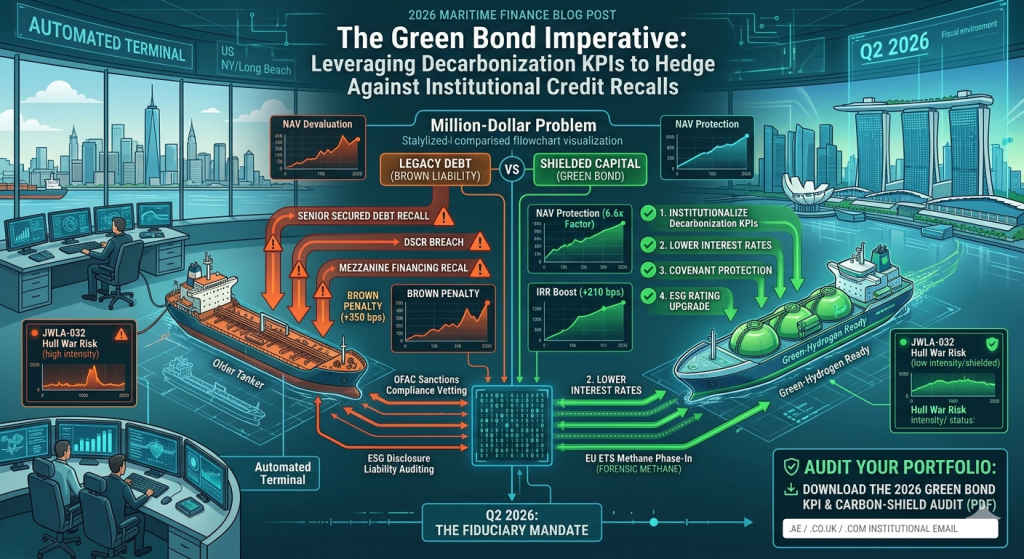
In the high-volatility Q2 2026 market, Green Bond Frameworks have transitioned from “marketing optics” to a critical liquidity defense against the systemic repricing of Senior Secured Debt. Shipowners failing to institutionalize Decarbonization KPIs risk an immediate 300-400 basis point “Brown Penalty,” as Tier-1 lenders trigger technical defaults based on mounting ESG Disclosure Liability and carbon-intensity overages.
The Economic Impact: Protecting the IRR from “Carbon Contagion”
For the C-suite in Singapore, London, New York, or Dubai, the “Million-Dollar Problem” is the collapse of the spread between operational cash flow and debt service. As of April 2026, the EU ETS Phase-In costs for methane slip are no longer an abstract projection—they are a direct hit to the balance sheet.
The Debt-Service Coverage Ratio (DSCR) Breach
Traditional shipowners holding non-green-linked debt are finding themselves in a “Fiscal Pincer.” On one side, the cost of carbon surrender for methane-heavy assets has eroded EBITDA by up to 15%. On the other, Western institutional lenders—under immense pressure from the Net-Zero Banking Alliance (NZBA)—are utilizing “Environmental Margin Adjustments.”
If your vessel’s carbon intensity index (CII) rating falls into the ‘D’ or ‘E’ bracket this year, your Senior Secured Debt could be reclassified as a distressed asset. This forces owners into the high-cost Mezzanine Financing market, where rates are currently hovering at 14-18% APR, effectively vaporizing the investor’s ROI.
Insurance Premiums as a Proxy for Risk
Underwriting in 2026 is forensic. At our Syndicate, we are seeing a direct correlation between a vessel’s “Green Bond” status and its Hull War Risk premiums. Under the JWLA-032 circular, ships with antiquated, high-emission propulsion systems are viewed as operational liabilities. Insurers perceive these vessels as having lower “Tradeability” in high-risk zones like the Red Sea. Conversely, “Green-Shielded” vessels enjoy lower Parametric Insurance Premiums, as their modern AI-integrated systems provide the data fidelity required to reduce “uncertainty loading” in the policy.
The Compliance/Legal Framework: The 2026 Enforcement Net
Navigating the regulatory grid of 2026 requires a defensive legal posture that integrates environmental performance with financial compliance.
I. ESG Disclosure Liability and the Fraud Clause
Under the latest 2026 SEC and ESMA mandates, “Greenwashing” is no longer a civil slap-on-the-wrist; it is a fiduciary crime. If a shipowner secures a Green Bond but fails to hit the stipulated Decarbonization KPIs, they face ESG Disclosure Liability that can trigger Arbitration & Litigation Costs exceeding the original loan value. Investors are now using “Performance-Linked Clawbacks” to reclaim capital if the carbon-reduction data is found to be fraudulent.
II. OFAC Sanctions Compliance and the “Shadow” Transition
In 2026, the US Treasury is using environmental non-compliance as a proxy for OFAC Sanctions Compliance investigations. The “Shadow Fleet” typically operates older, high-emission tonnage to obfuscate ownership. By adopting a transparent Green Bond Framework, an owner effectively provides a “Regulatory Safe Harbor” for their capital. A vessel with a verified Decarbonization KPI track record is significantly less likely to face Asset Seizure under suspicion of illicit STS (Ship-to-Ship) transfers or sanctioned trade.
III. AI-Driven Navigation Liability and JWC Mandates
The Joint War Committee (JWC) Circulars, specifically the JWLA-032 update, now incorporate “Technological Resilience” as a rating factor. Green Bonds often mandate the installation of AI-routing systems to optimize fuel consumption. While this satisfies decarbonization goals, it creates a new legal frontier: AI-driven navigation liability. If the AI optimizes for “Green” but leads the vessel into a kinetic strike zone in the Red Sea, the liability must be specifically insured. Green Bond Frameworks must, therefore, be coupled with modern Hull War Risk riders that account for algorithmic decision-making.
Strategic Recommendations: 3 Actionable Steps for the CEO
I. Institutionalize the “Green Margin” Audit
Immediately audit your current Senior Secured Debt for “Step-Up” interest clauses tied to CII performance. If you are at risk of a KPI miss, pivot to a Green Bond structure that allows for “Transition Credits.” This prevents a sudden liquidity drain and keeps your Arbitration & Litigation Costs at zero by avoiding breach-of-contract disputes with your lenders.
II. Deploy Parametric Hedges for EUA Price Spikes
The volatility of the 2026 carbon market is a threat to Green Bond compliance. Secure Parametric Insurance Premiums that pay out if the price of European Union Allowances (EUAs) exceeds a predetermined threshold. This “Carbon Liquidity Bridge” ensures you can afford the compliance costs needed to hit your KPIs and maintain your lower interest rates.
III. Hard-Code “Methane Slip” Mitigation into CAPEX
With the EU ETS Phase-In costs for methane slip now fully active, any LNG-dual fuel asset without methane-capture technology is a “Walking Default.” Use the proceeds of a Green Bond to retrofit your fleet with catalyst systems. This not only lowers your interest rate but also protects the vessel’s residual value, preventing it from becoming a “Stranded Asset” in the 2027-2030 cycle.
Professional Advisory for 2026 Capital Shielding
Securing a Green Bond in 2026 is no longer about sustainability—it is about structural financial survival. As the enforcement of Joint War Committee (JWC) Circulars and JWLA-032 intensifies, the intersection of Senior Secured Debt & Mezzanine Financing has become a legal minefield. Managing your ESG Disclosure Liability while avoiding Asset Seizure requires a forensic underwriting approach that legacy brokers cannot provide. At Oitha Marine, we specialize in Specialized Insurance Cover and Professional Advisory Services designed to navigate the “Human-Machine-Carbon” nexus. Protect your portfolio from soaring Arbitration & Litigation Costs by anchoring your capital stack in a verified Green Bond Framework today.
FAQ: Green Bonds and Maritime Risk (2026)
Q: Why are Green Bonds significantly cheaper than traditional Senior Secured Debt in 2026? A: Tier-1 banks now face “Capital Adequacy” penalties for holding “Brown” assets on their balance sheets. To mitigate their own risk, they offer 150-250 bps discounts to shipowners who can prove Decarbonization KPI compliance, effectively offloading their regulatory risk to the borrower.
Q: Can a “Green KPI” miss lead to a vessel being seized? A: While not a direct cause for Asset Seizure, a major KPI breach can trigger a “Cross-Default” in your fleet’s financing. This allows lenders to accelerate debt repayment, leading to the appointment of receivers—effectively a private seizure of the asset.
Q: How does AI-driven navigation liability affect my Green Bond? A: Most 2026 Green Bonds require “Smart-Routing” to ensure emissions targets are met. However, if the AI system fails to comply with OFAC Sanctions Compliance (e.g., entering a sanctioned port to save fuel), the owner remains liable. You must ensure your Specialized Insurance Cover includes an “AI-Error” rider.
Q: What is the impact of the JWLA-032 circular on Green Bond assets? A: JWLA-032 categorizes ships by their “Vulnerability Profile.” Green vessels, typically being newer and more technologically advanced, are seen as more resilient. This results in lower Hull War Risk surcharges, improving the overall debt-serviceability of the Green Bond.
Q: Is it too late to refinance into a Green Bond in 2026? A: No, but the “Window of Arbitrage” is closing. As more owners seek to escape Mezzanine Financing, the supply of Green Capital is becoming tighter. Forensic auditing of your Decarbonization KPIs should begin immediately to secure a “Front-of-Line” position with Singaporean and London lenders.
The “Brown Discount” and the Liquidity Trap
In the Q2 2026 maritime theater, the concept of “Fair Market Value” has been replaced by “Carbon-Adjusted Value.” For the shipowner in the UAE or UK, the “Million-Dollar Problem” manifests as a “Liquidity Trap.”
When a vessel fails its Decarbonization KPIs, it doesn’t just lose its “Green” status; it enters a cycle of Mezzanine Financing dependency. We are seeing portfolios where the interest payments on legacy debt are now larger than the vessel’s daily time-charter equivalent (TCE) earnings. This is the definition of a “Zombie Asset.”
Methane Slip: The 2026 “Black Swan”
The EU ETS Phase-In costs for methane slip have caught many LNG-dual fuel owners off guard. Under the “Forensic Methane” protocols of 2026, satellites are now monitoring methane plumes in real-time. This data is fed directly into bank compliance systems. If your vessel is “leaking” methane, your Green Bond interest rate will “Step-Up” automatically via smart contracts. This is why Specialized Insurance Cover for “Environmental Performance Volatility” has become the fastest-growing insurance line in Lloyd’s this year.
Conclusion: The 2026 Pivot
The shipowner of 2026 is no longer a navigator of seas, but a navigator of “Green Capital Grids.” By anchoring your fleet in a Green Bond Framework, you aren’t just lowering your interest rate; you are insulating your entire capital stack from the Arbitration & Litigation Costs that will inevitably sink the “Brown” fleet.
Oitha Marine is your lead underwriter in this transition. We provide the Professional Advisory Services needed to audit your Decarbonization KPIs and the Parametric Insurance Premiums needed to protect them. Don’t let your portfolio become a case study in Asset Seizure. Anchor in the Green Harbor today.
Recent Comments