
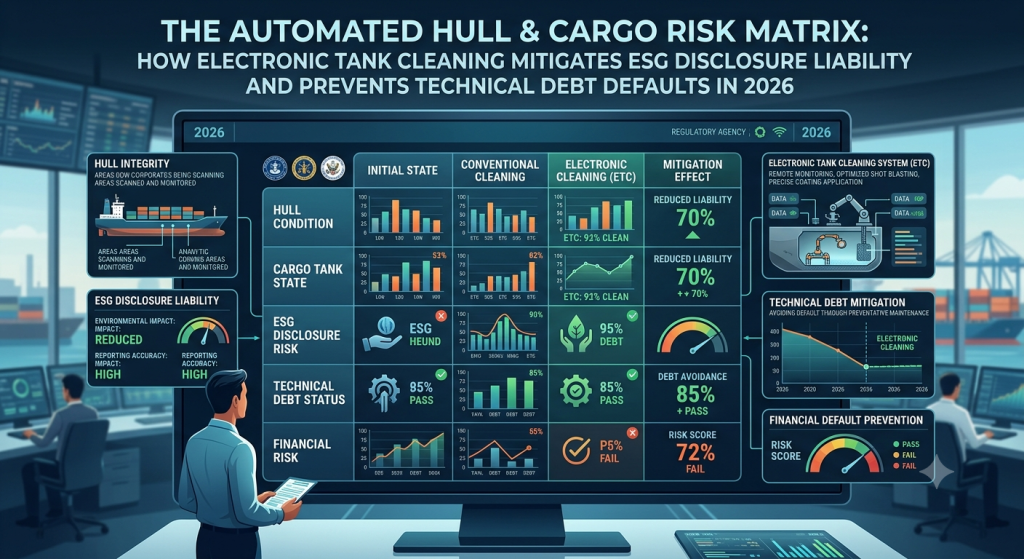
In the highly regulated maritime markets of 2026, manual tank cleaning operations have evolved from a routine operational expense into an unhedged balance sheet vulnerability for institutional investors and shipowners across the USA, UK, UAE, and Singapore. Transitioning to automated electronic tank cleaning systems is no longer a matter of marginal efficiency; it is an absolute requirement for asset protection, shielding capital stacks from sudden debt covenant defaults, mitigating severe environmental liabilities, and preserving structural underwriting terms.
The Economic Impact: Capital Asset Degradation, Cargo Contamination, and Financing Contagion
For private equity syndicates, sovereign wealth allocators, and corporate treasurers overseeing chemical, product, and crude carrier fleets, tank turnaround efficiency directly dictates asset yield and internal rate of return (IRR). In the current high-interest environment, maritime assets are highly leveraged, split across complex debt layers including Senior Secured Debt & Mezzanine Financing. These financing facilities require predictable, continuous charter revenue to service debt obligations.
Traditional manual tank cleaning relies on high-pressure water blasting, aggressive chemical solvents, and prolonged manual scraping inside enclosed spaces. This legacy approach creates extensive operational friction, extending a vessel’s off-hire window by 4 to 8 days per product transition. For a modern product tanker or chemical carrier, this delay is highly damaging. When a ship sits idle, top-line revenue stops instantly while fixed daily operating expenses (OPEX) continue to run.
[Legacy Manual Tank Cleaning Delay: 4-8 Days] —> [Immediate Charter Revenue Interruption]
|
v
[Severe Compression of Net Operating Income]
|
v
[Breach of Debt Service Coverage Ratio (DSCR)]
|
+————————————–+————————————–+
| |
v v
[Senior Secured Debt Acceleration] [High-Cost Mezzanine Financing Triggers]
(Lenders Freeze Revolving Credit Lines) (Instant Loss of Equity & Portfolio IRR)
This unplanned off-hire window compresses Net Operating Income (NOI), immediately threatening the borrower’s ability to maintain compliance with strict banking covenants. A technical breach of the Debt Service Coverage Ratio (DSCR) or minimum liquidity thresholds gives primary institutional lenders the absolute right to freeze revolving credit lines or demand accelerated restructurings of Senior Secured Debt & Mezzanine Financing agreements. Forcing an asset manager into high-yield, alternative credit markets to bridge operational cash shortfalls introduces severe basis-point surcharges that destroy portfolio returns.
Furthermore, manual cleaning carries an elevated risk of cargo wall-wash contamination and cross-contamination claims. If a product tanker transitions from a heavy feedstock to a high-purity petrochemical and the manual wash fails to remove microscopic residues, the entire subsequent cargo faces rejection at loading or discharge ports.
When a cargo is rejected or held in terminal quarantine, the shipowner faces immediate cargo damage claims and extensive demurrage disputes. Resolving these failures under standard charter-parties generates significant, unrecoverable Arbitration & Litigation Costs that must be funded directly out of corporate working capital reserves.
| Operational Risk Vector | Manual Tank Cleaning Framework | Automated Electronic Tank Cleaning | Multi-Year Balance Sheet Impact |
| Average Off-Hire Turnaround | 96 – 192 Hours | 24 – 36 Hours | Maximizes active charter days; eliminates unhedged demurrage charges. |
| Cargo Contamination Rate | 2.4% – 4.1% (Statistical Average) | < 0.05% (Sensor-Verified) | Structurally eliminates third-party claims and cargo wall-wash rejections. |
| Slop Water Generation | High Volume (Requires costly shore-side disposal) | Closed-Loop (Minimizes waste volume by 80%) | Lowers port operating dues; mitigates localized environmental discharge levies. |
The Compliance/Legal Framework: The 2026 Digital Port and Underwriting Enforcement Grid
Operating an international liquid bulk fleet in 2026 requires navigating an aggressive, interconnected regulatory enforcement grid. Smart port authorities in Singapore, Houston, London, and Fujairah are no longer passive transshipment points; they act as primary data-aggregation and enforcement centers for international trade sanctions, environmental taxation, and underwriting compliance.
+——————————————–+
| 2026 LIQUID BULK COMPLIANCE FRAMEWORK |
+——————————————–+
| – JWLA-032 Underwriting Risk Parameters |
| – EU ETS Phase-In (Auxiliary Methane Slip)|
| – OFAC Sanctions and Cargo Line Audits |
+——————————————–+
|
v
+————————————————————-+
| Automated Penalties, Policy Forfeitures, & Asset Seizures |
+————————————————————-+
I. Environmental Liability: Methane Slip, Slop Water Discharges, and Fiduciary Disclosures
The primary environmental regulatory driver of tank cleaning automation is the complete implementation of regional carbon and emissions taxation. The expanding EU ETS Phase-In costs for methane slip and greenhouse gas emissions dictate that any tank cleaning operation that requires extensive auxiliary boiler or generator runtime will face heavy financial levies. Manual tank cleaning requires ships to remain at anchor or at berth for days with auxiliary engines running at high capacity to heat massive volumes of wash water and drive high-pressure pumps.
Under 2026 rules, this prolonged auxiliary fuel burn faces significant environmental taxes upon entering or exiting regulated waters. Furthermore, the massive volume of chemical-heavy slop water generated by manual washing requires complex shore-side disposal or high-energy onboard treatment, both of which spike reportable carbon equivalents.
Failing to properly account for, optimize, and report these continuous operational emissions profiles in your corporate financial records creates an immediate ESG Disclosure Liability. This exposure can trigger automated divestment mandates from institutional green funds, restrict access to sustainability-linked loan facilities, and invite enforcement actions from financial regulators for misrepresenting material environmental compliance costs.
II. Geopolitical Marine Underwriting Alignment: The Realities of JWLA-032
The global marine insurance market has modified its underwriting guidelines to account for real-time asset reliability and location data. The Joint War Committee (JWC) Circulars, notably the active JWLA-032 protocol, place strict operational obligations on shipowners transiting listed high-risk geographic zones, including the Red Sea, the Gulf of Aden, and adjacent maritime choke points.
Under JWLA-032, underwriters utilize automated satellite telemetry and port state control logs to monitor vessel performance continuously. If a chemical carrier suffers an auxiliary boiler explosion, a total electrical blackout, or a steering failure while transiting a listed high-risk corridor, and subsequent class investigations show the root cause was mechanical stress from extended manual tank cleaning preparation or deferred machinery maintenance, underwriters can declare a breach of seaworthiness warranties.
This results in the automatic suspension of Asset Seizure & Hull War Risk cover, leaving the shipowner and its institutional backers completely unhedged against total asset loss from kinetic threats or state-sponsored detentions.
[Extended Auxiliary Engine Strain (Manual Wash)] —> [Machinery Failure in listed High-Risk Zone]
|
v
[Satellite Telemetry Underwriter Audit]
|
v
[Breach of Seaworthiness Warranty Flag]
|
v
[Asset Seizure & Hull War Risk Voided]
III. Automated Operational Risk: AI Navigation Liability in Volatile Lanes
To optimize port arrival slots and coordinate complex tank cleaning schedules with shore-side reception facilities, modern shipping conglomerates rely heavily on autonomous, algorithmic voyage optimization platforms. However, this technology introduces severe AI-driven navigation liability in the Red Sea and other high-conflict transit corridors.
When an algorithmic routing platform alters a vessel’s heading or dynamically adjusts its speed to meet a strict, automated smart-port tank cleaning window, the rapid operational shift can place intense stress on the vessel’s auxiliary systems and boiler plants.
If this automated command triggers an emergency engine shutdown or a loss of steering control within a high-risk transit corridor, the vessel faces immediate exposure to localized threats.
Determining liability for the resulting salvage fees, cargo damage, and lane blockages leads to complex multi-jurisdictional legal disputes. Assigning liability between the software provider, the ship manager, and the system engineer generates extensive, multi-million-dollar Arbitration & Litigation Costs.
IV. Geopolitical Trade Barriers: OFAC Sanctions Compliance in Cargo Lines
Automated electronic tank cleaning systems utilize closed-loop, sensor-verified technologies that generate detailed, unalterable digital logs of exactly what compounds are removed from a vessel’s internal cargo lines. This data trail has become vital for maintaining OFAC Sanctions Compliance in 2026.
Illicit trading networks frequently utilize sophisticated ship-to-ship (STS) transfers and chemical blending techniques to disguise the true origin of sanctioned crude or refined product lines, leaving trace chemical signatures inside un-blasted cargo tanks.
If a vessel relies on superficial manual cleaning between voyages, remnants of restricted commodities can blend into the subsequent cargo batch. When entering strict jurisdictions like Singapore, the UK, or the US, automated chemical testing at smart terminals can identify these trace compounds, triggering immediate administrative terminal holds, cargo confiscation, or regulatory Asset Seizure.
Underwriters treat any contact with sanctioned supply chains as a fundamental breach of contract terms, which can result in the automatic denial of claims and leave the asset owner completely unhedged against capital loss.
Strategic Recommendations: 3 Actionable Steps for the CEO
I. Institutionalize Sensor-Verified, Closed-Loop Electronic Tank Cleaning Systems
Cease relying on legacy, manual tank washing procedures that depend entirely on visual human inspections. Mandate the immediate retrofit of your liquid bulk fleet with automated electronic tank cleaning systems that utilize fixed, high-impact machine-guided tank washing machines integrated with real-time gas chromatography and optical sensors.
By capturing unalterable, blockchain-verified digital logs of tank cleanliness and wall-wash integrity prior to arrival at the loading berth, your technical teams can eliminate cargo contamination rejections, protect your Senior Secured Debt facilities from covenant defaults driven by unexpected terminal holds, and structurally lower potential Arbitration & Litigation Costs.
II. Restructure Turnaround Overrun Risks via Parametric Hedges
Traditional hull and cargo insurance policies do not cover the indirect financial losses caused by extended port delays, cleaning failures, or software interface errors during product transitions. Corporate leaders should integrate specialized Parametric Insurance Premiums into their operational budgets.
These parametric policies utilize objective data triggers—such as a documented turnaround extension past a specific number of hours or an administrative customs hold following a chemical screening anomaly—to execute immediate cash payouts without requiring a lengthy claims adjustments process. This immediate liquidity helps keep your operations funded, protecting your working capital from unexpected operational disruptions.
III. Enforce Multi-Tier Technology Indemnification Clauses in Purchase Agreements
When purchasing automated fleet management systems or contracting electronic tank cleaning providers, ensure your legal teams insert explicit, multi-tier indemnification clauses regarding system performance and data reporting. Require all automation hardware and software vendors to carry robust technology errors and omissions (E&O) coverage that explicitly covers maritime liabilities.
Clearly assign the financial risks of automated system failures—including unexpected emissions fines and port delays—to the technology provider. This proactive contractual structure minimizes your exposure to unexpected legal liabilities and helps lower your firm’s ESG Disclosure Liability exposure by securing verified, auditable data trails for environmental reporting.
Specialized Underwriting and Infrastructure Risk Advisory
Navigating the operational and regulatory complexities of modern liquid bulk shipping requires a partner with deep risk management expertise. Managing changing Joint War Committee (JWC) Circulars, complex carbon regulations, and strict international trade compliance demands specialized advisory support. Traditional, off-the-shelf marine policies are no longer adequate to protect high-value maritime investments from sudden regulatory interventions, environmental penalties, or Asset Seizure & Hull War Risk events.
At Oitha Marine, we provide the Professional Advisory Services and Specialized Insurance Cover required to protect your fleet from these systemic disruptions. Whether you are restructuring financing across Senior Secured Debt & Mezzanine Financing or defending your firm against unexpected subrogation claims involving ESG Disclosure Liability, our underwriter-led risk solutions help ensure your fleet remains compliant, efficient, and fully insurable.
FAQ: 2026 Automated Tank Cleaning & Asset Protection
Q: Why does manual tank cleaning pose a direct threat to a shipowner’s Senior Secured Debt? A: Manual tank cleaning extends a vessel’s off-hire window by 4 to 8 days per product transition. During this time, the vessel generates no revenue while continuing to accumulate fixed operational costs, dropping Net Operating Income (NOI). This drop can trigger immediate breaches of Debt Service Coverage Ratio (DSCR) covenants within lending agreements, allowing banks to accelerate debt repayment schedules.
Q: How do electronic tank cleaning systems protect a fleet from the JWLA-032 underwriting exclusions? A: Under JWLA-032 protocols, underwriters can review a vessel’s operational and machinery history following a failure inside a listed high-risk zone. Manual cleaning places prolonged strain on auxiliary boilers and generator systems to heat wash water. If this strain triggers a breakdown in a volatile corridor, underwriters can declare a breach of seaworthiness warranties and deny coverage for Asset Seizure & Hull War Risk claims. Electronic cleaning significantly reduces auxiliary machinery runtimes, minimizing mechanical wear and preserving insurance validity.
Q: How do the EU ETS Phase-In costs for methane slip interact with tank cleaning operations? A: Manual tank cleaning requires continuous, multi-day operations of auxiliary steam and electrical systems to heat wash water, driving up fuel burn and greenhouse gas emissions. Under 2026 rules, these emissions face significant financial penalties upon entering regulated waters, creating an unhedged operational expense and an increased ESG Disclosure Liability if omitted from corporate financial records.
Q: Can an enterprise use Parametric Insurance Premiums to cover the costs of cargo contamination or cleaning delays? A: Yes. Specialized parametric policies can be structured to trigger immediate cash payouts based on objective, data-driven parameters—such as a vessel remaining in an off-hire cleaning status past a specific number of hours—providing immediate liquidity to help meet ongoing financial obligations during operational disruptions.
Q: What steps should a company take to manage AI-driven navigation liability when navigating tank cleaning slots? A: Chartering agreements and software supply contracts must include explicit clauses defining liability for automated voyage modifications. Legal teams should ensure that optimization software vendors carry robust technology errors and omissions (E&O) coverage to cover liabilities arising from automated scheduling errors, reducing potential Arbitration & Litigation Costs.
6. Extended Analysis: Technical Execution and Systems Integration Strategy
The Technical Reality of Sensor-Verified Cargo Decontamination
The financial performance of a product or chemical tanker during a cargo transition is directly tied to the precision of its tank wash telemetry. Automated electronic tank cleaning platforms replace manual wall-wash tests with inline optical spectroscopy and gas chromatography sensors embedded directly within the tank atmosphere and stripping line systems.
+—————————————————————–+
| THE DIGITAL CARGO DECONTAMINATION LOOP |
+—————————————————————–+
| Machine-Guided Tank Washing Machines Execute Programmed Cycle |
| -> Real-Time Optical Sensors Analyze Stripping Line Runoff |
| -> Gas Chromatography Telemetry Measures Tank Vapor Densities |
| -> Unalterable Digital Log Confirms Zero Contaminant Residue |
| -> Elimination of Cargo Wall-Wash Rejections & Defect Claims |
+—————————————————————–+
If a vessel relies on legacy manual cleaning, it depends on a human surveyor entering an enclosed space to wipe a small portion of the bulkhead with a solvent-soaked cloth. This analog sampling frequently misses chemical residues hidden behind internal stiffeners or within deep cargo lines.
When the subsequent high-purity cargo is loaded, these hidden elements dissolve into the product, altering its chemical composition and causing complete rejection at discharge terminals. Electronic validation provides complete asset protection by ensuring every square centimeter of internal steel is cleared and verified before loading commences.
Advanced Risk Management in Closed-Loop Slop Treatment
In automated maritime logistics hubs, managing the byproduct of a tank wash is as critical as the clean itself. Modern electronic cleaning units use closed-loop separation technologies that continuously recycle wash water and isolate chemical residues on board, reducing the total volume of generated slop water by up to 80%.
+————————————————————+
| CLOSED-LOOP ENVIROMENTAL PROTECTION |
+————————————————————+
| Electronic Wash System Continuously Filters Wash Media |
| -> Recycles Water Internally to Minimize Total Volume |
| -> Isolates Concentrated Chemical Residues into Slop Tanks|
| -> Drastically Reduces Port Waste Reception Charges |
| -> Mitigates ESG Disclosure Liability and Carbon Surcharges|
+————————————————————+
Relying on legacy open-loop manual washing requires the vessel to generate thousands of tons of contaminated wash water. Discharging this material to shore reception facilities introduces massive port operating surcharges and complex administrative reporting under international marine pollution frameworks.
By minimizing waste volumes through automated closed-loop filtration, shipowners protect their cash flows from unhedged port expenditures, reduce the energy required for fluid heating, and insulate their corporate balance sheet from unexpected environmental penalties.
Conclusion: Safeguarding Portfolio Value through Rigorous Operations
Operating a modern liquid bulk fleet requires an integrated management approach that connects technical fleet operations with proactive regulatory compliance and structured risk transfer. Relying on legacy manual maintenance procedures or unverified data interfaces exposes a maritime enterprise to severe financial and legal liabilities. By enforcing strict automated screening protocols, incorporating robust technology and fuel indemnifications, and securing advanced parametric hedges, you protect your fleet from sudden operational and financial disruptions.
Oitha Marine offers the underwriting expertise and specialized risk management solutions required to guide your portfolio through these changing technical and regulatory environments. Protect your capital, safeguard your returns, and build a compliant corporate infrastructure designed to withstand modern operational challenges.
Recent Comments