
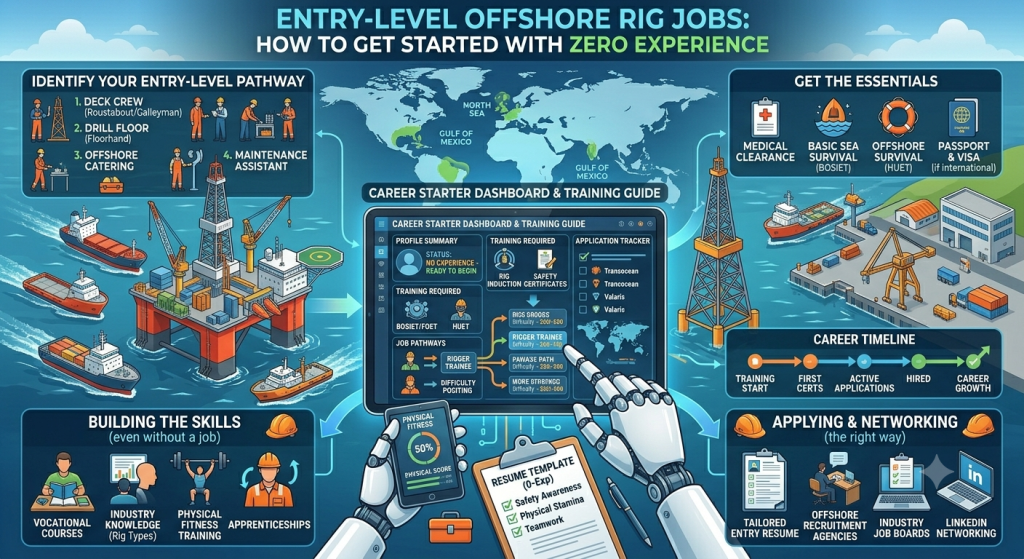
The offshore oil and gas sector represents one of the highest-paying blue-collar career paths in the global energy market. For individuals looking to pivot into an industry that rewards physical stamina, technical aptitude, and strong teamwork, the offshore sector offers an unparalleled financial springboard. On an offshore drilling platform, gas production facility, or drillship, it is entirely possible for an entry-level worker with zero prior experience to build a lucrative career that scales rapidly into six-figure territory.
However, breaking into the offshore industry can feel incredibly restrictive to outsiders. Global operating standards, safety compliance mandates, and competitive talent pools mean that you cannot simply show up at a coastal heliport with a standard corporate resume and expect a job. Landing your first hitch requires a thorough understanding of the offshore operational ecosystem, securing the exact safety credentials required for deployment, and targeting the correct entry-level roles.
As an established maritime services and offshore infrastructure organization, Oitha Marine supports the development of the next generation of industrial energy talent. This comprehensive guide serves as your strategic roadmap to securing entry-level offshore rig jobs with zero industry experience, detailing the roles to target, the certifications you need, and the recruitment pipelines to navigate.
The Reality of the Offshore Lifestyle and Financial Rewards
Before pursuing the credentials required to step foot on an offshore drilling rig, you must understand the lifestyle. Offshore work is defined by the roster system (also known as a hitch). Employees live and work onboard the rig for a set rotation period—most commonly 2 weeks on/2 weeks off, 3 weeks on/3 weeks off, or 4 weeks on/4 weeks off.
During your active rotation, you will work rigorous, physically demanding 12-hour shifts every single day. There are no weekends or holidays at sea. In exchange for this intensive schedule, the industry offers exceptional corporate benefits:
- High Earning Potential: Because of the hazardous environment and isolated locations, entry-level positions yield significantly higher base salaries than equivalent land-based roles.
- Minimal Living Expenses: While onboard, the operating company fully covers your accommodation, laundry services, catered meals, and international or domestic travel to and from the rig’s designated crew-change heliport. This allows crew members to save the vast majority of their take-home income.
- Extended Time Off: A standard rotation gives you up to six months of cumulative vacation time per year, allowing for unmatched work-life balance during your off-roster weeks.
Top Entry-Level Offshore Rig Jobs to Target
When browsing maritime employment networks or global job boards like SEEK and Indeed, do not search for generalized titles like “rig worker.” Instead, focus your efforts entirely on these specific, entry-level gateway positions that explicitly accept applicants with no prior drilling experience.
1. Roustabout (Deck Crew)
The Roustabout is the foundational entry-level position on any offshore drilling unit. Operating under the direct supervision of the Crane Operator and Deck Foreman, roustabouts are the backbone of the platform’s material logistics.
- Primary Responsibilities: Unloading supply vessels, hooking up cargo slings to cranes, moving drilling equipment across the deck, painting superstructure steel, and executing continuous industrial cleaning to keep the deck free of slip hazards.
- Career Path: This is the ultimate stepping stone. Successful roustabouts are regularly promoted to Roughneck (working directly on the high-intensity drill floor) or enter technical tracks to become crane operators or derrickmen.
2. Galley Hand / Utility Allrounder (Catering & Hospitality)
An offshore rig is a floating mini-city that houses anywhere from 50 to 200+ crew members. Keeping this workforce fed, clean, and rested requires a dedicated camp-services crew. Galley Hands and Utility Allrounders handle the hospitality operations of the living quarters.
- Primary Responsibilities: Assisting the offshore chefs with food preparation, washing industrial kitchen equipment, cleaning crew cabins, running the commercial laundry facility, and maintaining immaculate sanitation standards across the living quarters (accommodation block).
- Career Path: This role is ideal for individuals transitioning from the commercial hospitality, restaurant, or hotel sectors. It provides immediate offshore exposure, allowing you to network with drilling crews and learn the layout of the rig without working on the dangerous drill floor.
3. Rig Welder / Maintenance Assistant (Trainee)
If you possess a basic trade background—such as land-based welding, mechanical repair, or electrical trade schooling—you can bypass standard deck labor by applying as a maintenance trainee or assistant to the Rig Mechanic, Motorman, or Rig Welder.
- Primary Responsibilities: Fabricating basic brackets, conducting routine preventative maintenance on low-pressure pumps, assisting with engine room cleanups, and sorting specialized technical tools.
- Career Path: This track leads directly into highly paid technical specializations, such as becoming a fully qualified Motorman, Chief Mechanic, or Subsea Engineer.
Step 1: Secure Your Mandatory Mandatory Safety Certifications
If your resume does not list the baseline, legally mandated safety certifications required by international maritime and energy laws, applicant tracking systems (ATS) used by major drilling contractors will automatically reject your application. Before applying for roles, you should invest in the following credentials:
[BOSIET or FOET Safety Course] ➔ [Offshore Medical Certificate (OGUK/ENG1)] ➔ [Biometric Security Credentials]
1. BOSIET (Basic Offshore Safety Induction and Emergency Training)
Managed under the global standards of OPITO, the BOSIET course is the non-negotiable passport to working offshore worldwide. This intensive 3-day course covers:
- Helicopter Underwater Escape Training (HUET): Simulating a helicopter ditching at sea, teaching you how to use emergency breathing systems and escape a submerged, capsized cabin.
- Sea Survival and First Aid: Learning how to deploy life rafts, survive in open ocean currents, and administer emergency medical care.
- Firefighting and Self-Rescue: Navigating smoke-filled corridors and utilizing industrial fire suppression equipment.
2. Valid Offshore Medical Certificate (OGUK / ENG1)
Offshore rigs are highly remote, often located hours away from a shore-based hospital via helicopter. Consequently, every worker must pass a rigorous physical examination administered by an oil and gas approved physician. The exam checks cardiovascular health, lung capacity, hearing, vision, and drug/alcohol screening to ensure you can safely handle the physical demands of emergency evacuations.
3. Biometric and Port Security Credentials
Depending on your operational region, you will need standardized security identification card profiles to access commercial port limits and helicopter terminals. In the United States, this is the TWIC (Transportation Worker Identification Credential); in other global regions, equivalent national port security clearances are mandatory.
Step 2: Crafting an Offshore-Optimized Resume
Drilling contractors look at hundreds of entry-level resumes daily. To stand out, you must completely pivot your resume away from conversational text and format it like a highly compliant corporate profile.
- Lead with Your Safety Credentials: Put your BOSIET (OPITO Approved), OGUK Medical, and security cards at the very top of page one in bold text. If a recruiter sees these immediately, your resume bypasses the initial rejection pile.
- Translate Your Land-Based Skills: If you have never worked offshore, translate your previous physical labor experience into transferable “rig-ready” terminology.
- Construction workers: Highlight your experience working at heights, operating heavy machinery, using rigging equipment, and adhering to strict OSHA safety protocols.
- Agricultural/Farm workers: Emphasize mechanical maintenance capabilities, working long hours in extreme weather conditions, and handling heavy manual labor.
- Military veterans: Focus on your disciplined teamwork, strict adherence to chain of command, operational safety awareness, and adaptability to rotating shifts.
Step 3: Navigating the Recruitment Pipeline
Securing an entry-level position requires targeting the specific tiers of employers operating within the global offshore energy sector.
Tier 1: International Drilling Contractors
These companies own and operate the actual multi-million dollar drilling rigs, jack-ups, and drillships. They handle the primary hiring cycles for roustabouts and roughnecks. Key global operators to monitor include Valaris, Transocean, Noble Corporation, and Seadrill.
Tier 2: Specialized Offshore Catering Agencies
If you are pursuing a galley hand or hospitality track, do not apply directly to the drilling contractors. Instead, apply to the global catering conglomerates that are contracted to run the accommodation blocks onboard the rigs. Companies like Sodexo Remote Sites, Compass Group, and Entier manage these hiring networks.
Tier 3: Maritime Staffing and Crew Management Agencies
Major oil majors and drilling contractors frequently outsource their entry-level crew procurement to specialized staffing agencies. Partnering with reputable crewing agencies like Airswift or Oitha Marine allows you to get your credentials inside vetted talent databases used by operators to fill sudden personnel vacancies globally or regionally.
Frequently Asked Questions (FAQ)
Can I get an offshore rig job if I have absolutely zero experience?
Yes. Positions such as a Roustabout or a Galley Hand are explicitly classified as entry-level positions designed for individuals with no prior offshore experience. However, while prior drilling experience isn’t required, having the mandatory BOSIET safety certifications and an OGUK Medical certificate is non-negotiable.
How much can a beginner expect to earn on an offshore rig?
Entry-level salaries vary depending on the geographic trade lane and specific employer. On average, a starting Roustabout or Galley Hand can expect an annual salary ranging between $55,000 and $75,000 USD. As you accumulate active sea days and earn advanced technical qualifications, salaries quickly climb past $100,000 USD.
What is the most difficult aspect of the offshore lifestyle for beginners?
Most entry-level workers find the initial transition to the roster schedule to be the most challenging aspect. Working 12-hour shifts for 14 to 28 consecutive days in a confined, isolated environment requires high mental resilience, strong emotional discipline, and the ability to work cohesively within diverse teams.
Who pays for my travel to the offshore platform?
Under standard international maritime labor agreements, the operating oil company or drilling contractor covers 100% of your operational travel expenses. They will coordinate and pay for your flights, ground transportation, and hotel stays from a pre-agreed regional hub city directly to the heliport or marine terminal.
How long does it take to get promoted from an entry-level position?
Promotions in the offshore sector are heavily dependent on performance, safety record, and mechanical aptitude. A dedicated Roustabout who demonstrates strong safety leadership, learns the deck logistics quickly, and assists the drilling crew during down-times can realistically transition into a higher-paying Roughneck role within 12 to 24 months.
Conclusion: Take the First Step with Oitha Marine
Breaking into the offshore industry requires dedication, investment in basic safety qualifications, and a strategic approach to recruitment. While the entry barriers are high, the financial freedom, extended time off, and long-term career growth make the offshore sector one of the most rewarding industrial paths available today.
Oitha Marine remains deeply invested in fostering a safe, highly competent, and technically proficient maritime and offshore workforce. By providing advanced vessel operations, marine cargo handling, and robust crew management support, we connect operational excellence with top-tier talent.
Are you ready to kickstart your career in the offshore sector or streamline your corporate crew management workflows with fully compliant personnel? Contact the operations team at Oitha Marine today to explore our staffing, chartering, and offshore support services.
Recent Comments