
Navigating the global maritime logistics landscape requires an ironclad understanding of vessel operations, contractual frameworks, and international maritime standards. For corporate procurement departments, oil majors, infrastructure contractors, and logistics directors, securing sea-bound tonnage is one of the most capital-intensive aspects of supply chain management.
Whether you are coordinating an offshore construction project in the Gulf of Guinea, executing an emergency supply run to a deepwater asset, or arranging a bulk cargo movement between international terminals, selecting the correct charter structure is critical.
This comprehensive guide breaks down the precise steps of the commercial vessel chartering process, details standard contract models, and outlines structural strategies to maximize operational efficiency while minimizing commercial liabilities.
Understanding Charter Configurations
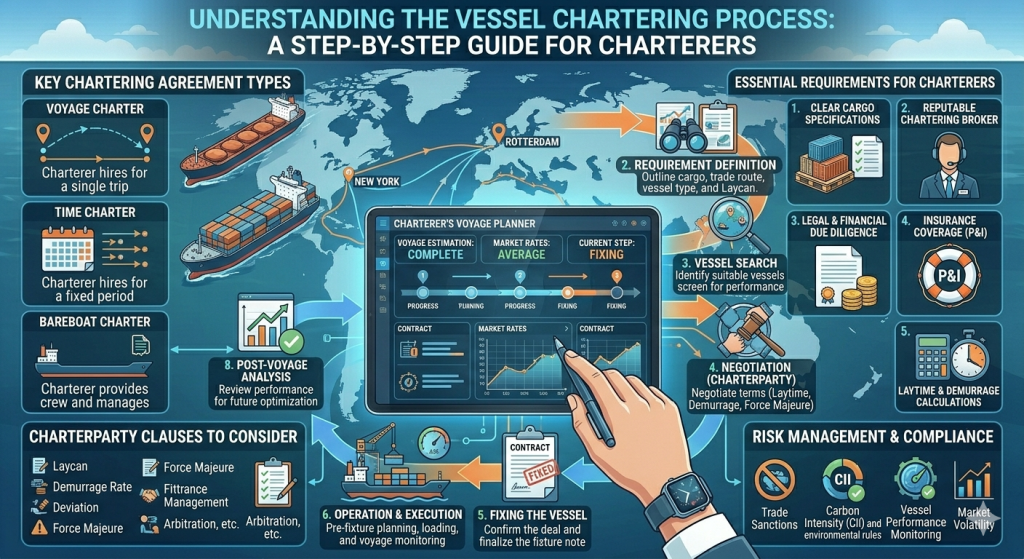
Before a charterer approaches a shipowner or an independent shipbroker, they must identify the precise legal and financial framework that best suits their project timeline and risk tolerance. In the international shipping sector, vessel hire is divided into three distinct legal configurations. Each assigns operational control, expense liabilities, and maintenance responsibilities differently.
+——————————————————————-+
| TYPES OF VESSEL CHARTERS |
+——————————–+———————————-+
| VOYAGE CHARTER | TIME CHARTER |
| • Fixed trip (Port A to B) | • Hired for specific duration |
| • Owner pays fuel/crew/ports | • Charterer pays fuel & port fees|
| • Freight based on cargo tons | • Owner manages technical/crew |
+——————————–+———————————-+
|
v
+———————————-+
| BAREBOAT CHARTER |
| • Full operational lease |
| • Charterer pays all costs |
| • Crewing & insurance by tenant |
+———————————-+
Voyage Charter
A voyage charter represents the hiring of a vessel and its crew for a single, specific passage or a series of consecutive voyages between designated ports (e.g., from an offshore loading terminal to a regional refinery jetty).
- Financial Structure: The charterer pays the shipowner a mutually agreed freight rate, calculated either as a lump sum or on a per-metric-ton basis of the cargo loaded.
- Expense Distribution: The shipowner retains absolute operational control and bears responsibility for all running costs. This includes crew wages, provisions, marine insurance, vessel maintenance, vessel fuel (known as bunkers), and standard port disbursements.
- Ideal Use Case: Excellent for one-off commodity shipments, bulk movements, and spot-market cargo transfers where the charterer prefers a fixed cost profile with minimal operational exposure.
Time Charter
Under a time charter configuration, the charterer hires a fully operational, crewed, and provisioned vessel for a defined period—ranging from a few weeks to several consecutive years.
- Financial Structure: The charterer pays a fixed daily or monthly “hire rate” to the shipowner throughout the contract duration.
- Expense Distribution: Commercial management shifts entirely to the charterer. While the shipowner remains legally responsible for technical upkeep, crew management, and hull insurance, the charterer assumes liability for all voyage-specific expenses. This includes bunker fuel consumption, port dues, tug assistance, canal transits, and cargo handling charges.
- Ideal Use Case: Heavily utilized by offshore oil and gas operators requiring continuous logistics support, such as Fast Support Vessels (FSVs), Platform Supply Vessels (PSVs), or Anchor Handling Tug Supply (AHTS) units dedicated to long-term drilling campaigns.
Bareboat Charter (Demise Charter)
A bareboat charter operates as a complete financial and operational lease. The shipowner surrenders physical possession of the vessel to the charterer without a crew, fuel, stores, or insurance coverage.
- Financial Structure: The charterer pays a baseline lease rate for the asset’s structural use.
- Expense Distribution: The charterer assumes complete legal and operational responsibility for the ship. This means the charterer must source an STCW-compliant crew, manage all technical maintenance, secure comprehensive Hull & Machinery (H&M) and Protection & Indemnity (P&I) insurance coverage, and pay every operational expense.
- Ideal Use Case: Tailored for major maritime industrial entities, state-backed operators, or specialized subsea contractors who possess internal ship-management wings and require complete autonomy over a vessel without the capital expense of an outright purchase.
The Step-by-Step Vessel Chartering Procedure
Securing high-value maritime tonnage demands an organized approach to negotiation, safety verification, and contract finalization. Skipping single verification windows can lead to heavy penalties, operational delays, or legal disputes.
1
The Inquiry & Specification Phase
Step 1
1.The Inquiry & Specification Phase:Step 1.
The charterer creates a formal operational profile detailing their project requirements. This profile must specify the exact cargo characteristics, required vessel capabilities (e.g., specific Bollard Pull for towing operations, clear deck cargo area, or dynamic positioning class), destination parameters, and the LAYCAN window. The LAYCAN dictates the earliest date the vessel can arrive for loading and the absolute latest cancelling date the charterer will accept before terminating the agreement.
2
The Indicative Offer & Negotiation
Step 2
2.The Indicative Offer & Negotiation:Step 2.
The inquiry is floated to the market either directly to shipowners or via specialized shipbrokers. Interested owners return a formal “Owner’s Offer,” which specifies the baseline hire or freight rates, bunker consumption allowances, and standard trading exclusions. The charterer and owner execute a series of structured counters until a preliminary agreement on price, timeline, and location is reached.
3
The Fixture & ‘Subject To’ Clauses
Step 3
3.The Fixture & ‘Subject To’ Clauses:Step 3.
Once the core commercial numbers align, the deal moves to a “Fixture.” However, the agreement is legally held under “Subject To” (Subs) clauses. This means the contract is pending final clearance of specific milestones, such as board approvals, final cargo availability, or a formal On-Hire Condition Survey. Independent marine surveyors execute this survey at the delivery port to document the structural state of the hull and compute the exact fuel remaining on board (ROB).
4
Signing the Charterparty Agreement
Step 4
4.Signing the Charterparty Agreement:Step 4.
With all “subjects” lifted, the transaction is finalized by signing a formal Charterparty Agreement. This document acts as the overarching legal contract governing the charter. To maintain clarity, the industry relies on standardized templates developed by international bodies like BIMCO (The Baltic and International Maritime Council) and the New York Produce Exchange (NYPE), tailored with custom rider clauses to fit local regulatory demands.
5
Voyage Execution & Laytime Management
Step 5
5.Voyage Execution & Laytime Management:Step 5.
The vessel is mobilized to the delivery point. During voyage charters, operational tracking focuses entirely on Laytime—the total hours allocated in the contract for loading and discharging cargo. If the charterer’s port operations exceed this window, they incur daily penalties known as Demurrage. Conversely, if cargo operations finish ahead of schedule, the charterer may receive financial incentives known as Despatch from the shipowner.
Standardized Industry Contracts: BIMCO and NYPE Forms
To prevent ambiguities regarding liability, the global shipping market avoids custom-written contracts from scratch. Instead, industry professionals utilize pre-vetted, legally tested contract forms, appending custom rider clauses only when necessary.
BIMCO Standard Contracts
BIMCO is the global authority on maritime contract development. Their forms are designed to evenly distribute operational risks between owners and charterers.
- GENCON 2022: The premier, general-purpose standard form utilized globally for voyage charters. It handles dry cargo, bulk commodities, and general industrial freight movements.
- SUPPLYTIME 2015: The absolute benchmark contract for the offshore oil and gas industry. It is engineered explicitly for support crafts, crew boats, and dive-support vessels, featuring highly detailed allocations for specialized offshore machinery and dynamic positioning liabilities.
- BARECON 2017: The universally recognized standard template for bareboat charters, balancing the long-term maintenance obligations of the lessee with the asset protection rights of the true owner.
NYPE 2015 (New York Produce Exchange)
The NYPE form is the most widely used time charter party contract framework in the world. Jointly developed by ASBA (Association of Ship Brokers and Agents), the Singapore Maritime Foundation, and BIMCO, the NYPE 2015 edition provides clear language governing electronic documentation, anti-piracy measures, bunker fuel quality standards, and international sanctions compliance.
Risk Mitigation & Regulatory Compliance
Executing a successful charter requires adhering to national and international maritime regulations to ensure safety and prevent asset seizures.
+——————————————————————-+
| CRITICAL CHARTERING COMPLIANCE |
+——————————————————————-+
| NIMASA Flag State Regs | Ensures active safety and anti-pollution|
| | certification compliance. |
+————————-+—————————————–+
| Coastal & Cabotage Act | Dictates strict operational preferences |
| | for domestic vessels and crews. |
+————————-+—————————————–+
| P&I Club Indemnity | Provides liability cover for oil spills,|
| | cargo damage, and crew injuries. |
+——————————————————————-+
NIMASA Compliance
All commercial vessels operating within regional territorial waters must maintain active compliance with national regulatory bodies, such as the Nigerian Maritime Administration and Safety Agency (NIMASA). Charterers must verify that prospective vessels hold valid flag-state documentation, up-to-date statutory safety certs, and strict anti-pollution clearances before scheduling mobilization.
The Cabotage Act
For near-shore, coastal, and inter-jetty transits, charterers must conform directly to the provisions of the Coastal and Inland Shipping (Cabotage) Act. This legislation dictates that vessels engaged in domestic trade must be built locally, owned by domestic citizens, and manned by domestic seafarers, unless a formal federal waiver is officially secured.
P&I Club Coverage
Before signing any charterparty, the charterer must ensure the vessel maintains active, unrestricted coverage with a reputable Protection and Indemnity (P&I) Club. This mutual insurance association provides essential third-party indemnity protection covering high-impact risks such as accidental oil pollution, cargo damage, wreck removal costs, and crew injuries during offshore runs.
Frequently Asked Questions (FAQ)
Q: What is the difference between Demurrage and Despatch in a voyage charter?
A: Demurrage is a financial penalty paid by the charterer to the shipowner if the loading or unloading operations exceed the total allowed “Laytime” hours stated in the contract. Despatch is a financial bonus or discount paid by the shipowner back to the charterer if the cargo operations are completed ahead of schedule, saving the owner valuable operational time.
Q: What does the term “LAYCAN” mean during negotiations?
A: LAYCAN stands for “Laydays Cancelling.” It represents a specific window of dates. The first date is the earliest day the shipowner can present the vessel for loading. The final date (the cancelling date) gives the charterer the automatic legal right to terminate the charter contract if the vessel fails to arrive and present a formal Notice of Readiness (NOR) by that deadline.
Q: Who is responsible for paying for fuel (bunkers) during a charter?
A: In a Voyage Charter, the shipowner is entirely responsible for purchasing and managing the vessel’s fuel. In a Time Charter and a Bareboat Charter, the commercial control shifts to the charterer, meaning the charterer is responsible for purchasing, paying for, and monitoring all fuel consumed during the contract duration.
Q: What is an On-Hire Condition Survey, and why is it mandatory?
A: An On-Hire Condition Survey is an independent technical inspection carried out by certified marine surveyors right before a vessel is delivered to the charterer. It documents the exact physical condition of the ship’s hull, decks, and cargo holds, while measuring the precise volume of fuel remaining on board (ROB). This survey prevents legal disputes over pre-existing damage when the ship is eventually returned to the owner.
Q: Can a charterer sublet a vessel to a third party?
A: A charterer can only sublet a vessel if a specific “Sublet Clause” is explicitly included and approved within the signed Charterparty Agreement. Standard forms like the NYPE generally permit subletting, provided the original charterer remains fully liable to the shipowner for the execution of all contract terms and hire payments.
Looking for Compliant Vessel Chartering Services? Oitha Marine provides reliable, fully compliant, and vetted vessel chartering configurations across regional and international waterways. Whether your project requires specialized offshore support vessels, tugboats, or product barges, our operations team delivers seamless logistics management from fixture to voyage execution. Contact our commercial desk directly at info@oithamarine.com to receive a tailored voyage estimate and fleet specification overview.
Recent Comments