
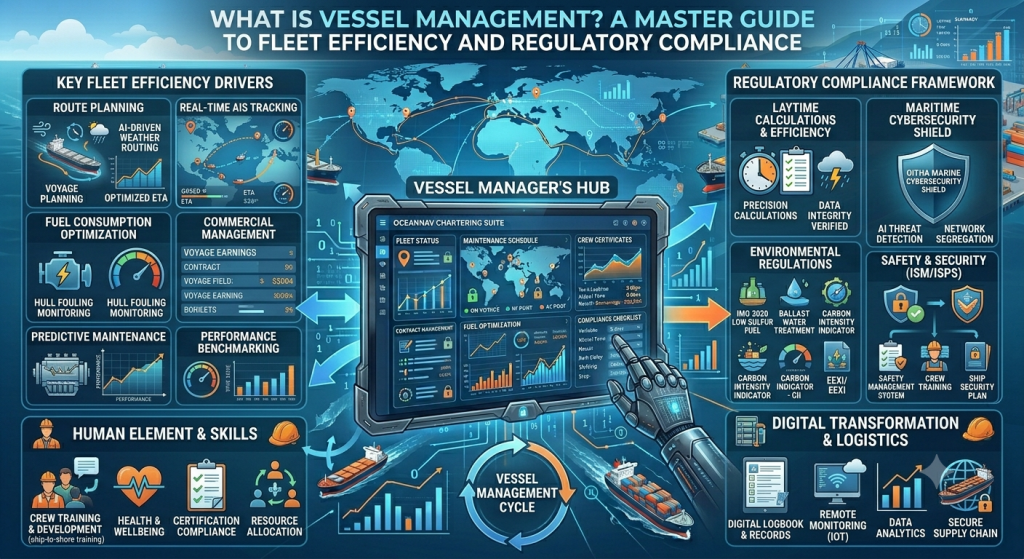
The global economy relies on a massive, invisible engine: the maritime transport sector, which carries more than 80% of international trade. Moving billions of tons of raw materials, energy resources, consumer electronics, and specialized industrial equipment daily requires a global fleet of complex commercial vessels. Yet, owning an ocean-going asset like an oil tanker, bulk carrier, or offshore support vessel is only half the battle. The true differentiator between a highly profitable maritime operation and a catastrophic financial or environmental liability lies in vessel management.
Vessel management is a multi-dimensional discipline that sits at the intersection of international engineering, corporate finance, maritime law, human resource logistics, and environmental stewardship. For shipowners, institutional investors, and cargo charterers, outsourcing or executing top-tier ship management is essential to safeguard their assets, maximize operational efficiency, and avoid severe regulatory penalties.
As an established leader in ship chartering, cargo logistics, and fleet operations, Oitha Marine maintains a state-of-the-art framework for vessel management. This definitive guide breaks down the core pillars of ship management, outlines the strategies required to optimize fleet efficiency in 2026, and provides a roadmap for navigating the increasingly complex web of international maritime compliance.
Defining Vessel Management: The Operational Core
At its most fundamental level, vessel management (often referred to as ship management) is the professional service or internal operational department responsible for the daily running, maintenance, compliance, and commercial execution of a maritime vessel or an entire fleet.
The primary objective of a vessel manager is to keep the ship in a state of absolute seaworthiness. In maritime law, seaworthiness means the vessel is structurally sound, technically sound, fully manned with a competent crew, properly provisioned, and entirely fit to safely transport its designated cargo across perilous international trade routes.
The Four Core Pillars of Vessel Management
To smoothly manage an ocean-going asset, vessel management companies divide operations into four specialized, tightly integrated technical and administrative pillars:
1. Technical Management (Engineering & Maintenance)
Technical management is the engineering heartbeat of the operation. It ensures that the physical asset is continuously maintained to the highest structural and mechanical standards.
- Planned Maintenance Systems (PMS): Vessel managers utilize specialized digital software to track the running hours of main engines, auxiliary generators, pumps, and purification systems, scheduling routine overhauls before critical mechanical failures occur.
- Dry-Docking Management: International maritime laws require commercial ships to enter a dry-dock facility twice every five years for underwater hull inspections, anti-fouling painting, and propeller/rudder servicing. Technical managers oversee the massive engineering budgets, shipyard selections, and project timelines for these complex refits.
- Supply Chain Procurement: Sourcing marine-grade spare parts, specialized lubricants, and technical provisions globally and delivering them to the vessel during narrow port windows requires an efficient, highly responsive maritime procurement network.
2. Crew Management (Crewing & Manning Logistics)
A ship is only as good as the crew that commands it. Crew management involves the end-to-end human resource logistics required to keep a vessel fully operational under international labor laws.
- Recruitment and Vetting: Sourcing highly qualified masters, chief engineers, deck officers, and ratings who hold valid STCW (Standards of Training, Certification, and Watchkeeping) credentials.
- Crew Rotations and Travel Logistics: Managing the complex, rotating travel itineraries of international crew members, including securing visas, booking flights, handling port security clearances, and coordinating smooth handovers at designated crew-change ports.
- Payroll, Health, and Welfare: Overseeing maritime labor contracts, ensuring compliance with the Maritime Labour Convention (MLC), and managing onboard medical care, catering, and crew mental well-being during extended sea deployments.
3. Commercial Management (Voyage Execution)
While technical and crew management focus on keeping the ship moving safely, commercial management focuses on turning that movement into corporate revenue.
- Charterparty Execution: Ensuring the ship operates strictly within the legal boundaries and performance parameters established in the signed charter contract (e.g., maintaining agreed-upon transit speeds and daily fuel consumption limits).
- Bunker Optimization: Purchasing marine fuel (bunkers) represents up to 50% to 60% of a vessel’s total voyage operating expenses. Commercial managers analyze global fuel markets to purchase high-quality fuel at the most competitive rates.
- Port Disbursement and Agency Coordination: Appointing local port agents, coordinating with harbor pilots and tugboat operators, and settling all port dues, canal tolls, and customs fees efficiently.
4. Risk Management & Insurance
Operating multi-million dollar assets in hazardous marine environments requires robust corporate risk mitigation. Vessel managers secure and manage complex, specialized insurance profiles:
- Hull & Machinery (H&M): Covers physical damage to the ship’s structure and onboard machinery caused by heavy weather, collisions, or groundings.
- Protection & Indemnity (P&I) Clubs: Mutual insurance associations that provide unlimited third-party liability coverage for risks such as marine pollution (oil spills), cargo damage, crew injury or loss of life, and wreck removal.
Driving Fleet Efficiency through Digital Transformation
In the modern maritime landscape, maximizing fleet efficiency is no longer achieved through manual logging and traditional guesswork. Forward-thinking companies rely on digital innovation and data analytics to optimize workflows.
[IoT Sensor Data Intake] ➔ [Real-Time Telemetry Analysis] ➔ [Route & Speed Optimization] ➔ [Reduced Fuel Burn & Emissions]
1. Smart Route Optimization & Weather Routing
Advanced vessel management systems integrate real-time satellite weather tracking with a ship’s onboard GPS telemetry. By continuously analyzing wave heights, ocean currents, wind vectors, and tropical storm trajectories, shore-based managers can dynamically alter a vessel’s route. This predictive navigation minimizes hull resistance, avoids structural stress from heavy weather, and significantly reduces total transit times and fuel burn.
2. Just-In-Time (JIT) Port Arrival
Historically, ships would sail at maximum speed to a destination port, only to sit idle at anchor for days waiting for an open berth, wasting massive amounts of bunker fuel. Modern ship management software coordinates live port terminal congestion data with the vessel’s propulsion systems. If a berth is delayed, the vessel proactively reduces its transit speed (known as eco-speeding), ensuring it arrives precisely when the terminal is ready. This minimizes port congestion, preserves machinery lifespan, and protects charterers from costly port delays.
Navigating the Modern Maritime Compliance Matrix
Operating a commercial vessel requires strict adherence to an unforgiving web of international regulations enforced by the International Maritime Organization (IMO), flag state administrations, and port state control (PSC) authorities. Failure to comply results in instant vessel detentions, massive corporate fines, or criminal liabilities for shipowners.
The Foundation of Fleet Compliance: The Mandatory International Codes
Vessel managers must integrate three critical international codes directly into their daily Safety Management Systems (SMS):
| IMO Regulation / Code | Full Name | Primary Focus Areas |
| SOLAS | Safety of Life at Sea | Structural fire protection, life-saving appliances (lifeboats), navigational safety, and emergency radio communications. |
| MARPOL | International Convention for the Prevention of Pollution from Ships | Preventing marine pollution from oil spills, toxic chemical discharges, sewage, plastics, and harmful ship exhaust emissions. |
| ISM Code | International Safety Management Code | Providing an international standard for the safe management and operation of ships and for pollution prevention. Requires a verified Document of Compliance (DoC). |
Navigating De-Carbonization Targets
Environmental compliance has taken center stage in global vessel management. The industry is governed by aggressive greenhouse gas reduction mandates, primarily tracked through two major metrics:
- EEXI (Energy Efficiency Ship Index): A technical regulation requiring older ships to modify their hardware (such as installing engine power limiters) to meet modern energy efficiency benchmarks.
- CII (Carbon Intensity Indicator): An operational metric that tracks a vessel’s annual carbon emissions against its cargo capacity and distance traveled. Ships receive an efficiency grade from A to E. Vessels scoring low grades must immediately implement strict corrective action plans to optimize their routes, speeds, and fuels, or face losing their operational licenses.
Frequently Asked Questions (FAQ)
What is the primary difference between a shipowner and a vessel manager?
The shipowner is the corporate entity or institutional investor that holds legal title to the asset and provides the investment capital. The vessel manager is the highly specialized operational partner hired by the owner to execute the daily technical maintenance, crewing, safety compliance, and voyage logistics required to keep the ship running legally and profitably.
What happens if a vessel fails a Port State Control (PSC) inspection?
If a PSC inspector detects a major deficiency during an inspection—such as malfunctioning lifeboats, oily water separator bypasses, or unqualified crew members—the vessel will be slapped with an official detention order. The ship is legally forbidden from leaving the port limits until the vessel management team corrects the deficiency and passes a re-inspection, causing catastrophic schedule disruptions and financial losses.
How does vessel management impact a ship’s resale value?
A ship is a depreciating asset prone to harsh marine corrosion. Consistent, high-tier technical vessel management backed by flawless, digitized maintenance logs ensures the hull and machinery remain pristine. This slows the physical asset’s degradation, allows it to easily clear rigid surveys by Classification Societies, and commands a significantly higher premium in the secondary sales market.
What are P&I Clubs, and why are they critical in vessel management?
Protection and Indemnity (P&I) Clubs are non-profit, mutual insurance cooperatives made up of shipowners and charterers. Unlike standard commercial insurance, P&I clubs provide open-ended coverage for massive third-party liabilities that could bankrupt a standard company, such as catastrophic oil spills, crew fatalities, cargo losses, and wreck removal operations.
Can an entry-level logistics company manage commercial ships independently?
Because the legal liabilities, engineering complexities, and financial risks involved in international maritime operations are exceptionally high, attempting to manage vessels without specialized maritime captains, chief engineers, and legal compliance officers is highly discouraged. Growing firms partner with established maritime managers to leverage existing infrastructure safely.
Conclusion: Partnering with Oitha Marine for Operational Excellence
Vessel management is a highly intricate balancing act. Successfully running a modern commercial fleet requires a seamless blend of mechanical engineering precision, human resource synchronization, and constant vigilance against evolving global compliance frameworks. In an industry where operational downtime equals massive capital loss, investing in elite ship management protocols is the single best way to maximize profit and insulate your business from liability.
Oitha Marine remains dedicated to setting the benchmark for maritime excellence across the ship chartering, vessel management, and cargo logistics sectors. By fusing hands-on technical expertise and comprehensive crew vetting with advanced digital route planning and proactive regulatory tracking, we deliver unparalleled safety and financial efficiency to our global maritime partners.
Are you looking to optimize your commercial fleet’s performance, charter highly compliant vessels, or secure elite crew management services tailored for the modern regulatory era? Contact the commercial operations team at Oitha Marine today to discuss your comprehensive fleet and maritime requirements.
Recent Comments