
The global maritime industry operates on tight margins, volatile fuel prices, and strict regulatory timelines. In this fast-paced environment, traditional methods of managing voyages—such as relying on disconnected spreadsheets, endless email threads, and manual mathematical calculations—are no longer sufficient. Commercial ship procurement, vessel management, and cargo tracking require absolute precision. A single computational error in a laytime statement can result in thousands of dollars in unrecovered demurrage or severely strain relationships between shipowners, charterers, and brokers.
To mitigate these operational risks, forward-thinking maritime organizations like Oitha Marine leverage specialized, next-generation technology. Digital transformation in the shipping sector has moved beyond basic port documentation. Today, implementing advanced ship chartering software is a core operational necessity. This technology acts as a centralized nervous system for modern fleet operations, enabling commercial operators to execute precise voyage estimations, track maritime assets in real time, and handle complex contractual calculations with absolute accuracy.
What is Ship Chartering Software?
At its core, ship chartering software is an enterprise-grade digital platform designed explicitly to manage the commercial lifecycle of a vessel’s voyage. Unlike generic logistics or inventory tracking systems, maritime chartering platforms are built around the unique legal and financial structures of international shipping law and BIMCO contract templates.
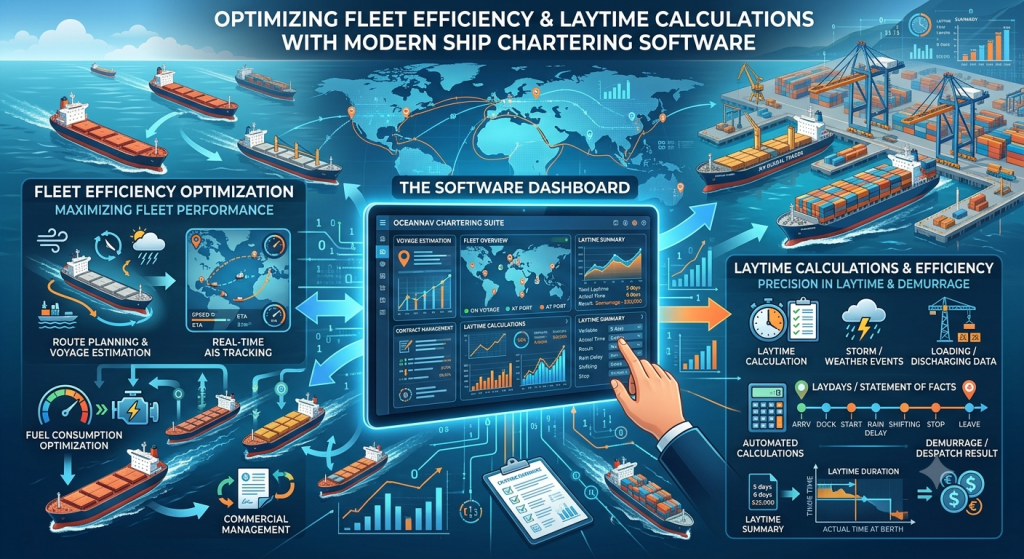
These platforms integrate multi-source data feeds—including automated AIS (Automatic Identification System) vessel tracking, global port directory APIs, historical bunker fuel pricing, and weather forecasting models—into a single operational dashboard. This unified approach allows ship operators, charterers, and commercial managers to oversee a fixture from the initial pre-fixture voyage estimation all the way to post-fixture financial closeouts and laytime settlements.
The Key Modules of Advanced Maritime Chartering Technology
To truly understand how digital tools optimize fleet efficiency, it is useful to look at the specific modules contained within a top-tier ship chartering platform. These specialized tools address distinct operational pain points throughout the lifespan of a charterparty agreement.
1. Pre-Fixture Voyage Estimation and Calculation
Before a contract is ever signed (known as “fixing” the vessel), a commercial team must run a comprehensive voyage estimate to determine profitability. Doing this manually is slow and prone to human error.
Advanced software allows an operator to instantly calculate the financial viability of a proposed voyage charter. By inputting basic parameters—such as the cargo volume, loading/discharge ports, expected ship speed, and current bunker consumption rates—the system automatically runs complex algorithms to predict the total voyage duration, total fuel costs, port disbursements, and the final Net Present Value (NPV) or Time Charter Equivalent (TCE) rate. This speed gives companies a massive competitive edge when bidding on available spot market cargo.
2. Live Cargo Tracking and AIS Integration
Once a ship is fixed clean and departs for its destination, real-time visibility becomes paramount for both the ship operator and the cargo owner.
Modern platforms integrate live satellite and terrestrial AIS data directly into the user interface. This means charterers do not have to wait for manual daily noon reports from the ship’s captain to know where their cargo is. The software automatically calculates the vessel’s live speed, monitors sea conditions, flags potential geographic or weather delays, and continuously updates the estimated time of arrival (ETA) at the destination port. This transparency allows shore-based teams to optimize port scheduling, notify customs agents early, and minimize idle time at the berth.
3. Automated Laytime and Demurrage Calculation
The financial closeout of a voyage charter frequently triggers disputes surrounding laytime—the contractually agreed-upon time framework allowed for loading and discharging cargo. Because laytime terms are filled with complex legal conditions (such as SHINC/SHEX clauses, weather working days, and local port holidays), manual calculations are notoriously difficult.
A dedicated laytime module automates this entire headache. Users simply input the key milestones from the Statement of Facts (SoF) provided by the port agent, such as:
- The exact time the Notice of Readiness (NOR) was tendered and accepted.
- The exact minutes cargo operations stopped due to bad weather or equipment failure.
- The official completion time of the hoses-off or hatches-closed phase.
The software automatically filters these events through the specific rules of the signed Charterparty, generating a clean, unassailable laytime statement. It instantly calculates whether the transaction has entered demurrage (where the charterer pays a penalty to the owner for delays) or despatch (where the owner rewards the charterer for early completion).
How Oitha Marine Utilizes Technology to Drive Client Value
At Oitha Marine, our operational philosophy centers on combining deep regional maritime expertise—particularly across Nigeria, West Africa, and global trade lanes—with cutting-edge digital infrastructure. We utilize advanced ship chartering software systems to ensure our clients receive maximum efficiency, transparency, and risk protection during every single voyage.
[Real-Time AIS Tracking] ➔ [Precise Laytime Automation] ➔ [Minimized Port Congestion] ➔ [Reduced Voyage Costs]
Eliminating Information Asymmetry
In traditional shipping arrangements, cargo owners are often left in the dark regarding the operational status of their chartered vessels. By leveraging digitized voyage management, Oitha Marine ensures all stakeholders have access to a single, verified source of truth. From real-time positioning to automated tracking of variable voyage expenses, our digital workflows eliminate guesswork. This high level of transparency minimizes disputes, accelerates transaction closeouts, and fosters long-term trust with our commercial partners.
Proactive Demurrage Mitigation
Port congestion is a frequent challenge in active maritime hubs. If a vessel sits idle outside a crowded terminal because of poor logistical synchronization, demurrage charges accumulate rapidly, draining a project’s profitability.
Oitha Marine’s software infrastructure constantly analyzes historical port turnaround times and active terminal congestion data. By combining these predictive analytics with precise AIS tracking, our operations team can make proactive adjustments—such as subtly adjusting a vessel’s transit speed to match an open berthing window (known as “Just-In-Time” arrival). This proactive approach directly reduces unnecessary bunker consumption, lowers carbon emissions, and saves our clients from facing expensive port delays.
The Strategic Future: Evolving Maritime Regulations
The adoption of ship chartering software is also heavily driven by evolving international regulatory frameworks. Environmental compliance has taken center stage in global shipping operations.
The International Maritime Organization (IMO) enforces strict regulations regarding vessel carbon emissions, primarily measured through the Carbon Intensity Indicator (CII) framework. Vessels are graded from A to E based on their operational efficiency. Modern chartering software automatically tracks a ship’s real-time fuel consumption and emissions profiles against these global compliance standards.
When Oitha Marine manages or charters an asset, our software platforms help evaluate and track these environmental data points. This ensures our clients are partnering with vessels that comply with modern green mandates, protecting their supply chains from unexpected regulatory fines or port access restrictions in eco-sensitive trade zones.
Frequently Asked Questions (FAQ)
What is the primary purpose of ship chartering software?
Ship chartering software is designed to automate and streamline the commercial, financial, and operational lifecycles of maritime voyages. It handles complex tasks including pre-fixture voyage estimations, live AIS vessel and cargo tracking, automated laytime calculations, and charterparty contract management.
How does software help prevent demurrage disputes?
Demurrage disputes usually occur because parties disagree on how specific port delays should be counted against the allowed laytime. Software resolves this by taking the raw Statement of Facts (SoF) timeline from the port and automatically processing it against the exact clauses in the Charterparty. This generates a standardized, mathematically transparent calculation that leaves no room for manual bias or human error.
What data does a voyage estimation tool require to provide an accurate quote?
An accurate voyage estimation relies on entering several key inputs: the specific cargo weight and type, the exact loading and discharge ports, the ship’s average speed, its specific fuel consumption rate per day (both at sea and while in port), current bunker fuel market prices, and expected port disbursement costs.
Can ship chartering software integrate with existing corporate ERP systems?
Yes. Top-tier, modern maritime platforms are built with robust Application Programming Interfaces (APIs). This allows them to integrate smoothly with a company’s existing corporate ERP systems, financial accounting software, or broader supply chain management tools, ensuring seamless data flow across the entire organization.
Why is software tracking important for modern environmental regulations like CII?
International maritime laws place strict carbon intensity caps on commercial vessels. Software continuously tracks fuel usage, sailing distances, and emissions data in real time. This allows ship operators to proactively optimize routes and speeds to maintain a compliant environmental rating, avoiding costly operational penalties.
Conclusion: Partnering for a Digitized Maritime Future
As the shipping sector continues to evolve, the line separating highly profitable logistics operations from inefficient ones will be determined by data utilization. Relying on outdated, manual processes introduces unnecessary risk into high-stakes commercial transactions. Implementing dedicated ship chartering software streamlines operations, protects corporate capital, and builds the verifiable transparency that modern B2B clients demand.
Oitha Marine remains committed to driving this digital transformation across the offshore and shipping sectors. By pairing our extensive hands-on operational capabilities in ship chartering, vessel management, and cargo handling with advanced digital tools, we provide our clients with an incredibly safe, reliable, and highly optimized shipping experience.
Are you looking to streamline your corporate maritime logistics, charter a highly efficient vessel, or secure dependable offshore support? Contact the commercial operations team at Oitha Marine today to discuss your specific fleet and cargo requirements.
Recent Comments