
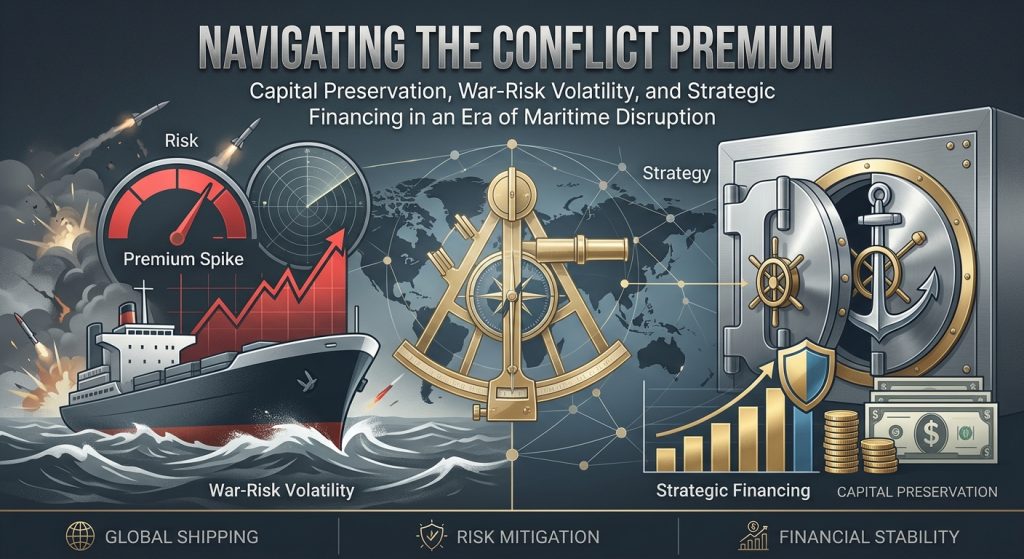
The global maritime transportation industry operates as the circulatory system of world trade, moving over 80 percent of international goods by volume. Historically, commercial shipping frameworks were designed to absorb localized disruptions through standardized charterparty agreements, baseline Hull & Machinery (H&M) cover, and flexible financing structures. However, systemic military escalations in critical chokepoints—most visibly illustrated by direct confrontations in the Persian Gulf, the Strait of Hormuz, the Gulf of Oman, and the southern Red Sea Corridor—have dismantled long-held operational assumptions.
Geopolitical tensions between state actors, specifically involving Iran and the United States, alongside non-state proxy disruptions, have introduced a compounding structural crisis across commercial maritime operation. What was once viewed as localized, transboundary friction has escalated into a structural shift defined by exponential war-risk insurance spikes, short-notice policy cancellations, lender-enforced operational exclusions, and unprecedented working capital compression.
This comprehensive analysis examines the mechanics of this operational reality. Designed for shipowners, marine underwriters, maritime attorneys, ship finance executives, and institutional investors, this report evaluates the systemic impacts on insurance and capital markets, outlines concrete contractual and operational strategies, and provides a forward-looking roadmap for capital preservation during sustained maritime conflict.
1. The Anatomy of Geopolitical Disruption in Commercial Shipping
Commercial ocean transport relies on predictable transit corridors, standardized liability regimes, and uninterrupted access to international financial clearing systems. The escalation of military operations across primary Middle Eastern maritime choke points—namely the Strait of Hormuz, through which approximately 20 to 25 percent of the world’s seaborne petroleum and a third of global liquefied natural gas (LNG) pass—has altered this equilibrium.
The Mechanism of Maritime Vulnerability
Unlike terrestrial infrastructure, seaborne assets are mobile, highly capital-intensive, and inherently exposed to asymmetric warfare. Modern maritime warfare in restricted waterways no longer relies solely on conventional naval surface engagements; it encompasses:
- Asymmetric Missile and Drone Strikes: Unmanned Aerial Vehicles (UAVs) and Anti-Ship Ballistic Missiles (ASBMs) targeted at commercial tonnage.
- Electronic Warfare and Navigation Interference: Regional GPS/GNSS spoofing and AIS (Automatic Identification System) manipulation, causing unintended navigational deviations, collisions, or accidental entry into territorial waters.
- Boarding, Seizure, and Detainment: State-sanctioned vessel seizures under regulatory or retaliation pretexts, locking up physical capital for months or years.
- Physical Interdiction and Mining: Limpet mines and sea-launched improvised explosive devices positioned along deep-water transit channels.
These operational realities do not merely risk physical asset destruction; they disrupt the complex legal and contractual Web connecting shipowners, charterers, cargo owners, primary insurers, P&I Clubs, and mortgage-holding banking syndicates.
+———————————————————–+
| GEOPOLITICAL WARFARE EVENT |
| (Missile/Drone Strike, Seizure, GPS Spoofing, Mine Threat) |
+—————————–+—————————–+
|
+————————-+————————-+
| |
v v
+———————–+ +———————–+
| INSURANCE RE-PRICING | | FINANCIAL RE-STRAIN |
+———–+———–+ +———–+———–+
| • High-Risk Area (HRA)| | • LTV Covenant Breach |
| AP surcharges | | • OFAC/Sanctions Holds|
| • 72-hr / 7-day policy| | • Working Capital |
| cancellations | | Compression |
| • P&I Excess Limits | | • Increased Cash |
| & CTL Trigger Gaps | | Reserve Mandates |
+———–+———–+ +———–+———–+
| |
+————————-+————————-+
|
v
+———————————————————–+
| SHIPOWNER WORKING CAPITAL & OPERATIONAL |
| RE-ALLOCATION IMPLICATIONS |
+———————————————————–+
2. Impacts on Maritime Insurance Frameworks
Marine insurance operates on a multi-tiered risk distribution model splitting physical loss, third-party liability, and war-related perils. The escalation of regional warfare fundamentally disrupts this structure.
War-Risk Premiums and High-Risk Area (HRA) Escalations
Under standard commercial practices, standard Marine Hull & Machinery (H&M) policies exclude loss or damage resulting from war, hostile acts, capture, seizure, restraint, and weapons of war via standard war exclusion clauses (e.g., Institute War and Strikes Clauses). To operate in volatile waters, shipowners must procure specialized War Risk Insurance.
When the Joint War Committee (JWC)—comprising underwriters from the Lloyd’s Market Association (LMA) and the International Underwriting Association (IUA)—adds or expands a waterway within its Listed Areas, underwriters gain the legal right to apply Additional Premiums (AP) for any vessel entering those coordinates.
- Historical Baseline vs. Conflict Peaks: Prior to conflict escalation, transit APs routinely averaged between 0.05% and 0.10% of a vessel’s total insured hull value. During active escalation periods in the Persian Gulf and Red Sea corridors, AP rates reached 3.5% to 7.5%, with extreme spikes exceeding 10% per transit for vulnerable or state-affiliated tonnage.
- The Financial Impact on Tonnage: For a modern Very Large Crude Carrier (VLCC) with an agreed hull value of $120 million, an AP spike from 0.05% to 3.5% transforms a single-transit war risk insurance bill from $60,000 to $4,200,000. This single expense item frequently exceeds the entire operational voyage budget, instantly converting profitable spot charter voyages into loss-making liabilities unless effectively passed to charterers.
The 72-Hour and 7-Day Notice of Cancellation Mechanisms
War risk insurance policies incorporate unilateral cancellation provisions. Marine underwriters routinely maintain the contractual right to cancel war risk cover or amend premium rates upon giving 72 hours’ notice (for specialized lines) or 7 days’ notice (for standard hull war lines).
When military hostilities spike:
- Underwriters immediately issue blanket notices of cancellation across defined geographic blocks.
- Coverage terminates automatically upon the expiration of the notice period.
- To maintain coverage, shipowners must negotiate reinstatement terms under dramatically increased rates, reduced sub-limits, or heightened operational warranties (such as daylight-only transit or mandatory security escort protocols).
Constructive Total Loss (CTL), Trapping, and Blocking Discrepancies
A primary area of financial exposure for shipowners during state-level blockades or channel closures involves vessel detainment without physical destruction.
- The 12-Month Trapping Rule: Under standard Institute War Clauses, if a vessel is prevented from leaving a port or waterway due to physical blockades, sunken blockships, or state seizure, the vessel is not immediately deemed a Total Loss. Shipowners must demonstrate that they have been continuously deprived of possession or movement for 12 consecutive months before claiming a Constructive Total Loss (CTL) to recover the insured value from war risk underwriters.
- Loss of Hire (LoH) Coverage Gaps: Standard Marine Loss of Hire policies traditionally cover revenue loss resulting from physical damage to the vessel caused by an insured peril. If a vessel is delayed, anchored, or rerouted due to war risk threats or channel blockades without suffering physical hull damage, standard LoH policies do not respond. Specialized Detainment/Trapping Loss of Hire extensions are required, though these become virtually uncurable or prohibitively expensive once hostilities break out.
Protection & Indemnity (P&I) Liabilities and Excess Limits
Third-party liabilities—including crew injury/fatality, wreck removal, oil pollution, and environmental damage—are insured through Mutual P&I Clubs within the International Group of P&I Clubs (IG P&I).
+——————————————————————-+
| IG P&I CLUB WAR RISK COVERAGE LAYERS |
+——————————————————————-+
| EXCESS WAR P&I COVER: Up to US $500 Million |
| (Arranged collectively by International Group P&I Clubs) |
+——————————————————————-+
| ATTACHMENT POINT / PRIMARY WAR POLICY COVER: |
| Equivalent to Vessel Proper Insured Hull Value (e.g., $100M) |
+——————————————————————-+
| PRIMARY H&M / HULL WAR POLICY |
| (Written by Commercial Market / Specialist War Underwriters) |
+——————————————————————-+
- The Primary Attachment Threshold: Excess War P&I cover provided by IG Clubs attaches only above the proper value of the vessel’s primary Hull War policy (or a underlying baseline sum, typically up to the vessel’s hull value). If a shipowner under-insures their primary hull war value, a dangerous gap opens between primary cover and the P&I excess layer.
- Bio-Chem and Weapons Exclusions: Standard P&I war risk policies strictly exclude liabilities arising from chemical, biological, bio-chemical, or electromagnetic weapons, as well as cyber-attack vectors targeting shipboard operating systems.
3. Structural Shifts in Ship Financing and Banking Capital
Maritime debt markets are exceptionally sensitive to geopolitical volatility. Commercial banks, export credit agencies (ECAs), and private maritime debt funds rely on predictable cash flows and clear mortgage enforcement capabilities. Conflict in major energy corridors introduces direct asset and counterparty risk to capital providers.
Loan-to-Value (LTV) Covenants and Asset Repricing
Ship finance facilities are secured by primary mortgages over vessels, supplemented by assignments of earnings and insurance policies.
+———————————–+
| MARITIME LOAN COVENANT MATRIX |
+—————–+—————–+
|
+———————–+———————–+
| |
v v
+———————–+ +———————–+
| MINIMUM VALUE CLAUSE | | OPERATIONAL GEOGRAPHY |
| (LTV RATIO) | | COVENANTS |
+———–+———–+ +———–+———–+
| Asset revaluations in | | Strict exclusion of |
| conflict zones can | | JWC listed conflict |
| trigger mandatory | | zones without prior |
| equity top-ups. | | lender approval. |
+———————–+ +———————–+
- Asset Depreciations in High-Risk Zones: A vessel trapped within an active conflict zone or subject to persistent war risk threats suffers immediate commercial liquidity devaluation. Lenders reserve the contractual right under loan agreements to demand updated Independent Broker Valuations (IBVs).
- Loan-to-Value (LTV) Breaches: If market valuations fall or if insurance underwriters restrict coverage terms, the vessel’s adjusted asset value may fall below the mandatory LTV threshold (typically 65% to 75% of loan-to-value). This triggers a Minimum Value Clause breach, requiring the shipowner to either:
- Inject additional cash equity within 30 days to pay down the principal;
- Provide acceptable supplementary collateral (e.g., unencumbered tonnage or cash deposits); or
- Face technical default and potential mortgage enforcement.
Operational Geography Covenants and Default Triggers
Modern bilateral and syndicated loan agreements contain explicit navigation warranty clauses.
- Mandatory Lender Consent: Shipowners are prohibited from trading vessels into JWC Listed High-Risk Areas without giving prior written notice to the facility agent and securing explicit confirmation that all requisite war risk insurances, AP coverage, and security protocols are active.
- Unauthorized Navigation Defaults: Entering an active military zone without verifying full insurance coverage constitutes an immediate Event of Default. This entitles the banking syndicate to accelerate the loan, declare all outstanding principal instantly due, and freeze associated earnings accounts held with the lender.
Sanctions Compliance, OFAC Tripwires, and Capital Freezes
State-level maritime warfare often coincides with secondary sanctions, trade blockades, and intensified regulatory enforcement by agencies such as the U.S. Department of the Treasury’s Office of Foreign Assets Control (OFAC), the UK Office of Financial Sanctions Implementation (OFSI), and the European Union.
- Intermediary Bank Interdictions: Financial clearing houses and correspondent banks utilize automated compliance algorithms to screen SWIFT wire transfers, Letters of Credit (LCs), and freight remittances.
- The “Dark Fleet” Contagion Effect: Innocent commercial operators working near high-risk zones run severe risks of operational cross-contamination. If a vessel anchors near areas associated with sanctioned ship-to-ship (STS) energy transfers or interacts with entities indirectly linked to state-controlled port operators, international clearing banks will automatically freeze incoming freight payments, pending extensive compliance audits that can paralyze a shipowner’s cash flow for months.
Working Capital Squeezes and Liquidity Compression
The combined cost of geopolitical disruption places severe pressure on a shipowner’s operational cash reserves:
Voyage Working Capital Requirement=Bunker Costs+War Risk APs+Extended Transit Days+Canal/Port Surcharges\text{Voyage Working Capital Requirement} = \text{Bunker Costs} + \text{War Risk APs} + \text{Extended Transit Days} + \text{Canal/Port Surcharges}Voyage Working Capital Requirement=Bunker Costs+War Risk APs+Extended Transit Days+Canal/Port Surcharges
When vessels are forced to avoid volatile chokepoints like the Strait of Hormuz or the Bab-el-Mandeb Strait, rerouting around the Cape of Good Hope adds 10 to 14 sailing days to a Middle East/Europe or Asia/Europe transit. This extended voyage profile requires:
- Significant upfront capital for extra bunker fuel fuel burn;
- Delayed freight collection cycles (increasing Days Sales Outstanding / DSO); and
- Higher overall operational expenditures (OpEx) for crew war-hazard pay bonuses.
Financiers now require higher minimum liquidity buffers—often raising required cash reserve covenants from $500,000 per vessel to $1,500,000–$3,000,000 per vessel—to absorb voyage delays and insurance cash calls.
4. Operational and Legal Strategies for Shipowners
To preserve capital and protect physical assets in high-risk operational environments, shipowners must update their legal frameworks, insurance structures, and fleet management practices.
Charterparty Engineering: Customizing BIMCO Clauses
Standard, unamended charterparty agreements are inadequate during active maritime conflicts. Owners must ensure that standard BIMCO war risk provisions are tailored to mitigate financial exposure.
+————————————————————————————+
| CONTRACTUAL WAR RISK RISK-ALLOCATION MATRIX |
+——————–+—————————————————————+
| CLAUSE MECHANISM | STRATEGIC FUNCTION & OWNER PROTECTION |
+——————–+—————————————————————+
| CONWARTIME 2025 | Grants Master absolute discretion to refuse orders into |
| (Time Charters) | dangerous zones. Requires Charterer to pay all War Risk APs, |
| | crew hazard bonuses, and maintain hire during war delays. |
+——————–+—————————————————————+
| VOYWAR 2025 | Protects voyage operators by allocating extra transit costs, |
| (Voyage Charters) | alternate route freight adjustments, and delay freight |
| | surcharges directly to the Charterer/Cargo owner. |
+——————–+—————————————————————+
| Custom Liberty | Explicitly permits deviation to clear danger zones without |
| & Rerouting | triggering unlawful deviation claims or breach of custom |
| Clauses | obligation to proceed with utmost dispatch. |
+——————–+—————————————————————+
CONWARTIME 2025 vs. VOYWAR 2025 Protocols
- CONWARTIME 2025 (Time Charters): The updated BIMCO CONWARTIME clause establishes that the vessel, crew, and cargo do not need to be exposed to actual physical attack to justify a refusal to proceed. The test is whether, in the reasonable judgment of the Master or Shipowner, the vessel may be exposed to War Risks. If the vessel transits a risk area, all additional war risk premiums, kidnap and ransom (K&R) covers, crew bonuses, and liability surcharges are for the Charterer’s account. Furthermore, the vessel remains fully on hire for all time lost due to war risk delays or security detours.
- VOYWAR 2025 (Voyage Charters): Addresses the positioning before, during, and after loading. If an area becomes dangerous prior to loading or transit, the shipowner can request the charterer to nominate a safe alternative port. If no nomination is made within 48 hours, the owner may cancel the charterparty or discharge cargo at a safe alternative port, with such action deemed full performance of the contract.
“Utmost Dispatch” vs. Liberty to Deviate
Under common maritime law, a shipowner owes a strict duty to cargo interests to proceed along the customary geographical route with utmost dispatch. Unjustified deviation breaches the contract of carriage, invalidating standard bill of lading exclusions and voids underlying marine insurance policies. Shipowners must incorporate explicit Liberty Clauses permitting vessel deviations to save life/property, avoid war risk regions, or follow naval advice without committing a breach of contract.
Comprehensive Insurance Portfolio Optimization
Relying solely on baseline marine cover creates significant balance-sheet risk. Shipowners should structure a multi-layered insurance portfolio:
+——————————————————————-+
| OPTIMIZED SHIPOWNER INSURANCE PORTFOLIO |
+——————————————————————-+
| 1. Primary Marine Hull & Machinery (H&M) |
| – Covers standard marine perils (collision, grounding, engine) |
+——————————————————————-+
| 2. Standalone Hull War & Strikes Insurance |
| – Written to 100% of agreed fleet asset values |
+——————————————————————-+
| 3. Standalone Blocking & Trapping / Detainment Cover |
| – Secures CTL payout if trapped in chokepoints > 6 months |
+——————————————————————-+
| 4. War Loss of Hire (LoH) / Business Interruption |
| – Protects daily hire income during non-damage blockages |
+——————————————————————-+
| 5. International Group P&I Cover + Excess War Liabilities |
| – Third-party pollution, wreck removal, and crew liabilities |
+——————————————————————-+
- Non-Damage Loss of Hire (LoH) Extensions: Securing specialized insurance lines that pay daily indemnity rates (e.g., $20,000–$50,000/day for up to 90 or 180 days) when a vessel is delayed or blocked from operating due to war perils, even in the absence of physical hull damage.
- Reduced Trapping Periods: Negotiating tailored policy endorsements that reduce the standard 12-month trapping/detainment period down to 6 months, allowing faster capital recovery and debt retirement following vessel seizure or channel blockades.
- Dual-Mechanism Primary War Cover: Maintaining standalone primary war policies with flexible, pre-agreed AP caps to prevent market pricing gouging during sudden geopolitical events.
Operational Resilience and Onboard Defense
Beyond financial and legal structuring, physical security measures are critical to managing operational risk:
- Hardening and Electronic Defense Protocols: Installing anti-boarding physical barriers, reinforced citadel spaces with independent communication links, fire-monitors, and acoustic devices.
- Navigation Safeguards Against GPS Spoofing: Establishing dual-redundant, non-satellite navigation protocols (e.g., optical bearings, radar matching, and manual dead reckoning) when transiting zones known for electronic warfare and GPS spoofing.
- Naval Escorts and Convoy Integration: Coordinating transits through International Maritime Security Construct (IMSC) channels, United States Naval Forces Central Command (NAVCENT) guidelines, or specialized state-escorted maritime corridors.
5. Strategic Lessons for the Broader Maritime Ecosystem
The fallout from Middle Eastern naval disruptions extends across the global trade, insurance, and banking networks. These developments highlight key structural lessons for the broader industry:
+——————————————————————-+
| STRUCTURAL LESSONS FOR MARITIME STAKEHOLDERS |
+——————————————————————-+
| SHIPFINANCE BANKS –> Integrate “Chokepoint Sensitivity Models” |
| into credit underwriting frameworks. |
+——————————————————————-+
| MARINE UNDERWRITERS–> Adopt real-time AIS/satellite tracking for |
| dynamic, automated AP pricing models. |
+——————————————————————-+
| CARGO SHIPPERS –> Transition from “Just-In-Time” logistics to|
| “Just-In-Case” strategic inventory buffer. |
+——————————————————————-+
For Ship Finance Institutions and Institutional Debt Funds
- Chokepoint Stress-Testing in Credit Risk: Credit committees must evaluate loan applications using dynamic chokepoint stress models. Underwriting assumptions must test whether a borrowing entity can maintain debt service obligations under a 30% reduction in fleet utilization combined with a 200% increase in war-risk operational expenses.
- Insurance Policy Assignment Audits: Lenders must conduct rigorous audits of borrower insurance policies, verifying that loss payee clauses, notice of cancellation requirements, and mortgagees’ interest insurances (MII) fully protect the bank if an owner inadvertently breaches a navigation warranty.
For Marine Insurers and Reinsurance Syndicates
- Dynamic Risk Pricing via Real-Time Telemetry: Traditional static geographic risk zones are being replaced by dynamic risk models utilizing real-time AIS satellite telemetry, vessel flag identification, ownership screening, and threat intelligence feeds.
- Managing Cumulative Exposure: Underwriting syndicates must actively monitor cumulative exposure in narrow waterways. If a single syndicate underwrites 30% of the commercial tonnage transiting the Strait of Hormuz simultaneously, a single multi-vessel missile attack or sea-mine deployment can trigger catastrophic capital drawdown.
For Global Supply Chain Managers and Freight Forwarders
- Abandoning Pure “Just-in-Time” Supply Chains: Global importers and manufacturers can no longer construct supply chains around fragile, single-corridor transit times. Ocean logistics strategies must shift to “Just-in-Case” models, maintaining larger safety stocks and diversifying sourcing locations.
- Contractual Cost Allocation Transparency: Shippers must prepare for dynamic freight pricing structures incorporating floating geopolitical surcharges, fuel adjustment factors (BAF), and war-risk cost pass-throughs.
6. Comprehensive Structural Comparison
The following matrix details the operational, contractual, and financial parameters across standard operational conditions versus active geopolitical conflict states:
| Operational Parameter | Baseline / Standard Maritime Conditions | Active Conflict / High-Risk Area Conditions | Strategic Action / Mitigation Required |
| War Risk Insurance Premium (AP) | 0.05% – 0.10% of total insured hull value. | 3.5% – 7.5%+ of insured hull value per transit (with temporary spikes exceeding 10%). | Incorporate strict CONWARTIME/VOYWAR clauses to automatically transfer AP costs to charterers. |
| Notice of Policy Cancellation | Standard annual renewal terms with standard annual terms. | 72-hour to 7-day unilateral cancellation notices issued by underwriters. | Maintain pre-negotiated reinstatement rate caps and establish real-time broker communication channels. |
| Constructive Total Loss (CTL) Trigger | Instantaneous upon physical destruction or total structural failure. | 12-month continuous deprivation of use (trapping/blocking) required for non-damaged vessels. | Negotiate customized policy endorsements to reduce trapping CTL threshold from 12 months down to 6 months. |
| Loss of Hire (LoH) Coverage | Responds to daily earnings losses caused by physical hull damage from an insured peril. | Standard LoH excludes delays, detours, or trapping without physical hull damage. | Purchase standalone Non-Damage Loss of Hire and Detainment insurance coverage. |
| Ship Finance LTV Covenants | Standard annual or semi-annual asset valuation updates (65%–75% LTV limit). | Rapid asset devaluation in risk areas can trigger immediate Minimum Value Clause breaches. | Maintain higher cash liquidity buffers ($1.5M–$3.0M per vessel) to satisfy lender margin calls. |
| Charterparty Delay Allocation | Delays caused by route preference or weather are often borne by the shipowner. | Delays due to war risk threats or safety detours are transferred to the charterer (vessel stays on-hire). | Ensure time charter agreements do not contain bespoke charterer rider clauses overriding standard BIMCO protections. |
| Transit Route Selection | Direct route via primary shipping canals and narrow geographical chokepoints. | Multi-week rerouting around major capes (e.g., Cape of Good Hope), adding 10–14 days. | Adjust bunker fuel hedge strategies, update delivery windows, and renegotiate Bill of Lading arrival commitments. |
7. Actionable Roadmap for Corporate Governance & Risk Management
To protect fleet balance sheets against ongoing geopolitical volatility, corporate management teams should implement a structured, multi-phase execution framework.
PHASE 1: AUDIT & IDENTIFY
• Conduct fleet-wide charterparty legal gap analyses.
• Audit debt agreements for strict navigation warranty compliance.
• Review primary war risk policy attachment thresholds and P&I excess limits.
│
▼
PHASE 2: CONTRACTUAL RE-ENGINEERING
• Mandate BIMCO CONWARTIME 2025 / VOYWAR 2025 clauses across all charter fixtures.
• Insert non-damage deviation and liberty provisions in Bills of Lading.
• Negotiate 6-month trapping CTL endorsements with war risk underwriters.
│
▼
PHASE 3: FINANCIAL & LIQUIDITY SHIELDING
• Increase per-vessel cash liquidity reserves to absorb upfront bunker/AP demands.
• Establish pre-approved credit lines to handle delayed freight collection cycles.
• Implement strict OFAC/Sanctions counterparty screening protocols for all charters.
│
▼
PHASE 4: OPERATIONAL HARDENING
• Implement real-time AIS, GPS-spoofing detection, and secure navigation protocols.
• Mandate daily security briefings with NAVCENT, IMSC, and local P&I correspondents.
• Harden physical vessel structures (citadels, anti-boarding gear) for high-risk transits.
Phase 1: Contractual & Insurance Gap Audit
- Conduct a legal audit across all active time and voyage charterparties to verify the inclusion of recent BIMCO war risk clauses without conflicting charterer rider provisions.
- Inspect existing loan agreements to identify exact navigation warranties, LTV breach thresholds, and notice requirements for trading in JWC Listed Areas.
- Review primary war risk policies to ensure the agreed insured value fully covers the primary attachment point required for International Group P&I excess war liabilities.
Phase 2: Restructuring and Policy Optimization
- Negotiate policy endorsements to shorten trapping and blocking Constructive Total Loss (CTL) terms from 12 months down to 6 months.
- Secure standalone War Loss of Hire (LoH) insurance to cover daily operational earnings during non-physical detainment or channel blockades.
- Embed explicit Liberty to Deviate provisions within all issued Bills of Lading to eliminate unlawful deviation liabilities during strategic rerouting.
Phase 3: Capital and Liquidity Preservation
- Increase corporate cash reserves or secure dedicated standby liquidity lines ($1.5M to $3.0M per active vessel) to cover upfront bunker purchases and elevated war-risk AP cash calls during long reroutings.
- Implement enhanced sanctions compliance protocols to screen all charterers, cargo owners, sub-charterers, and bunkering suppliers against OFAC/OFSI database lists, preventing frozen wire transfers.
Phase 4: Operational Security Protocols
- Establish standardized bridge operating procedures to mitigate electronic warfare threats, including manual navigation verification protocols during suspected GPS spoofing events.
- Ensure all vessels transiting volatile corridors register with regional security bodies (e.g., MSCHOA, UKMTO, IMSC) and strictly execute Vessel Hardening Protocols prior to entering defined High-Risk Areas.
Frequently Asked Questions (FAQ)
What is the difference between standard Marine Hull & Machinery (H&M) insurance and War Risk Insurance?
Standard Marine Hull & Machinery (H&M) insurance covers physical loss or damage to a vessel resulting from conventional marine perils such as collisions, strandings, heavy weather, fires, or machinery breakdowns. However, standard H&M policies contain explicit war exclusion clauses that void coverage for losses caused by weapons of war, missile strikes, military blockades, seizures, terrorism, or hostile state actions.
War Risk Insurance is a specialized policy purchased separately to cover these explicitly excluded risks. It covers both physical hull damage from war perils and operational liabilities, subject to specific geographic navigation warranties and Additional Premiums (APs) when entering designated High-Risk Areas.
How does the Joint War Committee (JWC) influence ship operational costs?
The Joint War Committee (JWC)—comprising representatives from the London underwriting market—regularly updates the JWC Listed Areas. These are geographical zones identified as posing elevated risks to commercial shipping from war, terrorism, piracy, or political instability.
While the JWC does not directly set insurance rates, its updates give marine underwriters the legal right to suspend standard trading warranties for vessels entering these listed zones. Shipowners must notify their underwriters before entering a JWC listed area and pay an Additional Premium (AP). This AP directly increases voyage costs, often expanding operational budgets by millions of dollars per transit during active conflicts.
What happens if a vessel is blocked or trapped in a waterway without taking physical damage?
If a vessel is blocked, trapped, or detained in a waterway (e.g., due to sunken vessels, military blockades, or local port closures) without suffering physical hull damage, it is not immediately considered a total loss.
Under standard Institute War Clauses, the shipowner must endure a continuous detention period—typically 12 consecutive months—before the vessel can be declared a Constructive Total Loss (CTL). Once the 12-month threshold is reached, the shipowner can abandon the vessel to war risk underwriters and claim its full insured value. Shipowners can negotiate bespoke policy endorsements that shorten this trapping CTL period from 12 months to 6 months, accelerating debt payoff and capital recovery.
Who pays for war risk insurance surcharges under standard BIMCO charterparties?
Under standardized BIMCO war risk clauses—such as CONWARTIME 2025 (for time charters) and VOYWAR 2025 (for voyage charters)—the financial responsibility for additional war risk insurance costs falls upon the Charterer.
- Under CONWARTIME 2025, the charterer must reimburse the shipowner for all additional war risk premiums, crew hazard bonuses, and specialized kidnap and ransom (K&R) covers required to execute the voyage. Furthermore, the vessel remains fully on-hire during any security-related delays or mandatory deviations.
- Under VOYWAR 2025, if an area becomes unsafe, the owner can demand an alternative safe port nomination from the charterer or cancel the charterparty if no alternative is provided, treating any safety deviations as due fulfillment of the contract.
How do war risk spikes lead to default under ship mortgage agreements?
Maritime loan agreements contain strict financial and operational covenants designed to protect the lender’s mortgage security. War risk disruptions can trigger defaults through multiple mechanisms:
- Navigation Warranty Breaches: If a vessel enters a JWC Listed Area without notifying the mortgage-holding bank or without securing pre-approved war risk insurance, it causes an immediate, uncurable Event of Default.
- Minimum Value Clause (LTV) Breaches: If a vessel’s market value drops due to being trapped or operating in an active conflict zone, the Loan-to-Value (LTV) ratio may exceed contractual limits (e.g., rising above 70% LTV). The lender can then issue a margin call requiring the owner to inject cash equity or provide additional collateral within 30 days.
- Liquidity Covenants: Surging upfront bunker costs for long reroutings, combined with multi-million dollar war risk AP cash calls, can rapidly deplete a shipowner’s cash reserves below the minimum working capital balances required by bank loan covenants.
What is the “12-Month Trapping Rule” in marine war risk insurance?
The 12-Month Trapping Rule is a standard contractual provision in marine war risk policies. It establishes that if a vessel is physically prevented from leaving a port, canal, or sea region due to military blockades, regulatory detainment, or channel obstructions, the owner cannot claim an immediate total loss payout.
The shipowner must prove that they have been continuously deprived of the operational use and control of the vessel for 12 full consecutive months. Only after this time elapses can the owner claim a Constructive Total Loss (CTL) and receive the policy’s agreed insured value. Owners frequently seek to purchase tailored endorsements that reduce this period down to 6 months to avoid prolonged balance-sheet distress.
Recent Comments