
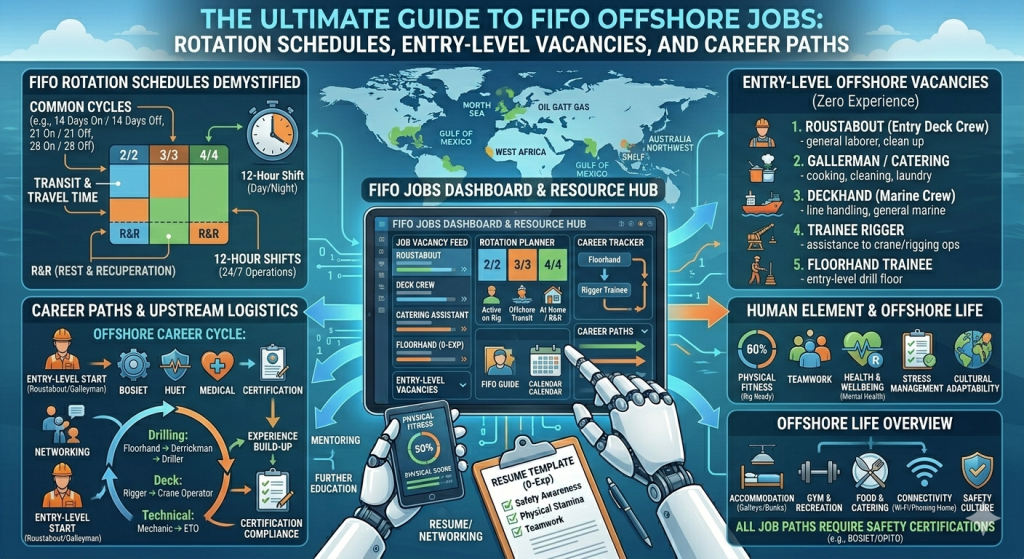
The global offshore marine and energy industries rely on an elite, specialized labor framework known as Fly-In Fly-Out (FIFO). For professionals looking to build a high-paying career, securing an offshore job vacancy on an oil rig, drillship, or offshore support vessel (OSV) represents the pinnacle of blue-collar and engineering financial success.
However, breaking into the offshore sector requires more than just a strong work ethic. It demands an intimate understanding of complex offshore jobs rotation structures, international maritime safety compliances, and targeted recruitment pathways. This comprehensive guide provides an authoritative analysis of the offshore FIFO ecosystem, mapping out entry-level opportunities, compensation metrics, and long-term career advancement blueprints.
1. Demystifying the FIFO Offshore Model
At its core, fifo offshore jobs are defined by an operational structure where workers are transported via helicopter or specialized crew transfer vessels directly to remote maritime assets. Unlike standard industrial positions, offshore personnel live and work entirely on-site for the duration of their hitch, followed by an equivalent, uninterrupted period of rest at their home destination.
The Dynamics of Offshore Jobs Rotation Schedules
The structure of an offshore schedule is designed to balance peak operational productivity with severe fatigue management regulations. The standard offshore jobs 28 28 shift pattern (28 days on shift, followed by 28 days of paid field leave) is the benchmark across international waters, including the Gulf of Mexico, the North Sea, and West African maritime blocks.
[28 Days On-Site: 12-Hour Daily Shifts] ===(Helicopter Transit)===> [28 Days Paid Off-Site Rest]
Alternative configurations adapt to regional logistics and project scopes:
- The 3w/2w Shift Pattern: Common in near-shore assets and specific European shelf operations, the offshore jobs 3w/2w cycle splits work into three weeks on-site and two weeks off-site.
- Even-Time Rotations (2w/2w or 4w/4w): Widely utilized within domestic Australian sectors and major LNG exploration blocks, ensuring absolute equity between days worked and days rested.
During the active phase of the rotation, standard operating procedures dictate 12-hour shifts daily. This demands immense physical and psychological resilience, compensated for by complete freedom from work-related obligations during the off-cycle.
2. Analysis of the Offshore Job Market and Entry-Level Vacancies
The primary barrier to entry for prospective crew members is navigating the baseline requirements for an offshore jobs no experience entry pathway. While operator companies require highly technical crews, every asset relies on an indispensable support tier to maintain production, maritime stability, and hospitality.
| Position Tier | Job Title | Primary Responsibility | Essential Starting Certifications |
| Drilling/Deck Entry | Roustabout | Heavy lifting, deck cleaning, paint maintenance, pipe handling assistance. | OPITO BOSIET, HUET, Marine Medical |
| Catering & Hospitality | Galley Hand / Utility | Industrial cleaning, food preparation assistance, laundry services. | STCW Food Safety, BOSIET, Flag State Discharge Book |
| Technical Support | Maintenance Assistant | Basic mechanical/electrical tracking, tool inventory, lubrication. | Relevant trade certificate, OPITO IMIST |
The Roustabout: The Gateway to the Drill Floor
For individuals targeting a career in drilling operations, the Roustabout position is the fundamental starting point. Roustabouts manage the physical logistical flow of the asset. They offload supply vessels, maintain structural cleanliness, and assist the crane operator. Excelling as a Roustabout leads directly to promotion as a Roughneck, positioning you directly within the high-income drilling crew hierarchy.
3. High-Value Skill Sets and Premium Technical Roles
As professionals progress beyond introductory deck positions, specialized skill sets command premium day rates from major operator groups and international tier-1 crewing agencies.
Subsea and Drilling Specialties
Advanced drilling operations utilize automated cyber-base cabins. Key personnel such as the Assistant Driller and Driller supervise complex hydraulic strings and mud-circulation parameters. Furthermore, Subsea Engineers manage the blowout preventer (BOP) stacks and marine riser systems, occupying some of the most critical safety roles on a floating asset.
Marine and Asset Operations
Modern offshore environments are typically floating structures rather than fixed platforms. Dynamic Positioning (DP) Operators utilize computerized thruster systems to maintain a vessel’s exact position over a wellhead without anchors, a capability crucial for deepwater exploration. This discipline requires comprehensive certification regulated by the Nautical Institute, pairing marine deck officer credentials with specialized simulator and sea-time logs.
4. Crucial Maritime Certifications and Regulatory Compliances
Operating on a floating production asset or drilling rig requires strict adherence to global maritime and energy safety standards. Sponsoring operators will not review a job offshore vacancy application unless the candidate holds the current mandatory compliance credentials.
OPITO BOSIET with CA-EBS
The international gold standard for offshore survival training is the OPITO-approved Basic Offshore Safety Induction and Emergency Training (BOSIET). Modern compliance frameworks leverage BOSIET with CA-EBS Digital Delivery protocols. This allows candidates to complete the comprehensive theoretical models online before completing the practical evaluations in a single day at an accredited training center.
[Online Theory Modules] -> [1-Day Practical Pool Assessment] -> [4-Year Global OPITO Certification]
The course encompasses four mandatory segments:
- Safety Induction: Hazard identification, waste management, and safety culture systems.
- Helicopter Safety and HUET: Helicopter Underwater Escape Training, simulating a controlled ditching and inverted survival scenario in a specialized environmental pool.
- Sea Survival and First Aid: Liferaft deployment, marine hyperthermia mitigation, and immediate emergency stabilization.
- Firefighting and Self-Rescue: Handheld extinguisher management and navigation through zero-visibility, smoke-filled corridors.
Medical Fitness Standards
Every offshore professional must secure an official oil and gas medical certificate, such as an OEUK (formerly OGUK) or Norwegian Directorate of Health medical. These assessments confirm proper pulmonary, cardiovascular, and audiometric health, alongside specific fitness clearances for shallow-water Compressed Air Emergency Breathing System (CA-EBS) training.
5. Global Offshore Hubs and Recruitment Blueprints
The offshore energy sector operates across distinct geographic regions, each presenting unique deployment profiles and regulatory structures.
Major Geographic Sectors
- The North Sea (UK/Norway): Characterized by stringent safety oversight, harsh environmental criteria, and robust union frameworks. Production emphasizes deepwater engineering and wind energy support structures.
- The Gulf of Mexico (US/Mexico): A major global hub for deepwater drilling platforms and extensive offshore support vessel networks.
- Australasia and Southeast Asia: Centers of massive LNG extraction blocks. The region offers premium compensation scales, strictly regulated by regional maritime authorities.
A Strategic Framework for Securing an Offshore Position
[Target Credentials Active] -> [Build Maritime-Formatted CV] -> [Register with Tier-1 Crewing Agencies] -> [Direct Operator Application]
To secure a position within competitive international crewing databases, implement this systematic approach:
- Align Credentials Pre-Application: Obtain your passport, an unrestricted marine medical certificate, and a valid OPITO BOSIET independently. Self-funding these credentials distinguishes you from casual job seekers and demonstrates immediate operational readiness.
- Format a Technical CV: Structure your resume around safety performance, mechanical competencies, and adaptability to high-stress, remote environments. Highlight heavy industry backgrounds like commercial construction, agricultural mechanics, or military service.
- Register with Tier-1 Maritime Agencies: Submit your profile to recognized global crewing firms, including Brunel, Airswift, Atlas Professionals, and pan-industry marine staffing agencies.
6. Industry FAQ: Frequently Asked Questions
What is the entry-level salary expectation for a FIFO offshore job?
Entry-level roles such as Roustabouts or Galley Utilities generally earn between $50,000 and $80,000 USD annually, depending on the global region and the specific tax structures of the operating zone. Technical positions and specialized engineering roles regularly exceed $150,000 to $220,000 USD per year, complemented by comprehensive corporate health cover and paid international travel.
How do maritime operators handle internet connectivity and crew welfare offshore?
Modern drilling assets and production platforms utilize high-bandwidth VSAT and Low Earth Orbit (LEO) satellite systems to provide crews with stable internet access. This infrastructure supports high-definition video communication with families during off-shift hours. Facilities typically include commercial-grade gymnasiums, cinema rooms, catered dining halls, and private or twin-share cabins with sound dampening.
How has cybersecurity changed operations for modern offshore crews?
Modern offshore platforms are highly digital environments where operational technology (OT) interfaces with global networks. In line with the latest BIMCO Cybersecurity Guidelines, crew members must follow strict protocols. This includes banning unauthorized personal devices in control rooms, avoiding personal USB drives on asset computers, and completing regular onboard cyber risk awareness training.
What is the structural validity period for an OPITO BOSIET certification?
A standard OPITO BOSIET certification remains valid for four years from the date of practical assessment completion. Prior to expiration, active crew members must complete a one-day Further Offshore Emergency Training (FOET) course to refresh their safety competencies and extend their compliance validity for an additional four years.
Can individuals with zero maritime experience secure an offshore position?
Yes. Heavy industrial skills from sectors like mining, civil construction, commercial scaffolding, or heavy equipment mechanics transfer directly to deck and drilling operations. Sponsoring employers value a proven track record of safe operations in high-risk environments over specific prior maritime tenure for introductory roles.
Operational Insight: The offshore industry values safety above all else. Arriving on an asset with a proactive, risk-aware mindset and completed baseline certifications is the most reliable way to build a lasting, high-income maritime career.
Recent Comments