
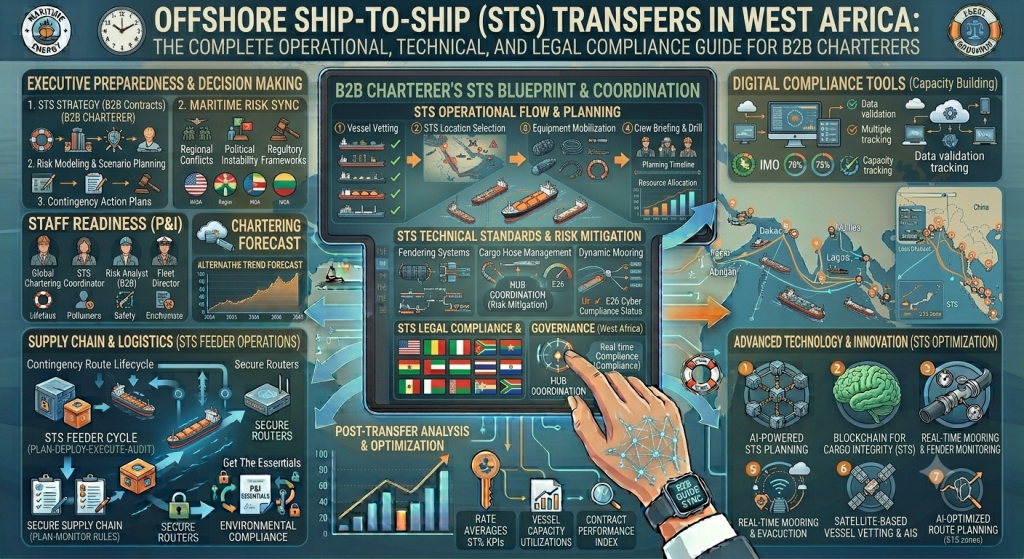
In international liquid bulk trading, time and structural draft are the ultimate arbiters of arbitrage profitability. Along the critical maritime corridors of West Africa—stretching from the Nouadhibou basin down to the active offshore oil fields of the Gulf of Guinea—marine infrastructure constraints frequently threaten cargo voyage margins. When draft limitations at regional port terminals prevent fully laden Suezmax or Very Large Crude Carrier (VLCC) vessels from berthing, or when terminal queues introduce expensive demurrage risks, offshore Ship-to-Ship (STS) transfers become the primary tool for operational optimization.
Executing an STS transfer is an advanced marine maneuver. It requires the dynamic double-banking of two massive vessels—the Constant Vessel (typically a Floating Storage and Offloading [FSO] asset or a larger discharging tanker) and the Maneuvering Vessel (the receiving tanker)—in open waters to execute high-volume liquid hydrocarbon custody transfers.
This guide provides technical directors, oil traders, and marine superintendents with a comprehensive operational blueprint. It details the safety standards, structural physics, and regional regulatory compliance required to execute safe, efficient, and OCIMF-compliant offshore STS campaigns in West Africa.
+———————————————————————————+
| THE SHIP-TO-SHIP TRANS-DELIVERY PATTERNS |
+——————-+—————————+———————————+
| Phase 1: Planning | Phase 2: Double-Banking | Phase 3: Cargo Flow |
| POAC risk review | Approach and mooring with | Secure manifold tie-in, |
| and vessel vetting| primary pneumatic fenders | continuous flow-metering and |
| under OCIMF rules.| absorb physical kinetic E.| custody tracking. |
+——————-+—————————+———————————+
The B2B Commercial Economics: Why STS is Key to Margin Protection
For energy trading desks and commercial charterers, an offshore STS transfer is more than just a mechanical operation; it is a critical strategy for financial risk management and supply chain optimization.
1. Channel Draft Optimization & Port Access
Major regional ports across the West African coast (such as Lagos, Cotonou, Lomé, and Douala) have restrictive channel drafts, often limited to 11 to 14 meters. A fully laden Suezmax or VLCC drawing 16 to 22 meters of draft cannot safely transit these entry channels.
By utilizing offshore STS transfers in deepwater anchorage zones, a deep-draft vessel can “lighten” its cargo load into shallow-draft Medium Range (MR) or Handymax product tankers. These smaller vessels can then safely access inland terminals, enabling the seamless distribution of refined petroleum products without grounding hazards.
2. Eliminating Port Congestion & Demurrage Exposure
Demurrage charges on modern oil tankers can range from $30,000 to over $85,000 per day depending on market volatility and vessel class. In congested ports, vessels can wait at anchor for up to 10 to 20 days before securing a berth.
Offshore STS transfers allow charterers to bypass port queues entirely. By transshipping cargo in designated offshore zones, the primary transport hull can be discharged and released back into the spot freight market on schedule, protecting the charterer from costly project delays.
3. Cargo Consolidation and Arbitrage Blending
Traders actively utilize offshore double-banking to consolidate cargo volumes. Smaller parcels of crude oil or distillates from regional production facilities can be pooled into a single VLCC hull, enabling the exporter to secure lower long-haul spot freight rates to East Asian or European markets.
Additionally, STS maneuvers facilitate the inline blending of off-spec petroleum products, allowing traders to adjust chemical parameters (such as density, sulfur content, or flashpoints) to meet specific regional market specifications before customs clearance.
Pre-Operational Planning and Vessel Vetting Protocols
An offshore STS operation should only begin after a comprehensive risk assessment and structural vetting campaign. Failing to establish proper pre-arrival checks can lead to structural collisions, line failures, or port state detentions.
The Role of the Person in Overall Advisory Control (POAC)
The cornerstone of any safe ship-to-ship transfer is the appointment of a qualified Person in Overall Advisory Control (POAC). In accordance with IMO and OCIMF guidelines, the POAC must be an experienced Master Mariner with verified command history in ship-to-ship transfers and double-banking maneuvers.
While the POAC does not override the ultimate command authority of each vessel’s Captain, they act as the primary operational authority who:
- Drafts and distributes the STS Joint Operations Plan.
- Conducts the pre-maneuver safety briefings with both vessel crews.
- Directs the approach angle, speed, and mooring line patterns.
- Monitors local weather trends and commands emergency stop protocols if environmental thresholds are breached.
+—————————————+
| THE STS PRE-FLIGHT COMPLIANCE |
+—————————————+
|
+——————————-+——————————-+
| |
v v
[HUMAN & MANAGEMENT] [VESSEL CAPABILITY]
• Appoint certified POAC. • Dynamic structural compatibility.
• Draft STS Joint Operations Plan. • Verify manifold layout compatibility.
• Confirm clear communication paths. • Confirm auxiliary winch and mooring ratings.
Mandatory Vessel Vetting Criteria
Before mobilizing shipping assets to an offshore anchorage, the chartering desk must verify that both vessels meet strict vetting criteria:
- SIRE 2.0 Inspection Status: Both tankers must hold a clean, active Ship Inspection Report Programme (SIRE) profile. Vetting records must show no outstanding high-risk observations regarding mooring winches, cargo manifolds, inert gas systems (IGS), or closed-loop sampling equipment.
- Manifold and Mooring Compatibility: The vessels must match structurally. Marine operations teams must model the parallel body length (PBL) of both ships in both loaded and ballast drafts. This ensures that the primary fendering systems align with structural shell frames rather than soft structural flare zones.
- Closed-Loop System Integrity: In compliance with modern MARPOL rules, both vessels must confirm their cargo containment and piping systems are fully sealed, with functional vapor recovery systems to prevent environmental emissions.
The Engineering and Physics of Double-Banking
Bringing two large vessels together in open waters requires managing complex hydrodynamic forces. Technical superintendents must calculate these forces to prevent structural damage.
1. Kinetic Energy of Approach and Fender Selection
During the final approach phase, the Maneuvering Vessel approaches the Constant Vessel (typically anchored or making slow headway on a heading parallel to prevailing winds and currents) at an angle of 10 to 15 degrees. The approach velocity ($v$) must be carefully managed to prevent overloading the primary fenders.
The kinetic energy ($E_k$) generated during contact is calculated using the following formula:
$$E_k = \frac{1}{2} M_v v^2 C_b C_m C_c$$
Where:
- $M_v$ represents the displacement mass of the Maneuvering Vessel in metric tons.
- $v$ is the approach velocity (which must be kept below $0.15 \text{ m/s}$ or approximately 0.3 knots).
- $C_b$ is the berthing coefficient, accounting for the eccentric point of contact relative to the vessel’s center of gravity.
- $C_m$ is the virtual mass factor, incorporating the hydrodynamic mass of the water column moving along with the hull.
- $C_c$ is the configuration coefficient, adjusting for the cushioning effect of the water trapped between the two parallel hulls.
To absorb this calculated kinetic energy, the operation must deploy high-performance pneumatic fenders conforming to ISO 17357 standards. For standard product tankers, this typically requires a minimum of four primary Yokohama-type fenders (e.g., 3.3m x 6.5m size equipped with heavy-duty chain-and-tyre nets) to distribute the impact load across the ship’s internal web frames.
+————————————————————————+
| Mooring Configuration Layout |
+————————————————————————+
| |
| +————————————————————–+ |
| | CONSTANT VESSEL | |
| +————————————————————–+ |
| \ \ | | | | | | / / |
| \ Springs\ | | | | | | / Springs/ |
| Headlines \ |Breast Lines| |Breast Lines / Sternlines |
| \ | | | | | | / |
| / / \ | | | | | | / \ \ |
| / / \ / \ \ |
| +————————————————————–+ |
| | MANEUVERING VESSEL | |
| +————————————————————–+ |
| |
+————————————————————————+
2. Mooring Line Distribution & Tension Management
Once the hulls make contact, mooring lines must be secured immediately to prevent relative movement, which can strain and rupture the cargo transfer hoses.
- Headlines and Sternlines: Provide overall longitudinal restraint.
- Breast Lines: Leading perpendicular to the hull to hold the vessels close together and counteract wind and wave separation.
- Spring Lines: Leading nearly parallel to the hull side to absorb the surge and sway forces generated by moving swell patterns.
To prevent line snapping due to mismatched elasticities, all mooring lines must have similar tension properties. Steel wire ropes should be fitted with synthetic tail ropes (at least 11 meters in length) to absorb shock loads in offshore swells.
Operational Safety, Hydrocarbon Handling, and Environmental Safeguards
Once the vessels are safely moored together, the physical cargo transfer operations must follow strict, step-by-step safety measures.
+——————————————————————-+
| THE CORE HYDROCARBON HANDLING PATHWAY |
+——————————————————————-+
| 1. Pre-Transfer Safety Meeting and Line Verification |
| Confirming emergency shut-down (ESD) protocols. |
+——————————————————————-+
|
v
+——————————————————————-+
| 2. Vapor Control and Manifold Alignment |
| Ensuring vapor recovery and flange testing is complete. |
+——————————————————————-+
|
v
+——————————————————————-+
| 3. Cargo Flow with Incremental Pump Rate Checks |
| Starting flow slowly to prevent electrostatic hazards. |
+——————————————————————-+
1. Electrostatic Dissipation & Insulating Flanges
Liquid hydrocarbons moving through cargo hoses generate significant static electricity. If this static charge discharges as a spark near volatile vapors, it can cause a catastrophic explosion.
- Insulating Flanges: An insulating flange or one length of non-conductive hose must be installed at each manifold connection. This prevents structural electrical currents (caused by galvanic corrosion differences between the two hulls) from traveling along the cargo hose.
- Electrical Discontinuity: In compliance with international rules, electrical bonding cables must never be used between the two ships during STS transfers. Instead, safety relies on strict electrical discontinuity across the hose strings.
2. Vapor Recovery & Closed Loop Transfers
In compliance with MARPOL Annex VI, West African regional ports are increasing their focus on environmental emissions. Modern B2B operations employ Vapor Balancing techniques:
- Instead of venting cargo tank vapors into the atmosphere as the receiving ship is filled, vapor return hoses connect the two ships.
- Vapors from the receiving ship are returned back to the discharging ship’s tanks, creating a closed loop that eliminates environmental odor issues and reduces fuel loss.
3. Emergency Shutdown (ESD) Systems
Both vessels must establish a synchronized Emergency Shutdown (ESD) protocol. If a mooring line parts, a hose leaks, or an electrical failure occurs, the POAC must command an immediate shut-down.
Manual or automatic ESD links must close the manifold valves and stop the cargo pumps on both vessels within 30 seconds of activation, preventing environmental pollution.
Legal and Regulatory Compliance in the Gulf of Guinea
Operating in West African waters requires navigating a complex and overlapping web of local maritime laws, cabotage restrictions, and environmental protection agencies.
+——————————————————————-+
| THE REQUISITE REGULATORY APPROVAL PATH |
+——————————————————————-+
| 1. Host Nation Maritime Approvals (e.g., NIMASA in Nigeria) |
| Securing operating permits within territorial waters. |
+——————————————————————-+
|
v
+——————————————————————-+
| 2. Local Port Authority Clearance (e.g., NPA / Port-de-Cotonou) |
| Registering designated offshore STS coordinate sectors. |
+——————————————————————-+
|
v
+——————————————————————-+
| 3. Marine Escort and Defense Coordination |
| Securing armed escort support to protect high-value assets. |
+——————————————————————-+
1. Host-Nation Customs and Cabotage Approvals
Before any STS operation begins within national waters, the local protective agent must secure clearances from host-nation authorities:
- NIMASA (Nigerian Maritime Administration and Safety Agency): For operations in Nigerian waters, vessels must be cleared by NIMASA to confirm compliance with safety and environmental rules.
- Cabotage Compliance: If cargo is transshipped between local ports, operators must secure valid Cabotage Waivers to prevent vessel detention or heavy financial penalties.
- Customs Clearance: Customs authorities must verify the cargo manifest, confirm import/export duties have been settled, and clear the vessel’s documentation before cargo pumps are turned on.
2. Guarding Against Piracy and Maritime Security Risks
The Gulf of Guinea presents distinct security challenges that require specific maritime logistics preparations. High-value cargo transfers require active protection:
- Navy-Approved Escort Boats: Operators must coordinate with regional navies to deploy certified security escort vessels.
- Armed Guard Deployments: Securing navy personnel on board the support vessels during the operations.
- Dynamic Security Plans: Maintaining continuous radar watch and strict radio silence on non-essential communication channels to prevent pirate attacks.
3. Preventing Vessel Arrests: P&I Letters of Undertaking
If a local claimant disputes cargo volumes or alleges a minor pollution incident, they may attempt to secure a court-ordered ship arrest.
To prevent costly vessel detentions, the local agent must work alongside the P&I Club’s legal team to arrange security. Courts and maritime authorities regularly accept a P&I Club Letter of Undertaking (LOU) or a bank guarantee as sufficient security, allowing the vessel to continue sailing while the legal case is decided in court.
High-Compliance STS Coordination with Oitha Marine
Executing complex, offshore ship-to-ship transfers requires a partner with deep local roots and a commitment to international standards.
Oitha Marine provides turnkey, high-compliance offshore STS coordination and maritime support services across the West African region. Combining local operational expertise with international safety standards, we deliver reliable, risk-mitigated logistics solutions for the global energy sector.
Our Comprehensive STS Support Services
- Certified POAC Appointees: We provide highly experienced, Master Mariner POACs to coordinate and oversee all double-banking maneuvers.
- Specialized Marine Asset Chartering: Our fleet includes high-performance Platform Supply Vessels (PSVs), Anchor Handling Tug Supply (AHTS) vessels, and certified towing tugs equipped for double-banking maneuvers.
- High-Specification Fendering Equipment: We arrange certified Yokohama pneumatic fenders and heavy-duty cargo hoses to ensure safe vessel contact and reliable transfer operations.
- Security and Escort Logistics: We coordinate with local naval forces to provide navy-approved escort vessels, ensuring secure transit and protection for your high-value cargo operations.
By maintaining strict compliance with OCIMF standards, local content regulations, and international safety laws, Oitha Marine reduces operational risk and protects your project timelines.
Frequently Asked Questions (FAQ)
Q: What is the primary role of the POAC during an offshore STS transfer?
A: The Person in Overall Advisory Control (POAC) is a certified master mariner responsible for coordinating the entire STS operation. They manage the safety briefing, direct the maneuvering vessel’s approach, supervise the mooring configuration, and monitor the entire cargo transfer to ensure safety compliance.
Q: Why is an electrical bonding cable prohibited during cargo transfers?
A: In the past, bonding cables were used to connect the two vessels before hose connection. However, static electricity can discharge as a spark when connecting or disconnecting this cable, posing a severe explosion risk. Safety now relies on strict electrical discontinuity, using insulating flanges and non-conductive hose sections.
Q: How does Oitha Marine manage security risks in the Gulf of Guinea?
A: We manage security risks by coordinating
Recent Comments