
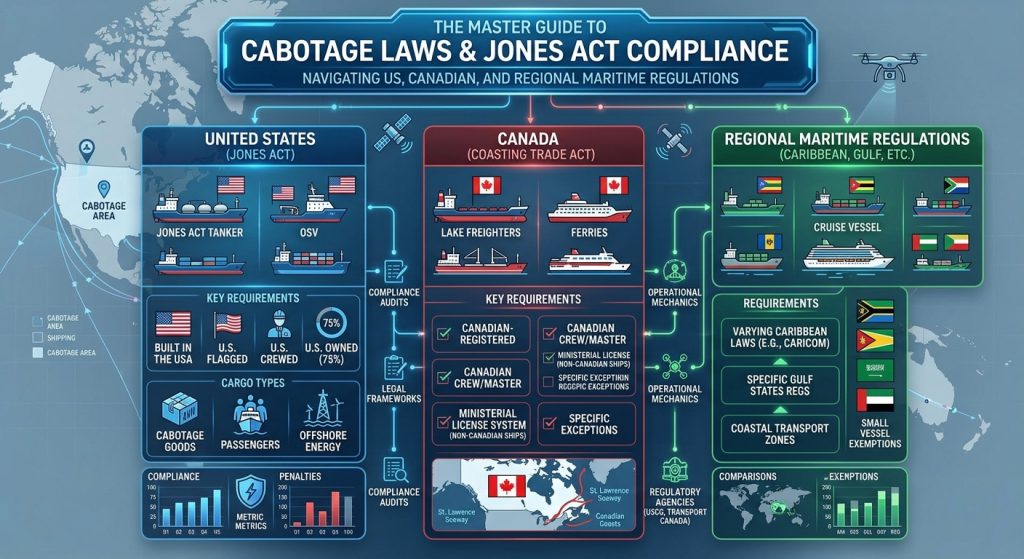
Cabotage laws govern the transport of goods and passengers between ports within the same sovereign territory. Designed to protect domestic maritime industries, national security, and coastal trade routes, these regulations dictate which vessels are legally permitted to engage in coastwise commercial trade.
For maritime attorneys, charterers, fleet operators, and logistics executives, compliance with domestic cabotage regimes—most notably the Merchant Marine Act of 1920 (The Jones Act) in the United States and the Coasting Trade Act in Canada—is an operational and legal imperative. Navigating these rules incorrectly can lead to catastrophic financial penalties, cargo forfeiture, operational delays, and loss of commercial operating licenses.
This comprehensive compliance guide analyzes the operational, legal, and financial mechanics of global cabotage regimes, statutory requirements, enforcement frameworks, waiver procedures, and corporate compliance strategies.
1. Statutory Foundations: The Legal Architecture of Cabotage
Cabotage regulations reserve domestic coastal and inland waterborne trade exclusively for national-flagged, locally built, and domestically crewed vessels.
┌─────────────────────────────────────────────────────────────────────────┐
│ THE THREE PILLARS OF CABOTAGE │
└────────────────────────────────────┬────────────────────────────────────┘
│
┌───────────────────────────┼───────────────────────────┐
│ │ │
┌────────┴──────────┐ ┌────────┴──────────┐ ┌────────┴──────────┐
│ 1. National Flag │ │ 2. Local Build │ │ 3. Citizen Ownership│
│ & Registry │ │ Requirement │ │ & Crewing │
└───────────────────┘ └───────────────────┘ └───────────────────┘
The United States: Section 27 of the Merchant Marine Act of 1920 (The Jones Act)
Codified at 46 U.S.C. § 55102, the Jones Act mandates that all waterborne transportation of merchandise between points in the United States—either directly or via a foreign port—must be conducted on vessels that meet four primary criteria:
- U.S.-Built: The vessel hull and superstructure must be constructed entirely within the United States or its territories.
- U.S.-Flagged: The vessel must be documented under the laws of the United States with a valid coastwise endorsement issued by the U.S. Coast Guard (USCG) National Vessel Documentation Center (NVDC).
- U.S.-Owned: At least 75% of the entity owning the vessel must be controlled by U.S. citizens (under the “Section 2 Citizen” test codified at 46 U.S.C. § 50501).
- U.S.-Crewed: The master, all officers, and at least 75% of the unlicensed crew must be U.S. citizens or lawful permanent residents.
Canada: The Coasting Trade Act (S.C. 1992, c. 31)
Canada’s Coasting Trade Act regulates the transportation of goods and passengers, as well as marine activities of a commercial nature (such as dredging, seismic surveying, and offshore construction), within Canadian waters and above the continental shelf.
Unlike the U.S. Jones Act, which enforces a strict statutory prohibition against foreign vessels without exception, Canadian law permits foreign-flagged or non-duty-paid vessels to operate in domestic trade only when no suitable Canadian-flagged vessel is available through a formal Coasting Trade License application process overseen by the Canadian Transportation Agency (CTA) and the Canada Border Services Agency (CBSA).
2. Global Cabotage Regimes Comparison Matrix
Understanding how cabotage enforcement varies across international jurisdictions allows global charterers and vessel operators to optimize asset allocation without triggering statutory violations.
| Country / Region | Primary Governing Statute | Build Requirement | Crewing / Ownership Mandate | Temporary Foreign Waiver Mechanism | Primary Enforcement Body |
| United States | Jones Act (46 U.S.C. § 55102) | Strict U.S.-Build required (100% hull/superstructure) | 75%+ U.S. Citizen Ownership; 75%+ U.S. Crew | Extremely strict; National Defense interest only | U.S. Customs and Border Protection (CBP) / MARAD |
| Canada | Coasting Trade Act (S.C. 1992, c. 31) | Foreign-built permitted if import duties are paid | Canadian Registry preferred; waivers available | Yes (CTA “No Suitable Canadian Vessel” test) | Canadian Transportation Agency (CTA) / CBSA |
| United Arab Emirates | UAE Maritime Code (Federal Law No. 26) | Foreign-built permitted under UAE registration | UAE National Ownership (51%+); GCC flagging rules | Foreign vessels permitted via local agency permits | UAE Ministry of Energy & Infrastructure (MOEI) |
| United Kingdom | Merchant Shipping Act 1995 | No domestic build mandate | Open market / EU & International registries | Fully open market (Liberalized cabotage) | Maritime and Coastguard Agency (MCA) |
| European Union | Council Regulation (EEC) No 3577/92 | EU Member State Registry | EU Country Registry / EU Crewing requirements | Open access for all EU-flagged vessels | Individual EU Member State Port Authorities |
3. Operational Risk Zones: Offshore Energy, Dredging, and Towing
Cabotage violations frequently stem from a misunderstanding of what constitutes “coastwise trade” under statutory law. The legal definition extends beyond carrying containerized cargo between two ports.
┌─────────────────────────┐
│ COASTWISE TRADE DOMAIN │
└────────────┬────────────┘
│
┌────────────────────────────┼────────────────────────────┐
│ │ │
┌─────┴──────────────┐ ┌─────────┴────────────┐ ┌───────────┴───────────┐
│ Commercial Cargo │ │ Offshore Energy │ │ Dredging, Towing & │
│ Transportation │ │ Construction │ │ Subsea Support │
│ (Inter-port moves) │ │ (Wind/Oil & Gas) │ │ (46 U.S.C. § 55109/11)│
└────────────────────┘ └──────────────────────┘ └───────────────────────┘
A. Offshore Wind and Oil & Gas Infrastructure
The rise of offshore wind projects along the U.S. Atlantic Seaboard has placed the Jones Act at the center of offshore project development.
- The Outer Continental Shelf Lands Act (OCSLA): Under 43 U.S.C. § 1333(a), U.S. coastwise laws apply to all artificial islands, installations, and devices attached to the seabed of the Outer Continental Shelf (OCS) for the purpose of exploring, developing, or producing resources.
- Monopiles and Turbines as “Points”: When a vessel transports wind turbine components (turbines, blades, monopile foundations) from a U.S. port to a fixed seabed location on the OCS, that location is legally classified as a coastwise point. Transporting these materials using a foreign-flagged vessel constitutes a direct violation of 46 U.S.C. § 55102.
- Feeder Vessel Model vs. Heavy Lift Installations: To comply with regulations, developers frequently utilize U.S.-flagged Jones Act feeder barges to transport components from port to the offshore site, allowing specialized foreign-flagged Wind Turbine Installation Vessels (WTIVs) to remain stationary on jack-up legs at the installation site without moving cargo between points.
[U.S. Port] ──► [Jones Act Compliant Feeder Barge] ──► [Offshore Wind Site]
│
▼
[Stationary Foreign-Flagged WTIV]
(Positioned on Jack-up legs)
B. Dredging Operations (46 U.S.C. § 55109)
Dredging operations within U.S. waters are subject to independent, strict statutory requirements. Under 46 U.S.C. § 55109, no vessel may engage in dredging unless it is U.S.-built, U.S.-flagged, U.S.-owned (75%), and U.S.-crewed. Transporting dredged material (spoils) from a dredging site and depositing it within the U.S. 3-nautical-mile territorial sea or 200-nautical-mile Exclusive Economic Zone (EEZ) is strictly reserved for domestic vessels.
C. Towing and Salvage Operations (46 U.S.C. § 55111)
Towing vessels operating between U.S. coastwise points or towing a Jones Act vessel must be U.S.-built, U.S.-flagged, and U.S.-owned. Foreign tugs attempting to tow vessels between U.S. ports or perform domestic harbour drayage face immediate seizure and civil fines under U.S. Coast Guard and Customs enforcement rules.
4. The U.S. Jones Act Waiver Process
Obtaining a waiver to operate a non-Jones Act vessel in U.S. coastwise trade is legally difficult and administratively complex. Under federal law, commercial convenience or financial cost savings are never valid grounds for a waiver.
[APPLICANT REQUEST]
(Urgent Logistics/Fuel Deficit)
│
▼
[Department of Defense Review]
(Must certify National Defense Necessity)
│
▼
[Maritime Administration (MARAD) Vessel Survey]
(Checks for Available U.S. Flagged Ships)
│
▼
[Department of Homeland Security (DHS) Order]
(Formal Waiver Authorization Issued)
Statutory Grounds for a Waiver (46 U.S.C. § 501)
Waivers are granted under narrow circumstances:
- National Defense Necessity: The Secretary of Homeland Security may issue a waiver only if it is determined to be in the interest of national defense.
- Department of Defense Application: If the waiver request originates directly from the Secretary of Defense, the Department of Homeland Security (DHS) can grant it immediately.
- MARAD Market Survey Requirement: For non-DoD requests, the Maritime Administration (MARAD) must conduct a survey of available U.S.-flagged coastwise vessels. If suitable U.S. vessels are available to perform the transport, the waiver must be denied by law.
5. Enforcement Mechanics, Penalties, and Legal Precedents
Customs authorities enforce cabotage statutes aggressively. Mistakes carry severe financial penalties based on cargo value rather than shipping rate margins.
Financial Penalties under 46 U.S.C. § 55102
Under U.S. Customs and Border Protection regulations (19 C.F.R. § 4.80b), the statutory penalty for unlawfully transporting merchandise between coastwise points on a non-compliant vessel is equal to the value of the merchandise or the actual cost of transportation, whichever is greater.
Penalty Amount=max(Value of Merchandise,Freight Charges Received)
Real-World Compliance Case: If a foreign-flagged vessel transports $20,000,000 worth of refined petroleum between Texas and New York, CBP can issue a monetary fine of $20,000,000 against the charterer/operator, completely liquidating the economic viability of the voyage.
Key CBP Ruling Categories (HQ Rulings)
U.S. Customs and Border Protection Headquarters issues binding administrative rulings on Jones Act interpretations. Key rulings include:
- Third-Party Intermediate Stops (Prussian Rule): Transporting goods from U.S. Port A to Foreign Port B, unloading, reloading, and transporting them to U.S. Port C remains a Jones Act violation if the primary purpose of the voyage is continuous transit between U.S. points.
- Vessel Equipment vs. Merchandise: Items permanently attached to a vessel (e.g., specialized subsea ROVs, permanent cranes, drilling mud used on site) are classified as “vessel equipment” rather than “merchandise,” allowing foreign installation vessels to utilize them on site without triggering coastwise penalties.
6. Corporate Compliance Protocol for Charterers and Operators
To mitigate cabotage exposure across multi-jurisdictional supply chains, maritime organizations should implement a structured risk protocol.
1. Execute Pre-Fixture Cabotage Assessments
Before executing a charter party agreement for offshore construction, dredging, or domestic cargo distribution:
- Verify the vessel’s Coastwise Endorsement via the National Vessel Documentation Center (NVDC) database.
- Confirm that the chain of vessel ownership meets the 75% Section 2 Citizen test (46 U.S.C. § 50501).
- Request structural construction records confirming no major hull modifications or rebuilds were completed in foreign shipyards after initial domestic construction.
2. Include Standard Cabotage Indemnity Clauses in Charter Parties
Ensure all Baltic and International Maritime Council (BIMCO) or custom charter party contracts contain explicit indemnification provisions:
“Charterers warrant that all voyage instructions issued to the Vessel shall fully comply with the coastwise laws of the jurisdiction in which the Vessel operates (including, but not limited to, 46 U.S.C. § 55102 for operations within U.S. waters). Charterers shall indemnify, defend, and hold harmless Shipowners, its managers, and agents against any and all civil penalties, fines, seizures, or legal expenses arising from Charterer’s breach of coastwise compliance.”
3. Seek Formal Customs Rulings Prior to Execution
For complex offshore energy, subsea cable laying, or multi-port construction projects, do not rely solely on legal opinion letters. Submit a formal administrative ruling request to U.S. Customs and Border Protection (Regulations and Rulings, Office of Trade) or the Canadian Transportation Agency to obtain a binding, written determination prior to vessel deployment.
B2B Compliance & Risk Management Protocol
Operating commercial vessels or chartering assets across domestic trade lanes requires strict administrative safeguards to protect your organization from regulatory fines, vessel seizures, and commercial disputes:
- Foreign Rebuild Tracking: Under U.S. law, a domestic vessel that undergoes a major modification or has its hull/superstructure rebuilt outside the United States permanently loses its Jones Act coastwise trading privileges. Vessel buyers and charterers must audit the full shipyard maintenance history of a vessel prior to acquisition.
- Managing Dual-Registry Assets: In jurisdictions like Canada and the UAE, foreign-flagged vessels operating under temporary coasting licenses must track their exact operational dates. Operating even a single day past the expiration of a Coasting Trade License can result in immediate customs seizure and retroactive duty assessments.
- Documenting Offshore Project Equipment: When deploying specialized equipment (e.g., subsea trenchers, diving systems, offshore accommodation blocks) on foreign vessels in domestic waters, maintain clear inventory logs showing that the items constitute permanent vessel machinery rather than commercial cargo destined for offshore placement.
Frequently Asked Questions (FAQ)
1. Does the Jones Act apply to cargo shipments between the U.S. mainland and Puerto Rico, Hawaii, or Alaska?
Yes. The Jones Act applies to trade between the U.S. mainland and non-contiguous states and territories, including Hawaii, Alaska, Puerto Rico, and Guam. Cargo moving between domestic ports and these locations must use U.S.-built, U.S.-flagged, and U.S.-owned vessels.
2. What is the “Foreign Rebuild Rule” under the Jones Act?
If a U.S.-built vessel undergoes major structural alterations or has more than a specified percentage of its hull/superstructure steel replaced in a foreign shipyard, it permanently loses its coastwise endorsement. Once lost, coastwise privileges cannot be restored without a special act of Congress.
3. How does Canada’s Coasting Trade Act differ from the U.S. Jones Act?
The U.S. Jones Act prohibits foreign-built or foreign-flagged vessels from participating in domestic trade. Canada’s Coasting Trade Act allows foreign or non-duty-paid vessels to operate under a temporary Coasting Trade License if the Canadian Transportation Agency (CTA) determines that no suitable Canadian-flagged vessel is available.
4. Can a foreign-flagged vessel transport passengers between U.S. ports?
No. Passenger transportation between U.S. ports is governed by the Passenger Vessel Services Act (PVSA) of 1886 (46 U.S.C. § 55103). Like the Jones Act, the PVSA requires vessels carrying passengers between U.S. ports to be U.S.-built, U.S.-flagged, U.S.-owned, and U.S.-crewed.
5. What happens if a charterer accidentally violates cabotage laws?
A breach of cabotage laws triggers civil enforcement actions by customs authorities (such as U.S. CBP or CBSA in Canada). Penalties often equal the full commercial value of the cargo or the total freight revenue generated by the unlawful voyage, and the vessel may be subject to detention or seizure.
Need expert guidance on Jones Act compliance, Coasting Trade Act licenses, or offshore maritime chartering contracts? Contact the maritime attorneys and logistics advisors at Oitha Marine to secure your operational compliance strategy.
Recent Comments