
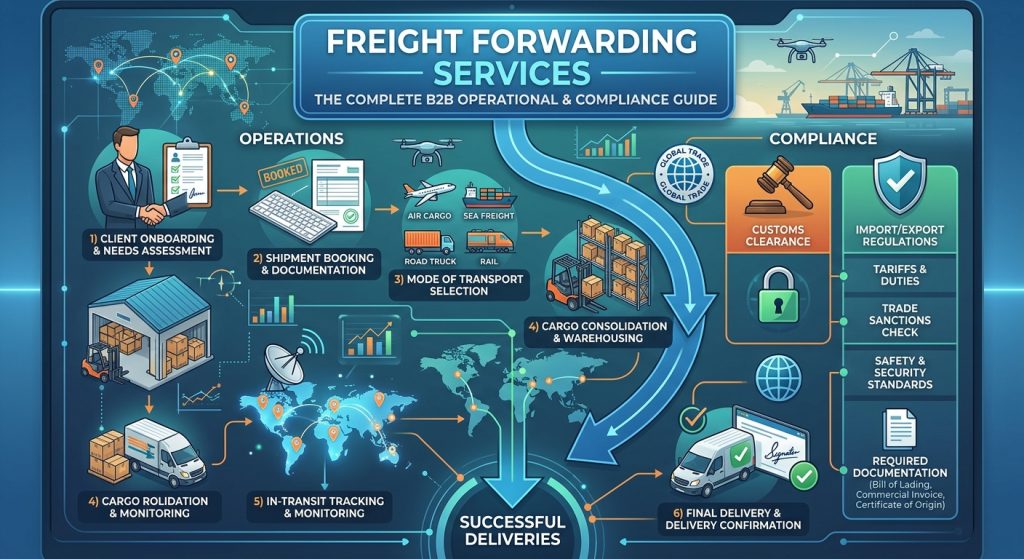
Navigating global supply chains requires balancing cost, speed, modal selection, and regulatory compliance. In an era defined by ongoing maritime routing diversions, volatile spot rates, and strict customs enforcement across North America, Europe, and the Middle East, selecting the right freight forwarding service directly impacts profit margins and supply chain continuity.
┌────────────────────────────────────────────────────────────────────────┐│ GLOBAL FREIGHT FORWARDING OPERATIONAL HUB │└───────────────────────────────────┬────────────────────────────────────┘ │ ┌──────────────────────────┼──────────────────────────┐ │ │ │┌────────┴─────────┐ ┌────────┴─────────┐ ┌────────┴─────────┐│ Air Freight │ │ Ocean Freight │ │ Inland & Customs ││ (Expedited / │ │ (FCL / LCL / │ │ (3PL / Drayage /││ Temperature) │ │ Breakbulk) │ │ IOR / Compliance)│└──────────────────┘ └──────────────────┘ └──────────────────┘A professional freight forwarder does not own the ships, planes, or trucks. Instead, they act as the architect and intermediary for international trade—leveraging carrier volume contracts, negotiating space allocations, managing cross-border customs entries, and providing end-to-end cargo visibility.
1. What Are Modern Freight Forwarding Services?
Freight forwarding is a specialized B2B logistics service that coordinates the international movement of commercial cargo from an origin factory or warehouse to a final destination. Forwarders combine multiple transportation modes—ocean, air, road, and rail—into a unified transport chain.
Core Services Provided by Top-Tier Forwarders
- Multimodal Transport Execution: Booking vessel space, air freight charters, and inland drayage.
- Customs Brokerage & Clearance: Managing entry filings with agencies like U.S. Customs and Border Protection (CBP), Canada Border Services Agency (CBSA), HM Revenue & Customs (HMRC), and Dubai Customs.
- Cargo Consolidation: Combining Less-than-Container Load (LCL) shipments into Full Container Loads (FCL) to optimize freight spend.
- Documentation & Compliance: Issuing Master and House Bills of Lading (B/L), Certificates of Origin, and Commercial Invoices.
- Marine Insurance & Risk Mitigation: Protecting cargo against loss, damage, or General Average declarations during transit.
2. Ocean Freight vs. Air Freight vs. Intermodal Logistics
Selecting the proper mode of transport depends on cargo value, volume, shelf life, and lead-time constraints.
| Operational Criteria | Ocean Freight (FCL / LCL) | Air Freight (Standard / Express) | Road & Intermodal Freight |
| Ideal Cargo Type | High-volume, heavy, non-perishable goods | High-value, perishable, urgent, or high-density cargo | Regional cross-border trade & final-mile drayage |
| Cost Basis | Per container (FCL) or per CBM (LCL) | Per volumetric/chargeable weight (kg) | Per mile / kilometer or truckload (FTL/LTL) |
| Transit Speed | Slowest (14–45+ days) | Fastest (1–5 days) | Moderate (Regional dependent) |
| Environmental Footprint | Lowest CO2 per ton-kilometer | Highest carbon emissions | Moderate |
| Reliability Influence | Port congestion, weather, rerouting | Flight schedules, airport handling | Highway bottlenecks, border crossings |
The Volumetric Weight Formula (Air Freight)
Air freight rates are calculated based on Chargeable Weight, which is the greater of actual gross weight or volumetric weight. Freight forwarders use the standard IATA volumetric divisor:
Volumetric Weight (kg)=6000Length (cm)×Width (cm)×Height (cm)
(Note: Express couriers often use a 5000 divisor).
3. Global Trade Lane Realities & Operational Disruptions
Modern freight forwarders operate in an environment where supply chain disruptions are standard operational conditions.
[ORIGIN FACTORY] │ ▼ [Origin Port / Airport] │ ┌─────────────────────┴─────────────────────┐ │ │[Standard Ocean Route] [Air Freight Charter](Cape of Good Hope Diversions) (High Value / Urgent) +10-14 Days Transit Fastest Transit │ │ └─────────────────────┬─────────────────────┘ │ ▼ [Destination Customs Entry] (CBP / HMRC / CBSA / DET) │ ▼ [Final Mile Door Delivery]Key Geographic Trade Dynamics:
- North America (US & Canada): Intermodal connectivity from West Coast ports (Los Angeles/Long Beach, Vancouver) to inland rail ramps (Chicago, Toronto) requires forwarders with strong drayage networks to prevent storage and chassis surcharges.
- Middle East (UAE & GCC): Modern logistics hubs like Jebel Ali (Dubai) and Khalifa Port (Abu Dhabi) rely on forwarders adept at re-export documentation, free-zone transfers (e.g., JAFZA), and sea-air modal shifts.
- Asia-Europe / Transatlantic: Continued rerouting around the Cape of Good Hope adds 10 to 14 days to ocean transit times, making real-time vessel tracking and predictive lead-time adjustments mandatory for forwarders.
4. Key Considerations When Selecting a Freight Forwarder
To protect your supply chain from unexpected costs and clearance delays, evaluate prospective freight forwarders against these four critical criteria:
- Digital Integration & Real-Time Tracking: Does the forwarder offer cloud-based platform access providing milestone tracking, electronic document management, and automated customs milestone alerts?
- Customs Brokerage Expertise: In-house licensed customs brokers prevent clearance delays. A failure in Harmonized System (HS) code classification can result in severe fines or cargo holds.
- Carrier Allocation & Volume Contracts: Does the forwarder hold direct Service Contracts (SC) with major ocean carrier alliances and airline networks to guarantee space during peak season space crunches?
- Transparent Fee Structures: Ensure quotes distinguish between base freight rates, Bunker Adjustment Factors (BAF), Terminal Handling Charges (THC), Security Fees (ISPS), and local destination delivery fees.
5. Freight Forwarding Services vs. 3PLs vs. 4PLs
Understanding where your provider sits in the supply chain hierarchy is vital for operational alignment:
┌────────────────────────────────────────────────────────────────────────┐│ SUPPLY CHAIN PROVIDER LEVELS │├────────────────────────────────────────────────────────────────────────┤│ 2PL: Carrier (Vessel Operator / Airline / Trucking Company) │├────────────────────────────────────────────────────────────────────────┤│ Freight Forwarder: Intermediary for booking, documents & customs │├────────────────────────────────────────────────────────────────────────┤│ 3PL: Integrated provider handling freight, warehousing & fulfillment │├────────────────────────────────────────────────────────────────────────┤│ 4PL: Master logistics manager overseeing all 3PLs and supply chains │└────────────────────────────────────────────────────────────────────────┘- Freight Forwarder: Focuses primarily on the transportation and customs clearance of goods from point A to point B.
- 3PL (Third-Party Logistics): Expands on forwarding by providing warehousing, pick-and-pack fulfillment, inventory management, and distribution services.
- 4PL (Fourth-Party Logistics): Acts as a neutral manager overseeing a client’s entire supply chain network, managing multiple 3PLs, freight forwarders, and technology vendors.
Key Trends Shaping Global Shipping Today
Navigating a modern supply chain requires staying ahead of these critical industry shifts:
- Longer Ocean Routes & Delays: Shipping line diversions around Africa’s Cape of Good Hope add 10 to 14 days to transit times. Reliable forwarders use alternative sea-air routes—like transshipping through Dubai—to keep cargo moving fast.
- E-Commerce & New Manufacturing Hubs: As companies move production to countries like Vietnam, India, and Indonesia, air and ocean freight demand in these regions is booming. Working with forwarders who have guaranteed space on ships and planes is essential.
- Real-Time Digital Tracking: B2B shippers need instant visibility. Top freight forwarders now offer live portal tracking and digital paperwork to prevent costly port delays and customs holds.
- Carbon Tracking & Green Shipping: Global environmental rules are getting stricter. Forwarders are now offering carbon emission reports and options to use cleaner biofuels to help shippers meet sustainability targets.
Frequently Asked Questions (FAQ)
1. What is the difference between a Freight Forwarder and a Customs Broker?
A freight forwarder organizes the physical movement and transportation of goods internationally. A customs broker is a licensed specialist focused specifically on entry declarations, tariff classification, duty payment, and regulatory compliance with local government agencies. Many top forwarders offer both services in-house.
2. What documents does a freight forwarder handle?
Key documents include the Bill of Lading (B/L) or Air Waybill (AWB), Commercial Invoice, Packing List, Certificate of Origin, Shipper’s Letter of Instruction (SLI), and relevant import/export licenses.
3. How do freight forwarders charge for their services?
Forwarding fees typically consist of the primary freight charge (ocean/air/road rate), origin handling fees (THC), customs clearance fees, documentation fees, and destination delivery fees. Ensure your forwarder provides an itemized quote to prevent unexpected billings.
4. What is the difference between FCL and LCL in ocean freight forwarding?
FCL (Full Container Load) means a single shipper books an entire container (20ft, 40ft, or 40ft HC) for their exclusive use. LCL (Less-than-Container Load) involves a forwarder consolidating cargo from multiple shippers into one shared container.
5. Why do I need marine cargo insurance if the carrier is liable?
Carriers operate under strict legal limits of liability under international conventions (such as the Hague-Visby or Hamburg Rules), which usually cap carrier liability at a small amount per package or kilogram. Marine cargo insurance provides full-value protection against loss, damage, or General Average declarations during international transit.
Need reliable global logistics, freight booking, or customs clearance support? Contact the maritime and freight specialists at Oitha Marine to optimize your cargo operations.
Recent Comments