
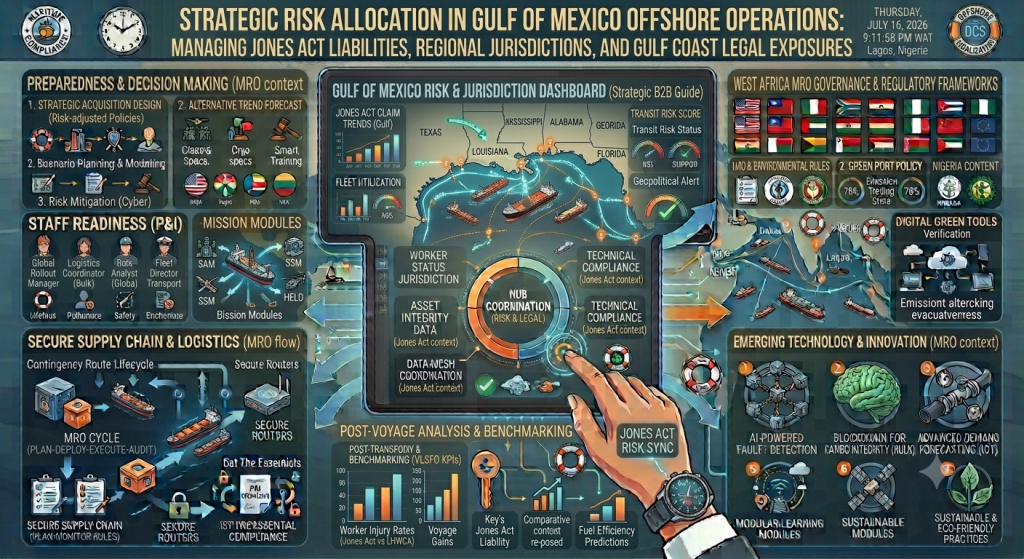
For international maritime operators, offshore energy contractors, and fleet managers, deploying crew vessels, platform supply vessels (PSVs), and offshore tugs in the U.S. Gulf of Mexico is a highly complex, high-stakes operational undertaking.
The U.S. Gulf Coast—stretching from the energy and logistics hubs of Houston, Texas, to the busy maritime gateways of New Orleans and Baton Rouge, Louisiana—operates under some of the most stringent and plaintiff-friendly maritime injury frameworks in the world.
[ US Gulf Coast Maritime Jurisdictions ]
│
┌────────────────────────────────┴────────────────────────────────┐
▼ ▼
[ Southern District of Texas ] [ Eastern District of Louisiana ]
• Venue: Houston & Galveston • Venue: New Orleans & Baton Rouge
• Strict interpretation of “vessel status” • Historically high damage awards
• Rigorous enforcement of employer safety • Complex multi-party operational claims
When an incident occurs offshore, the location of the filing can completely change the employer’s legal exposure. A single injury claim filed in Louisiana or Texas can quickly result in millions of dollars in damages under the Merchant Marine Act of 1920 (The Jones Act).
This technical guide analyzes the operational risks, jurisdictional differences, and insurance strategies required to manage offshore injury liabilities across major Gulf Coast maritime hubs.
1. Navigating the Operational Reality of the Gulf of Mexico
The Gulf of Mexico is one of the busiest maritime energy corridors in the world. Deepwater drilling platforms, semi-submersibles, and a vast network of supporting crew boats and offshore supply vessels operate continuously.
Because these vessels and platforms work in close proximity under demanding weather conditions, the risk of operational incidents is a constant concern for risk managers. When an offshore injury occurs, the legal status of the worker and the location of the venue determine whether the employer faces a capped workers’ compensation claim or an uncapped negligence lawsuit.
2. The Regional Venues: Texas vs. Louisiana Maritime Jurisdictions
The legal environment for maritime claims along the Gulf Coast is heavily shaped by the decisions of two distinct federal courts: the U.S. Court of Appeals for the Fifth Circuit (which covers Texas and Louisiana) and local state district courts.
Understanding the differences between these jurisdictions is essential for managing litigation risk.
[ Incident Offshore Louisiana / Texas ] ──► Determine Venue
│
┌────────────────────────┴────────────────────────┐
▼ ▼
[ Eastern District of Louisiana ] [ Southern District of Texas ]
• Venue: New Orleans / Baton Rouge • Venue: Houston / Galveston
• High concentration of maritime trials • Home to major global energy headquarters
• Complex “Maintenance & Cure” rules • Focus on technical contract language
A. The Louisiana Maritime Environment (New Orleans & Baton Rouge)
Louisiana is the historic center of U.S. maritime law. Courts in New Orleans and Baton Rouge handle a high volume of offshore litigation.
- The Litigious Landscape: The high density of offshore workers, combined with a specialized local legal sector, makes Louisiana courts a frequent venue for high-stakes maritime trials.
- Maintenance & Cure Penalties: Courts in this region strictly enforce an employer’s obligation to provide maintenance and cure (food, lodging, and medical treatment) to injured crew members. If an employer unreasonably delays or denies these payments, Louisiana courts can award substantial punitive damages and attorney’s fees, significantly increasing the financial risk of a claim.
B. The Texas Maritime Environment (Houston & Galveston)
As the energy capital of the world, Houston is home to the corporate headquarters of major drilling contractors, oil companies, and offshore vessel operators.
- Vessel and Fleet Definitions: Texas courts frequently handle complex arguments regarding whether a specialized offshore structure—such as a jack-up rig, a floating production unit (FPU), or a customized pipe-laying barge—qualifies as a “vessel in navigation” under the Jones Act.
- Contractual Indemnification: Litigation in Houston often focuses on resolving complex multi-party contracts, such as determining whether a vessel owner or an offshore operator is ultimately responsible for an injury under Knock-for-Knock indemnity agreements.
3. The Anatomy of an Offshore Injury Claim: Negligence vs. Unseaworthiness
When a qualified crew member brings a claim under the Jones Act, their legal counsel typically builds the case on two separate pillars of liability:
Pillar 1: Employer Negligence (The Featherweight Standard)
Under 46 U.S.C. § 30104, maritime employers must provide a reasonably safe working environment. Unlike land-based personal injury cases, where a plaintiff must prove the employer’s actions were the primary cause of the injury, the Jones Act utilizes a featherweight burden of proof.
An operator can be held liable if their negligence contributed in any way, however small, to the worker’s injury. Examples include:
- Failing to provide proper personal protective equipment (PPE) for heavy offshore lifts.
- Allowing a crew boat to transit in rough seas beyond its certified operational limits.
- Operating with an undertrained or fatigued crew.
Pillar 2: The Absolute Warranty of Unseaworthiness
Separate from negligence, a shipowner has an absolute, non-delegable duty to provide a seaworthy vessel. This means the hull, equipment, and crew must be reasonably fit for their intended purpose.
Unseaworthiness is a strict liability standard. A vessel owner can be held liable for an injury even if they had no prior knowledge of the defect. Common causes of unseaworthiness claims in offshore operations include:
- Worn or uncertified lifting cables on a deck crane.
- Slippery decks lacking non-skid paint or proper drainage.
- An inadequate number of crew members assigned to execute a high-risk offshore transfer.
4. Landmark Legal Precedents and Offshore Decommissioning Rules
In addition to ongoing litigation risks along the Gulf Coast, federal administrative bodies continue to redefine what activities are governed by coastwise cabotage and Jones Act laws. In a significant development, U.S. Customs and Border Protection (CBP) issued Ruling HQ H349684, clarifying the application of the Jones Act during the decommissioning and removal of offshore platforms on the Outer Continental Shelf (OCS).
Holland & Knight
This ruling established a clear three-part standard for operators to determine when an offshore structure ceases to be a coastwise point subject to the Jones Act:
Holland & Knight
[ Decommissioning Asset Status ]
│
┌────────────────────────────┴────────────────────────────┐
▼ ▼
[ Permanently Plugged Well ] [ Offshore Platform Structure ]
• Deemed “Abandoned” by BSEE • Remains a “Coastwise Point”
• No longer a coastwise point • Transporting removed modules to shore
• Foreign-flagged vessels permitted • requires coastwise-qualified vessels
A. Wells and Plugging Operations
Under HQ H349684, once an offshore well is permanently plugged and abandoned according to Bureau of Safety and Environmental Enforcement (BSEE) standards, the wellhead itself is no longer considered a coastwise point. Consequently, foreign-flagged offshore construction vessels can safely perform direct well-capping and plug-and-abandonment operations without violating cabotage laws.
Holland & Knight
B. Platform Removal and Towing Restrictions
Crucially, CBP ruled that the physical offshore platform structure remains a coastwise point even after all associated wells are abandoned and the processing machinery is disconnected.
Holland & Knight
Because the platform remains a coastwise point, any movement of materials, removed topside modules, or mooring systems from the platform to a domestic port must be executed by coastwise-qualified (Jones Act-compliant) vessels. For example, towing a barge carrying dismantled platform scrap ashore requires the use of coastwise-qualified tugs.
Holland & Knight+ 1
C. The Rigs-to-Reefs Exception
Under the same ruling, once the platform’s hull is disconnected from the seabed, towing the hull to a designated pristine seabed site on the OCS to create an artificial reef under the “Rigs-to-Reef” program does not violate the coastwise laws, meaning foreign-flagged tugs can be utilized for this specific leg of the voyage.
CROSS Ruling – U.S. Customs and Border Protection
This ruling requires offshore energy operators and marine construction firms to carefully plan their vessel charters to ensure compliant operations throughout the entire decommissioning process.
5. Strategic Risk Mitigation for Offshore Fleet Managers
To protect against these high-value liabilities, international operators and vessel owners should implement several key risk-management practices:
1. Implement Comprehensive Daily Logging
To defend against claims from land-based contractors claiming “seaman” status under the Jones Act, maintain meticulous daily logs documenting exactly who is onboard and what tasks they are performing. Verifiable logs are the strongest evidence for proving a worker does not meet the 30% temporal requirement for seaman status.
2. Standardize Knock-for-Knock Indemnity Contracts
When chartering vessels to offshore operators or working with third-party service contractors, ensure all agreements contain clear, reciprocal Knock-for-Knock indemnity clauses. These clauses require each party to take full responsibility for injuries to their own employees and contractors, regardless of who was at fault for the incident.
3. Secure Robust Maritime Employer’s Liability (MEL) Insurance
Standard corporate workers’ compensation policies do not cover Jones Act negligence, maintenance and cure, or unseaworthiness claims. Fleet operators must secure dedicated Maritime Employer’s Liability (MEL) and Protection & Indemnity (P&I) policies with sufficient limits to handle complex, multi-party litigation along the Gulf Coast.
Technical FAQ: Offshore Jurisdictional & Compliance Questions
Q1: Does the Jones Act apply to foreign nationals working on foreign-flagged vessels in the Gulf of Mexico?
Generally, no. Under 46 U.S.C. § 30105, foreign seamen working on foreign-flagged vessels engaged in offshore oil and gas exploration are generally barred from filing Jones Act lawsuits in U.S. courts if a remedy is available to them in their home country or the nation where the vessel is flagged.
Q2: What is the statute of limitations for filing an offshore injury claim under the Jones Act?
A qualified seaman has exactly three (3) years from the date of the injury to file a formal negligence lawsuit under the Jones Act. Failing to file within this three-year window permanently bars the claim.
Q3: How do courts determine if a floating oil production facility is a “vessel” under the Jones Act?
Courts apply the “reasonable observer” test established by the U.S. Supreme Court. A floating structure is considered a vessel if a reasonable observer would look at it and conclude it is practically capable of maritime transportation. Floating platforms that are permanently anchored, lack propulsion, and rarely move are often classified as fixed structures, placing their workers under the LHWCA rather than the Jones Act.
Q4: Can an injured offshore worker recover both LHWCA benefits and Jones Act damages?
No. The Jones Act and the LHWCA are mutually exclusive. While an injured worker can initially receive LHWCA compensation benefits while their true legal status is being investigated, they must credit those payments back to the employer if they are later determined to be a Jones Act seaman and recover damages through a negligence lawsuit.
Q5: What is the legal significance of “venue selection” clauses in maritime employment contracts?
A venue selection clause requires employees to file any work-related injury lawsuits in a specific, agreed-upon court (such as a federal court in Houston rather than a state court in New Orleans). These clauses are generally enforceable in federal maritime law and help employers manage their litigation risk by avoiding highly litigious local jurisdictions.
Strategic Summary: Operational Compliance & Risk Management
Successfully managing offshore operations along the Gulf Coast requires a proactive approach to safety and compliance:
- Enforce Rigorous Safety Audits: Conduct regular inspections of all vessel equipment, lifting gear, and safety systems to minimize exposure to unseaworthiness claims.
- Establish Clear Contractual Protections: Work with experienced maritime counsel to draft robust charter agreements and service contracts that clearly assign injury liabilities.
- Maintain Clear Operational Records: Keep accurate, up-to-date records of crew schedules, training certifications, and vessel maintenance logs to defend against unwarranted negligence claims.
Secure Cabotage Compliance and Fleet Advisory with Oitha Marine
Navigating complex maritime jurisdictions, auditing fleet liabilities, and ensuring regulatory compliance across global trade lanes requires an experienced maritime partner. At Oitha Marine, we support shipowners, offshore operators, and terminal managers with expert vessel sourcing, regulatory compliance reviews, and comprehensive marine logistics coordination.
Protect your marine operations from regulatory and compliance risks. Contact our technical management desk today at oithamarine.com or visit Oitha Marine Technical Insights to schedule a professional operational assessment.
Recent Comments