
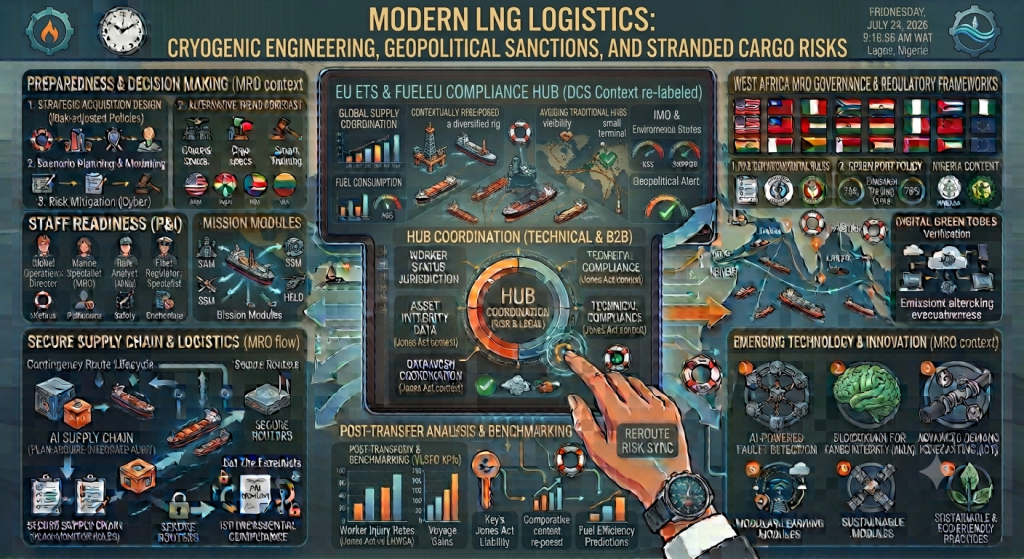
The global energy transition has placed Liquefied Natural Gas (LNG) at the center of maritime trade corridors. Transporting methane gas supercooled to -162°C (-260°F) requires some of the most sophisticated engineering in commercial shipping, operating under strict international safety codes.
However, the modern LNG cargo ship sector is no longer defined solely by cryogenic containment technology and boil-off gas management.
The market faces unprecedented geopolitical friction, strict international sanctions enforcement, and an increasing volume of stranded Russian LNG cargo held in dark fleet tankers, floating storage units (FSUs), and unscheduled ship-to-ship (STS) transfer locations across Northern Europe and Asia.
[ Global LNG Cargo Flow & Friction Points ]
│
┌────────────────────────────────────┼────────────────────────────────────┐
▼ ▼ ▼
[ Cryogenic Transit ] [ Geopolitical Bottlenecks ] [ Offshore STS Transfers ]
• -162°C Liquefaction • Sanctions on Arctic LNG 2 • SIGTTO transfer protocols
• Membrane vs. Moss Tanks • Stranded Shadow Fleet Cargoes • FSU storage & regasification
• Boil-Off Gas (BOG) Re-injection • OFAC & EU Import Restrictions • STS risk mitigation in EEZs
For shipowners, energy traders, charterers, and offshore logistics providers, managing LNG transport demands an integrated understanding of cryogenic vessel mechanics, international regulatory compliance (IGC Code), and geopolitical risk auditing.
Technical Architecture of the Modern LNG Cargo Ship
An LNG cargo ship is a specialized carrier designed to carry liquid methane at 1/600th of its gaseous volume. Maintaining this ultra-low temperature requires advanced cargo containment systems (CCS) and active vapor pressure management.
[ LNG Tank Containment Technologies ]
│
┌─────────────────────────────┴─────────────────────────────┐
▼ ▼
[ Membrane Systems (GTT Mark III / NO96) ] [ Moss Spherical Systems (Type B) ]
• Integrates directly into vessel inner hull • Self-supporting aluminum spheres
• Maximizes volumetric cargo capacity • High mechanical impact resistance
• Low visual profile & optimized aerodynamics • Distinct visual deck profile
A. Containment Systems: Membrane vs. Moss Spheres
- Membrane Containment (GTT Mark III & NO96): Dominating over 80% of modern newbuild orders, membrane systems utilize a thin metallic barrier (Invar or corrugated stainless steel) supported by rigid insulation built directly into the ship’s inner hull. This design maximizes volumetric deck space and reduces aerodynamic drag.
- Moss Spherical Tanks (IMO Type B): Utilizing independent, heavy-gauge aluminum spheres welded inside protective hold spaces, Moss-type carriers offer superior resistance to sloshing damage during partial-filling conditions, making them well-suited for harsh North Atlantic and Arctic routes.
B. Boil-Off Gas (BOG) and Reliquefaction Mechanics
During transit, ambient heat ingress causes a small fraction of the liquid cargo to vaporize—a process known as Boil-Off Gas (BOG). Modern LNG ships manage BOG through three primary pathways:
- Dual-Fuel / Tri-Fuel Diesel Electric (DFDE/TFDE) Engines: Burning BOG directly as propulsion fuel, reducing emissions and operating costs.
- Onboard Reliquefaction Plants: Re-compressing and cooling BOG back into liquid state to return it to cargo tanks, minimizing cargo loss during long ocean transits.
- Gas Combustion Units (GCU): Safely incinerating excess BOG when the vessel is idle at anchor or restricted from burning gas in port, preventing tank over-pressurization.
Geopolitical Bottlenecks: Sanctions and Stranded Russian LNG Cargoes
The maritime LNG trade has entered a volatile era driven by Western sanctions targeting major Russian energy projects, most notably Novatek’s Arctic LNG 2 facility in Siberia.
[ Stranded Cargo Resolution Lifecycle ]
│
[ Loading at Arctic Terminal ] ──► [ Transshipment / FSU Anchoring ] ──► [ Dark Fleet STS Transfer ]
│
▼
[ Refusal at Mainstream Terminals ] ◄── [ AIS Dark Sailing & Reflagging ] ◄────────┘
A. The Evolution of the Shadow LNG Fleet
To bypass US Department of the Treasury (OFAC) and EU import bans, a parallel shadow fleet of aging LNG tankers has emerged.
Unlike crude oil tankers—which can easily transfer unrefined petroleum—handling cryogenic LNG requires specialized, aging carriers equipped with functional reliquefaction systems.
Many of these vessels undergo frequent reflagging, opaque ownership changes, and off-grid operational maneuvers to move sanctioned gas.
B. Floating Storage Units (FSUs) and Unscheduled STS Bottlenecks
Sanctions have created severe logistical bottlenecks, resulting in stranded Russian LNG cargo floating at sea without immediate discharge options:
- Saam & Koryak FSUs: Massive floating storage units deployed near Murmansk and Kamchatka have served as transshipment hubs. However, as sanctions target these storage units directly, tankers often remain anchored for weeks with full cargoes.
- Refusal at Import Terminals: Mainstream Asian and European regasification terminals increasingly refuse entry to vessels linked to sanctioned projects or dark fleet management entities.
- Offshore STS Transshipment Risks: To hide cargo origins, dark fleet operators attempt ship-to-ship transfers in international waters. Conducting STS transfers of cryogenic liquid outside established SIGTTO-compliant terminals presents severe environmental, explosion, and structural failure risks.
Operational Safety and SIGTTO Compliance in Offshore LNG Transfers
Ship-to-ship (STS) transfer of LNG—whether for commercial distribution, floating storage offloading, or marine bunkering—is governed by strict protocols established by the Society of International Gas Tanker and Terminal Operators (SIGTTO).
[ Essential SIGTTO Transfer Protocols ]
│
┌────────────────────────┴────────────────────────┐
▼ ▼
[ Mechanical Emergency Shutdown ] [ Cryogenic Hoses & Vapor Return ]
• Linked ESD-1 and ESD-2 systems • Vacuum-insulated transfer hoses
• Automatic dry-break couplers • Closed-loop vapor balancing lines
• Pneumatic / optical link matching • Nitrogen line purging prior to flow
Core Safety Requirements for Offshore LNG Transfers:
- Linked Emergency Shutdown (ESD) Systems: Dual-vessel electronic or pneumatic links ensure that if an emergency occurs on either ship, transfer pumps instantly trip and emergency release couplings (PERCs) disconnect automatically without cargo leakage.
- Closed-Loop Vapor Balancing: During liquid transfer, vapor displaced from the receiving vessel’s tanks must be piped back to the donor ship via a dedicated vapor return line to maintain stable tank pressures.
- Line Inerting and Nitrogen Purging: Prior to introducing cryogenic liquid, transfer lines are purged with dry nitrogen gas to eliminate oxygen and moisture, preventing ice formation and explosive atmospheres inside the pipes.
Technical B2B FAQ: LNG Cargo Operations and Compliance
Q1: What happens to an LNG cargo ship if boil-off gas (BOG) cannot be burned or reliquefied?
If a vessel loses propulsion (cannot burn BOG in engines) and experiences a reliquefaction plant failure, tank pressure will rise. The vessel will route excess gas to its onboard Gas Combustion Unit (GCU) to burn the vapor safely. If the GCU also fails, safety relief valves (SRVs) will automatically vent gas into the atmosphere high above the masthead to prevent catastrophic over-pressurization.
Q2: Why are stranded Russian LNG cargoes more difficult to manage than stranded crude oil cargoes?
Unlike crude oil—which can remain stable in conventional tanker holds for months—LNG constantly vaporizes due to heat ingress. If a shadow fleet LNG vessel remains stranded at anchor without active reliquefaction or an operational outlet for its BOG, cargo volume continually degrades, creating sustained tank pressure management challenges.
Q3: What international codes govern the design and operation of an LNG cargo ship?
LNG carriers are governed primarily by the International Code for the Construction and Equipment of Ships Carrying Liquefied Gases in Bulk (IGC Code), enforced by the IMO. Operational guidelines are supplemented by SIGTTO standards and classification society rules (such as DNV, ABS, or Lloyd’s Register).
Q4: How do charterers verify that an LNG vessel is free from dark fleet or sanctions exposure?
Charterers conduct rigorous due diligence using real-time satellite AIS tracking, historical ownership audits, reflagging records, and Class society verification. Vessels that have turned off AIS transponders near sanctioned FSUs (such as Saam or Koryak) or engaged in unverified STS transfers in non-designated zones are automatically flagged and blacklisted by mainstream P&I Clubs and chartering desks.
Q5: Can standard offshore supply vessels (OSVs) participate in LNG bunkering or STS operations?
No. Standard OSVs lack cryogenic handling equipment and double-walled insulated piping. Offshore LNG bunkering and transfer require specialized LNG Bunkering Vessels (LNGBVs) equipped with subsea positioning systems, dynamic positioning (DP2/DP3), cryogenic transfer arms, and SIGTTO-compliant linked ESD systems.
Partner with Oitha Marine for Advanced Offshore Logistics and Marine Compliance
Managing complex offshore energy logistics, vessel chartering, and regulatory risk requires a trusted maritime partner. At Oitha Marine, we support shipowners, energy operators, and commercial charterers across West Africa and international trade routes with expert vessel sourcing, offshore logistics support, and rigorous compliance management.
Ensure seamless, risk-free operations for your fleet. Contact our technical management team today at oithamarine.com or visit Oitha Marine Technical Insights to request an operational assessment.
Recent Comments