
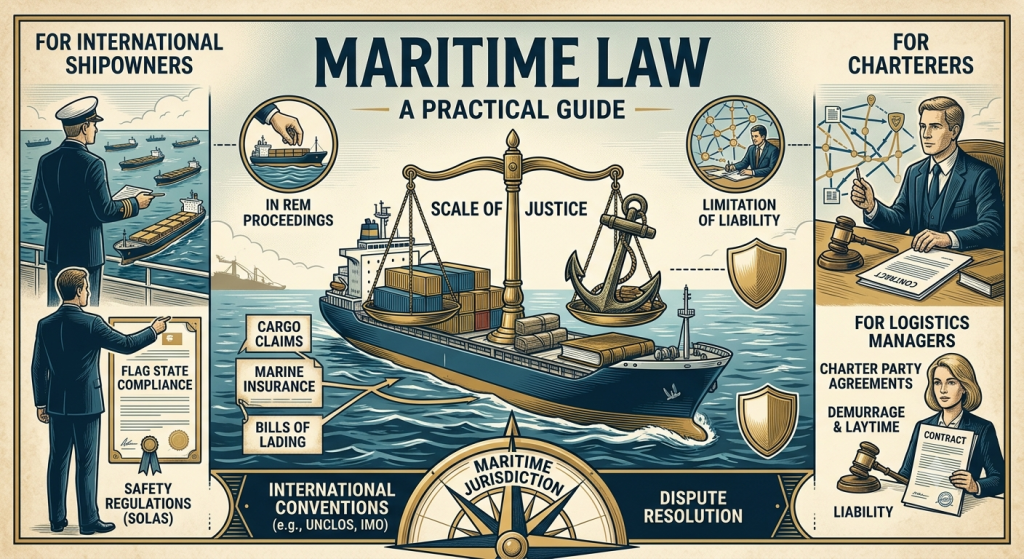
Global maritime commerce operates within a unique, highly specialized legal framework that bridges sovereign national jurisdictions and international waters. For shipowners, corporate logistics directors, and commercial charterers operating across North America, Europe, and major energy corridors, navigating maritime law (admiralty law) is critical to risk management, contractual integrity, and operational continuity.
Whether drafting a time charter party, managing vessel liabilities, or ensuring compliance with international safety conventions, a firm grasp of maritime legal principles prevents costly disputes. This comprehensive guide explores the core mechanics of maritime law, enforcement jurisdictions, liability structures, and how strategic alignment with experienced operators like Oitha Marine safeguards international maritime assets and supply chains.
Core Mechanics: What is Maritime Law and How Does It Apply?
Maritime law—often used interchangeably with admiralty law—is a distinct body of law governing private maritime disputes, shipping, navigation, marine commerce, and salvage. Unlike land-based domestic laws, maritime law is shaped by centuries of international custom, treaties, and specialized judicial systems.
The scope of maritime law covers several essential operational areas:
- Jurisdictional Reach: It governs events occurring on navigable waters, encompassing the high seas, territorial waters, and connecting commercial waterways.
- Contractual Governance: It dictates the interpretation of commercial agreements, including bills of lading, charter parties (time and voyage charters), and marine insurance policies.
- Tort and Liability: It handles incidents involving collisions, groundings, cargo loss, environmental pollution, and personal injury at sea.
Classifications, Legal Concepts, and Operational Frameworks
Understanding the structural pillars of maritime law requires examining how legal obligations are categorized between private commercial duties and public international regulations.
Key Legal Instruments and Concepts
- Admiralty Jurisdiction: Grants specialized courts the authority to hear maritime disputes, often including the unique power to arrest a vessel (in rem action) to secure maritime claims or unpaid debts.
- Carriage of Goods by Sea (COGSA / Hague-Visby Rules): Establishes standard legal liabilities and immunities of ocean carriers regarding cargo damage or loss during transit, limiting liability per package or unit unless higher values are declared.
- The Four Pillars of International Maritime Regulation: While distinct from commercial maritime contract law, international shipping is globally regulated by foundational conventions enforced by the International Maritime Organization (IMO):
- SOLAS (Safety of Life at Sea)
- MARPOL (Prevention of Pollution from Ships)
- STCW (Standards of Training, Certification and Watchkeeping for Seafarers)
- MLC (Maritime Labour Convention)
Compliance, Enforcement, and Risk Management
Enforcing maritime law involves a complex network of coastal state authorities, international flag states, and naval or coast guard agencies (such as the US Coast Guard). For corporate logistics managers, non-compliance can result in severe financial penalties, vessel detention, or criminal liabilities.
Key Compliance and Enforcement Vectors
- Flag State and Port State Control (PSC): Vessels must comply with the laws of their registered flag state as well as the rigorous inspection regimes of port states they visit. Deficiencies can lead to immediate port detentions.
- Contractual Risk Allocation (Indemnity and Limitation of Liability): Modern maritime contracts utilize standard clauses (such as BIMCO terms) to clearly define who bears financial responsibility when operational accidents, delays, or third-party claims occur.
- Environmental Enforcement: Strict liability regimes govern accidental hydrocarbon discharges or waste management failures under international protocols like MARPOL Annex I.
Commercial Considerations: Protecting Assets and Managing Disputes
For commercial operators and charterers, legal foresight directly protects profit margins and asset valuations.
Essential Commercial Risk Strategies
- Clear Charter Party Drafting: Ambiguities in time or voyage charter agreements regarding off-hire periods, safe port designations, and bunker quality frequently lead to expensive international arbitration (e.g., LMAA in London or SMA in New York).
- Vetted Marine Insurance (P&I and Hull & Machinery): Securing robust Protection and Indemnity (P&I) club coverage is mandatory for shielding corporate balance sheets against catastrophic third-party maritime claims.
- Operational Due Diligence: Partnering with established regional marine service providers ensures that all local port clearances, safety regulations, and documentation align seamlessly with international legal standards.
Frequently Asked Questions (FAQs)
1. What is maritime law in simple terms?
Maritime law (or admiralty law) is a specialized legal system that governs commerce, navigation, shipping, and legal disputes occurring on navigable waters or the high seas, separating maritime contracts and accidents from land-based legal frameworks.
2. When and where does maritime law apply?
Maritime law applies to activities on navigable waters—including oceans, seas, and commercially navigable rivers and lakes. It governs incidents and contracts related to shipping, vessel operations, cargo transport, and maritime commerce regardless of the nationalities involved, provided the event falls under admiralty jurisdiction.
3. Who enforces maritime law?
Maritime law is enforced through a combination of national admiralty courts, international tribunals, and specialized state agencies such as coast guards and port state control authorities. Private disputes are typically resolved through commercial arbitration or specialized maritime courts.
4. How do maritime laws impact vessel chartering and logistics?
Maritime laws dictate the legal parameters of charter agreements, cargo liabilities, safety obligations, and financial remedies (such as off-hire provisions or demurrage). Understanding these rules ensures that charterers and shipowners allocate risk fairly and avoid costly litigation.
Conclusion and Strategic Call to Action
Navigating the complexities of maritime law is a fundamental requirement for maintaining the legal security, operational efficiency, and profitability of international shipping supply chains. For corporate logistics managers, oil traders, and charterers operating across the USA, UK, Canada, and global energy markets, partnering with an experienced maritime entity ensures full operational compliance and risk mitigation.
Oitha Marine delivers elite maritime services, specialized vessel chartering solutions, and professional logistics support designed to meet international standards and protect your commercial interests in complex operational environments.
Looking to secure dependable vessel tonnage or expert marine logistics support aligned with global standards? Contact Oitha Marine today to discuss your operational requirements with our team.
Recent Comments