
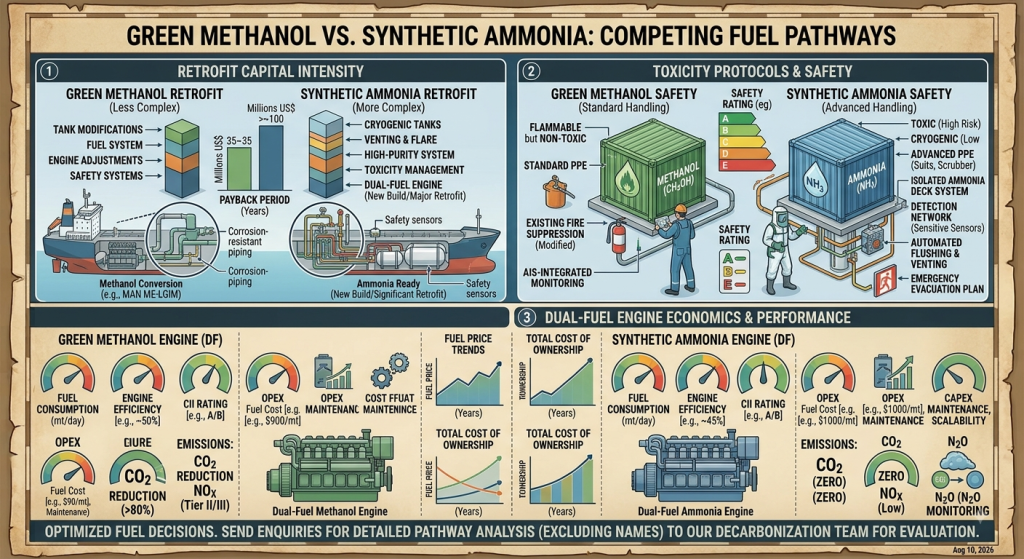
The commercial shipping industry is entering an era of fuel diversification driven by stricter greenhouse gas emission mandates. With the enforcement of the International Maritime Organization’s (IMO) revised GHG Strategy targets, the FuelEU Maritime regulation, and the inclusion of shipping in the European Union Emissions Trading System (EU ETS), fleet owners can no longer rely on single-fuel propulsion strategies.
Two primary zero/near-zero carbon candidates have emerged for deep-sea merchant vessels: Green Methanol ( / Bio-Methanol) and Synthetic Green Ammonia (
). While both offer paths to compliance under regional and global regulations, their operational profiles, retrofit costs, toxicity hazards, and engine mechanics differ significantly.
This technical analysis evaluates the engineering complexity, capital expenditure (CapEx), operational expenditure (OpEx), and safety frameworks required to deploy green methanol and synthetic ammonia dual-fuel propulsion systems.
Section 1: Chemical & Thermodynamic Profiles
Selecting a alternative fuel vector requires balancing energy density against physical storage constraints. Both green methanol and synthetic ammonia require larger storage volumes than conventional heavy fuel oil (HFO) or marine gas oil (MGO).
┌──────────────────────────────────────────────┐
│ Volumetric Storage Density Comparison │
└──────────────────────┬───────────────────────┘
│
┌──────────────────────────────────────┼──────────────────────────────────────┐
▼ ▼ ▼
┌──────────────────────────┐ ┌──────────────────────────┐ ┌──────────────────────────┐
│ Very Low Sulfur Fuel Oil │ │ Green Methanol (e-CH3OH) │ │ Green Ammonia (e-NH3) │
├──────────────────────────┤ ├──────────────────────────┤ ├──────────────────────────┤
│ Energy Density: 42.7 MJ/kg│ │ Energy Density: 19.9 MJ/kg│ │ Energy Density: 18.6 MJ/kg│
│ Volumetric Factor: 1.0x │ │ Volumetric Factor: 2.2x │ │ Volumetric Factor: 3.2x │
│ Storage: Ambient Deck │ │ Storage: Ambient Liquid │ │ Storage: Cryogenic / Press│
└──────────────────────────┘ └──────────────────────────┘ └──────────────────────────┘
Thermodynamic Fuel Matrix
| Thermodynamic Metric | HFO / MGO Baseline | Green Methanol ( | Synthetic Ammonia ( |
| Lower Heating Value (LHV) | ~42.7 MJ/kg | ~19.9 MJ/kg | ~18.6 MJ/kg |
| Liquid Density | ~0.89 kg/L | ~0.79 kg/L | ~0.68 kg/L (at |
| Volumetric LHV vs. HFO | 100% | ~42% (2.3x space required) | ~31% (3.2x space required) |
| Boiling Point at Ambient Pressure | > | ||
| Auto-Ignition Temperature | ~ | ||
| Pilot Fuel Dependency | N/A (Direct Ignition) | 3%–5% MGO / Bio-diesel | 5%–15% MGO (Ignition Enhancer) |
Section 2: Dual-Fuel Engine Mechanics & Combustion Paradigms
Dual-fuel engines designed for low-flashpoint or non-carbon fuels rely on specialized injection systems and pilot fuel ignition. Both major two-stroke engine designers—MAN Energy Solutions (ME-LGIM for Methanol, ME-LGIA for Ammonia) and WinGD (X-DF-M and X-DF-A)—have developed dedicated injection architectures.
Lloyd’s List
┌────────────────────────────────────────────────────────┐
│ Two-Stroke Dual-Fuel Combustion Concepts │
└───────────────────────────┬────────────────────────────┘
│
┌────────────────────────────────┴────────────────────────────────┐
▼ ▼
┌────────────────────────────────────────┐ ┌────────────────────────────────────────┐
│ MAN ME-LGIM / WinGD X-DF-M (Methanol) │ │ MAN ME-LGIA / WinGD X-DF-A (Ammonia) │
├────────────────────────────────────────┤ ├────────────────────────────────────────┤
│ • Diesel-Cycle Injection (High Press) │ │ • High-Pressure Direct Injection │
│ • Hydraulic Booster Injection Valves │ │ • Corrosion-Resistant Fuel Injectors │
│ • Pilot Fuel: 3% MGO Ignition Spike │ │ • Pilot Fuel: 5%-15% MGO Spike │
│ • Moderate Flame Speed / Easy Tuning │ │ • Slow Laminar Burning / SCR Required │
└────────────────────────────────────────┘ └────────────────────────────────────────┘
Methanol Combustion Profile (ME-LGIM / X-DF-M)
- Injection Mechanics: Methanol is injected at high pressure (~300–600 bar) directly into the cylinder near top dead center (TDC) using hydraulic fuel booster injection valves (FBIV).
- Ignition Support: Because methanol has a low Cetane number (~3), a small pilot injection of conventional MGO (3%–5% energy share) is required to initiate stable combustion.
- Emissions Profile: Eliminates
and reduces
emissions by up to 80% relative to HFO due to lower peak combustion temperatures, often meeting IMO Tier III limits without selective catalytic reduction (SCR) units.
Ammonia Combustion Profile (ME-LGIA / X-DF-A)
- Injection Mechanics: Ammonia requires direct liquid injection at elevated pressures (>700 bar). Due to ammonia’s narrow flammability range (15%–28% in air) and slow burning velocity, combustion tuning is more complex.
- Ignition Support: Requires a higher pilot fuel injection (5%–15% energy share) to sustain combustion stability across varying engine loads.
- Emissions Profile: Eliminates direct
emissions from fuel combustion. However, it generates significant nitrous oxide (
), a greenhouse gas with a global warming potential 273 times higher than
. Ammonia combustion also releases unburned ammonia slip (
) and high
levels, requiring mandatory SCR systems and specialized
abatement catalysts.
Section 3: Engine Retrofit CapEx & Capital Intensity
Retrofitting an existing vessel’s two-stroke main engine from HFO/MGO to dual-fuel operation involves modifying the fuel supply system, upgrading cylinder heads, and installing specialized storage tanks.
CapEx Component Breakdown (15,000 TEU Container Vessel Baseline)
| Retrofit Capital Component | Green Methanol Dual-Fuel ($) | Synthetic Ammonia Dual-Fuel ($) |
| Engine Modification Kit (FBIV/Piping) | $2.5M – $3.5M | $4.0M – $5.5M |
| Fuel Storage Tanks & Insulation | $3.0M – $4.5M (Modified Hull / Type C) | $6.5M – $9.0M (Cryogenic / Pressurized) |
| Fuel Supply Condition System (LFSS) | $1.2M – $1.8M | $2.5M – $3.8M |
| Safety, Venting & Gas Detection | $0.8M – $1.2M | $2.5M – $4.0M (Double-wall / Absorption) |
| Exhaust After-Treatment ( | $0.5M – $1.0M (Standard Tier III) | |
| Shipyard Labor & Off-Hire Downtime | $2.0M – $3.0M (25–35 Days) | $3.5M – $5.0M (40–55 Days) |
| Total Estimated Retrofit CapEx | $10.0M – $15.0M | $21.0M – $30.8M |
Mathematical Total Cost of Ownership (TCO) Model

Where:
= Mass of fuel type
consumed (Methanol/Ammonia + Pilot Fuel)
= Price per metric ton of fuel
= Verified Well-to-Wake GHG emissions (
)
= Regulatory carbon price (e.g., EU ETS allowance price + IMO carbon levy)
Section 4: Toxicity, Safety Protocols & HAZID Frameworks
The fundamental operational distinction between methanol and ammonia lies in human toxicity and environmental handling hazards. Methanol is a low-flashpoint flammable liquid (), whereas ammonia is a highly toxic, corrosive gas under ambient conditions.
[ AMMONIA SAFETY HAZARD MITIGATION LAYER ]
│
( Double-Walled Fuel Lines )
│
▼
[ Nitrogen Purging System (N2 Inerting) ]
│
▼
[ Optical & Chemical Sensor Array (1 ppm Threshold) ]
│
┌──────────────┴──────────────┐
▼ ▼
[ Water Scrubber Tower ] [ Emergency Vapor Bleed ]
(Absorbs Toxic NH3 Gas) (Vents to Safe Deck Zone)
Safety & Toxicity Protocol Comparison
- Immediately Dangerous to Life or Health (IDLH):
- Methanol: 6,000 ppm. Flammability is the primary hazard. Managed using standard low-flashpoint fuel protocols (MSC.1/Circ.1621).
- Ammonia: 300 ppm. Highly toxic via inhalation. Exposure above 2,500 ppm can be fatal within minutes.
- Double-Walled Piping & Nitrogen Purging: Fuel lines for both fuels must be double-walled. For ammonia, the outer annular space must be continuously swept with inert Nitrogen (
) or maintained under negative pressure with high-frequency gas detection.
- Water Scrubber & Absorption Towers: Ammonia vent lines cannot discharge directly into the atmosphere near accommodation spaces. Emergency relief valves must route released gas through dedicated water-based absorption towers to capture ammonia vapor as aqueous ammonia.
- Targeted Crew Training: Deck and engine officers handling ammonia bunkering must hold advanced STCW certification for hazardous liquid gas handling, wearing full Level A vapor-protective suits during fuel transfer operations.
Frequently Asked Questions (FAQ)
Fleet Transition & Commercial Strategy
Q: Why is green methanol seeing faster commercial adoption than ammonia?
A: Methanol handles as a liquid at ambient temperatures and pressures, requiring lower capital expenditure for bunker storage and shipyard modifications. Ammonia’s high toxicity (IDLH 300 ppm) and requirement for complex after-treatment systems (De- SCR) have extended its testing and approval timelines.
Q: Can a vessel retrofitted for green methanol be easily converted to run on ammonia later?
A: No. Methanol fuel tanks, fuel supply systems, and engine injection valves are fundamentally incompatible with ammonia due to ammonia’s corrosive effects on copper/zinc alloys, higher pressure requirements, and distinct toxicity protocols. A second conversion would require replacing the entire fuel supply architecture.
Technical & Environmental Compliance
Q: How do green methanol and ammonia dual-fuel engines perform under EU ETS rules?
A: Both fuels drastically lower direct Tank-to-Wake carbon penalties under EU ETS. However, under FuelEU Maritime’s Well-to-Wake accounting, shipowners must ensure their fuel supplier provides proof of origin (e.g., e-methanol or e-ammonia produced via certified renewable electricity) to avoid penalties.
Q: What is “ammonia slip” and why is it an environmental concern?
A: Ammonia slip refers to unburned ammonia gas escaping through the exhaust stack during combustion. If released into the atmosphere, unburned ammonia contributes to air pollution, fine particulate matter () formation, and marine ecosystem acidification. Exhaust gas systems must include catalytic scrubbers to eliminate slip.
Recent Comments