
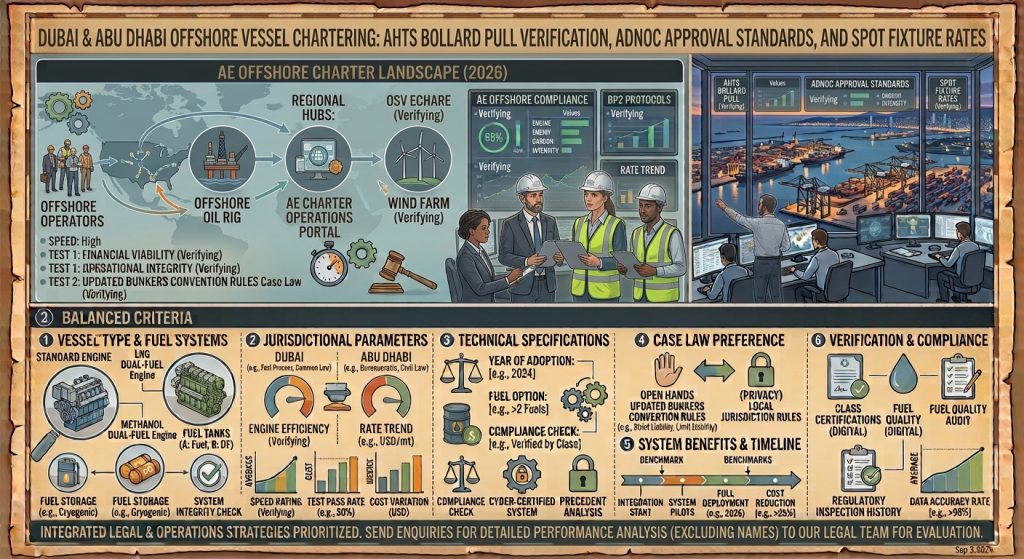
The offshore support vessel (OSV) charter market across the Emirate of Abu Dhabi and Dubai represents one of the world’s most capital-dense, highly audited marine logistics hubs. Driven by the Abu Dhabi National Oil Company’s (ADNOC) multi-billion-dollar capacity expansion plans—specifically across offshore fields such as Hail & Ghasha, Upper Zakum, and Belbazem—demand for Anchor Handling Tug Supply (AHTS) vessels and Platform Supply Vessels (PSVs) has hit historic highs. Charterers, vessel operators, and institutional ship financiers face an intricate operational ecosystem dominated by rigid technical requirements: static bollard pull verification, Unified Vendor Qualification System (UVQS) audits, In-Country Value (ICV) score weightings, and Critical Infrastructure and Coastal Protection Authority (CICPA) clearances.
Concurrently, global energy supply chains face cross-border regulatory integration. The European Union’s Ecodesign for Sustainable Products Regulation (ESPR EU 2024/1781) expands compliance mandates far beyond EU geographical borders. Tier-1 engineering, procurement, and construction (EPC) contractors, vessel managers, and marine equipment manufacturers operating out of the United States, Canada, the United Kingdom, and Australia into Gulf Cooperation Council (GCC) waters must align physical vessel operations with digital compliance systems.
This report provides a comprehensive analysis of Arabian Gulf OSV spot and term charter dynamics, static bollard pull testing mechanics, ADNOC technical prequalification, and the architectural integration of Digital Product Passports (DPP) into machine-readable customs and port state inspection protocols.
MAIN BODY ARCHITECTURE
ARABIAN GULF OSV OPERATIONAL & REGULATORY ARCHITECTURE
┌─────────────────────────────────────────┐ ┌─────────────────────────────────────────┐
│ ADNOC & UAE REGULATORY GATEWAY │ │ EU ESPR & GLOBAL DATA COMPLIANCE │
│ • Unified Vendor Qualification (UVQS)│ │ • Regulation (EU) 2024/1781 (ESPR) │
│ • In-Country Value (ICV) Certification│ │ • Scope 3 LCA & Material BOM Data │
│ • CICPA Security Clearances │ │ • Digital Product Passport (DPP) │
└────────────────────┬────────────────────┘ └────────────────────┬────────────────────┘
│ │
└───────────────────────────┬─────────────────────────────┘
│
▼
┌───────────────────────────────────────────────────────────────────────────────────────────────────┐
│ ARABIAN GULF FLEET DISPATCH │
│ • Static Bollard Pull Verification (IMCA M 179 / Class Certification) │
│ • Spot & Term Charter Execution ($14,000 – $38,000+/day) │
└────────────────────────────────────────────────┬──────────────────────────────────────────────────┘
│
▼
┌───────────────────────────────────────────────────────────────────────────────────────────────────┐
│ DECENTRALIZED ENTERPRISE DATA BRIDGE │
│ • Digital Product Passport (DPP) Data Node Execution │
│ • Unique Product Identifiers (UID) (ISO/IEC 15459 Data Matrix) │
│ • Machine-Readable Customs Clearance & Automated Market Surveillance │
└───────────────────────────────────────────────────────────────────────────────────────────────────┘
1. Statutory Scope of Abu Dhabi & Dubai OSV Chartering: ADNOC Approval Standards & CICPA Frameworks
Securing offshore vessel charter contracts in the United Arab Emirates requires navigating a strict dual-layered regulatory framework governed by state energy mandates and national security authorities.
+—————————————————————————————————+
| ADNOC PREQUALIFICATION & UAE PERMIT MATRIX |
+———————————+——————————–+——————————–+
| REGULATORY / COMPLIANCE GATEWAY | MANDATORY MECHANISM | COMMERCIAL / OPERATIONAL IMPACT|
+———————————+——————————–+——————————–+
| ADNOC UVQS Prequalification | SAP Ariba Registration + IDD | Unlocks participation in |
| | Integrity Due Diligence | offshore tenders (Work Group |
| | Screening | Codes) across 14 subsidiaries |
+———————————+——————————–+——————————–+
| In-Country Value (ICV) | Annual Audited Financial Score | Directly impacts commercial |
| Certification | (Local Procurement, Emirat- | evaluation; higher ICV score |
| | izatiion, Capex in UAE) | can override higher dayrates |
+———————————+——————————–+——————————–+
| CICPA Security Clearance | Security Vetting via Abu Dhabi | Required for vessel entry into |
| (Critical Infrastructure) | Police / Coastal Protection | offshore oilfields and security|
| | Authority | exclusion zones |
+———————————+——————————–+——————————–+
| Supreme Petroleum Council (SPC) | Trade License Endorsement | Statutory authorization to |
| Commercial Approval | for Abu Dhabi Onshore/Offshore | execute oilfield services in |
| | Oilfield Services | the Emirate of Abu Dhabi |
+———————————+——————————–+——————————–+
ADNOC Unified Vendor Qualification System (UVQS) & Exiger Screening
To qualify as an approved offshore vessel owner or technical manager, companies must pass through the ADNOC Unified Vendor Qualification System (UVQS) handled via SAP Ariba. The process begins with Integrity Due Diligence (IDD) executed through automated compliance platforms (Exiger) to audit Ultimate Beneficial Owners (UBOs), financial health, and global sanction exposure.
Following IDD clearance, technical prequalification requires submitting Quality Management Systems (ISO 9001, 14001, 45001), International Safety Management (ISM) documentation, and proof of vessel classification with Recognized Organizations (e.g., DNV, ABS, Lloyd’s Register).
In-Country Value (ICV) Score Optimization
The In-Country Value (ICV) program serves as a critical commercial differentiator. During ADNOC offshore charter evaluations, submitted dayrates are mathematically adjusted using the bidder’s certified ICV percentage score:
Stainless Steel Pipes Supplier | Round Tubes & Custom Profiles | MFY

Operators that invest in UAE-based drydocking (e.g., Dubai Drydocks World or Albwardy Damen), employ UAE nationals, and source local marine supplies secure higher ICV scores, allowing them to win contracts even when bidding higher nominal dayrates than foreign-based competitors.
Stainless Steel Pipes Supplier | Round Tubes & Custom Profiles | MFY
2. Spot Fixture Benchmarks & Technical Verification: AHTS Static Bollard Pull Mechanics
The Arabian Gulf offshore support vessel market exhibits strong supply tightness across medium-to-large AHTS units and high-capacity PSVs. The surge in rig count across Abu Dhabi and Dubai waters has created a highly competitive spot market.
Arabian Gulf OSV Dayrate Benchmarks
+—————————————————————————————————+
| 2026 ARABIAN GULF OSV DAYRATE BENCHMARKS |
+——————————-+————————+——————-+———————-+
| VESSEL CLASS | TECHNICAL SPEC | TERM DAYRATE RANGE| SPOT MARKET RANGE |
+——————————-+————————+——————-+———————-+
| Anchor Handling (AHTS) | 80–100t BP, DP2 | $14,000 – $18,000 | $19,000 – $24,000 |
| Large AHTS (>150t BP) | >150t BP, DP2, FI FI 1 | $24,000 – $30,000 | $32,000 – $38,000+ |
| Platform Supply Vessel (PSV) | >3,500 DWT, DP2 | $16,000 – $21,000 | $22,000 – $28,000 |
| Fast Supply Intervention (FSI)| 30–40 Knots, DP1/DP2 | $7,000 – $10,000 | $11,000 – $14,000 |
+——————————-+————————+——————-+———————-+
Static Bollard Pull Verification Protocols (IMCA M 179 Standard)
For AHTS vessels engaged in rig moves, deepwater anchor placement, and towing floating production units, static bollard pull is the primary technical metric. ADNOC and regional offshore operators mandate rigorous verification of continuous bollard pull under IMCA M 179 guidelines prior to charter acceptance.
IMCA M 179 BOLLARD PULL TEST SETUP
┌─────────────────────────┐ ┌────────────────────────┐
│ AHTS TEST VESSEL │ │ SHORE / FIXED BOLLARD │
│ • Displacement: Full │======= 300m+ Continuous Towline =====│ • Calibrated Load Cell│
│ • Engine: 100% MCR │ │ • Graphic Recording │
│ • Trim: Even / Stern │ │ • +/- 2% Accuracy │
└─────────────────────────┘ └────────────────────────┘
▲ ▲
│ │
└───────────────────── Water Depth > 20m ────────────────────────┘
The physical testing procedure requires strict adherence to environmental and operational criteria:
- Water Depth & Clearance: Water depth at the test location must exceed 20 meters within a 100-meter radius of the vessel to eliminate propeller wash reflection and shallow-water suction effects.
- Environmental Thresholds: Tests must be executed in wind speeds under 5 meters per second (approx. 10 knots) and current speeds below 0.5 meters per second.
- Engine Output & Duration: Main engines run at Maximum Continuous Rating (MCR) for a minimum continuous duration of 10 minutes. Certified continuous bollard pull is recorded as the unassisted average force maintained without decline over this 10-minute window.
- Instrumentation: Load cells must be certified by an approved classification society accurate within
. Load readings are continuously recorded graphically and digitally on shore or aboard a monitoring barge.
3. Cross-Border Trade & Digital Compliance Architecture: Aligning GCC Marine Operations with EU ESPR (2024/1781)
Tier-1 manufacturers, offshore equipment exporters, and logistics forwarders in the USA, Canada, UK, and Australia shipping marine equipment, dynamic positioning spares, and subsea hardware into GCC hub ports (such as Jebel Ali or Khalifa Port) for eventual export or deployment onto EU-flagged vessels face strict regulatory obligations under the Ecodesign for Sustainable Products Regulation (ESPR EU 2024/1781).
+—————————————————————————————————+
| ESPR ARCHITECTURAL IMPLEMENTATION FOR CROSS-BORDER MARITIME |
+———————————-+—————————————————————-+
| ESPR MANDATE REQUIREMENT | MARITIME SUPPLY CHAIN ARCHITECTURAL IMPACT |
+———————————-+—————————————————————-+
| Unique Product Identifier (UID) | Machine-readable 2D DataMatrix (ISO/IEC 15459) applied to |
| | all engine parts, winches, and subsea valves |
+———————————-+—————————————————————-+
| Material Composition & BOM | Granular listing of base metals, rare earth minerals, and |
| | synthetic polymers across all assembly tiers |
+———————————-+—————————————————————-+
| Scope 3 Life Cycle Assessment | Verification of embodied carbon metrics ($\text{kg CO}_2\text{|
| | e}$) from raw material sourcing to vessel installation |
+———————————-+—————————————————————-+
| Decentralized Data Architecture | Suppliers host data on secure enterprise nodes, permitting |
| | API queries from European Automated Market Surveillance |
+———————————-+—————————————————————-+
Decentralized Enterprise Data Storage vs. Central DPP Registry
To balance commercial trade secrecy with regulatory transparency, ESPR utilizes a dual-tier data architecture:
- Central EU DPP Registry: Hosts basic product identification, global classification codes, Unique Product Identifiers (UIDs), and compliance confirmation flags accessible to port state customs authorities.
- Decentralized Enterprise Nodes: Maintained independently by marine machinery OEMs and logistics providers on secure, cloud-based data nodes. Sensitive details—including Bill of Materials (BOM) breakdowns, exact supplier costs, and proprietary engineering designs—remain hosted on these private nodes.
When equipment crosses customs borders or undergoes port state inspection, automated market surveillance systems scan the physical 2D DataMatrix barcode, querying the central registry to confirm the validity of the underlying product payload.
4. Corporate Step-by-Step Roadmap for Establishing Compliance and Offshore Audit Readiness
To ensure uninterrupted vessel operations and eliminate border detention risks, shipowners, offshore operators, and logistics forwarders must execute a structured 5-step roadmap.
1
Complete ADNOC UVQS Prequalification & Commercial Setup
Scope: Trade Licenses, SPC Approvals, and Integrity Due Diligence
1.Complete ADNOC UVQS Prequalification & Commercial Setup:Scope: Trade Licenses, SPC Approvals, and Integrity Due Diligence.
Secure an Abu Dhabi Department of Economic Development (ADDED) license with Supreme Petroleum Council (SPC) authorization. Complete SAP Ariba profile questionnaires, pass Exiger Integrity Due Diligence (IDD) vetting, and register under specific offshore vessel Work Group codes.
2
Optimize Corporate In-Country Value (ICV) Score
Scope: Audit Verification, In-Country Spend, and Local Procurement
2.Optimize Corporate In-Country Value (ICV) Score:Scope: Audit Verification, In-Country Spend, and Local Procurement.
Engage an accredited ICV certifying body to audit financial accounts. Increase local expenditure by utilizing UAE-based shipyards for drydocking, routing vessel maintenance through local service providers, and executing structured Emirati workforce recruitment plans.
3
Execute IMCA M 179 Static Bollard Pull Certification
Scope: Physical Testing, Load Cell Calibration, and Class Endorsements
3.Execute IMCA M 179 Static Bollard Pull Certification:Scope: Physical Testing, Load Cell Calibration, and Class Endorsements.
Coordinate with an accredited classification society to conduct static bollard pull testing in water depths exceeding 20 meters. Maintain 100% MCR for 10 consecutive minutes using calibrated load cells ( accuracy) and update the vessel’s official Class Bollard Pull Certificate.
4
Obtain CICPA Security Approvals & Vessel Entry Permits
Scope: Security Clearances, Coastal Passes, and Fleet Security
4.Obtain CICPA Security Approvals & Vessel Entry Permits:Scope: Security Clearances, Coastal Passes, and Fleet Security.
Submit vessel details, crew manifests, and security documentation to the Critical Infrastructure and Coastal Protection Authority (CICPA). Secure permanent or project-specific coastal security passes for all crew members and technical personnel accessing offshore oilfield exclusion zones.
5
Deploy Digital Product Passport (DPP) Data Nodes
Scope: UID Integration, Data Nodes, and Custom Declarations
5.Deploy Digital Product Passport (DPP) Data Nodes:Scope: UID Integration, Data Nodes, and Custom Declarations.
Establish a decentralized enterprise data node compliant with ISO/IEC 15459 data structure standards. Embed machine-readable UIDs on all major marine machinery components and integrate DPP metadata into automated export declarations to pass EU automated market surveillance audits.
INSIGHTFUL CONCLUSION: 3-TO-5-YEAR STRATEGIC OUTLOOK
Over the next 3 to 5 years, the offshore vessel charter market in the Arabian Gulf will experience a profound technological and regulatory shift. The historical reliance on basic dayrate competition is giving way to a multi-variable chartering model where technical performance, local value creation, and digital compliance dictate market share.
Vessel operators in Tier-1 jurisdictions that invest in modernizing their fleets—integrating hybrid-electric propulsion, securing certified bollard pull ratings, and achieving top-tier ICV scores—will capture long-term charter agreements with energy majors. Conversely, operators relying on legacy tonnage without automated data compliance or low ICV scores will be relegated to volatile, lower-margin spot market opportunities.
Stainless Steel Pipes Supplier | Round Tubes & Custom Profiles | MFY
Furthermore, as global supply chain directives like the EU ESPR framework become standard operating practice, the integration of Digital Product Passports into standard customs clearance workflows will become universal. Maritime logistics providers and vessel managers who establish decentralized data storage nodes and automated compliance protocols today will safeguard their operational resilience across global energy trade corridors.
DEEP-DIVE FAQ SECTION
Q1: What is the exact role of an In-Country Value (ICV) certificate during an ADNOC offshore vessel tender, and can a low ICV score disqualify a bidder?
Answer: An ICV certificate quantifies a company’s financial contribution to the UAE economy through local procurement, manufacturing, investment, and employment of UAE nationals. While a low ICV score does not automatically disqualify a vendor during technical evaluation, it places the bidder at a major commercial disadvantage.
During commercial evaluations, ADNOC applies a formula that adjusts the submitted bid price based on the bidder’s certified ICV score. A competitor with a higher ICV score can win a contract even if their base dayrate is higher than that of a bidder with a low ICV score.
Q2: What are the primary physical causes of test failure during an AHTS static bollard pull verification under IMCA M 179 standards?
Answer: Test failures or certified pull downgrades typically stem from:
- Insufficient Water Depth: Testing in water shallow enough (under 20 meters) to cause propeller wash recirculation, creating artificial turbulence that reduces effective thrust.
- Thermal Overheating: Failure of engine cooling systems or thruster hydraulics during the mandatory 10-minute continuous 100% MCR run.
- Uncalibrated Load Cells: Discrepancies exceeding the allowed
accuracy margin between digital readouts and physical force.
- Adverse Currents/Wind: Currents exceeding 0.5 m/s or wind speeds above 5 m/s causing directional instability, forcing the vessel to use steering thrust that subtracts from pure linear bollard pull.
Q3: How does the Critical Infrastructure and Coastal Protection Authority (CICPA) pass system impact offshore vessel operations in Abu Dhabi?
Answer: CICPA pass approval is a national security requirement for accessing Abu Dhabi’s offshore oilfields, ports, and restricted coastal zones. Every vessel, crew member, and onshore technician must possess valid CICPA clearances issued via Abu Dhabi security authorities. Operating without valid CICPA passes results in immediate vessel arrest, severe financial penalties, and blacklisting from ADNOC oilfield operations.
Q4: How does the European Union’s ESPR framework apply to an AHTS vessel operating purely within the Arabian Gulf?
Answer: ESPR applies whenever an offshore vessel owner, operator, or charterer imports machinery, replacement parts, or specialized subsea gear manufactured in or passing through the European Union, or when the offshore asset itself is owned by an EU entity or flagged in an EU member state.
Spare parts (such as replacement thruster blades, control units, or specialized winches) manufactured in Tier-1 nations like the UK, USA, or Australia for deployment in GCC offshore fields must carry a Digital Product Passport (DPP) to clear EU export/import controls without facing border detention.
Q5: What is the operational difference between an Anchor Handling Tug Supply (AHTS) vessel and a Platform Supply Vessel (PSV) in offshore energy operations?
Answer:
- AHTS Vessels: High-horsepower vessels equipped with heavy-duty winches, stern rollers, shark jaws, and towing pins. They are specifically designed for high-pull tasks like deploying and retrieving heavy offshore anchors, towing mobile offshore drilling units (MODUs), and handling subsea mooring chains.
- PSVs: Optimized for high-volume cargo transport. They feature large open deck spaces (
) and specialized bulk tanks below deck designed to carry drill water, liquid mud, dry bulk cement, methanol, and general deck supplies from onshore supply bases out to offshore rigs and platforms.
Recent Comments