
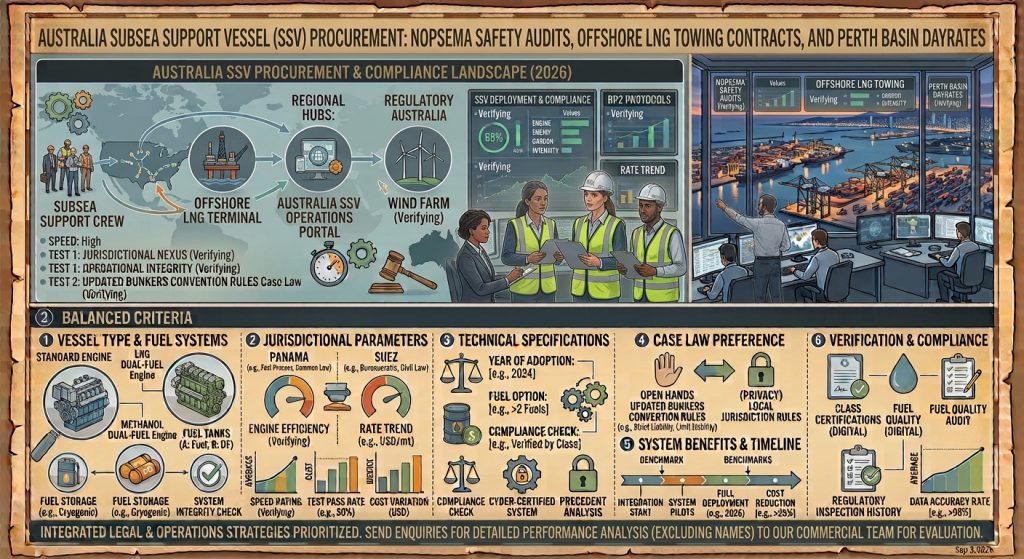
The subsea support vessel (SSV) and light construction market across Western Australia’s North West Shelf, the Browse Basin, and the Perth Basin represents one of the most capital-intensive and regulatory-intensive marine logistics corridors globally. Driven by multi-billion-dollar field maintenance, subsea tie-backs, and backfill gas projects for LNG liquefaction hubs (including Gorgon, Wheatstone, Pluto, and Prelude FLNG), charterers and Tier-1 EPCIC contractors face acute operational bottlenecks. Vessel chartering strategies are dictated by three compounding forces: strict safety management validation under the National Offshore Petroleum Safety and Environmental Management Authority (NOPSEMA), high Dynamic Positioning Class 2/3 (DP2/DP3) operational standards, and localized labor and cabotage regulations under the Navigation Act 2012 and Fair Work Act 2009.
Concurrently, multinational supply chains face a digital transformation mandated by international trade regulations. The European Union’s Ecodesign for Sustainable Products Regulation (ESPR EU 2024/1781) enforces strict traceability across marine machinery, heavy subsea umbilical systems, and specialized subsea trees. Tier-1 engineering firms, vessel operators, and logistics forwarders based in the United States, Canada, the United Kingdom, and Australia shipping equipment into global waters must align physical vessel mobilization with the EU Digital Product Passport (DPP) Registry, Unique Product Identifiers (UID), and granular Material Composition & Bill of Materials (BOM) verification.
This report delivers a comprehensive corporate analysis of Australian SSV dayrate dynamics, NOPSEMA Safety Case approval workflows, offshore LNG towage protocols, and the architecture required to integrate DPP metadata into automated market surveillance and cross-border customs clearance systems.
MAIN BODY ARCHITECTURE
AUSTRALIAN SUBSEA & GLOBAL COMPLIANCE ARCHITECTURE
┌─────────────────────────────────────────┐ ┌─────────────────────────────────────────┐
│ AUSTRALIAN OFFSHORE REGULATORY │ │ EU ESPR & GLOBAL DATA COMPLIANCE │
│ • OPGGS Act / NOPSEMA Safety Case │ │ • Regulation (EU) 2024/1781 (ESPR) │
│ • Navigation Act 2012 Coastal Trading│ │ • Scope 3 LCA & Material BOM Data │
│ • Fair Work Act Australian Pay Rules │ │ • Digital Product Passport (DPP) │
└────────────────────┬────────────────────┘ └────────────────────┬────────────────────┘
│ │
└───────────────────────────┬─────────────────────────────┘
│
▼
┌───────────────────────────────────────────────────────────────────────────────────────────────────┐
│ AUSTRALIAN SSV FLEET DISPATCH │
│ • DP2/DP3 Subsea Crane Verification (150t – 250t AHC Cranes) │
│ • Spot & Term Charter Execution ($45,000 – $95,000+/day) │
└────────────────────────────────────────────────┬──────────────────────────────────────────────────┘
│
▼
┌───────────────────────────────────────────────────────────────────────────────────────────────────┐
│ DECENTRALIZED ENTERPRISE DATA BRIDGE │
│ • Digital Product Passport (DPP) Data Node Execution │
│ • Unique Product Identifiers (UID) (ISO/IEC 15459 Data Matrix) │
│ • Machine-Readable Customs Clearance & Automated Market Surveillance │
└───────────────────────────────────────────────────────────────────────────────────────────────────┘
1. Statutory Scope of Australian Offshore Operations: NOPSEMA Safety Cases & Coastal Trading Protocols
Executing subsea support vessel operations within Australian Commonwealth waters (beyond the 3-nautical-mile state border out to the 200-nautical-mile Exclusive Economic Zone limit) is governed by the Offshore Petroleum and Greenhouse Gas Storage Act 2006 (OPGGS Act) and enforced by NOPSEMA.
+—————————————————————————————————+
| AUSTRALIAN OFFSHORE REGULATORY COMPLIANCE GATEWAYS |
+———————————-+——————————–+——————————-+
| REGULATORY / LEGISLATIVE FRAMEWORK| MANDATORY MECHANISM | COMMERCIAL / OPERATIONAL IMPACT|
+———————————-+——————————–+——————————-+
| NOPSEMA Safety Case Acceptance | Facility/Vessel Safety Case | Statutory prohibition of |
| (OPGGS Safety Regulations) | Submission & Scope of Validation| offshore operations without an|
| | (90-day assessment window) | accepted Safety Case in force |
+———————————-+——————————–+——————————-+
| Coastal Trading (Revitalising | Temporary License (TL) System | Mandatory 5-voyage minimum; |
| Australian Shipping) Act 2012 | via Department of Infrastructure| subject to challenge by local |
| | | Australian-flagged operators |
+———————————-+——————————–+——————————-+
| Fair Work Act 2009 | Fair Work Ombudsman (FWO) | Mandatory payment of |
| (Seagoing Industry Award) | Marine Order 11 Enforcement | Australian Pay Rates to all |
| | | foreign crew on coastal routes|
+———————————-+——————————–+——————————-+
| AMSA Marine Orders | Port State Control (PSC) & | Structural inspection of |
| (Navigation Act 2012) | Flag State Safety Approvals | lifting gear, gangways, and |
| | | dynamic positioning logs |
+———————————-+——————————–+——————————-+
NOPSEMA Safety Case & Scope of Validation (SoV) Mechanics
Unlike prescriptive regulatory regimes, Australia operates a risk-based performance framework. Before any SSV, Light Construction Vessel (LCV), or Inspection, Maintenance, and Repair (IMR) asset can engage in offshore petroleum activities, it must be designated as a “facility” or operate under an accepted Facility Safety Case.
The operator must demonstrate that all hazards associated with subsea lifts, saturation diving, remotely operated vehicle (ROV) deployments, and close-proximity operations to LNG infrastructure are reduced to As Low As Reasonably Practicable (ALARP). Under NOPSEMA guidelines, new or significantly modified vessels require a formal Scope of Validation (SoV) agreed upon with an independent validating body (e.g., DNV, ABS, or Lloyd’s Register) before safety case submission.
Cabotage & Foreign Crew Wage Mandates
Vessel charterers mobilizing foreign-flagged SSVs into Western Australia must navigate the Coastal Trading Act 2012. Foreign vessels operate under Temporary Licenses (TL), which require logging planned voyages on a public portal, exposing the schedule to potential preemption by Australian-flagged general cargo or offshore vessels.
Simultaneously, under the Fair Work Act 2009, foreign mariners operating under a Temporary License or engaged in extended offshore operations must be paid local wage rates equivalent to the Seagoing Industry Award, drastically increasing daily vessel operational expenditure (OPEX).
2. Subsea Dayrate Benchmarks & Deepwater Technical Integration
The Australian market for subsea support vessels features high barriers to entry due to mobilization distances from European and Southeast Asian hubs, rigorous NOPSEMA entry requirements, and specialized technical configurations.
Australian Subsea & Offshore Support Vessel Dayrate Benchmarks
+—————————————————————————————————+
| 2026 AUSTRALIAN SSV & OFFSHORE DAYRATE BENCHMARKS |
+——————————-+————————+——————-+———————-+
| VESSEL CLASS | TECHNICAL SPEC | TERM DAYRATE RANGE| SPOT MARKET RANGE |
+——————————-+————————+——————-+———————-+
| Large IMR / SSV | DP2, 100t-150t AHC Crane| $45,000 – $60,000 | $65,000 – $80,000 |
| Heavy Construction SSV | DP3, >250t AHC Crane, | $70,000 – $85,000 | $90,000 – $115,000+ |
| | Dual Work-Class ROVs | | |
| Saturation Diving Support | DP2/DP3, 18-Man Twin | $80,000 – $100,000| $110,000 – $140,000 |
| Vessel (DSV) | Bell Sat System | | |
| High-HP Anchor Handling (AHTS)| >200t BP, DP2, FI FI 2 | $35,000 – $48,000 | $52,000 – $70,000 |
+——————————-+————————+——————-+———————-+
Active Heave Compensation (AHC) & Dynamic Positioning Protocols
Deepwater subsea operations across the Exmouth Plateau and Browse Basin demand exact position-keeping and heave mitigation:
AHC & DP INTEGRATION SPECIFICATION
┌─────────────────────────┐ ┌────────────────────────┐
│ DP2 / DP3 POSITIONING │ │ ACTIVE HEAVE CRANE │
│ • 3x DGPS / GLONASS │======= Real-Time Motion Data =======│ • 150t–250t Capacity │
│ • 2x Hydroacoustic (HPR)│ (MRU / Inertial Sensors) │ • Subsea Depth: 3000m │
│ • Laser/Radar (CyScan) │ │ • Active Winch Cut │
└─────────────────────────┘ └────────────────────────┘
▲ ▲
│ │
└───────────────────── Sea State Mitigation ─────────────────────┘
- Active Heave Compensated (AHC) Cranes: SSVs deployed for subsea tree installations or manifold placements utilize AHC winches driven by real-time Motion Reference Units (MRUs). The system measures ship pitch, roll, and heave, dynamically paying out or hauling in wire rope to keep subsea payloads stationary relative to the seabed in wave heights exceeding 3.5 meters.
- DP2/DP3 Redundancy & Consequence Analysis: Dynamic positioning systems must maintain station-keeping during close-approach operations inside the 500-meter zone of LNG facilities (e.g., Prelude FLNG or Ichthys Central Processing Facility). System architecture requires independent power loops, split bus-ties, and continuous real-time failure mode simulation software to prevent drift-off or drive-off incidents during critical subsea lifts.
3. Cross-Border Compliance Integration: Aligning Australian Marine Supply Chains with EU ESPR (2024/1781)
Tier-1 engineering, procurement, and construction management (EPCM) contractors operating out of Perth, Sydney, London, and Houston shipping subsea infrastructure, flexible flowlines, and marine propulsion spares into Australian offshore projects are legally impacted by European Union trade mandates.
The EU Ecodesign for Sustainable Products Regulation (ESPR EU 2024/1781) introduces digital compliance tracking across complex industrial supply chains.
+—————————————————————————————————+
| ESPR DATA ARCHITECTURE FOR MARITIME INFRASTRUCTURE |
+———————————-+—————————————————————-+
| ESPR MANDATE REQUIREMENT | SUBSEA LOGISTICS ARCHITECTURAL IMPACT |
+———————————-+—————————————————————-+
| Unique Product Identifier (UID) | Mandatory 2D DataMatrix (ISO/IEC 15459) applied to subsea |
| | manifolds, umbilical terminations, and marine spares |
+———————————-+—————————————————————-+
| Material Composition & BOM | Public disclosure of alloy matrices, corrosion-resistant |
| | coatings, and rare earth element compositions |
+———————————-+—————————————————————-+
| Scope 3 Life Cycle Assessment | Verification of embodied carbon metrics ($\text{kg CO}_2\text{|
| | e}$) from raw material extraction to seabed deployment |
+———————————-+—————————————————————-+
| Decentralized Data Architecture | Manufacturers maintain enterprise data nodes queried via REST |
| | APIs by European Automated Market Surveillance systems |
+———————————-+—————————————————————-+
Decentralized Enterprise Data Architecture vs. Central DPP Registry
The ESPR enforcement framework splits data storage into two layers:
- Central EU DPP Registry: Holds top-level metadata, safety declarations, global tariff classification codes, and Unique Product Identifiers (UIDs) accessible to customs officials.
- Decentralized Enterprise Nodes: Maintained by marine machinery manufacturers and subsea technology vendors on private, encrypted infrastructure. These nodes house confidential Bill of Materials (BOM) data, Scope 3 Life Cycle Assessment (LCA) calculations, and structural finite element analysis (FEA) reports.
When subsea equipment moves from origin manufacturing hubs in the UK, USA, or EU to Western Australian staging ports (such as Dampier or Henderson) before offshore installation, customs authorities scan physical UIDs to verify that the digital product passport matches underlying manifest data, eliminating border detention risks.
4. Corporate Step-by-Step Roadmap for Establishing Compliance, NOPSEMA Audit Readiness, and DPP Governance
To ensure uninterrupted vessel mobilization, avoid NOPSEMA prohibition notices, and eliminate cross-border trade friction, offshore vessel operators and subsea contractors must execute a structured 5-step operational framework.
1
Initiate NOPSEMA Safety Case & Scope of Validation (SoV) Approval
Scope: OPGGS Act Compliance, Scope of Validation, and Hazard Identification
1.Initiate NOPSEMA Safety Case & Scope of Validation (SoV) Approval:Scope: OPGGS Act Compliance, Scope of Validation, and Hazard Identification.
Nominate a registered operator and agree on a Scope of Validation (SoV) with NOPSEMA and an independent classification society. Develop a comprehensive Safety Case demonstrating that subsea, lifting, and dynamic positioning hazards are reduced to As Low As Reasonably Practicable (ALARP). Submit the safety case well in advance of the 90-day statutory assessment window.
2
Secure Australian Cabotage Clearance & Fair Work Wage Alignment
Scope: Coastal Trading Temporary Licenses and Fair Work Wage Compliance
2.Secure Australian Cabotage Clearance & Fair Work Wage Alignment:Scope: Coastal Trading Temporary Licenses and Fair Work Wage Compliance.
Apply for a Temporary License (TL) under the Coastal Trading Act 2012. Conduct a formal review with maritime legal counsel to ensure foreign vessel crew pay scales are fully aligned with the Seagoing Industry Award under the Fair Work Act 2009 for the full duration of coastal operations.
3
Execute DP2/DP3 System Verification & Subsea Crane Audits
Scope: IMCA M 179 Standards, Crane Certifications, and MRU Calibration
3.Execute DP2/DP3 System Verification & Subsea Crane Audits:Scope: IMCA M 179 Standards, Crane Certifications, and MRU Calibration.
Perform annual DP trials in accordance with IMCA M 139 standards. Verify the calibration of Motion Reference Units (MRUs) and Active Heave Compensation (AHC) crane systems under maximum dynamic load conditions, updating classification certificates and NOPSEMA validation logs.
4
Build Digital Product Passport (DPP) Enterprise Data Nodes
Scope: Multi-Tier Bill of Materials (BOM) Mapping & Life Cycle Analysis
4.Build Digital Product Passport (DPP) Enterprise Data Nodes:Scope: Multi-Tier Bill of Materials (BOM) Mapping & Life Cycle Analysis.
Establish secure, decentralized enterprise data nodes compliant with ISO/IEC 15459 data structure standards. Extract full material compositions and Scope 3 LCA carbon metrics from Tier-1 through Tier-4 subsea equipment suppliers.
5
Integrate Automated Customs Clearance & Port State Inspection Workflows
Scope: API Integration, Port State Control, and Customs Verification
5.Integrate Automated Customs Clearance & Port State Inspection Workflows:Scope: API Integration, Port State Control, and Customs Verification.
Affix ISO/IEC-compliant 2D DataMatrix UIDs to physical subsea hardware and vessel replacement components. Integrate UID validation into shipping manifests and customs filings to pass automated market surveillance checks at origin and destination ports.
INSIGHTFUL CONCLUSION: 3-TO-5-YEAR STRATEGIC OUTLOOK
The subsea support vessel market across Australia and the broader Indo-Pacific region is entering a phase defined by structural fleet tightness and stringent regulatory oversight. Over the next 3 to 5 years, demand for high-specification SSVs, saturation diving vessels, and heavy-lift construction assets will remain elevated, driven by major LNG field backfill developments, subsea decommissioning mandates on mature North West Shelf assets, and emerging offshore carbon capture and storage (CCS) projects.
Vessel charterers and contractors that succeed in this environment will be those that integrate regulatory compliance directly into their operational models. Assets that combine low-emission hybrid-electric propulsion, advanced DP2/DP3 redundancy, pre-accepted NOPSEMA Safety Cases, and full Digital Product Passport compatibility will command peak dayrates and secure multi-year term charters.
Conversely, operators relying on unvalidated legacy vessels without digital compliance capabilities face regulatory delays, cost inflation from wage disputes, and commercial exclusion from Tier-1 offshore energy projects.
DEEP-DIVE FAQ SECTION
Q1: What triggers a mandatory revision of an accepted NOPSEMA Safety Case for a subsea support vessel operating in Australian waters?
Answer: Under the OPGGS (Safety) Regulations, a Safety Case revision is triggered by:
- Significant Changes to Operations: Any major modification to the vessel’s physical structure, dynamic positioning systems, or subsea lifting equipment (e.g., adding a saturation diving spread or replacing an AHC crane).
- 5-Year Statutory Expiry: Regulations mandate a comprehensive review and formal re-submission every five years.
- Change of Registered Operator: Transferring operational control of the facility/vessel to a new corporate entity.
- NOPSEMA Direction: A formal request from NOPSEMA following a safety audit, occupational health incident, or technical failure.
Q2: How does the Australian Fair Work Act 2009 affect foreign-flagged subsea support vessels operating under a Coastal Trading Temporary License?
Answer: Foreign-flagged vessels operating under a Temporary License (TL) issued under the Coastal Trading (Revitalising Australian Shipping) Act 2012 become subject to Australian workplace laws under the Fair Work Act 2009 after completing a threshold number of coastal voyages or operating for extended periods on the Australian Continental Shelf.
Operators must pay all crew members (including foreign marine crew and subsea technicians) base salary rates and overtime conditions equivalent to the local Seagoing Industry Award. Failure to comply leads to enforcement actions by the Fair Work Ombudsman (FWO), back-pay assessments, and potential detention of the vessel by the Australian Maritime Safety Authority (AMSA).
Q3: What is the technical difference between an Active Heave Compensated (AHC) crane and a Passive Heave Compensated (PHC) crane during subsea operations?
Answer:
- Active Heave Compensated (AHC) Cranes: Utilize real-time electronic sensors (Motion Reference Units) that continuously measure vessel heave, roll, and pitch. An automated control system feeds power into hydraulic or electric motors to pay out or haul in the crane wire, keeping the subsea load completely stationary relative to the seabed regardless of vessel movement.
- Passive Heave Compensated (PHC) Cranes: Rely on mechanical spring-and-damper systems or hydraulic accumulators. They react to load tension changes rather than predicting motion electronically, offering less precision and lower sea-state operational limits than AHC systems in deepwater subsea lifts.
Q4: How does the EU ESPR framework legally apply to a subsea contractor operating out of Perth, Western Australia?
Answer: The EU ESPR applies whenever an Australian subsea contractor procures subsea equipment, valves, umbilicals, or marine spares manufactured in the EU, or when subsea assemblies installed on Australian projects are subsequently re-exported into European jurisdictions or deployed on EU-flagged/owned offshore assets.
The equipment must feature a machine-readable Unique Product Identifier (UID) linked to a Digital Product Passport (DPP) that verifies material composition, carbon footprint, and regulatory compliance.
Q5: What are the primary operational risks during offshore LNG tug towing operations and floating facility positioning in Western Australia?
Answer: Key operational risks include:
- Extreme Environmental Forces: Cyclonic weather conditions, heavy swells, and strong tidal currents characteristic of the Exmouth Plateau and Browse Basin.
- High Dynamic Line Tensions: Risk of towline snap or winch failure during high-tonnage pulls, requiring real-time line tension monitoring systems and automatic quick-release mechanisms.
- Complex Hydrodynamics: Close-proximity maneuvering alongside massive Floating LNG (FLNG) assets or Central Processing Facilities (CPFs), where unexpected hydrodynamic interaction forces can cause collision or loss of station-keeping control.
Recent Comments