
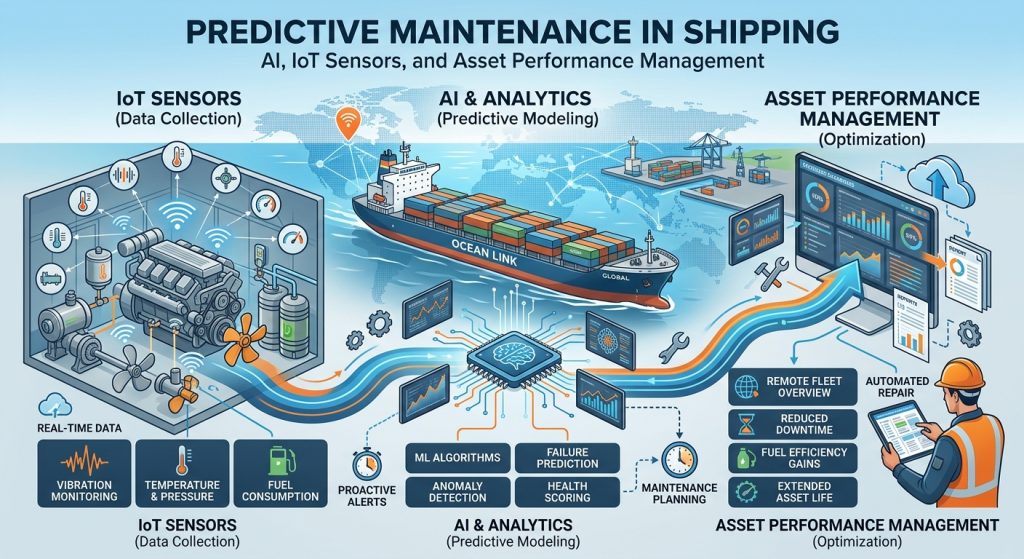
Unplanned machinery downtime is one of the most expensive operational risks in commercial shipping. A major auxiliary engine failure, main engine bearing scuffing, or turbocharger breakdown at sea can trigger thousands of dollars per hour in charter party off-hire penalties, emergency towage fees, port demurrage, and costly drydock repairs.
Traditionally, ship technical managers operated on Preventive Maintenance (PM) schedules—servicing machinery based strictly on running hours recommended by Original Equipment Manufacturers (OEMs). However, servicing equipment too early wastes operational budgets and overhaul hours, while unexpected component fatigue still causes off-hire events between service intervals.
The industry is undergoing a structural shift toward AI-Driven Predictive Maintenance (PdM) and Condition-Based Maintenance (CBM). By combining edge-computing IoT sensor networks, high-frequency satellite telemetry, machine learning anomaly detection, and Digital Twin architecture, fleet operators can predict component failures weeks before they manifest—transforming shipboard engineering from reactive firefighting into data-driven asset management.
1. The Architecture of AI-Driven Marine Predictive Maintenance
Modern Predictive Maintenance replaces static running-hour schedules with continuous, real-time health monitoring of critical vessel machinery.
┌─────────────────────────────────────────────────────────────────────────┐
│              SHIPBOARD TO SHORE DATA & PREDICTIVE PIPELINE              │
└────────────────────────────────────┬────────────────────────────────────┘
                                     │
         ┌───────────────────────────┼───────────────────────────┐
         │                           │                           │
┌────────┴──────────┐       ┌────────┴──────────┐       ┌────────┴──────────┐
│ 1. IoT Sensor     │       │ 2. Onboard Edge   │       │ 3. Satellite      │
│    Suite          │       │    Analytics Bus  │       │    Telemetry      │
│ (Vibration/Oil/   │       │ (Local Inference &│       │ (LEO/VSAT Cloud  │
│ Temp/Pressure)    │       │ Anomaly Detection)│       │ Transmission)     │
└───────────────────┘       └───────────────────┘       └───────────────────┘
                                                                 │
                                                                 ▼
                                                        ┌───────────────────┐
                                                        │ 4. Fleet Dashboard│
                                                        │    & Digital Twin │
                                                        │ (CBM Insights &   │
                                                        │ Work Orders)      │
                                                        └───────────────────┘
Layer 1: Advanced IoT Sensor Arrays
Continuous monitoring requires high-frequency data collection across primary marine systems. Sensors mounted directly on critical machinery capture multidimensional operational telemetry:
- Tri-Axial Accelerometers & Vibration Sensors: Installed on main engine turbochargers, stern tube bearings, gearboxes, and centrifugal pumps to detect mechanical imbalance, shaft misalignment, bearing micro-pitting, and gear tooth wear.
- Acoustic Emission (AE) Sensors: Capture high-frequency ultrasonic waves (20 kHz to 1 MHz) to identify early friction, micro-cracking, gas leakage, and valve blow-by long before thermal or audible symptoms occur.
- In-Line Lubricating Oil Sensors: Measure dielectric constant, viscosity, metallic wear debris particles (ferrous vs. non-ferrous), moisture saturation (aw), and soot loading in real time, eliminating sole reliance on monthly laboratory oil sample analysis.
- Thermal & Pressure Transducers: Monitor exhaust gas cylinder temperatures, fuel injection rail pressure spikes, scavenge air receiver pressures, and heat exchanger delta-T (ΔT) thermal efficiency.
Layer 2: Onboard Edge Analytics & Filtering
Ships operate in environments with variable satellite bandwidth. Transmitting raw, high-frequency vibration spectrum data (20 kHz sample rates) continuously to the cloud is unfeasible.
Edge computing gateways installed in the Engine Control Room (ECR) process raw sensor signals locally:
- Time-Domain to Frequency-Domain Transformation: Converts time-series vibration data into Fast Fourier Transform (FFT) spectral bands onboard.
- Edge Anomaly Detection: Applies local Machine Learning (ML) inference models (such as Isolation Forests or Autoencoders) to detect immediate operational deviations.
- Data Compression & Prioritization: Transmits only aggregated statistics, trend metrics, and anomaly flags to shore via Low Earth Orbit (LEO) satellite networks (e.g., Starlink, OneWeb, VSAT), reserving full raw waveform bursts for flagged anomaly events.
2. Machine Learning Algorithms & Digital Twin Modeling
Once transmitted shore-side, AI platforms interpret complex multivariate data streams to forecast Remaining Useful Life (RUL) for shipboard components.
                          ┌────────────────────────┐
                          │   MULTIVARIATE DATA    │
                          │      FEED INPUTS       │
                          └───────────┬────────────┘
                                      │
            ┌─────────────────────────┴─────────────────────────┐
            │                                                   │
┌───────────┴────────────┐                             ┌────────┴───────────┐
│ Machine Learning Models│                             │ Digital Twin Core │
├────────────────────────┤                             ├───────────────────┤
│ • Fast Fourier (FFT)   │                             │ Dynamic Physics   │
│ • Random Forests       │ ───────────► ◄────────────  │ & Thermodynamics  │
│ • LSTM / Recurrent     │                             │ Baseline Model    │
│   Neural Networks      │                             │                   │
└────────────────────────┘                             └───────────────────┘
                                      │
                                      ▼
                        ┌───────────────────────────┐
                        │ PREDICTIVE HEALTH OUTPUTS │
                        ├───────────────────────────┤
                        │ • Anomaly Root Cause      │
                        │ • Remaining Useful Life   │
                        │ • Automated PMS Action    │
                        └───────────────────────────┘
Key AI/ML Models in Marine Engineering
- Fast Fourier Transform (FFT) & Envelope Analysis: Isolates specific bearing defect frequencies (e.g., Outer Race Pass Frequency – BPFO, Inner Race Pass Frequency – BPFI) to pinpoint exact rolling element failure mechanisms.
- Long Short-Term Memory (LSTM) Networks: A recurrent neural network (RNN) architecture designed to process time-series sequences. LSTMs analyze historical operational trends to predict how cylinder liner wear or exhaust valve degradation will evolve over the next 500 to 2,000 operating hours.
- Random Forest & Gradient Boosting Classifiers: Evaluate multi-parameter inputs (e.g., scavenge air temperature, fuel rack position, turbocharger RPM, exhaust temperature) to diagnose complex combustion issues like scuffing or fuel injector fouling.
Digital Twins for Marine Asset Performance
A Digital Twin is a real-time, physics-informed digital replica of a physical marine asset (such as a 2-stroke MAN B&W or WinGD main engine). The Digital Twin combines baseline thermodynamic engineering formulas with live IoT data.
By comparing the real-time operational performance of an engine against its synthetic “ideal state” baseline under identical ambient conditions (sea water temperature, barometric pressure, fuel density), the AI isolates degradation caused by fouling, component wear, or mechanical friction.
3. High-Value Machinery Use Cases
Predictive maintenance delivers maximum return on investment (ROI) when applied to critical, single-point-of-failure shipboard assets.
| Machinery Asset | Failure Mode Prevented | Primary Sensors Used | AI Detection Capability | Commercial Impact Saved |
|---|---|---|---|---|
| Main Engine Turbocharger | Nozzle ring fouling, blade erosion, bearing destruction | Tri-axial vibration, acoustic emission, exhaust delta-P | Detects rotor unbalance and surge onset 300+ hours prior to physical damage | Prevents engine derating, speed loss, and $150k+ emergency overhaul costs |
| 2-Stroke Cylinder Liners | Liner scuffing, ring breaking, blow-by | Acoustic emissions, Liner temperature thermocouples, drain oil iron sensors | Pinpoints lubrication breakdown and micro-scuffing before catastrophic liner seizure | Avoids major main engine failure, towage, and weeks of unbudgeted off-hire |
| Auxiliary Engines (Gensets) | Fuel injector dribble, bearing fatigue, crankcase explosion risks | In-line oil quality (viscosity/ferrous debris), vibration, exhaust temp | Identifies combustion imbalance and oil dilution from fuel leakage | Guarantees power availability in port and prevents blackouts during maneuvering |
| Purifiers / Separators | Bowl unbalance, disk stack clogging, bearing failure | FFT Vibration analysis, water-in-oil sensors, motor current draw | Detects sludge build-up and mechanical misalignment before bowl damage | Prevents fuel contamination arriving at main engines, protecting fuel pumps |
| Stern Tube & Bearings | Seal degradation, seawater ingress, white metal wiping | Shaft displacement sensors, water-in-oil sensors, temp probes | Identifies lubrication breakdown and shaft alignment drift at sea | Prevents emergency drydocking for stern tube seal replacement |
4. Class Society Approvals & Machinery Survey Schemes
Transitioning a vessel from conventional time-based overhauls to predictive condition-based maintenance requires approval from Classification Societies (e.g., DNV, ABS, Lloyd’s Register, ClassNK).
┌─────────────────────────────────────────────────────────────────────────┐
│               CLASS SOCIETY CBM APPROVAL WORKFLOW                       │
└────────────────────────────────────┬────────────────────────────────────┘
                                     │
┌────────────────────────────────────┴────────────────────────────────────┐
│ 1. System Qualification: Sensor accuracy & network cyber resilience     │
├─────────────────────────────────────────────────────────────────────────┤
│ 2. CBM Notation Assignment: DNV (qualship / CBM), ABS (SMART-MND)       │
├─────────────────────────────────────────────────────────────────────────┤
│ 3. Survey Replacement: Annual physical teardowns replaced by data audits│
└─────────────────────────────────────────────────────────────────────────┘
Class Schemes & Survey Alternative Notations
- DNV: Assigns the CBM notation (Condition Based Maintenance) under its Machinery Planned Maintenance System (MPMS) framework.
- American Bureau of Shipping (ABS): Offers the SMART (MND) (Machinery Class Notation) recognizing AI-driven predictive health platforms.
- Lloyd’s Register (LR): Operates the MPMS-CBM authorization scheme.
Financial and Operational Benefits of Class CBM Schemes
- Elimination of Arbitrary Open-and-Inspect Overhauls: Under traditional Class rules, machinery must be dismantled periodically for physical inspection. Dismantling healthy machinery introduces human error, contamination, and assembly defects. CBM allows operators to delay overhauls if sensor data confirms optimal component health.
- Survey on Data Audit: Class surveyors review validated AI platform diagnostic logs, oil analysis trends, and vibration spectra instead of forcing physical equipment teardowns during drydock.
- Extended Asset Lifecycle: Components are replaced based on actual physical wear rather than conservative running-hour limits, cutting spare parts expenditure by 15% to 30%.
5. Strategic Implementation Roadmap for Fleet Operators
Deploying predictive maintenance across a commercial fleet requires a structured execution strategy.
[Phase 1: Pilot & Sensor Retrofit] ──► [Phase 2: Edge-to-Cloud Integration] ──► [Phase 3: PMS System Automation]
       (3-6 Months)                             (6-12 Months)                             (12-18 Months)
Phase 1: Fleet Readiness Assessment & Sensor Retrofit (Months 1–6)
- Critical Asset Audit: Identify high-risk machinery across the fleet (Main Engines, Auxiliary Generators, Turbochargers, Main Air Compressors, Steering Gear).
- Sensor Standardization: Install industrial-grade, Class-approved IoT vibration accelerometers, inline oil condition sensors, and pressure transducers with standardized industrial protocols (Modbus RTU, NMEA 2000, OPC UA).
Phase 2: Edge Gateway Deployment & Model Calibration (Months 6–12)
- Install ECR Edge Processors: Deploy marine-spec industrial PCs in Engine Control Rooms to process high-frequency signals locally.
- Establish Baseline Models: Run machinery under varied load profiles (ballast, laden, ECO speed, full maneuvering) to allow machine learning algorithms to map normal operational baselines.
- Establish LEO Satellite Pipelines: Connect edge gateways to onboard Starlink/VSAT systems to stream structured operational data to shore.
Phase 3: Planned Maintenance System (PMS) Integration (Months 12–18)
- API Connection to AMOS / SERTICA / Danaos / ABS Wavesight: Integrate AI predictive health alerts directly into the ship management software.
- Automate Work Orders: Configure the system to automatically generate condition-based work orders, reallocate spare parts stock, and notify superintendents when component health scores cross defined warning thresholds.
- Train Engineering Crew: Educate Chief Engineers and First Assistant Engineers on interpreting FFT spectrum analytics and AI confidence scores to prevent false dismissals of early warning alerts.
6. B2B Compliance, Cyber Security & Risk Protocol
Connecting shipboard machinery controls and IoT networks to cloud analytics introduces operational and cybersecurity risks that must be managed:
- IMO Resolution MSC.428(98) Maritime Cyber Risk Compliance: IoT edge gateways connected to the engine room automation system must maintain strict network segmentation. Utilize hardware unidirectional data diodes or air-gapped firewalls between Operational Technology (OT) networks (engine controls) and Information Technology (IT) satellite networks to prevent shore-side cyber intrusion into propulsion systems.
- Data Integrity & Sensor Calibration: Predictive AI relies entirely on input data quality. Temperature sensor drift, loose accelerometer mounts, or uncalibrated oil transducers generate false positives or dangerous false negatives. Establish mandatory quarterly sensor verification routines within the vessel’s Safety Management System (SMS).
- Contractual Off-Hire Safeguards: Ensure Charter Party terms recognize condition-based maintenance routines. When an AI alert mandates immediate precautionary main engine maintenance at sea or in port, clear operational logging demonstrates proactive seaworthiness under Hague-Visby requirements.
7. Frequently Asked Questions (FAQ)
1. How does Predictive Maintenance (PdM) differ from Condition-Based Maintenance (CBM)?
Condition-Based Maintenance (CBM) monitors current equipment health using real-time thresholds (e.g., triggering an alarm when vibration exceeds 5 mm/s). Predictive Maintenance (PdM) uses advanced AI and historical machine learning models to forecast when that threshold will be crossed in the future, providing calculated Remaining Useful Life (RUL) estimates weeks in advance.
2. Can AI predictive maintenance completely replace human marine engineers?
No. AI platforms act as decision-support systems for Chief Engineers and shore-based superintendents. While AI excels at processing complex, multi-variable sensor trends across an entire fleet, physical repairs, mechanical diagnostic verifications, and complex overhauls still require experienced marine engineers on board.
3. What is the typical Payback Period / ROI for installing AI predictive systems on a vessel?
For commercial ocean-going vessels (Container ships, Tankers, Bulk Carriers), the average Return on Investment (ROI) is achieved within 8 to 14 months. Preventing a single off-hire event caused by an auxiliary generator breakdown or main engine turbocharger failure instantly pays for the initial sensor hardware and software installation costs.
4. How do predictive maintenance systems handle poor satellite connectivity at sea?
Modern systems utilize edge computing. High-frequency calculations, Fast Fourier Transforms (FFT), and initial ML anomaly inferences are processed locally on industrial computers inside the ship’s engine room. Only lightweight data summaries and urgent anomaly alerts are sent via satellite, ensuring continuous onboard monitoring even during complete satellite link outages.
5. Will Class Societies accept AI predictive data in place of scheduled drydock inspections?
Yes, provided the vessel holds a recognized Class notation for Condition-Based Maintenance (e.g., DNV CBM, ABS SMART-MND). Under these notations, Class surveyors accept validated data logs, sensor calibration histories, and AI condition reports in lieu of mandatory physical teardown inspections for qualified machinery assets.
Need expert technical guidance on upgrading your fleet to AI predictive maintenance, selecting Class-approved IoT sensors, or integrating CBM into your Planned Maintenance System? Contact the marine engineering and technology advisors at Oitha Marine.
Recent Comments