
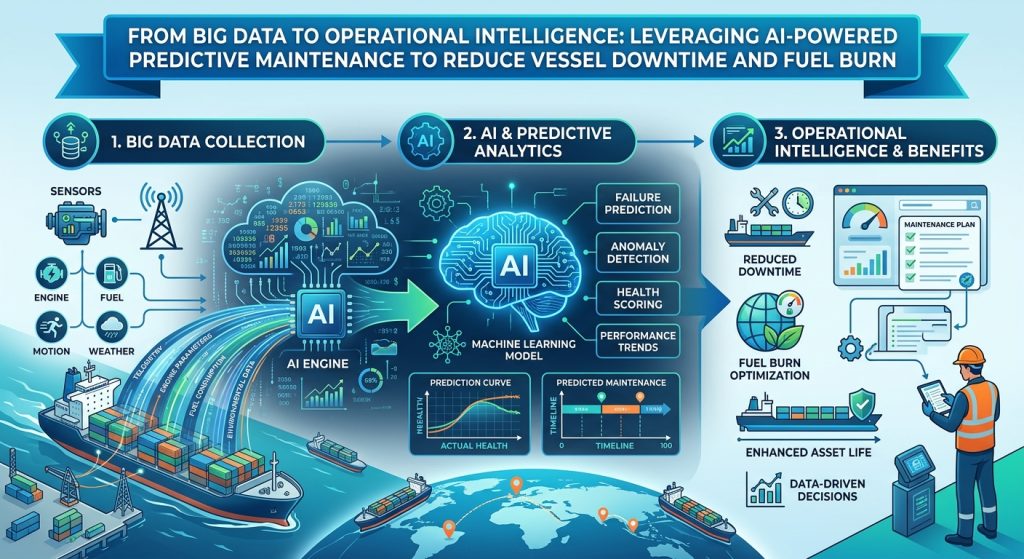
In an era of tight operating margins, aggressive emissions mandates, and increasingly complex onboard machinery, commercial maritime operators can no longer rely on reactive or calendar-based maintenance schedules. For Chief Operating Officers (COOs), fleet managers, and chief engineers, unpredicted machinery failure doesn’t just mean high repair bills—it triggers catastrophic supply chain delays, severe charter party penalties, and unnecessary fuel burn.
The modern solution lies in transitioning from isolated data collection to actionable operational intelligence. By integrating Internet of Things (IoT) sensor networks with machine learning (ML) models, commercial shipping companies are establishing smart fleet performance management systems. This guide explores how technical decision-makers are leveraging AI-driven predictive maintenance and route optimization to maximize fleet uptime, streamline maintenance expenditures, and hit net-zero targets.
1. The Operational Reality: From Reactive Fixes to Predictive Intelligence
Historically, maritime maintenance relied on two traditional paradigms:
- Corrective (Reactive) Maintenance: Fixing components after a failure occurs. This leads to costly unscheduled off-hire time, expedited spare part shipping costs, and potential safety hazards.
- Planned (Preventative) Maintenance Systems (PMS): Servicing machinery based on fixed running hours or calendar intervals (e.g., servicing an auxiliary engine every 2,000 hours regardless of actual mechanical health).
While PMS prevents some catastrophic breakdowns, it introduces hidden operational inefficiencies. Over-servicing healthy components consumes valuable crew labor, risks introducing human error during assembly, and wastes operational capital.
[Maintenance Evolution in Commercial Shipping] ┌─────────────────────────────────────────────────────────┐ │ 1. Corrective (Reactive) │ │ Fix after breakdown ──► High Downtime & Risk │ └────────────────────────────┬────────────────────────────┘ │ ▼ ┌─────────────────────────────────────────────────────────┐ │ 2. Preventative (Calendar/Hours-Based) │ │ Service on schedule ──► Over-servicing & High Labor │ └────────────────────────────┬────────────────────────────┘ │ ▼ ┌─────────────────────────────────────────────────────────┐ │ 3. Predictive (AI & IoT Condition Monitoring) │ │ Service on demand ──► Zero Unplanned Downtime & Low OpEx │ └─────────────────────────────────────────────────────────┘The Predictive Advantage
AI predictive maintenance for commercial vessels shifts maintenance schedules from arbitrary time thresholds to continuous real-time health evaluations. AI algorithms analyze continuous telemetry—such as vibration analysis, oil condition, exhaust gas temperatures, and thermal dynamics—to detect micro-anomalies weeks before physical component failure occurs.
2. Technical Architecture: Edge Computing, IoT Sensors, and Cloud Analytics
Deploying an end-to-end predictive maintenance ecosystem requires a robust, high-frequency data pipeline spanning the vessel’s engine room to shore-side operation centers.
[Maritime IoT & AI Data Pipeline Architecture] [Onboard IoT Sensors] ──► [Onboard Edge Server] ──► [Satellite Telemetry] ──► [Shore Cloud & AI Engine] • Engine Vibration • Local Signal Processing (VSAT / Starlink) • Anomaly Detection Models • Lube Oil Quality • Anomaly Filtering • Remaining Useful Life (RUL) • Exhaust Temperatures • Real-Time Alerts • Fleetwide Benchmarking1. High-Frequency Onboard IoT Sensor Layers
Modern 2-stroke main propulsion engines, auxiliary diesel generators, purifiers, and turbochargers are fitted with high-precision IoT sensors monitoring:
- Vibration and Acoustics: Piezoelectric accelerometers monitor bearing wear, shaft misalignment, and valve seating issues.
- Fluid Dynamics & Oil Health: Optical sensors and dielectric constant meters measure oil degradation, fuel dilution, soot build-up, and metallic wear particles in real time.
- Thermal Dynamics: Thermocouples monitor exhaust gas temperatures per cylinder to detect fuel injection faults or valve leakage.
2. Edge Computing vs. Satellite Bandwidth Constraints
Transmitting raw, uncompressed high-frequency sensor data (often sampled at several kilohertz) via satellite communication (VSAT or Low Earth Orbit networks like Starlink) is neither cost-effective nor bandwidth-efficient.
- Edge Processing Units: Onboard edge servers run localized algorithms to filter noise, compress continuous time-series data, and process critical safety signals instantly.
- Cloud Analytics Sync: Summarized trend data and flagged anomaly parameters are continuously synced to shore-side databases for deep fleetwide machine learning model training.
3. Dual-Impact AI Framework: Combining Machinery Health and Route Optimization
The true power of vessel lifecycle optimization software emerges when engine health data is combined with hydrodynamic hull performance and weather routing.
┌─────────────────────────────┐ ┌─────────────────────────────┐ │ Engine Health Telemetry │ │ Real-Time Hydrodynamic Data │ │ (Combustion, Fuel Pressure) │ │ (Hull Resistance, Slip) │ └──────────────┬──────────────┘ └──────────────┬──────────────┘ │ │ └──────────────────┬──────────────────┘ │ ▼ ┌───────────────────────────────┐ │ AI Integrated Performance │ │ Optimization │ └───────────────┬───────────────┘ │ ▼ ┌───────────────────────────────┐ │ Optimized RPM, Speed & Route │ │ = Minimal Fuel Burn & Downtime│ └───────────────────────────────┘1. AI-Powered Fuel Consumption Analytics
Fuel accounts for over 50% of a commercial vessel’s total operating expenses. Maritime fuel consumption analytics leverage AI models to correlate engine load, specific fuel oil consumption (SFOC), shaft power, and hull resistance against real-time operational parameters.
- Detecting Hull Fouling: AI algorithms measure subtle increases in shaft torque required to maintain speed. By distinguishing between environmental resistance (waves/currents) and biological hull growth, the system calculates the exact point where hull cleaning yields a net-positive financial return.
- Optimal SFOC Tuning: Machine learning models identify peak fuel efficiency windows for variable engine loads, providing chief engineers with real-time feedback to adjust injection timing, air-fuel ratios, and power distribution across auxiliary generators.
2. Weather-Aware Dynamic Route Optimization
Legacy weather routing relies on static weather forecasts and basic speed curves. AI-driven dynamic routing evaluates dynamic environmental variables (wave height, wave direction, wind, sea currents) against the vessel’s specific hydrodynamic response model.
- Emissions Reduction: Optimizing vessel speed and voyage trajectory reduces total fuel consumption by 5% to 12% without compromising target Arrival Times (ETA).
- CII Score Protection: By mitigating heavy sea resistance and preventing engine over-speeding, automated route optimization protects the vessel’s Carbon Intensity Indicator (CII) rating.
4. Quantifying the ROI: Financial and Operational Impact
For executive leadership, investing in smart fleet performance management systems requires a clear, measurable return on investment (ROI).
| Metric | Traditional Preventative Maintenance | AI-Driven Predictive Maintenance | Operational Impact |
| Unplanned Off-Hire Days | 3–7 days per vessel / year | < 1 day per vessel / year | Eliminates $20k–$80k/day in lost charter revenue |
| Spare Parts Inventory | High safety stock (Static) | Just-in-Time Procurement | Reduces tied-up capital in inventory by 20–30% |
| Fleet Fuel Burn | Baseline (High variance) | 5%–12% Reduction | Saves hundreds of metric tons of fuel per vessel annually |
| Drydock Maintenance Planning | Estimated scope | Precise targeted overhaul | Shortens drydock duration by 15–25% |
Financial Engineering Case Study
Consider a fleet of ten 8,000 TEU container ships operating on trans-pacific routes:
- Fuel Savings: A 6% fuel burn reduction achieved through combined AI route optimization and engine tuning saves approximately 1,200 metric tons of fuel per vessel annually. At $600/ton for VLSFO, this equals $720,000 per vessel in annual OpEx savings.
- Downtime Prevention: Preventing a single catastrophic main engine bearing failure saves approximately $300,000 in repair costs and avoids 5 days of off-hire time ($250,000 in lost revenue).
5. Implementation Roadmap for Chief Engineers and Fleet Managers
Transitioning a commercial fleet to an AI-driven operational model requires a structured step-by-step framework:
[Phase 1: Sensor Retrofit & Audit] ──► [Phase 2: Edge & Cloud Integration] ──► [Phase 3: AI Model Training] ──► [Phase 4: Full Operational Rollout]- Step 1: Audit Equipment and Standardize Sensor Interfaces Evaluate existing machinery infrastructure. Install standardized NMEA 0183/2000, Modbus, or CAN bus digital adapters on legacy mechanical engines and auxiliary systems.
- Step 2: Deploy Edge Hardware and Secure Telemetry Pipelines Install certified marine edge processing units in the engine control room (ECR). Establish encrypted, redundant satellite links for real-time shore-side data syncing.
- Step 3: Train Machine Learning Models on Historical & Fleetwide Data Feed historical PMS logs, oil sampling analysis reports, and real-time telemetry into ML pipelines to build baseline “digital twin” models for each vessel class.
- Step 4: Empower Onboard Crew and Shore-Side Operations Provide chief engineers and technical superintendents with intuitive dashboards that contextualize alarms, provide Remaining Useful Life (RUL) estimates for key components, and offer actionable step-by-step troubleshooting guides.
Frequently Asked Questions (FAQ)
How does AI-powered predictive maintenance handle legacy, non-digital engine designs?
Legacy mechanical engines without integrated electronic control units can be upgraded using non-intrusive external IoT sensors. Wireless vibration sensors, clamp-on ultrasonic flow meters, optical oil health sensors, and surface-mounted thermocouples can be installed on older machinery without requiring major mechanical modifications or class re-certification.
Does integrating cloud-connected IoT sensors onboard expose the vessel to cybersecurity risks?
Yes. Integrating Operational Technology (OT) with IT and cloud platforms introduces potential cyber vulnerabilities. Modern maritime predictive maintenance systems adhere to IMO Resolution MSC.428(98) and IACS Unified Requirements (UR) E26/E27. Security protocols include end-to-end hardware encryption, air-gapped critical control networks, unidirectional data diodes, and continuous OT network intrusion monitoring.
What is the difference between simple condition-based monitoring (CBM) and AI predictive maintenance?
Condition-Based Monitoring (CBM) triggers static alerts when a parameter crosses a predefined threshold (e.g., oil temperature exceeds 85°C). AI predictive maintenance analyzes multivariate correlations over time—detecting subtle, multi-parameter trends long before any single threshold is crossed, calculating the exact Remaining Useful Life (RUL) of the component.
Related Content & Resources
- IACS Unified Requirements UR E26 / E27 on Cyber Resilience – Official standards for securing onboard OT systems and network architectures.
- ISO 19848 & ISO 19849 Standards for Ship Board Data Management – International frameworks for standardizing vessel data structures and machinery data exchange.
- DNV Cyber Secure & Smart Vessel Class Notations – Technical documentation on class requirements for smart fleet management and remote diagnostic systems.
Recent Comments