
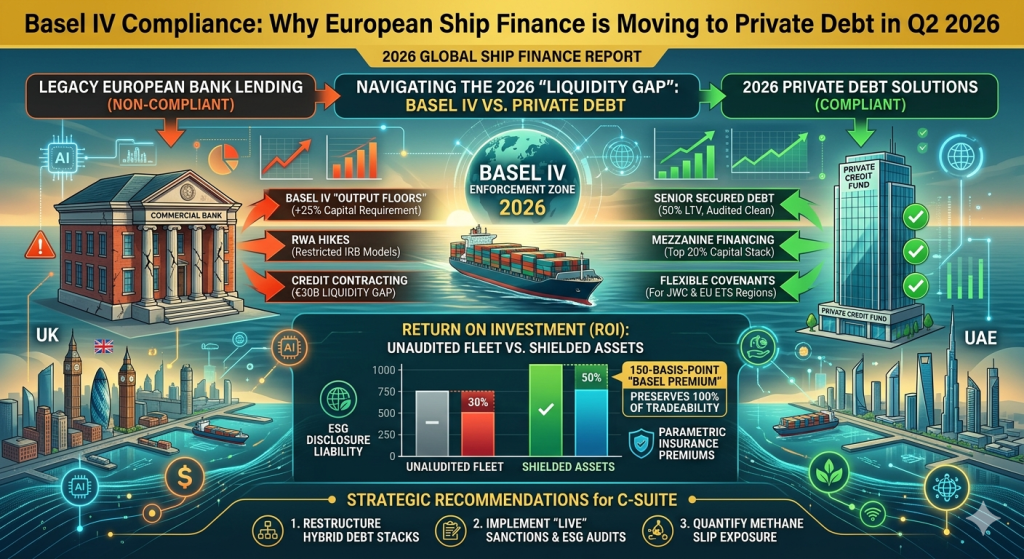
Executive Summary (BLUF): The full-scale implementation of Basel IV’s “output floors” has triggered a systemic retreat by European commercial banks from high-leverage maritime lending, creating a €30B liquidity gap. For institutional investors, this shift necessitates an immediate transition toward Senior Secured Debt & Mezzanine Financing to avoid asset-level insolvency as traditional credit lines contract.
1. The Economic Impact: The End of Cheap Capital and the Rise of the Private Credit Sovereign
As of Q2 2026, the maritime finance landscape has hit a regulatory wall. Basel IV is no longer a looming shadow; it is a balance sheet reality. By restricting the “Internal Ratings-Based” (IRB) models that European banks previously used to calculate risk-weighted assets, Basel IV has effectively hiked the capital requirements for ship loans by 15-25%.
The Valuation “Haircut”
For a shipowner in the UAE or UK, this means your “Cost of Capital” is no longer tethered to a friendly relationship with a commercial lender. Banks are now forced to offload maritime exposure to meet Tier-1 capital ratios. This has led to a surge in Mezzanine Financing structures where private debt funds are stepping in to provide the top 20% of the capital stack—at interest rates that reflect the heightened Asset Seizure & Hull War Risk environment of 2026.
If your fleet is not already positioned with a diversified debt portfolio, your ROI is being eroded by “Regulatory Friction.” We are seeing a 150-basis-point “Basel Premium” applied to any vessel that does not meet the latest ESG Disclosure Liability standards. In short: if you can’t prove your “Green” credentials with audited data, your traditional bank will call your loan, forcing you into a distressed refinancing scenario.
2. The Compliance/Legal Framework: Navigating the 2026 Regulatory Minefield
The migration to private debt isn’t just a choice; it’s a defensive maneuver against a convergence of legal and geopolitical pressures that traditional banks are no longer willing to underwrite.
JWLA-032 and the Insurance Trigger
The Joint War Committee (JWC) Circulars, specifically the JWLA-032 issued in early 2026, have significantly expanded the “Listed Areas” for war risk. This has caused a surge in Parametric Insurance Premiums, where payouts are triggered by AI-detected kinetic events rather than manual claims. Traditional lenders are terrified of the “Contagion Risk” associated with these areas. If a vessel enters a JWC-listed zone without pre-cleared OFAC Sanctions Compliance protocols, the bank’s own regulatory standing is at risk.
EU ETS Phase-In: The Methane Slip Liability
2026 marks the aggressive phase-in of methane slip monitoring under the EU Emissions Trading System (EU ETS). For investors in LNG-dual-fuel tonnage, the ESG Disclosure Liability is now a line-item expense. Failure to accurately report methane slip results in fines that are now being integrated into “Mortgagee Interest Insurance” (MII) clauses. If you default on an emissions fine, you are effectively in technical default on your Senior Secured Debt.
AI-Driven Navigation and the Red Sea Kinetic Risk
In the Red Sea corridors, the use of AI-driven navigation systems has created a new legal grey area regarding “Master’s Discretion.” Arbitration & Litigation Costs are skyrocketing as P&I Clubs and shipowners argue over whether an AI-steered vessel’s “decision” to deviate from a high-risk zone constitutes a breach of charter-party terms. Private debt providers are currently the only entities comfortable underwriting this “Algorithmic Risk.”
3. Strategic Recommendations: 3 Actionable Steps for the C-Suite
I. Restructure Toward Hybrid Debt Stacks
CEOs must move away from 100% commercial bank debt. The optimal 2026 structure involves a core of Senior Secured Debt (50% LTV) from a Tier-1 lender, layered with Mezzanine Financing from a specialized maritime private equity fund. This insulates the asset from a sudden bank-led margin call if Basel IV ratios shift again in Q4.
II. Implementation of “Live” Sanctions & ESG Audits
To maintain “Insurability,” fleets must move beyond annual audits. Real-time OFAC Sanctions Compliance software must be integrated into the bridge’s AIS. This provides a “Digital Safe Harbor” that can be used to negotiate lower Parametric Insurance Premiums with Lloyd’s syndicates, as it proves the vessel is actively avoiding sanctioned ship-to-ship (STS) transfer zones.
III. Quantify Methane Slip Financial Exposure
Before the Q3 EU ETS reconciliation, founders must perform a forensic gap analysis on their methane slip data. This isn’t about the environment—it’s about Asset Seizure prevention. Port authorities in the EU and UK now have the mandate to detain vessels with unpaid “Carbon Debt.” Ensure your private debt covenants include a “Carbon Liquidity Buffer” to prevent a minor reporting error from becoming a total asset seizure.
Frequently Asked Questions (FAQ)
Why is Basel IV affecting US and UAE owners if it’s a “European” regulation?
Because the vast majority of global ship finance still flows through European banks (HSBC, BNP Paribas, Deutsche Bank). Even if your company is based in Dubai or Houston, if your lender is European, they are bound by the Basel IV “Output Floor.” They are currently shedding non-US/EU flagged assets to reduce their risk-weighted assets (RWA).
What is the difference between Senior Secured Debt and Mezzanine Financing in 2026?
Senior Secured Debt has first priority on the asset (the ship) and usually offers lower interest rates but stricter covenants regarding ESG Disclosure Liability. Mezzanine Financing is subordinate to the senior debt, carries a higher interest rate (often 12-15% in 2026), but offers more flexibility regarding voyage patterns in JWC-listed areas.
How does the JWLA-032 circular impact my existing loan?
Most maritime loan agreements include a “Material Adverse Change” (MAC) or “Increased Cost” clause. If the Joint War Committee (JWC) expands a listed area (as seen in JWLA-032), your bank can legally pass the increased cost of Hull War Risk insurance and capital provisioning directly to you. This is why many owners are refinancing with private debt—to get “Fixed-Rate Risk” that doesn’t fluctuate with every JWC circular.
Can Parametric Insurance replace traditional Hull & Machinery (H&M) cover?
Not entirely, but in 2026, it is used as a “Gap Filler.” For example, if you are transiting the Red Sea, traditional H&M might have a $500k deductible for drone damage. A Parametric Insurance policy will pay out a flat $1M the moment an explosion is detected within 100 meters of the hull, regardless of the actual damage. This liquidity is vital for covering immediate Arbitration & Litigation Costs.
Is “Shadow Fleet” contagion a real risk for Private Debt?
Yes. Private debt providers are even more sensitive to OFAC Sanctions Compliance than banks because they lack the massive legal departments of a global bank. If your vessel is even tangentially linked to a “Dark Fleet” STS transfer, your private debt provider will likely have a “Trigger Clause” that allows for immediate Asset Seizure to protect their own investors.
Securing Your 2026 Financial Infrastructure
The transition from traditional bank lending to the private debt markets requires a sophisticated understanding of Arbitration & Litigation Costs and the evolving Joint War Committee (JWC) Circulars. Institutional investors should seek Professional Advisory Services specializing in Senior Secured Debt and ESG Disclosure Liability to ensure their portfolios remain “Bankable” in a Basel IV world. Whether you are navigating Hull War Risk in kinetic zones or managing OFAC Sanctions Compliance, specialized Mezzanine Financing and Parametric Insurance Premiums are the only tools capable of hedging against the volatility of the 2026 maritime market.
Recent Comments