
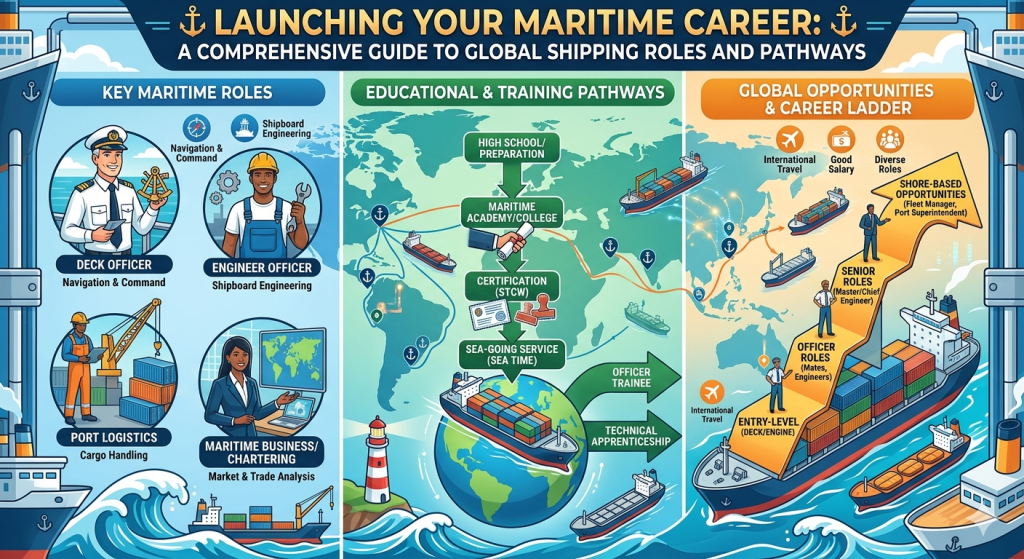
The global ocean economy is one of the most dynamic, highly capitalized, and fundamentally critical sectors of international commerce. Approximately 90% of global trade is moved by the international shipping industry, making marine transport the absolute engine of global supply chains. For students, mid-career professionals looking to pivot, and engineering graduates, a maritime career offers an unparalleled blend of technical challenge, rapid professional advancement, and international exposure.
Despite its massive scale, the maritime labor market faces a structural shortage of qualified personnel, particularly in specialized technical roles. Sourcing skilled seafaring officers, terminal managers, and marine superintendents has become a top priority for ship-owning companies and crewing agencies worldwide. This comprehensive guide details the modern seafaring and shoreside career matrix, evaluates required training pathways, outlines regulatory certification frameworks, and highlights the long-term professional advantages of committing to this global vertical.
Approved Maritime Training Institutes: Top Maritime Academies in Nigeria
For international shipowners seeking to verify local credentials or sponsor cadetship cohorts, understanding the accredited institutional landscape is critical. Below is a structured directory of the premier approved maritime training institutes and academies in Nigeria recognized by the Nigerian Maritime Administration and Safety Agency (NIMASA) and compliant with the global IMO STCW White List.
Directory of Approved Training Institutes
| Academy / Institute | Primary Campus Location | Approved STCW Programs & Vetting Focus |
| Maritime Academy of Nigeria (MAN Oron) | Oron, Akwa Ibom State | Premier national academy. Offers unlimited CoC paths in Nautical Science, Marine Engineering, and full STCW mandatory certifications. |
| Federal College of Fisheries & Marine Technology | Victoria Island, Lagos | Government-accredited college. Specializes in Nautical Science, Marine Engineering, and regional fisheries operations compliance. |
| Coastal Maritime Academy | Ikoyi / Lagos | Highly sought-after private institute for mandatory safety training (BST, PSC, FPFF). Coordinates foundational safety modules. |
| Charkin Maritime Academy | Port Harcourt, Rivers State | Advanced private academy featuring Dynamic Positioning (DP) simulators, offshore safety courses, and specialized industrial tanker training. |
| Stars Maritime Academy | Lagos | Specialized tactical training academy. Focuses on junior officer cadetship foundations and basic STCW compliance. |
| Crown Maritime Academy | Lagos | Provides auxiliary shipping, logistics administration, and port-state operations management foundations. |
| Oceanic Maritime Academy | Lagos | Technical academy focused on domestic coastal pilotage, inland waterway navigation, and utility vessel deck operations. |
| JOF Marine Academy | Lagos | Focuses on basic watchkeeping certifications, engineering ratings, and marine safety crew audits. |
| Global Maritime Academy | Delta State | Offers regional maritime studies, port state security operations, and vessel logistics management frameworks. |
| Merchant Marine Academy | Lagos | Tailored to domestic trade, coastal navigation safety standards, and regional tugboat crew preparation. |
Note: Vessel operators should cross-reference school fees and admission limits directly with accredited providers, or contract Oitha Marine to handle end-to-end cadet screening and structural sea-time pipelines on your behalf.
The Dual Architecture of Maritime Professions
Professional roles within the shipping vertical are cleanly divided into two interconnected domains: Shipboard (Seagoing) Roles and Shoreside (Corporate/Port) Roles. A successful professional path can evolve entirely within one domain or transition seamlessly from sea to shore as operational experience matures.
+——————————————————————-+
| THE MARITIME CAREER MATRIX |
+———————————+———————————+
| SHIPBOARD DECK & ENGINE ROLES | SHORESIDE CORPORATE & PORT |
| • Active vessel navigation | • Technical superintendency |
| • Mechanical & propulsion plant | • Marine insurance & chartering |
| • Direct offshore operations | • Terminal & port management |
+———————————+———————————+
Shipboard Occupations: The Deck and Engine Departments
Working aboard an active commercial vessel—whether an ultra-large container carrier, a liquid petroleum tanker, or a specialized offshore support vessel—demands clear departmental structure:
- The Deck Department: Responsible for safe passage planning, vessel navigation, cargo handling control, and overall hull maintenance. Progressing along this path moves an individual from an Ordinary Seaman (OS) or Deck Cadet up to Third Officer, Second Officer, Chief Officer, and ultimately to the rank of Ship’s Master (Captain).
- The Engine Department: Responsible for managing the vessel’s complex mechanical, electrical, and propulsion infrastructure. Marine engineers operate massive internal combustion engines, auxiliary power generators, sewage treatment units, and electrical grids. Roles advance from Engine Cadet or Oiler up to Fourth Engineer, Third Engineer, Second Engineer, and Chief Engineer.
Shoreside Opportunities: The Maritime Corporate Ecosystem
A modern shipping organization relies heavily on a specialized network of shoreside professionals to maintain fleet compliance and profitability. Many of these positions are filled by former seafarers who choose to bring their practical, hands-on vessel experience into the corporate sector. Critical shoreside career fields include:
- Technical Superintendency: Managing maintenance budgets, coordinating mandatory drydockings, and overseeing regulatory compliance for a dedicated group of vessels.
- Vessel Chartering and Commercial Operations: Structuring time-charter and voyage contracts, calculating freight matrices, and matching tonnage to market demands.
- Port and Marine Terminal Management: Overseeing cargo loading logistics, quay side cranes, and intermodal links with rail and trucking lines.
Education, Training, and Certification Frameworks
Entering the marine labor market requires specialized training and certification. Because commercial shipping operates across international boundaries, maritime qualifications are strictly standardized on a global scale.
+——————————————————————-+
| GLOBAL MARITIME QUALIFICATION STEPS |
+———————+———————————————+
| Formal Academics | • Pursuing a Bachelor of Science degree at |
| | an accredited maritime academy. |
+———————+———————————————+
| Statutory Standards | • Completing baseline security and safety |
| | courses mandated under the STCW Code. |
+———————+———————————————+
| Sea-Time Log | • Accumulating required sea-time months |
| | to qualify for officer board exams. |
+——————————————————————-+
The Role of Recognized Maritime Academies
For those seeking a structured entry point into an officer track, enrolling in an accredited state or national maritime academy is highly effective. Institutions like the Massachusetts Maritime Academy or California Maritime Academy host specialized career events that connect upcoming graduates directly with major shipping lines. These academy pathways combine intensive engineering or nautical science degree coursework with practical training aboard dedicated training ships, ensuring students master advanced bridge simulation and real-world engine room operations before graduation.
The STCW Code: The Global Safety Passport
Any individual working aboard a commercial ship over a specific tonnage must hold certifications that comply directly with the STCW Convention (International Convention on Standards of Training, Certification and Watchkeeping for Seafarers). This framework mandates baseline training covering:
- Personal Survival Techniques (PST).
- Fire Prevention and Basic Fire Fighting (FPFF).
- Elementary First Aid (EFA).
- Personal Safety and Social Responsibilities (PSSR).
Step-by-Step Path to Advancement in a Maritime Career
Building a resilient, high-earning trajectory in the maritime industry requires executing a disciplined, step-by-step career path:
1
Secure Baseline Medical and Security Clearance
Step 1
1.Secure Baseline Medical and Security Clearance:Step 1.
Before investing in maritime training, candidates must pass a thorough medical evaluation to verify physical fitness, eyesight, and color-vision compliance. Simultaneously, applying for regional port security credentials ensures clean records for entry into secure commercial port facilities.
2
Accumulate Supervised Sea-Time Service Hours
Step 2
2.Accumulate Supervised Sea-Time Service Hours:Step 2.
Advancement in nautical ranks requires documented hands-on sea-time. Cadets must accurately log their vessel service months under the direct supervision of certified officers, completing precise practical competencies in their training books while underway.
3
Sit for Professional Officer License Examinations
Step 3
3.Sit for Professional Officer License Examinations:Step 3.
Once baseline sea-time requirements are fully met, seafarers return ashore to sit for comprehensive flag-state board examinations. Passing these challenging tests unlocks an initial Officer of the Watch (OOW) license, opening the door to highly competitive global employment opportunities.
Frequently Asked Questions (FAQ)
Q: What is a maritime career, and what types of vessels can professionals work on?
A: A maritime career encompasses all professional roles dedicated to the operation, navigation, engineering, and commercial management of marine vessels and port infrastructure. Professionals can deploy across a diverse fleet, including ultra-large container ships, liquid chemical and oil tankers, bulk dry cargo carriers, passenger cruise lines, and specialized offshore support vessels.
Q: What is the STCW convention, and why is it mandatory for seafarers?
A: The STCW (Standards of Training, Certification and Watchkeeping) is an international regulatory convention managed by the IMO. It establishes strict, uniform safety and operational training baselines that seafarers must complete to work on commercial ships globally, ensuring that crews of all nationalities maintain identical, high safety standards at sea.
Q: How long does it typically take to advance from a cadet to a ship’s captain or chief engineer?
A: Advancing from an initial entry-level cadet role to the peak rank of Ship’s Master (Captain) or Chief Engineer generally requires between 8 to 12 years of active commercial shipping service. This timeline is heavily dependent on individual performance, passing mandatory flag-state board examinations, and consistently accumulating required sea-time months on active vessels.
Q: Can a marine engineer transition easily into a shoreside corporate role?
A: Yes. Marine engineering is a highly sought-after discipline in onshore sectors. The rigorous technical experience gained operating massive shipboard propulsion grids allows former engineers to transition into lucrative shoreside careers, including technical ship superintendency, port crane engineering management, stationary power plant operations, and marine insurance asset surveying.
Q: Are maritime academy career fairs open to individuals outside the formal student body?
A: Many prominent institutions, such as the Mass Maritime Academy or Cal Maritime Academy, host specialized career networking events. While select fairs prioritize currently enrolled student cadets, many events are structured to allow external maritime industry professionals, licensed seafarers, and shoreside logistics specialists to interface directly with global shipping employers.
Partner with the Operational Leaders at Oitha Marine Oitha Marine maintains a steadfast commitment to operational safety, maritime compliance, and logistics excellence across all commercial trade routes. We build and support top-tier maritime talent, ensuring our managed fleets and chartering operations deploy with fully certified, STCW-compliant crews to protect your high-value cargo and supply chain schedules. Contact our commercial operations team today at oithamarine.com to receive an immediate fleet overview or tailored logistics consultation.
Recent Comments