
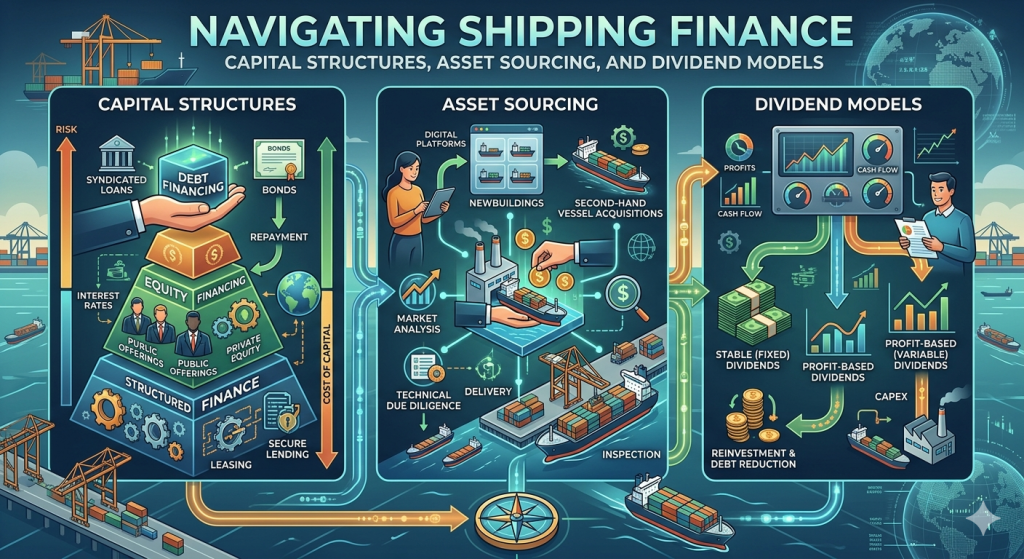
The global maritime industry relies on complex capital structures to sustain the lifeblood of international trade. Sourcing, building, and leasing high-value assets—ranging from ultra-large container vessels and offshore support crafts down to regional intermodal fleets—requires deep credit facilities and innovative financial engineering. For corporate operators, charterers, and maritime investors, understanding how these capital mechanisms work is essential for long-term viability.
This structural guide provides a comprehensive analysis of the modern shipping finance landscape, evaluates options for private asset procurement, and reviews the dividend performance frameworks of publicly listed ship-leasing firms.
The Core Architecture of Maritime Capital Sourcing
Procuring physical ocean-going assets demands specialized capital allocations. Unlike standard corporate financing, ship finance utilizes asset-backed debt structures, structured leasing, and public capital markets to spread risks across global syndicates.
+——————————————————————-+
| PRIMARY MARITIME FINANCE VEHICLES |
+———————————+———————————+
| PRIVATE ASSET LEASING / DEBT | PUBLIC CAPITAL MARKETS |
| • Traditional maritime debt | • High-yield equity listings |
| • Bareboat charter-back options | • Long-term contracted backlogs |
+———————————+———————————+
|
v
+———————————+
| INTERMODAL INFRASTRUCTURE |
| • Asset finance for containers |
| • Fleet expansion facilities |
+———————————+
Debt Financing and Asset-Backed Lending
Traditional bank debt remains a foundational layer for ship procurement. Syndicated maritime commercial banks provide senior secured loans, typically capped at a conservative Loan-to-Value (LTV) ratio. The physical ship serves as the primary collateral, backed by corporate guarantees and assignment of the vessel’s prospective charter earnings.
Structured Marine and Yacht Financing
For boutique operations, luxury fleets, or regional commercial crafts, specialized ship & yacht financing programs bridge the gap left by traditional corporate banking. These custom credit models frequently leverage bareboat charter-back arrangements, allowing an operator to deploy an asset immediately while preserving working capital, passing ownership only upon maturity of the lease term. This structural flexibility makes high-ticket maritime procurement accessible to mid-tier enterprise operators.
Intermodal Sourcing: Shipping Container Financing
A substantial segment of the industrial market focuses heavily on small-to-mid tier hardware asset financing. Intermodal shipping containers are the absolute backbone of containerized freight logistics, requiring continuous capital rotation to ensure sufficient equipment availability across varying seasonal trade demands.
+——————————————————————-+
| CONTAINER LEASING AND ASSET FINANCING |
+———————————+———————————+
| INTERMODAL FLEET FINANCING | INDUSTRIAL MODULAR FINANCING |
| • Procurement of heavy TEU lots | • Capital for site offices |
| • Tied to ocean cargo lines | • Land-based construction hulls |
+———————————+———————————+
Logistics providers and corporate cargo teams regularly tap shipping container financing lines to acquire large volumes of twenty-foot equivalent units (TEUs) and high-cube boxes. Financing these assets relies on lease-to-own agreements, structured operating leases, or revolving asset-backed credit lines.
Because containers maintain a highly predictable residual value on the secondary market—serving as secure onshore storage or modular site infrastructure—commercial underwriters offer flexible, low-risk interest profiles for multi-unit fleet expansion. This creates an open environment where operators can scale their storage capacity up or down dynamically depending on real-time trade volumes.
Public Markets: Analyzing Ship Finance Dividend History
For institutional and retail investors seeking direct exposure to maritime macro-cycles, the public equity markets offer unique cash-flow plays. The gold standard for historical research in this sector is Ship Finance International Limited (renamed SFL Corporation Ltd., traded under NYSE: SFL).
The SFL Corporation (ex-Ship Finance International) Model
Originally established in 2003 as a spin-off from Frontline Ltd., the company built a massive global business model centered around owning a diversified fleet of tankers, bulkers, container ships, and energy assets, then leasing them out on long-term time charters to top-tier global operators. This approach insulates the corporate balance sheet from immediate spot-market volatility. By shifting the operational risk to the charterer, the asset owner secures highly predictable cash flows.
A Legendary Track Record of Returns
When analysts review the ship finance dividend history of SFL, the metrics stand out as some of the most consistent in the entire industrial sector:
- Consecutive Payments: SFL has declared and paid cash dividends for every single quarter since its initial public listing in 2004.
- Long-Term Payouts: Over its history, the company has paid out over $2.8 billion in cumulative dividends to its shareholders.
- Steady Financial Performance: Reflecting a robust contracted backlog, the firm declared a strong quarterly dividend of $0.22 per share for Q1 2026, showcasing the long-term reliability of structured vessel charter leasing.
Step-by-Step Capital Deployment for Vessel Charterers
Before committing to a long-term maritime leasing contract or ship construction program, operators must follow a strict financial checklist:
1
Calculate the Debt Service Coverage Ratio (DSCR)
Step 1
1.Calculate the Debt Service Coverage Ratio (DSCR):Step 1.
Lenders require proof that the vessel’s fixed-rate time charter backlog or projected spot-market earnings can comfortably cover the principal and interest payments. Ensure your baseline operations yield a healthy DSCR margin to withstand cyclical charter rate dips.
2
Align Charter Term Maturities with Loan Amortization
Step 2
2.Align Charter Term Maturities with Loan Amortization:Step 2.
To mitigate downside risk, structure the asset’s financing timeline to match your long-term charterer commitments. If a vessel is financed over a 10-year term, securing solid, credit-worthy charter agreements for the initial 5 to 7 years minimizes refinancing exposure.
3
Verify International Legal and Flag-State Compliance
Step 3
3.Verify International Legal and Flag-State Compliance:Step 3.
Maritime financiers will not release capital unless the vessel complies with all international class parameters and regional regulatory bodies, such as NIMASA or flag-state safety codes. Total transparency in maritime compliance is mandatory for underwriting approval.
Frequently Asked Questions (FAQ)
Q: What is the main difference between private ship finance and public ship-owning equity models?
A: Private ship finance focuses on secured, asset-backed loans, private equity, or corporate credit facilities used by operators to buy and manage specific vessels. Public ship-owning companies (like SFL Corporation) raise capital via public stock listings, using pooled investor equity to build a large, diversified fleet that generates predictable, long-term quarterly dividends.
Q: Why did Ship Finance International Limited change its name to SFL Corporation?
A: The company transitioned its name to SFL Corporation Ltd. to reflect its evolution from a traditional, pure-play shipping financier into a broader, modern maritime asset-owning and charter leasing powerhouse with a highly diversified fleet across multiple global trade sectors.
Q: How does a long-term time charter backlog support dividend safety for maritime companies?
A: A time charter backlog consists of multi-year fixed-rate lease contracts signed with credit-worthy charterers. This model ensures steady, predictable revenues, insulating the ship-owning company from short-term spot market declines and giving management the financial visibility needed to sustain continuous quarterly dividend payments.
Q: Can shipping container financing lines be utilized for land-based modular projects?
A: Yes. Commercial financing for shipping container homes, site offices, and industrial workspace enclosures is highly common. Because standard ISO containers have a proven, durable resale value, lenders are comfortable structuring lease-to-own or commercial capital loans for both marine freight fleets and terrestrial modular projects.
Q: What role does inflation play in shipping finance valuations?
A: Inflation directly impacts steel prices, replacement costs, and shipyard construction backlogs. Consequently, older vessels often see their residual asset value remain stable or increase during high-inflation cycles. Financing structures often index lease rates to inflation protections to safeguard the underlying net asset value (NAV) for financiers.
Q: What is mezzanine finance in the context of ship finance?
A: Mezzanine finance represents a hybrid form of capital that sits between senior secured bank debt and pure equity. If a shipowner cannot provide the full equity portion required by a traditional lender, mezzanine lenders provide high-yield, subordinated debt that can convert into equity ownership if the borrower defaults.
Q: How do environmental regulations affect modern ship finance approval?
A: Under modern global frameworks like the Poseidon Principles, international marine banks must measure and report the carbon intensity of their shipping loan portfolios. Vessels that fail to meet strict environmental efficiency baselines face higher interest margins or outright rejection from top-tier institutional lenders.
Secure Elite, High-Compliance Vessel Chartering with Oitha Marine Oitha Marine provides premier, operationally resilient, and fully vetted vessel chartering configurations across major commercial routes. We focus on strict operational excellence and top-tier financial transparency, ensuring our fleet adheres completely to global maritime compliance and safety frameworks to protect your logistics timeline. Contact our commercial operations desk today at oithamarine.com to receive a rapid chartering estimate or fleet overview.
Recent Comments