
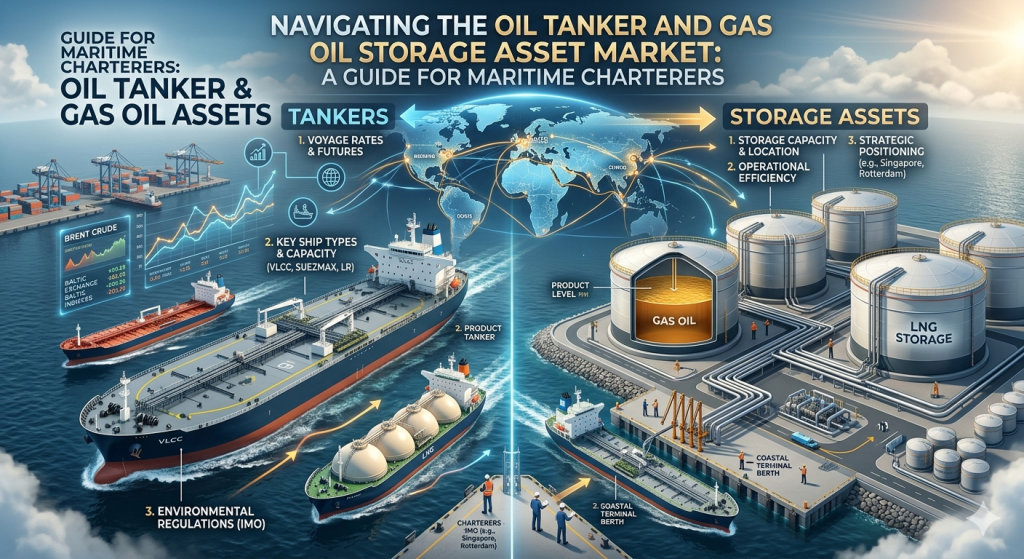
The global energy supply chain is highly capital-intensive, operationally rigid, and exposed to continuous geopolitical volatility. For commercial managers, supply chain directors, and downstream oil and gas traders, logistics planning relies on a fundamental balance: securing physical commodities while maintaining access to optimized transportation and storage infrastructure. In the maritime domain, this balance is managed by deploying liquid cargo assets, specifically crude oil carriers, product tankers, and static bulk storage installations.
Horizon Offshore Services
As energy markets navigate fluid trade routes, expanding production corridors, and shifting compliance frameworks, the strategic sourcing of these units has become a primary driver of commercial margins. This comprehensive guide provides maritime charterers, corporate procurement groups, and energy logistics operators with an analytical framework to navigate liquid cargo shipping. We break down asset acquisition, evaluate temporary vs. permanent infrastructure configurations, examine standard legal frameworks, and analyze the operational dynamics of modern liquid resource distribution.
Mobile vs. Static Logistics Infrastructure: The Macro Landscape
When establishing or expanding a liquid petroleum distribution footprint, procurement teams face a fundamental capital allocation decision. They must choose between investing in mobile offshore marine assets or building stationary onshore storage frameworks. Both approaches carry distinct capital expenditure (CapEx), operational expenditure (OpEx), and regulatory profiles.
+——————————————————————-+
| LIQUID CARGO ASSET ALLOCATION OPTIONS |
+———————————+———————————+
| MOBILE MARINE ASSETS | STATIC ONSHORE INFRASTRUCTURE |
| • Highly flexible deployment | • Fixed regional hub placement |
| • Eliminates regional lock-in | • Intensive localized compliance|
| • Direct multi-port cargo route | • High localized bulk capacity |
+———————————+———————————+
The Strategic Value of Mobile Tonnage
Operating mid-size or large-capacity maritime vessels provides energy charterers with unparalleled logistical flexibility. Mobile assets allow operators to continuously adjust their distribution routes to capture regional price differentials, exploit open arbitrage windows, or bypass sudden regional transit bottlenecks.
Rather than being constrained by the physical capacity of a single port or geographical terminal, a chartered oil tanker serves as a dual-purpose asset: an active long-haul transit mechanism and a floating storage unit (FSU) capable of holding inventory near target markets until demand peaks. This flexibility is crucial in volatile spot markets, where the ability to pivot trade patterns rapidly directly impacts corporate profitability.
The Role of Fixed Storage Configurations
Conversely, terrestrial static bulk terminals provide a highly stable foundation for predictable, regional downstream distribution loops. Establishing or leasing centralized gas oil storage tanks for sale 2025 or gas oil storage tanks for sale 2026 configurations provides high-volume, reliable containment fields for refined petroleum products like Automotive Gas Oil (AGO), Premium Motor Spirit (PMS), and Dual-Purpose Kerosene (DPK).
While static tanks lack the geographic mobility of a vessel, they deliver significantly lower long-term structural upkeep overhead per cubic meter compared to an active marine hull. They also interface directly with regional pipeline matrixes, automated truck loading racks, and inland industrial hubs.
Evaluating the Procurement Matrix: Acquisition vs. Chartering
For organizations evaluating market entry or capacity expansion, the primary financial dilemma centers on whether to purchase physical assets or secure them via flexible commercial chartering structures.
+———————————————————————–+
| THE STRATEGIC LIQUID FREIGHT PROCUREMENT MATRIX |
+———————+————————————————-+
| Asset Acquisition | • Demands substantial up-front CapEx allocation |
| | • Long-term technical & crew management liability|
| | • Complete operational control of the hull |
+———————+————————————————-+
| Commercial Charter | • Predictable OpEx structure via hire rates |
| | • Immediate access to modern, compliant fleets |
| | • Eliminates asset depreciation & disposal risk |
+———————+————————————————-+
The Realities of Direct Asset Purchases
Acquiring dedicated transport or containment equipment demands a substantial, long-term capital commitment. Reviewing international brokerage boards for an active oil tanker for sale or a used 275 gallon oil tank for sale near me or a standard industrial oil tank for sale reveals a capital-intensive transaction landscape. Beyond the initial purchase price, the true cost of asset ownership includes ongoing technical management, hull maintenance, specialized drydockings, and continuous regulatory certification.
For used infrastructure—ranging from a used oil tanks for sale configuration to modular 275 gallon oil tank for sale or 2nd hand oil tanks for sale units—the buyer assumes the full financial risk of structural fatigue, interior tank corrosion, residual chemical contamination, and potential environmental liability. If an inherited hull or tank fails thickness-gauging checks or lacks modern double-hull protections, the remediation costs can quickly outpace the asset’s initial value.
The Agility of the Chartering Model
Because ownership introduces significant operational risk and high upfront costs, experienced energy majors frequently turn to structured chartering agreements. Chartering allows logistics teams to match their exact transport capacity directly to short-to-medium-term commercial contracts. By entering a Voyage Charter, a Time Charter, or a specialized Bareboat Agreement, operators can leverage premium maritime tonnage without carrying long-term asset depreciation risks on their corporate balance sheets.
Furthermore, chartering grants immediate access to modern, eco-efficient fleets equipped with advanced emissions monitoring, automated inert gas systems, and dual-fuel propulsion engines. This allows charterers to comply with evolving environmental mandates without spending capital on extensive retrofits.
Operational Mechanics: Managing Liquid Cargo Transfers
Executing efficient fluid commodity transport requires close coordination between maritime crews, specialized terminal operators, and third-party inspectors. For bulk maritime liquid cargo movements, operations generally follow a standardized workflow:
1
Pre-Load Inspection & Tank Vetting
Phase 1
1.Pre-Load Inspection & Tank Vetting:Phase 1.
Before any cargo enters a vessel or shore installation, independent surveyors execute strict tank cleanliness verifications. For clean petroleum products, tanks must be completely free of active water, moisture, rust scales, or residual vapors from previous voyages. This vetting phase often includes inspecting the integrity of the heating coils and verifying the functionality of the onboard tank gauging systems.
2
Notice of Readiness & Connection
Phase 2
2.Notice of Readiness & Connection:Phase 2.
Once the vessel anchors at the terminal or comes alongside an FSU, the Master issues a formal Notice of Readiness (NOR). Upon acceptance, the vessel couples to the facility using specialized marine loading arms or flexible high-pressure hoses. During this phase, manifold valve configurations are cross-checked by both the ship’s chief mate and the shore loading master to prevent accidental spills or line cross-contamination.
3
Controlled Discharge & Volumetric Accounting
Phase 3
3.Controlled Discharge & Volumetric Accounting:Phase 3.
Pumping operations begin at a controlled, reduced rate to establish a positive pressure loop and prevent electrostatic hazards. Once lines are verified secure, pumping scales up to maximum safe operating limits. Volumetric totals are continuously calculated in real-time using calibrated automatic custody transfer meters on shore, balanced against the vessel’s internal ullage reports to identify and mitigate cargo variance.
The Critical Role of Ship-to-Ship (STS) Transshipment
When deep-draft crude carriers or large product tankers cannot access shallow regional ports or inner-harbor jetties, operators rely on Ship-to-Ship (STS) Transshipment. This process involves mooring two vessels together at sea—either at a designated offshore anchorage or while underway—to transfer liquid cargo directly between them.
STS operations require specialized equipment, including high-capacity rubber fenders, heavy-duty flexible transfer hoses, and dedicated mooring tugs. Because these transfers occur in open water, they demand strict adherence to international safety protocols to manage environmental risks and ensure seamless product evacuation.
Regulatory Frameworks & Compliance Protocols
Operating liquid cargo vessels or managing bulk fuel oil tanks for sale arrays requires strict compliance with overlapping national and international regulatory frameworks. Non-compliance can result in immediate asset detentions, severe financial penalties, or complete loss of operational licenses.
International IMO and MARPOL Standards
Every commercial oil tanker operating internationally must comply directly with the strict mandates established by the International Maritime Organization (IMO). Chief among these is the MARPOL Convention, which dictates international regulations for preventing marine pollution from ships.
Charterers must verify that all contracted vessels feature verified double-hull structural protections, active ballast water management systems (BWMS), and strict compliance with global sulfur emission caps. These systems are designed to minimize the environmental impact of normal operations and protect oceanic ecosystems in the event of a grounding or collision.
Regional Vetting and Environmental Guardrails
On a regional level, coastal operations are subject to oversight by localized flag-state administrations and environmental protection boards. These agencies mandate regular structural integrity audits, thickness-gauging checks for static steel storage fields, and valid Protection & Indemnity (P&I) club coverage to manage third-party pollution liabilities.
Furthermore, near-shore and domestic coastal movements must align with local cabotage laws. These regulations prioritize locally flagged, owned, and crewed vessels for domestic maritime trade, ensuring regional operators maintain high safety and operational standards across all coastal shipping corridors.
Frequently Asked Questions (FAQ)
Q: What is the main operational difference between an oil tanker and a floating storage unit (FSU)?
A: While both assets are marine hulls designed to hold large volumes of liquid petroleum, an active oil tanker features functional propulsion machinery, an international crew, and valid ocean-going safety certifications to transport cargo across global trade routes. An FSU is typically a repurposed or stationary vessel moored at a fixed offshore location, operating primarily as a static, floating bulk storage terminal without performing active transport voyages.
Q: Why do buyers prefer double-hull designs when searching for an oil tanker for sale?
A: International maritime regulations, specifically MARPOL mandates, strictly prohibit single-hull oil tankers from engaging in global commercial trade due to the high risk of accidental oil spills during collisions. Double-hull designs feature an integrated outer skin and an inner cargo hold space, providing a crucial structural buffer zone that significantly reduces the likelihood of environmental pollution if the outer hull suffers a breach.
Q: How do charterers mitigate the risk of cargo degradation inside gas oil storage tanks?
A: Managing product quality inside bulk infrastructure requires continuous environmental control. Operators regularly drain condensation from water-draw valves located at the base of the tank, install active nitrogen blanketing systems to prevent oxidation, and perform routine laboratory fuel testing. These steps help detect microbial growth or thermal stratification before the product degrades.
Q: What are the primary cost factors to verify when purchasing used oil tanks for sale?
A: Buyers looking at second-hand or used storage tanks must account for several critical costs beyond the baseline purchase price. These include professional interior tank cleaning and degassing, independent ultrasonic thickness testing (UTT) to evaluate steel corrosion, foundation and containment berm engineering, regional environmental permit fees, and specialized heavy-lift transportation to move the physical assets to their final operating location.
Q: How does a Time Charter contract protect an energy trader from spot-market volatility?
A: A Time Charter locks in a fixed, predictable daily or monthly hire rate for a vessel across a defined duration (such as 1 to 2 years). This commercial framework immunizes the charterer from sudden, sharp increases in spot-market freight rates driven by regional tonnage shortages or geopolitical disruptions, allowing logistics managers to calculate long-term supply chain budgets with high financial accuracy.
Need Compliant Liquid Cargo Logistics & Chartering Support? Oitha Marine provides reliable, fully vetted, and compliant maritime logistics configurations across regional and international shipping lanes. Whether your operations require flexible vessel chartering, secure Ship-to-Ship (STS) transshipment management, or optimized regional product transport solutions, our commercial operations desk delivers robust execution tailored to your specific trade profile. Contact our logistics team directly at oithamarine.com to receive a detailed technical overview or a prompt voyage estimate.
Recent Comments