
For UK and Canadian PE portfolios, where vessels frequently transit European Economic Area (EEA) waters, “Carbon Tax Shielding” has become a mandatory financial strategy. This 2026 Audit examines the implementation of AI-Driven Compliance Systems designed to automate the monitoring, reporting, and verification (MRV) process while actively optimizing voyages to minimize tax exposure.
1. The 2026 Financial Crisis: The “Carbon Leak” in PE Portfolios
In 2026, “Passive Compliance” is a losing strategy. Investors who rely on manual reporting are discovering “hidden leaks” in their quarterly distributions.
The Cost of the “Reactive” Model:
- The $1,500/Ton Penalty: In 2026, the FuelEU penalty for exceeding GHG intensity limits is no longer just a fine; it is a structural cost that compounds. For a standard Capesize bulk carrier, a 5% deviation from compliance targets results in a €450,000 annual penalty.
- The “Stranded Asset” Discount: UK and Canadian banks have begun applying a 10–15% “Carbon Risk” discount to the scrap and resale value of vessels that cannot produce a “Clean Digital Carbon Trail.”
- The Verification Lag: Manual MRV processes in 2026 lead to “Over-Provisioning.” PE firms are often holding 20% more carbon credits than necessary simply because they lack real-time data accuracy, tying up millions in dead capital.
2. The Solution: AI-Driven “Carbon Tax Shielding”
“Carbon Tax Shielding” is the integration of high-frequency sensor data with AI predictive modeling to ensure every nautical mile is optimized for the lowest possible tax bracket.
Implementation Components (2026 Market Rates):
- AI-Voyage Optimization Layer: $25,000 – $40,000 (Per Vessel/Year). This software analyzes weather, hull fouling, and fuel quality to recommend the “Greenest Path” that minimizes FuelEU exposure.
- Automated MRV Integration: $15,000 (One-time setup). Directly linking onboard flow meters to EU and UK reporting portals, eliminating manual entry errors.
- Pooling Strategy AI: $10,000 (Portfolio Level). FuelEU allows “Pooling,” where over-compliant vessels can offset under-compliant ones. AI manages this “Carbon Arbitrage” across a PE portfolio to zero out penalties.
3. ROI Analysis: AI-Shielding vs. Manual Compliance (20-Vessel Portfolio)
| Metric (2026 USD) | Manual Portfolio Management | AI-Shielded Portfolio |
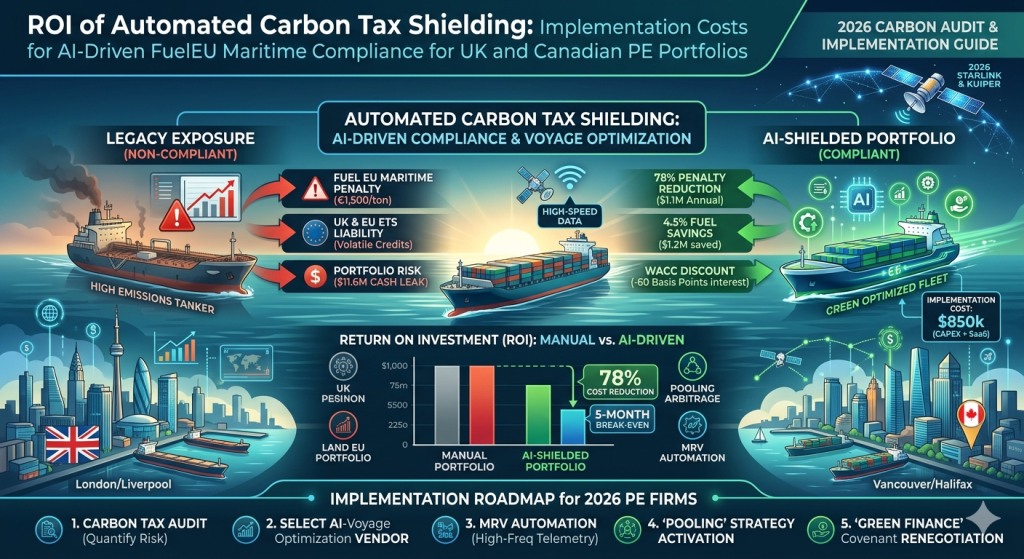
| Total Annual Penalties | $9,200,000 | $1,100,000 |
| Operational Efficiency Gain | 0% | 4.5% Fuel Savings |
| SaaS/AI Implementation Cost | $0 | $850,000 |
| Carbon Credit Carry Cost | $2,400,000 (High Buffer) | $600,000 (Precision) |
| Net Portfolio Impact | -$11,600,000 | -$2,550,000 |
The ROI Dividend: For a UK or Canadian PE firm, the shift to AI-driven shielding generates a 78% reduction in carbon-related cash leakage. The “System Payback” period is typically reached within the first 5 months of the 2026 fiscal year.
4. Regional Nuances: UK and Canadian “Green Finance” Links
While FuelEU is a European regulation, its impact on UK and Canadian investors is amplified by local “Green Finance” frameworks.
- UK (London Finance Hub): 2026 “Sustainability-Linked Loans” (SLLs) offered by major UK banks now require Real-Time Carbon Transparency. An AI-Shielded fleet can secure a 45-60 basis point discount on debt interest.
- Canada (ESG Disclosure Rules): Under the 2026 Canadian Sustainability Standards Board (CSSB) rules, PE firms must disclose the “Scope 3” emissions of their maritime assets. Automated shielding provides the “Audit-Ready” data required to avoid “Greenwashing” litigation.
5. Implementation Roadmap for PE Managing Directors
- The “Leak Audit” (Week 1-4): Back-test your 2025 voyage data against 2026 FuelEU penalty rates to quantify your “At-Risk Capital.”
- The Software Selection (Week 5-8): Select an AI vendor that supports “Pooling Arbitrage.” (e.g., OrbitMI, ZeroNorth, or custom 2026 AI solutions).
- The Data Link (Week 9-12): Install high-frequency telemetry on “High-Intensity” vessels (older tonnage) first to maximize immediate ROI.
- The Banking Pivot (Month 4): Present the “Compliance Shield” data to your lenders to renegotiate loan covenants.
Frequently Asked Questions (FAQ)
1. Does “Carbon Shielding” require new hardware on old ships?
Generally, no. Most 2026 AI solutions are “Software-First.” They pull data from existing noon reports and AIS tracking. However, for maximum ROI, installing Automated Torque Meters ($15k/vessel) provides the high-fidelity data the AI needs to truly “Shield” the asset from peak tax brackets.
2. How does the “Pooling” mechanism work in 2026?
FuelEU allows a company to “Pool” the GHG performance of multiple ships. If your 5 “Green” LNG ships are 20% under the limit, they can “cover” the 2 “Dirty” VLCCs in your portfolio. The AI manages this paper-trading to ensure you never pay a cash penalty.
3. Is the UK ETS different from the EU ETS in 2026?
Yes, but they are converging. 2026 has seen a “Linking Agreement” discussions, but currently, they operate as separate ledgers. AI shielding software is essential here because it manages the “Double-Reporting” requirement without doubling your administrative headcount.
4. What is the biggest risk of ignoring AI-driven compliance?
Asset Liquidity. In 2026, a vessel without a “Digital Carbon Passport” is nearly impossible to sell to a Tier-1 buyer. You are essentially holding a non-liquid asset that is depreciating at twice the normal rate due to its tax liability.
5. Can Canadian PE firms get tax credits for this software?
Yes. Under the 2026 Canadian Clean Tech Investment Tax Credit, software and hardware used to reduce industrial emissions (including maritime compliance AI) may be eligible for a 30% refundable tax credit.
Final Strategist’s Conclusion: Data as the New Fuel
In 2026, the most profitable shipping portfolios aren’t those with the newest ships; they are those with the best data shielding. For investors in the UK and Canada, AI-Driven FuelEU compliance is the only way to protect the bottom line from “Regulatory Erosion.”
The math is simple: Spend on the Shield, or pay the Penalty.
Recent Comments